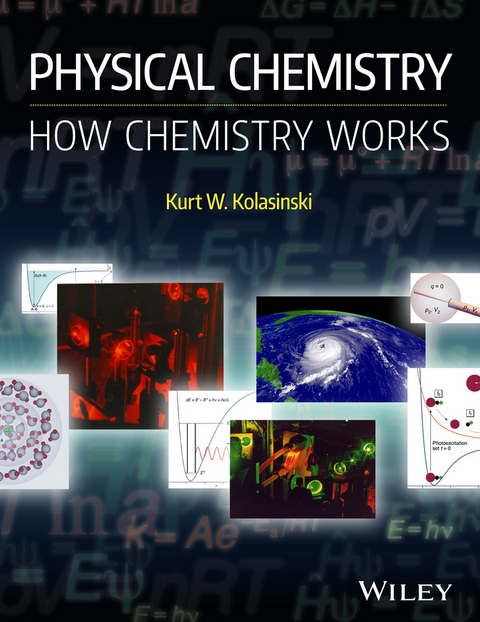

Much of chemistry is motivated by asking 'How'? How do I make a primary alcohol? React a Grignard reagent with formaldehyde. Physical chemistry is motivated by asking 'Why'? The Grignard reagent and formaldehyde follow a molecular dance known as a reaction mechanism in which stronger bonds are made at the expense of weaker bonds. If you are interested in asking 'why' and not just 'how', then you need to understand physical chemistry.
Physical Chemistry: How Chemistry Works takes a fresh approach to teaching in physical chemistry. This modern textbook is designed to excite and engage undergraduate chemistry students and prepare them for how they will employ physical chemistry in real life. The student-friendly approach and practical, contemporary examples facilitate an understanding of the physical chemical aspects of any system, allowing students of inorganic chemistry, organic chemistry, analytical chemistry and biochemistry to be fluent in the essentials of physical chemistry in order to understand synthesis, intermolecular interactions and materials properties. For students who are deeply interested in the subject of physical chemistry, the textbook facilitates further study by connecting them to the frontiers of research.
• Provides students with the physical and mathematical machinery to understand the physical chemical aspects of any system.
• Integrates regular examples drawn from the literature, from contemporary issues and research, to engage students with relevant and illustrative details.
• Important topics are introduced and returned to in later chapters: key concepts are reinforced and discussed in more depth as students acquire more tools.
• Chapters begin with a preview of important concepts and conclude with a summary of important equations.
• Each chapter includes worked examples and exercises: discussion questions, simple equation manipulation questions, and problem-solving exercises.
• Accompanied by supplementary online material: worked examples for students and a solutions manual for instructors.
• Written by an experienced instructor, researcher and author in physical chemistry, with a voice and perspective that is pedagogical and engaging.
Professor Kurt W. Kolasinski, West Chester University, Pennsylvania, USA Kurt Kolasinski has been a Professor of physical chemistry at West Chester University since 2014 having joined the faculty in 2006. He has held faculty positions at the University of Virginia (2004 - 2006), Queen Mary University of London (2001 - 2004), and the University of Birmingham (UK) (1995 - 2001). His research focuses on surface science, laser/surface interactions and nanoscience. A particular area of expertise is the formation of nanostructures in silicon and porous silicon using a variety of chemical and laser-based techniques. He is the author of over 100 scholarly publications as well as the widely used textbook Surface Science: Foundations of Catalysis and Nanoscience, which appeared in its third edition in 2012.
CHAPTER 1
Introduction
Much of chemistry is motivated by asking ‘how’. How do I make a primary alcohol? React a Grignard reagent with formaldehyde. How do I get a solution containing phenolphthalein to change from colorless to pink? Add base. How do I make solid barium sulfate? Add enough barium chloride dissolved in water to a solution of sodium sulfate and the barium sulfate precipitates out. Physical chemistry is motivated by asking ‘why’. The Grignard reagent and formaldehyde follow a molecular dance known as a reaction mechanism, in which stronger bonds are made at the expense of weaker bonds. In acidic solutions, the protonated form of phenolphthalein absorbs light in the ultraviolet range but is transparent in the visible range. When base is added, the phenolphthalein is converted to a deprotonated form which absorbs in the green part of the visible spectrum, peaking at 553 nm. The absorption of light occurs when an electron is promoted from its ground state to an excited state. BaCl2 and Na2SO4 are both highly soluble in water. BaSO4 is less soluble in water. When enough Ba2+ and SO42– are present in water, it is energetically more favorable for them to form a solid compound, which is denser than water and, therefore, precipitates to the bottom of the beaker. If you are interested in asking why and not just how, then you need to understand physical chemistry.
Introductory chemistry – general chemistry and an introduction to synthesis – has introduced all the major, sweeping, most important aspects of chemistry. In most cases you have been presented these ideas without foundations; that is, you have been told that certain phenomena occur – such as chemical bonding or phase transitions – but you have only had hints given to you about why these phenomena occur. You have been introduced to special cases and single-temperature results. However, you have not been given the machinery to move away from ideal cases, or to change parameters so as to predict what will happen next. Let us jog your memory about some key concepts (and perhaps add a few details I wish you would have been taught). This will illuminate where we have to go and motivate the discussion of much of our machinery building. It will also highlight some areas in which the simplifications of introductory chemistry sometimes border on myth building. The role of physical chemistry is to tear down mirages of explanation in order to construct the machinery that results in fundamental understanding. To a large extent, physical chemistry is the study and mastery of k, K, n, and ψ, (rate constant, equilibrium constant, moles, and wavefunction) and how they respond to t, T, and p (time, temperature, and pressure). That is, we want to understand the time evolution and response to experimental conditions of chemical systems. Along the way perhaps the three most important constants that we will have to understand the implications of are kB, h and NA (the constants of Boltzmann, Planck, and Avogadro, respectively) and how they relate to the energy, propensity for change and our ability to probe systems at the atomic level.
1.1 Atoms and molecules
Our chemical universe is made up of atoms and molecules. For the purposes of this course we are going to limit ourselves to electrons, protons and neutrons, and not worry about any internal structure of these particles (though we will mention the Higgs boson a couple of times, so don't get the blues!). Atoms are composed of a nucleus, where the protons and neutrons reside, and electrons that occupy the space outside of the nucleus. The space occupied by the electrons is called an orbital. Orbitals have specific shapes; you should recall the spherical s orbitals and dumbbell-shaped p orbitals (as usually represented in chemistry). The d orbitals and f orbitals are more complex yet. Atoms are neutral; that is, the number of negatively charged electrons exactly balances the number of positively charged protons. Neutrons carry no charge. An atom can be excited, for instance by the absorption of light. If the photons in the light are energetic enough, an electron can be removed from the atom to form a positive ion. Negative ions are formed when an atom captures an extra electron from some external source.
Certain atoms will form molecules when they interact with each other. Molecules have well-defined stoichiometries (ratios of how many atoms combine) and well-defined geometries with characteristic bond distances and bond angles. As molecules become bigger and bigger they may be able to take on several different configurations (isomers).
Figure 1.1 A potential energy diagram for the ground electronic state of the O2 molecule.
A molecule is held together by chemical bonds. An especially wicked misconception held by many is that energy is released when a chemical bond is broken. As shown in Fig. 1.1, energy is released when a chemical bond is formed. Chemical bond formation between two atoms must be an exothermic process or else it would never occur. Conversely then, it takes energy to break a chemical bond, and this is an endothermic process. Chemical bonds in molecules come in two broadly defined flavors. In a covalent bond, electrons are shared. If they are shared equally, a nonpolar bond is formed, but if they are shared unequally a polar bond is formed. Unless the geometry of the molecules has a special symmetry that makes charge distributions cancel out, polar bonds lead to polar molecules, that is, molecules that exhibit dipole moments. In ionic bonds, electrostatic forces hold together the positive and negative charges on ions formed by the transfer of at least one complete electron.
The motions of subatomic particles are governed by quantum mechanics, not classical mechanics. Classical mechanics describes everyday particles: billiard balls and apples falling on the heads of drowsy natural philosophers. Quantum mechanics is different. The energy states of electrons are governed by quantum mechanics. Electrons occupy atomic orbitals in atoms and molecular orbitals in molecules. Because covalent bonding is due to electrons and their sharing by atoms, bonding is inherently quantum mechanical in nature.
1.2 Phases
Moving from a single molecule or atom to collections of particles, the influences of intermolecular forces become important. There are a number of different types of intermolecular interactions: dipole–dipole, van der Waals and hydrogen bonding are some of the most common. The three most commonly encountered phases in chemistry are gases, liquids, and solids. In this course, we will not have to worry about the other two: plasmas and Bose–Einstein condensates, which are most likely to be encountered at very high or very low temperatures, respectively.
You are already familiar with the concept of an ideal gas and its equation of state
Intermolecular interactions are absent in an ideal gas. Even in a real gas, intermolecular interactions are weak as long as the pressure and temperature are far from the conditions that induce condensation. Gas-phase molecules are free to translate, rotate, and vibrate. There are also electronic excitations, but usually these are not accessible by thermal excitations. The places where we can put energy (translations, rotations, vibrations, and electronic states) are called degrees of freedom.
1.2.1 Directed practice
Throughout this book you will find directed practice, short exercises for the reader to collect their thoughts and reinforce concepts. Calculate the volume in m3 of one mole of ideal gas at standard temperature and pressure (STP is defined as T = 273.15 K and 100 kPa) and standard ambient temperature (T = 298.15 K) and atmospheric pressure (p = 101.325 kPa), denoted SATP.
[Answers: 0.0227 m3, 0.0245 m3]
As the temperature is lowered or the pressure increased, the particles in a gas are pushed together, and eventually intermolecular interactions will lead to condensation. Most commonly, a gas will condense into a liquid. Intermolecular interactions are much more important in liquids than gases because the molecules are much closer together. That the molecules are much closer together means that their density is much higher, and that they collide with each other much more frequently than gas-phase molecules. Liquid-phase molecules are still free to translate, rotate and vibrate, but the spectra associated with these degrees of freedom look different than when they are in the gas phase. Liquids are commonly classified as to whether they are polar or nonpolar. Like tends to dissolve like, and polar solvents are capable of dissolving ionic compounds (electrolytes) into their constituent ions. Nonelectrolytes dissolve without the formation of ions. Electrolyte solutions can conduct electrical currents.
At yet lower temperature and higher pressure, liquids condense into solids. Solids are usually denser than liquids, but there is not nearly as big a change during this phase transition as the one from the gas phase to a condensed phase. The atoms and molecules in a solid can no longer translate and rotate freely. There are still vibrations and electronic excitations. Solids are often classified by their electronic structure according to their electrical conductivity properties: metals conduct well and have no band gap between their valence and conduction bands, insulators conduct poorly because they have a large band gap; semiconductors are somewhere in...
| Erscheint lt. Verlag | 10.10.2016 |
|---|---|
| Sprache | englisch |
| Themenwelt | Naturwissenschaften ► Chemie ► Physikalische Chemie |
| Naturwissenschaften ► Physik / Astronomie | |
| Technik | |
| Schlagworte | Analytical Chemistry • Analytische Chemie • Chemie • Chemistry • detection • equation manipulation • intermolecular interactions • Materials properties • Materials Science • Materialwissenschaften • Physical Chemistry • Physikalische Chemie • Quantenphysik • synthesis |
| ISBN-13 | 9781118751206 / 9781118751206 |
| Informationen gemäß Produktsicherheitsverordnung (GPSR) | |
| Haben Sie eine Frage zum Produkt? |
 EPUB (Adobe DRM)
Kopierschutz: Adobe-DRM
Adobe-DRM ist ein Kopierschutz, der das eBook vor Mißbrauch schützen soll. Dabei wird das eBook bereits beim Download auf Ihre persönliche Adobe-ID autorisiert. Lesen können Sie das eBook dann nur auf den Geräten, welche ebenfalls auf Ihre Adobe-ID registriert sind.
Details zum Adobe-DRM
Dateiformat: EPUB (Electronic Publication)
EPUB ist ein offener Standard für eBooks und eignet sich besonders zur Darstellung von Belletristik und Sachbüchern. Der Fließtext wird dynamisch an die Display- und Schriftgröße angepasst. Auch für mobile Lesegeräte ist EPUB daher gut geeignet.
Systemvoraussetzungen:
PC/Mac: Mit einem PC oder Mac können Sie dieses eBook lesen. Sie benötigen eine
eReader: Dieses eBook kann mit (fast) allen eBook-Readern gelesen werden. Mit dem amazon-Kindle ist es aber nicht kompatibel.
Smartphone/Tablet: Egal ob Apple oder Android, dieses eBook können Sie lesen. Sie benötigen eine
Geräteliste und zusätzliche Hinweise
Buying eBooks from abroad
For tax law reasons we can sell eBooks just within Germany and Switzerland. Regrettably we cannot fulfill eBook-orders from other countries.
aus dem Bereich