


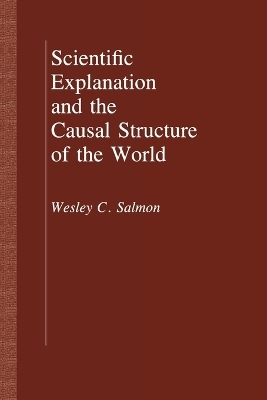
Scientific Explanation and the Causal Structure of the World
Seiten
1984
Princeton University Press (Verlag)
978-0-691-10170-5 (ISBN)
Princeton University Press (Verlag)
978-0-691-10170-5 (ISBN)
- Lieferbar (Termin unbekannt)
- Versandkostenfrei
- Auch auf Rechnung
- Artikel merken
Proposes philosophical theory of scientific explanation proposed that involves a treatment of causality that accords with the pervasively statistical character of contemporary science. This title describes three fundamental conceptions of scientific explanation - the epistemic, modal, and ontic.
The philosophical theory of scientific explanation proposed here involves a radically new treatment of causality that accords with the pervasively statistical character of contemporary science. Wesley C. Salmon describes three fundamental conceptions of scientific explanation--the epistemic, modal, and ontic. He argues that the prevailing view (a version of the epistemic conception) is untenable and that the modal conception is scientifically out-dated. Significantly revising aspects of his earlier work, he defends a causal/mechanical theory that is a version of the ontic conception. Professor Salmon's theory furnishes a robust argument for scientific realism akin to the argument that convinced twentieth-century physical scientists of the existence of atoms and molecules. To do justice to such notions as irreducibly statistical laws and statistical explanation, he offers a novel account of physical randomness. The transition from the "reviewed view" of scientific explanation (that explanations are arguments) to the causal/mechanical model requires fundamental rethinking of basic explanatory concepts.
The philosophical theory of scientific explanation proposed here involves a radically new treatment of causality that accords with the pervasively statistical character of contemporary science. Wesley C. Salmon describes three fundamental conceptions of scientific explanation--the epistemic, modal, and ontic. He argues that the prevailing view (a version of the epistemic conception) is untenable and that the modal conception is scientifically out-dated. Significantly revising aspects of his earlier work, he defends a causal/mechanical theory that is a version of the ontic conception. Professor Salmon's theory furnishes a robust argument for scientific realism akin to the argument that convinced twentieth-century physical scientists of the existence of atoms and molecules. To do justice to such notions as irreducibly statistical laws and statistical explanation, he offers a novel account of physical randomness. The transition from the "reviewed view" of scientific explanation (that explanations are arguments) to the causal/mechanical model requires fundamental rethinking of basic explanatory concepts.
Wesley C. Salmon (1925-2001) was University Professor of Philosophy at the University of Pittsburgh from 1983 to 1999 and the author of works that include The Foundations of Scientific Inference and Statistical Explanation and Statistical Relevance.
| Erscheint lt. Verlag | 21.12.1984 |
|---|---|
| Verlagsort | New Jersey |
| Sprache | englisch |
| Maße | 152 x 235 mm |
| Gewicht | 454 g |
| Themenwelt | Naturwissenschaften |
| ISBN-10 | 0-691-10170-1 / 0691101701 |
| ISBN-13 | 978-0-691-10170-5 / 9780691101705 |
| Zustand | Neuware |
| Informationen gemäß Produktsicherheitsverordnung (GPSR) | |
| Haben Sie eine Frage zum Produkt? |
Mehr entdecken
aus dem Bereich


aus dem Bereich
Eine kurze Geschichte | Über die Regeln unseres Lebens
Buch | Hardcover (2023)
Suhrkamp (Verlag)
CHF 47,60


