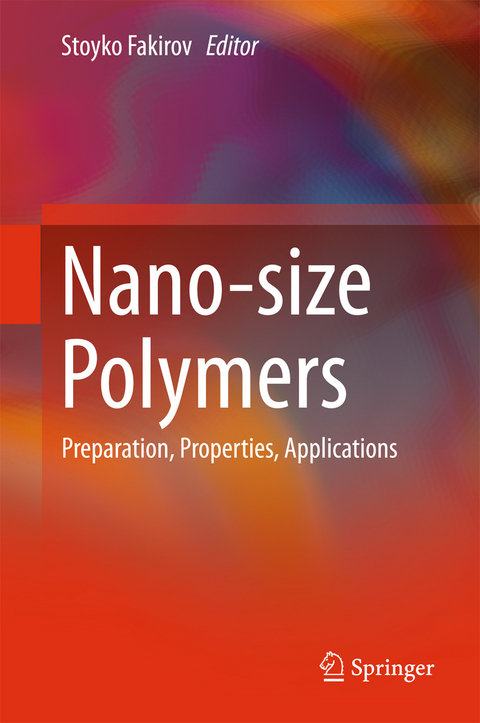
Nano-size Polymers (eBook)
VIII, 399 Seiten
Springer International Publishing (Verlag)
978-3-319-39715-3 (ISBN)

Stoyko Fakirov is currently a Professor at the University of Auckland, Department of Mechanical Engineering. His research interests include structure-properties relationships in polymers and composite materials, microscopic characterization, polymer materials science, manufacturing technologies for high performance plastics and composites with thermoplastic matrices, reactions in solid and molten condensation polymers (basics and commercial application), sequential reordering in condensation copolymers, chemical healing, micro- and nanofibrils reinforced composites, microhardness of polymers, gelatin- and starch-based biomaterials, materials for biomedical applications, and single polymer composites.
Stoyko Fakirov is currently a Professor at the University of Auckland, Department of Mechanical Engineering. His research interests include structure-properties relationships in polymers and composite materials, microscopic characterization, polymer materials science, manufacturing technologies for high performance plastics and composites with thermoplastic matrices, reactions in solid and molten condensation polymers (basics and commercial application), sequential reordering in condensation copolymers, chemical healing, micro- and nanofibrils reinforced composites, microhardness of polymers, gelatin- and starch-based biomaterials, materials for biomedical applications, and single polymer composites.
Preface 5
Contents 7
Introduction 9
1 Nanostructured and Nano-size Polymer Materials: How to Generate Them and Do We Need Them? 10
Nanocharacterization 12
Nanobiomaterials 15
Nanocomposites 15
Polymer Nanoparticles and Individual Polymer Chains 16
Nanofibers 17
Nanofilms and Coatings 18
Summary and Conclusions 20
References 20
Chemical Approaches for Preparation of Nano-size Polymers 23
2 Nano-sized Polymer Structures via Self-assembly and Co-assembly Approaches 24
Introduction 24
Polymeric Nanostructures Prepared via Self-assembly and Co-assembly of Preformed Copolymers 26
General Remarks 26
Nanostructures Prepared from Stimuli-responsive Copolymers 27
Nanostructures of Non-common Morphologies 30
Multicompartment Micelles 32
Hybrid Nanostructures 34
Nanostructures via Electrostatic Interactions 35
Hierarchical Self-assembly 37
Nanostructures Formed on a Surface 39
Polymerization-Induced Self-assembly 40
Biomedical Applications 46
Conclusions and Outlook 49
Acknowledgments 50
References 50
3 Direct Synthesis of Nano-size Polymers by Microemulsion Polymerization 54
Introduction 54
Phase Behavior 56
Phase Diagrams for Microemulsion Systems 59
Polymerization in Microemulsion 63
Thermal Polymerization 64
Photochemical Polymerization 74
High-Energy Radiation Polymerization 78
Microemulsion-Based Polymers: Characteristics and Applications 79
Conclusions 87
Acknowledgements 87
References 87
Physical Approaches for Preparation of Nano-size Polymers 92
4 Electrospinning: Current Status and Future Trends 93
Introduction 93
Processing and Fabrication 94
Electrospinning History and Principle 94
Electrospinnable Polymers 96
Types of Electrospinning 97
Melt Electrospinning 98
Needleless Electrospinning 99
Multijet Electrospinning 103
Multihole Electrospinning 104
Electroblowing (Gas-Assisted/Gas Jet Electrospinning) 104
Centrifugal Electrospinning 105
Near-Field Electrospinning (NFES) 106
Coaxial Electrospinning 107
Emulsion Electrospinning 110
Material and Processing Parameters 111
Fibre Alignment 113
Material Characterisation and Properties 117
Fibre Geometry and Morphology 118
Mechanical Properties 121
Tensile Tests 121
Stretching 123
Bending Tests 123
Resonance Frequency Method 125
Chemical Properties 127
Thermal Properties 128
Electrical Properties 128
Optical Properties 130
Applications 132
Fibre Reinforcement 132
Tissue Scaffolding 135
Drug Delivery 135
Nanofiltration 136
Nanosensors 137
Protective Clothing 138
Cosmetics 139
Summary 140
Future Trends and Recommendations 140
References 143
5 Isolation of Cellulose Nanowhiskers and Their Nanocomposites 159
Introduction 159
Cellulose and Cellulose Nanowhiskers (CNWs) 159
Raw Materials 160
Isolation Methods of Cellulose Nanowhiskers 161
Acid Hydrolysis Method 161
TEMPO Mediated Oxidation Method 162
Microbial Hydrolysis Method 163
The Characterization and Properties of Cellulose Nanowhiskers (CNWs) 163
Physical Structures 163
Chemical Structures 165
Morphological Properties 166
Thermal Properties 167
Elastic Modulus 169
Production and Properties of CNWs Reinforced Polymer Composites 169
Solvent Casting 170
Electrospinning 171
Melt Compounding 172
In Situ Polymerization 174
Concluding Remarks and Future Trends 175
References 175
6 From Polymer Blends to Nano-size Materials with Controlled Nanomorphology 182
Introduction 182
Manufacturing of Nano-size Materials and Articles via the MFC Concept 185
Effect of Hydrogen Bonding in Polymer Blends on Nanomorphology 187
Non-hydrogen Bonding Polymers 187
Hydrogen Bonding Polymers 190
Mechanism of Nanomorphology Formation in Polymer Blends Without and with Hydrogen Bonding 195
Application Opportunities of Nano-size Polymers 198
Conclusions and Outlook 199
Acknowledgments 199
References 200
7 Electrospun Polymer Nanofiber Separators and Electrolyte Membranes for Energy Storage and Conversion Applications 204
Introduction 204
Electrospun Polymer Nanofiber Separators for LIBs 206
Single-Component Polymer Nanofiber Separators 207
Multi-component Polymer Nanofiber Separators 210
Inorganic Nanofiller/Polymer Nanocomposite Separators 213
Electrospun Polymer Nanofiber Electrolyte Membranes for PEMFCs 216
Conclusions and Outlook 219
Acknowledgements 221
References 221
8 Converting of Bulk Polymers into Nanofibrils via Hot Stretching of Polymer Blends 227
Introduction 227
Nanofibrillation of Polymer Blends via “Melt Extrusion-Hot Stretching-Quenching” 228
Formation of Unique Nanohybrid Shish Kebabs Induced by Nanofibrils 232
Excellent and Comprehensive Mechanical Properties of In Situ Nanofibrillar Composites 238
Potential Application of In Situ Nanofibrillar Composites in Packaging Films 242
Conclusions and Outlook 247
Acknowledgments 248
References 248
9 Nano-size Polymers via Precipitation of Polymer Solutions 252
Introduction 252
Nanoprecipitation of Polymers 255
Polymers 256
Solvents and Non-solvents 257
Surfactants 257
Controlling Nanoparticle Size 258
Effects of Various Operating Conditions on the Final Size 258
Organic Phase Addition Rate 259
Method of Mixing of Phases 259
System Stirring Rate 261
Interfacial Tension 261
Ratio of Non-solvent to Solvent Flow Rates 262
Mixing Time 263
Effects of the Materials on Final Size 263
Effect of Polymers 264
Effect of Solvents 266
Effect of Stabilizers 267
Manufacturing Techniques Used in Nanoprecipitation 267
Bulk Method or Pot Pouring 268
Hydrodynamic Flow Focusing 269
Confined Jet Impinging Mixers 271
Mechanism of Nanoparticle Growth 272
Post-Processing Treatments 273
Solvent Elimination 275
Purification 275
Stabilization 276
Applications 276
Biomedical Applications 277
Summary 278
References 280
10 Fabrication and Properties of Spin-Coated Polymer Films 284
Introduction 284
Mechanisms of the Process 287
Modelling of the Process 288
Critical Parameters 289
Solution-Dependent Parameters 290
Solvent Evaporation and Volatility 290
Diffusivity of the Solute 291
Effect of Solvent on the Topology of the Film Surface 291
Thin Film Morphology 292
Interfacial Interactions 292
Transition Temperature 293
Influence of Molecular Weight 293
Other Factors Influencing the Spin Coating Process 295
Fabrication and Properties of the Films 295
Experimental Parameters 295
Morphology of the Polymer Film 296
Fabrication Processes and Applications 297
Microelectronics 297
Protective Coatings 298
Optics 299
Membranes 299
Anti-reflection (AR) Coatings 300
Other Applications 301
Summary 301
References 302
Application Opportunities of Nano-size Polymers 308
11 Electrospinning—Commercial Applications, Challenges and Opportunities 309
Introduction 309
Electrospinning Process 311
Taylor Cone Formation 311
Jetting Mechanism of Viscoelastic Material 313
Spinneret 314
Solution Electrospinning 315
Melt Electrospinning and Melt Blowing 316
Emulsion Electrospinning 318
Commercial Electrospinning Companies 318
Application of Nanofibres 328
Commercially Available Nanofibre Products 328
Filtration Industry 328
Acoustics Industry 330
Skin Care and Biomedical Industry 332
Composite Materials Industry 334
Sensing and Electronics Industry 335
Conclusion 337
References 338
12 Nanofibrillar Single Polymer Composites: Preparation and Mechanical Properties 343
Introduction 343
Single Polymer Composites: Definitions, Nomenclature, Advantages, and Disadvantages 344
Importance of Single Polymer Composites for Science and Technology of Polymer Composites and Their Environmental Impact 346
Methods for Preparation of Single Polymer Composites 348
Resin Infusion Method 349
Overheating Method 350
Film Stacking Method 350
Co-extrusion Method 351
Hot-Compaction Method 351
Methods for Preparation of Neat Polymer Nanofibrils and SPCs Thereof 352
Mechanical Performance of Nanofibrillar Single Polymer Composites 357
Conclusions and Outlook 361
Acknowledgment 362
References 362
13 Template-Assisted Approaches for Preparation of Nano-sized Polymer Structures 367
Polymer Capsules via Template-Assisted Methods 367
General Remarks 367
Layer-by-Layer Assembly 368
Surface Polymerization 373
Biomedical Applications of Polymeric Capsules 378
Cylindrical Polymer Brushes: Synthesis and Application as Templates for Organic–Inorganic Nanostructures 384
Conclusions and Outlook 390
Acknowledgments 390
References 391
Index 397
| Erscheint lt. Verlag | 1.9.2016 |
|---|---|
| Zusatzinfo | VIII, 399 p. 167 illus., 110 illus. in color. |
| Verlagsort | Cham |
| Sprache | englisch |
| Themenwelt | Naturwissenschaften ► Chemie |
| Technik ► Maschinenbau | |
| Wirtschaft | |
| Schlagworte | electrospinning • Electrospun Fibers • Nano-size Polymers • Polymer Nanocomposites • Polymer Nanofibrils • Polymer Nanomaterials |
| ISBN-10 | 3-319-39715-X / 331939715X |
| ISBN-13 | 978-3-319-39715-3 / 9783319397153 |
| Informationen gemäß Produktsicherheitsverordnung (GPSR) | |
| Haben Sie eine Frage zum Produkt? |
 PDF (Wasserzeichen)
DRM: Digitales Wasserzeichen
Dieses eBook enthält ein digitales Wasserzeichen und ist damit für Sie personalisiert. Bei einer missbräuchlichen Weitergabe des eBooks an Dritte ist eine Rückverfolgung an die Quelle möglich.
Dateiformat: PDF (Portable Document Format)
Mit einem festen Seitenlayout eignet sich die PDF besonders für Fachbücher mit Spalten, Tabellen und Abbildungen. Eine PDF kann auf fast allen Geräten angezeigt werden, ist aber für kleine Displays (Smartphone, eReader) nur eingeschränkt geeignet.
Systemvoraussetzungen:
PC/Mac: Mit einem PC oder Mac können Sie dieses eBook lesen. Sie benötigen dafür einen PDF-Viewer - z.B. den Adobe Reader oder Adobe Digital Editions.
eReader: Dieses eBook kann mit (fast) allen eBook-Readern gelesen werden. Mit dem amazon-Kindle ist es aber nicht kompatibel.
Smartphone/Tablet: Egal ob Apple oder Android, dieses eBook können Sie lesen. Sie benötigen dafür einen PDF-Viewer - z.B. die kostenlose Adobe Digital Editions-App.
Buying eBooks from abroad
For tax law reasons we can sell eBooks just within Germany and Switzerland. Regrettably we cannot fulfill eBook-orders from other countries.
aus dem Bereich