The Fragmentation of Aid (eBook)
359 Seiten
Palgrave Macmillan UK (Verlag)
978-1-137-55357-7 (ISBN)
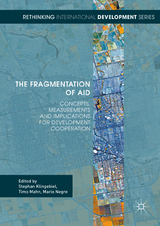
This edited volume provides an assessment of an increasingly fragmented aid system. Development cooperation is fundamentally changing its character in the wake of global economic and political transformations and an ongoing debate about what constitutes, and how best to achieve, global development. This also has important implications for the setup of the aid architecture. The increasing number of donors and other actors as well as goals and instruments has created an environment that is increasingly difficult to manoeuvre. Critics describe today's aid architecture as 'fragmented': inefficient, overly complex and rigid in adapting to the dynamic landscape of international cooperation. By analysing the actions of donors and new development actors, this book gives important insights into how and why the aid architecture has moved in this direction. The contributors also discuss the associated costs, but also potential benefits of a diverse aid system, and provide some concrete options for the way forward.
Stephan Klingebiel is Head of the Department of Bilateral and Multilateral Development Policy at the German Development Institute, Germany. His research and university teaching focus on the political economy of aid, aid development effectiveness, political economy and governance issues in sub-Saharan Africa, and crisis prevention and conflict management. He is a regular Visiting Professor at Stanford University, USA.
Timo Mahn is a researcher and public sector consultant at the German Development Institute / Deutsches Institut für Entwicklungspolitik (DIE). His research interests include public financial management, development effectiveness and the United Nations.
Mario Negre is a senior economist in the World Bank Research Group focusing on inclusive growth and shared prosperity as well as poverty and inequality measurement. He is seconded by the German Development Institute and has worked at the European Parliament in the past.This edited volume provides an assessment of an increasingly fragmented aid system. Development cooperation is fundamentally changing its character in the wake of global economic and political transformations and an ongoing debate about what constitutes, and how best to achieve, global development. This also has important implications for the setup of the aid architecture. The increasing number of donors and other actors as well as goals and instruments has created an environment that is increasingly difficult to manoeuvre. Critics describe today's aid architecture as 'fragmented': inefficient, overly complex and rigid in adapting to the dynamic landscape of international cooperation. By analysing the actions of donors and new development actors, this book gives important insights into how and why the aid architecture has moved in this direction. The contributors also discuss the associated costs, but also potential benefits of a diverse aid system, and provide someconcrete options for the way forward.
Stephan Klingebiel is Head of the Department of Bilateral and Multilateral Development Policy at the German Development Institute, Germany. His research and university teaching focus on the political economy of aid, aid development effectiveness, political economy and governance issues in sub-Saharan Africa, and crisis prevention and conflict management. He is a regular Visiting Professor at Stanford University, USA.Timo Mahn is a researcher and public sector consultant at the German Development Institute / Deutsches Institut für Entwicklungspolitik (DIE). His research interests include public financial management, development effectiveness and the United Nations. Mario Negre is a senior economist in the World Bank Research Group focusing on inclusive growth and shared prosperity as well as poverty and inequality measurement. He is seconded by the German Development Institute and has worked at the European Parliament in the past.r>
Chapter 1: Fragmentation: A key concept for development cooperation; Stephan Klingebiel, Timo Mahn and Mario Negre-. Chapter 2: Measuring fragmentation: the financial significance of aid relations; Fredrik Ericsson and Suzanne Steensen-. Chapter 3: Measuring cross-country proliferations - Towards a new non-proliferation treaty? Lau Schulpen and Rick Habraken-. Chapter 4: A composite index of aid fragmentation; Daniela Buscaglia and Anjula Garg-. Chapter 5: Bilateral donor bureaucracies and development cooperation pluralism; Erik Lundsgaarde-. Chapter 6: Fragmentation's losers: who are the aid orphans? Elena Pietschmann-. Chapter 7: Fragmenting aid or platform pluralism? The case of "vertical funds"; Margret Thalwitz-. Chapter 8: EU engagement in fragile and conflict-affected countries: comprehensive policy, fragmented operations; Mark Furness-. Chapter 9: South-South Cooperation and fragmentation - a non-issue? Gerardo Bracho and Sven Grimm-. Chapter 10: The age of choice: Developing countries in the new aid landscape; Romilly Greenhill, Annalisa Prizzon and Andrew Rogerson-. Chapter 11: Aid fragmentation and donor coordination in Uganda: A district-level analysis; Peter Nunnenkamp, Michaela Ran and Rainer Thiele-. Chapter 12: Aid fragmentation and effectiveness for infant and child mortality and primary school completion; Mitsuaki Furakawa-. Chapter 13: The implications of multi-bi financing for multilateral agencies: The example of the World Bank; Bernhard Reinsberg-. Chapter 14: Diversification in practice: How fragmented aid affects renewable energy support in the Philippines; Jens Marquardt-. Chapter 15: Managing diversity: A partner country perspective; Elena Pietschmann-. Chapter 16: One recipe for many cooks? Multi-actor coordination in post-conflict countries: benefits and risks; Tanja Kasten-. Chapter 17: The United Nation in development: Confronting fragmentation? Timo Mahn-. Chapter 18: How serious is the EU on aid fragmentation? James Mackie-. Chapter 19: Assessing the costs and benefits of reducing fragmentation: Coordination in European aid; Mario Negre and Stephan Klingebiel-. Chapter 20: Fragmentation and coherence: Is a more integrated approach the answer to Canadian aid effectiveness? Rachael Calleja, David Carment and Yiagadeesen Samy-. Chapter 21: Afterword - Fragmentation: A challenge of leadership; Eric Sollheim-.
| Erscheint lt. Verlag | 31.8.2016 |
|---|---|
| Reihe/Serie | Rethinking International Development series | Rethinking International Development series |
| Zusatzinfo | XXVI, 359 p. 10 illus., 2 illus. in color. |
| Verlagsort | London |
| Sprache | englisch |
| Themenwelt | Naturwissenschaften |
| Sozialwissenschaften ► Pädagogik ► Sozialpädagogik | |
| Sozialwissenschaften ► Politik / Verwaltung ► Europäische / Internationale Politik | |
| Sozialwissenschaften ► Politik / Verwaltung ► Vergleichende Politikwissenschaften | |
| Sozialwissenschaften ► Soziologie | |
| Schlagworte | Aid • Aid Architecture • aid coordination • aid effectiveness • Developing Countries • development aid • Development cooperation • Development Policy • development theory • donors • Foreign Aid • Fragmentation • OECD • Official Development Assistance • Political Economy of Aid • South-South cooperation |
| ISBN-10 | 1-137-55357-X / 113755357X |
| ISBN-13 | 978-1-137-55357-7 / 9781137553577 |
| Informationen gemäß Produktsicherheitsverordnung (GPSR) | |
| Haben Sie eine Frage zum Produkt? |
 PDF (Wasserzeichen)
DRM: Digitales Wasserzeichen
Dieses eBook enthält ein digitales Wasserzeichen und ist damit für Sie personalisiert. Bei einer missbräuchlichen Weitergabe des eBooks an Dritte ist eine Rückverfolgung an die Quelle möglich.
Dateiformat: PDF (Portable Document Format)
Mit einem festen Seitenlayout eignet sich die PDF besonders für Fachbücher mit Spalten, Tabellen und Abbildungen. Eine PDF kann auf fast allen Geräten angezeigt werden, ist aber für kleine Displays (Smartphone, eReader) nur eingeschränkt geeignet.
Systemvoraussetzungen:
PC/Mac: Mit einem PC oder Mac können Sie dieses eBook lesen. Sie benötigen dafür einen PDF-Viewer - z.B. den Adobe Reader oder Adobe Digital Editions.
eReader: Dieses eBook kann mit (fast) allen eBook-Readern gelesen werden. Mit dem amazon-Kindle ist es aber nicht kompatibel.
Smartphone/Tablet: Egal ob Apple oder Android, dieses eBook können Sie lesen. Sie benötigen dafür einen PDF-Viewer - z.B. die kostenlose Adobe Digital Editions-App.
Buying eBooks from abroad
For tax law reasons we can sell eBooks just within Germany and Switzerland. Regrettably we cannot fulfill eBook-orders from other countries.
aus dem Bereich