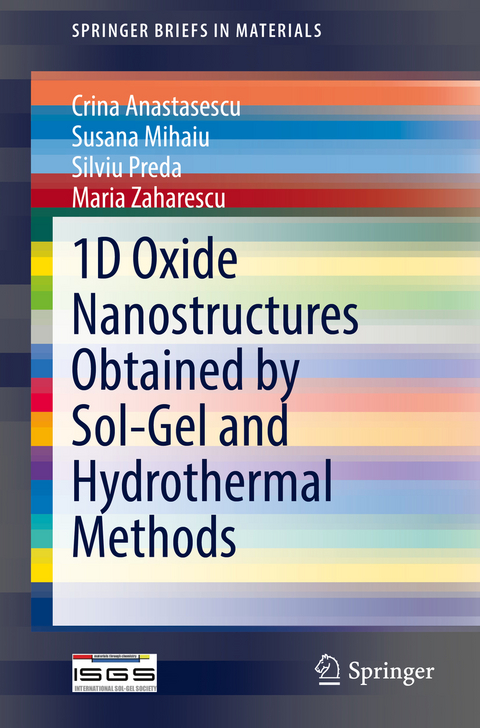
1D Oxide Nanostructures Obtained by Sol-Gel and Hydrothermal Methods (eBook)
VIII, 82 Seiten
Springer International Publishing (Verlag)
978-3-319-32988-8 (ISBN)
This book presents wet chemical sol-gel and hydrothermal methods for 1D oxide nanostructure preparation. These methods represent an attractive route to multifunctional nanomaterials synthesis, as they are versatile, inexpensive and, thus, appropriate for obtaining a wide range of oxide materials with tailored morphology and properties. Three specific oxides (SiO2, TiO2, ZnO) are discussed in detail in order to illustrate the principle of the sol-gel and hydrothermal preparation of 1D oxide nanostructures. Other oxides synthesized via this method are also briefly presented.
Throughout the book, the correlation between the tubular structure and the physico-chemical properties of these materials is highlighted. 1D oxide nanostructures exhibit interesting optical and electrical properties, due to their confined morphology. In addition, a well-defined geometry can be associated with chemically active species. For example, the pure SiO2 nanotubes presented a slight photocatalytic activity, while the Pt-doped SiO2 tubular materials act as microreactors in catalytic reactions. In the case of titania and titanate nanotubes, large specific surface area and pore volume, ion-exchange ability, enhanced light absorption, and fast electron-transport capability have attracted significant research interest. The chemical and physical modifications (microwave assisted hydrothermal methods) discussed here improve the formation kinetics of the nanotubes. The ZnO nanorods/tubes were prepared as random particles or as large areas of small, oriented 1D ZnO nanostructures on a variety of substrates. In the latter case a sol-gel layer is deposited on the substrate prior to the hydrothermal preparation. Using appropriate dopants, coatings of ZnO nanorods with controlled electrical behavior can be obtained.
Introduction (general considerations on the 1 D oxide nanostructures).- Synthesis of oxide nanotubes by sol-gel method.- Synthesis of oxide nanotubes/nanorods by hydrothermal method.
| Erscheint lt. Verlag | 30.8.2016 |
|---|---|
| Reihe/Serie | SpringerBriefs in Materials | SpringerBriefs in Materials |
| Zusatzinfo | VIII, 82 p. 29 illus., 7 illus. in color. |
| Verlagsort | Cham |
| Sprache | englisch |
| Themenwelt | Naturwissenschaften ► Chemie |
| Technik ► Maschinenbau | |
| Schlagworte | 1D oxide nanostructure • Hydrothermal synthesis nanostructures • Oxide nanomaterials sol-gel • Oxide nanostructures wet chemical methods • SiO2 based nanotubes • Sol-gel synthesis nanotubes • Titanate nanotubes • Tubular geometry nano • ZnO nanotubes |
| ISBN-10 | 3-319-32988-X / 331932988X |
| ISBN-13 | 978-3-319-32988-8 / 9783319329888 |
| Informationen gemäß Produktsicherheitsverordnung (GPSR) | |
| Haben Sie eine Frage zum Produkt? |
 PDF (Wasserzeichen)
DRM: Digitales Wasserzeichen
Dieses eBook enthält ein digitales Wasserzeichen und ist damit für Sie personalisiert. Bei einer missbräuchlichen Weitergabe des eBooks an Dritte ist eine Rückverfolgung an die Quelle möglich.
Dateiformat: PDF (Portable Document Format)
Mit einem festen Seitenlayout eignet sich die PDF besonders für Fachbücher mit Spalten, Tabellen und Abbildungen. Eine PDF kann auf fast allen Geräten angezeigt werden, ist aber für kleine Displays (Smartphone, eReader) nur eingeschränkt geeignet.
Systemvoraussetzungen:
PC/Mac: Mit einem PC oder Mac können Sie dieses eBook lesen. Sie benötigen dafür einen PDF-Viewer - z.B. den Adobe Reader oder Adobe Digital Editions.
eReader: Dieses eBook kann mit (fast) allen eBook-Readern gelesen werden. Mit dem amazon-Kindle ist es aber nicht kompatibel.
Smartphone/Tablet: Egal ob Apple oder Android, dieses eBook können Sie lesen. Sie benötigen dafür einen PDF-Viewer - z.B. die kostenlose Adobe Digital Editions-App.
Buying eBooks from abroad
For tax law reasons we can sell eBooks just within Germany and Switzerland. Regrettably we cannot fulfill eBook-orders from other countries.
aus dem Bereich