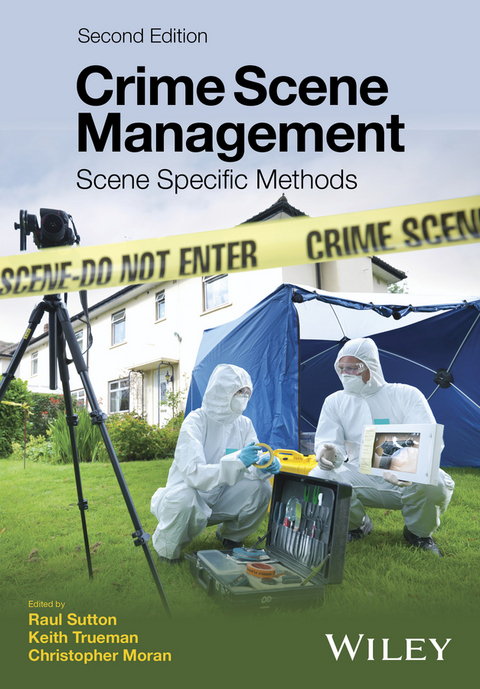
Crime Scene Management (eBook)
John Wiley & Sons (Verlag)
978-1-119-18091-3 (ISBN)
Second edition of an established text on common procedures for the identification and processing of evidence at scenes of crime
- Includes chapters on quality assurance and credibility of practices and processes
- issues surrounding major and complex crime
- Forensic handling of mass fatalities
- Crime scene reconstruction and impact on evidence recovery processes
Raul Sutton, Head of School, Biology, Chemistry and Forensic Science, School of Applied Science, University of Wolverhampton, UK.
Raul's research includes the way that we identify people from finger marks and palm marks left at scenes of crime, and also methods to improve the accuracy of post mortem interval determination using cartilage as a marker tissue.
Keith Trueman is a retired West Midlands Police officer
Christopher Moran, University of Wolverhampton, UK
Chris has extensive practical experience in the management of forensic investigations into serious and complex crime. He was a Forensic Scene Manager with West Midlands Police, has been responsible for the training and mentoring of newly appointed forensic investigators and the provision of training to police investigative officers from trainee detectives to SIOs.
Second edition of an established text on common procedures for the identification and processing of evidence at scenes of crime Includes chapters on quality assurance and credibility of practices and processes issues surrounding major and complex crime Forensic handling of mass fatalities Crime scene reconstruction and impact on evidence recovery processes
Raul Sutton, Head of School, Biology, Chemistry and Forensic Science, School of Applied Science, University of Wolverhampton, UK. Raul's research includes the way that we identify people from finger marks and palm marks left at scenes of crime, and also methods to improve the accuracy of post mortem interval determination using cartilage as a marker tissue. Keith Trueman is a retired West Midlands Police officer Christopher Moran, University of Wolverhampton, UK Chris has extensive practical experience in the management of forensic investigations into serious and complex crime. He was a Forensic Scene Manager with West Midlands Police, has been responsible for the training and mentoring of newly appointed forensic investigators and the provision of training to police investigative officers from trainee detectives to SIOs.
Title Page 5
Copyright Page 6
Contents 7
Introduction and Use of this Text 13
List of Contributors 16
About the Companion Website 17
Part I Crime Scene Principles 19
Chapter 1 The Crime Scene Context 21
1.1 Introduction 21
1.2 What is a crime? 22
1.3 The nature of the UK legal system 24
1.4 The legal system in England and Wales 25
1.5 Other courts 27
1.6 The judicial system in Northern Ireland 27
1.7 The Scottish legal system 29
1.8 Judicial processes that deal with causes of death 30
1.9 What constitutes evidence? 32
1.10 The chain of events in evidence gathering 33
1.11 The relationship between evidence gatherers and analysts 37
1.12 Health and safety considerations 38
Suggested further reading 39
Chapter 2 First Officer Attending 40
2.1 Introduction 40
2.2 Response to incident report 41
2.3 Personnel involved in the investigative process 42
2.4 Recording and recovery of scientific evidence 43
2.5 Initial considerations of the First Officer Attending (FOA) 43
2.6 Dealing with the victim 45
2.7 Dealing with witnesses 46
2.8 Dealing with suspects 47
2.9 Dealing with the crime scene(s) 47
2.10 Documentation 53
2.11 Dealing with violent crime 53
2.12 Summary and conclusion 54
Chapter 3 The Role of the Crime Scene Investigator 56
3.1 Introduction 56
3.2 Training the CSI 57
3.3 The responsibilities of a CSI 58
3.4 Forensic evidence 60
3.5 Request for CSI attendance at crime scenes 64
3.6 Actions when attending the crime scene 65
3.7 Initial scene assessment (including health and safety considerations) 66
3.8 Planning evidence recovery 69
3.9 Recording the evidence 70
3.10 The elimination process 76
3.11 Details of evidence recovered 76
3.12 Integrity, continuity and contamination 77
3.13 Packaging materials 82
3.14 Conclusion 86
Part II Evidence-gathering Techniques 89
Chapter 4 Police Photography, Video Recording, 3D Laser Scanning 91
4.1 Introduction 91
4.2 General guidelines 92
4.3 Equipment 93
4.4 Exposure 94
4.5 Image quality/size 98
4.6 Depth of field 99
4.7 White balance 101
4.8 Image data 101
4.9 Flash photography 102
4.10 Room interiors 103
4.11 Vehicles 103
4.12 Evidential items 103
4.13 Recording injuries to the person 104
4.14 Night photography 106
4.15 Footwear impressions 107
4.16 Fingerprints 108
4.17 Recording video evidence at crime scenes 110
4.18 The use of digital images in court 112
4.19 3D laser scanning of scenes 113
Suggested further reading 114
Chapter 5 Fingerprints 115
5.1 Introduction 115
5.2 The nature of friction ridge skin 117
5.3 The structure of friction ridge skin 118
5.4 Friction ridge growth 118
5.5 Principles of friction ridge identification 120
5.6 Comparison methodology 121
5.7 Chemical composition of latent prints 123
5.8 Identification of common locations for prints 125
5.9 The use of powdering techniques to enhance latent finger marks 127
5.10 Chemical development techniques 130
5.11 Laboratory and scene applications 131
5.12 Fingerprints in bodily fluids 133
5.13 Scenes of fire 136
5.14 Optical methods to reveal fingerprints (laser and other light sources) 137
5.15 New and emerging techniques 140
5.16 Remote transmission 140
5.17 Chapter summary 141
Acknowledgements 143
Selected further reading 144
Chapter 6 DNA-rich Evidence 146
6.1 Introduction and historical background 146
6.2 The structure and properties of DNA 147
6.3 DNA analysis 148
6.4 Types of DNA testing 148
6.5 Biological evidence 152
6.6 Procedures for collection of biological evidence: general considerations 154
6.7 Limitations of DNA evidence 165
6.8 Elimination and reference samples 166
6.9 Summary 166
References 167
Chapter 7 Blood Pattern Analysis 169
7.1 Introduction 169
7.2 History of the development of blood spatter as a scientific discipline 170
7.3 Composition of blood 171
7.4 Physical properties of blood 172
7.5 Causes of bleeding 174
7.6 Blood dynamics 175
7.7 Drop-surface impact and droplet pattern 175
7.8 Determination of area of origin of spatter 179
7.9 Cast-off patterns 180
7.10 Arterial damage patterns 181
7.11 Non-spatter patterns 184
7.12 Physiologically altered bloodstains 187
7.13 Volume bloodstains 191
7.14 Composite patterns 193
7.15 Investigative transfer and contamination issues 194
7.16 Recording traces 194
7.17 Summary 196
Suggested further reading 196
Chapter 8 Physical Evidence 198
8.1 Introduction 198
8.2 Tool marks 198
8.3 Clothing 200
8.4 Fibres 201
8.5 Footwear impressions 204
8.6 Glass fragments 206
8.7 Glass fragmentation 208
8.8 Soils 210
8.9 Firearms 211
8.10 Scene recovery of firearms 215
8.11 Gunshot residues (GSR) 217
8.12 Drugs of abuse (DOA) 218
8.13 The crime scene characteristics of various DOA 220
8.14 Presumptive tests for drugs 221
8.15 Amateur explosives 224
8.16 Summary 224
Suggested further reading 225
Part III Specialised Scenes and Report Writing 227
Chapter 9 Fire Scene Examination 229
9.1 Introduction 229
9.2 The nature of fire 230
9.3 The oxygen demand of fuels 232
9.4 Flame and fire classifications fire development
9.5 Types of evidence specific to fire scenes 237
9.6 Locating the origin of the fire 238
9.7 Fire cause determination and evidence-gathering methods 241
9.8 Methods for ascertaining whether a crime has been committed 244
9.9 Health and safety considerations 246
9.10 Summary 247
Suggested further reading 248
Chapter 10 Examination of Recovered Stolen Motor Vehicles 249
10.1 Introduction 249
10.2 What is a motor vehicle? 251
10.3 The definition of an auto crime 251
10.4 Auto crime scene examinations 255
10.5 Requests to attend an auto crime scene 256
10.6 The examination process 259
10.7 Conclusion 269
Chapter 11 Managing Complex Scenes and Multiple or Mass Fatality Scenes 270
11.1 Introduction 270
11.2 Self-briefing 272
11.3 Communication 273
11.4 Establishing priorities 273
11.5 Avoidance of contamination 274
11.6 The forensic strategy 275
11.7 ‘Defence’ case review meeting 277
11.8 Incident debrief 277
11.9 Introduction to mass fatality incidents 278
11.10 The range and nature of mass fatality incidents 279
11.11 The type of investigation conducted 279
11.12 Sequence of events in managing disaster victim identification scenes 280
11.13 Recovery of mortal remains 282
Suggested further reading 284
Chapter 12 Preparing Reports and Statements 285
12.1 Introduction 285
12.2 Documentation at the crime scene 286
12.3 Photography 287
12.4 Plans, sketches and diagrams 287
12.5 The exhibit label 289
12.6 Handling the evidence 293
12.7 Statements of evidence 296
12.8 Criminal Justice Act 1967, section 9 296
12.9 Crime scene examination statements 297
12.10 Conclusion 299
Chapter 13 Quality Assurance in Crime Scene Investigation 301
13.1 Introduction 301
13.2 Informal aspects of quality assurance 302
13.3 The development of formal quality assurance 302
13.4 The role of the Forensic Science Regulator 303
13.5 Responsibility for measuring quality assurance 304
13.6 The accreditation process 305
13.7 Organisational requirements for accreditation 306
13.8 Personnel requirements for accreditation 306
13.9 Resource requirements for accreditation 307
13.10 Process requirements for accreditation 307
13.11 Management requirements for accreditation 308
13.12 Maintaining accreditation 308
Suggested further reading 310
Appendices 311
Police Service Rank Structure 313
Photography Appendix 314
Finger Mark Visualisation Appendix 320
Index 321
EULA 331
| Erscheint lt. Verlag | 23.9.2016 |
|---|---|
| Sprache | englisch |
| Themenwelt | Studium ► 2. Studienabschnitt (Klinik) ► Rechtsmedizin |
| Naturwissenschaften ► Chemie | |
| Recht / Steuern ► Strafrecht ► Kriminologie | |
| Sozialwissenschaften | |
| Schlagworte | Analytische Chemie • Analytische Chemie / Forensik • Biowissenschaften • Chemie • Chemistry • Crime scene investigation • Criminal Law • Evidence • Forensic • Forensics • Forensic Science • Forensik • Forensische Psychologie • Genetik • Law • Life Sciences • <p>Crime Scene • Police</p> <p> </p> • Rechtswissenschaft • Strafrecht • undergraduate |
| ISBN-10 | 1-119-18091-0 / 1119180910 |
| ISBN-13 | 978-1-119-18091-3 / 9781119180913 |
| Informationen gemäß Produktsicherheitsverordnung (GPSR) | |
| Haben Sie eine Frage zum Produkt? |
 PDF (Adobe DRM)
Kopierschutz: Adobe-DRM
Adobe-DRM ist ein Kopierschutz, der das eBook vor Mißbrauch schützen soll. Dabei wird das eBook bereits beim Download auf Ihre persönliche Adobe-ID autorisiert. Lesen können Sie das eBook dann nur auf den Geräten, welche ebenfalls auf Ihre Adobe-ID registriert sind.
Details zum Adobe-DRM
Dateiformat: PDF (Portable Document Format)
Mit einem festen Seitenlayout eignet sich die PDF besonders für Fachbücher mit Spalten, Tabellen und Abbildungen. Eine PDF kann auf fast allen Geräten angezeigt werden, ist aber für kleine Displays (Smartphone, eReader) nur eingeschränkt geeignet.
Systemvoraussetzungen:
PC/Mac: Mit einem PC oder Mac können Sie dieses eBook lesen. Sie benötigen eine
eReader: Dieses eBook kann mit (fast) allen eBook-Readern gelesen werden. Mit dem amazon-Kindle ist es aber nicht kompatibel.
Smartphone/Tablet: Egal ob Apple oder Android, dieses eBook können Sie lesen. Sie benötigen eine
Geräteliste und zusätzliche Hinweise
Buying eBooks from abroad
For tax law reasons we can sell eBooks just within Germany and Switzerland. Regrettably we cannot fulfill eBook-orders from other countries.
aus dem Bereich