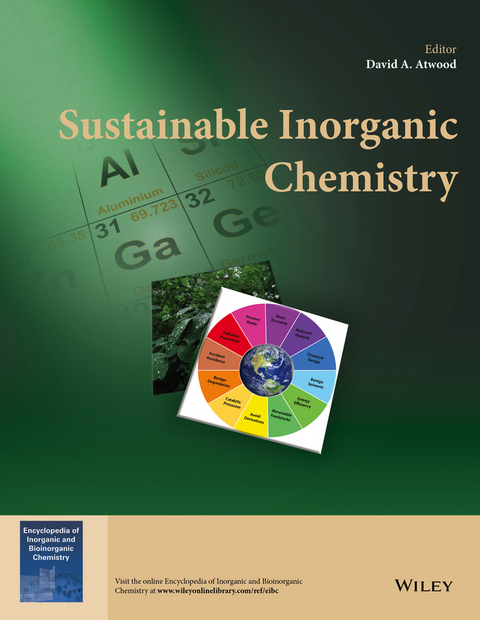
Sustainable Inorganic Chemistry (eBook)
John Wiley & Sons (Verlag)
978-1-118-75146-6 (ISBN)
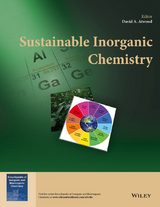
The Earth's natural resources are finite and easily compromised by contamination from industrial chemicals and byproducts from the degradation of consumer products. The growing field of green and sustainable chemistry seeks to address this through the development of products and processes that are environmentally benign while remaining economically viable. Inorganic chemistry plays a critical role in this endeavor in areas such as resource extraction and isolation, renewable energy, catalytic processes, waste minimization and avoidance, and renewable industrial feedstocks.
Sustainable Inorganic Chemistry presents a comprehensive overview of the many new developments taking place in this rapidly expanding field, in articles that discuss fundamental concepts alongside cutting-edge developments and applications. The volume includes educational reviews from leading scientists on a broad range of topics including: inorganic resources, sustainable synthetic methods, alternative reaction conditions, heterogeneous catalysis, photocatalysis, sustainable nanomaterials, renewable and clean fuels, water treatment and remediation, waste valorization and life cycle sustainability assessment.
The content from this book will be added online to the Encyclopedia of Inorganic and Bioinorganic Chemistry.
David Atwood joined the chemistry department at the University of Kentucky faculty as an Associate Professor in 1998. He has over 160 publications, 10 patents, and serves on numerous editorial boards, including the Encyclopedia of Inorganic and Bioinorganic Chemistry. He is the founding editor and editor-in-chief of the journal Main Group Chemistry. His research interests include detection and removal of heavy metal contaminants such as mercury, cadmium and lead, from the environment, the preparation of nanoparticulate metal oxides, prevention of aluminum alloy oxidation, and the synthesis of new Lewis acid compounds to effect new reactions, such as the breaking of phosphate esters bonds like those found in nerve gas agents and pesticides and the destruction of methyl-t-butyl ether (MTBE) a widespread water contaminant.
The Earth's natural resources are finite and easily compromised by contamination from industrial chemicals and byproducts from the degradation of consumer products. The growing field of green and sustainable chemistry seeks to address this through the development of products and processes that are environmentally benign while remaining economically viable. Inorganic chemistry plays a critical role in this endeavor in areas such as resource extraction and isolation, renewable energy, catalytic processes, waste minimization and avoidance, and renewable industrial feedstocks. Sustainable Inorganic Chemistry presents a comprehensive overview of the many new developments taking place in this rapidly expanding field, in articles that discuss fundamental concepts alongside cutting-edge developments and applications. The volume includes educational reviews from leading scientists on a broad range of topics including: inorganic resources, sustainable synthetic methods, alternative reaction conditions, heterogeneous catalysis, photocatalysis, sustainable nanomaterials, renewable and clean fuels, water treatment and remediation, waste valorization and life cycle sustainability assessment.The content from this book will be added online to the Encyclopedia of Inorganic and Bioinorganic Chemistry.
David Atwood joined the chemistry department at the University of Kentucky faculty as an Associate Professor in 1998. He has over 160 publications, 10 patents, and serves on numerous editorial boards, including the Encyclopedia of Inorganic and Bioinorganic Chemistry. He is the founding editor and editor-in-chief of the journal Main Group Chemistry. His research interests include detection and removal of heavy metal contaminants such as mercury, cadmium and lead, from the environment, the preparation of nanoparticulate metal oxides, prevention of aluminum alloy oxidation, and the synthesis of new Lewis acid compounds to effect new reactions, such as the breaking of phosphate esters bonds like those found in nerve gas agents and pesticides and the destruction of methyl-t-butyl ether (MTBE) a widespread water contaminant.
Cover 1
Title Page 5
Copyright 6
Contents 9
Contributors 13
Series Preface 19
Volume Preface 21
Recovery of Gold from Incinerated Sewage Sludge 24
Rare Earth Recycling from NdFeB 32
Life Cycle Sustainability Assessments 48
Trends in Food and Agricultural Waste Valorization 66
Toxicity Assessment of Molecular Rhenium(VII) Epoxidation Catalysts 76
Challenges in Green Analytical Chemistry 90
Mobile Apps for Green Chemistry 100
Renewable Plant-Based Raw Materials for Industry 110
Sustainable Synthesis of Fine Chemicals from Aliphatic Nitro Compounds 128
Sustainable Production of Glycerol 142
Production of Biopropylene Using Biomass-Derived Sources 152
Methylethers from Alcohols and Dimethyl Carbonate 166
Sustainable Surfactants Based on Amino Acids 182
Sustainable Biosurfactants 198
Solvent Systems for Sustainable Chemistry 216
Fluorous Hydrocarbon Oxidation 234
Ionic Liquids: Industrial Applications 244
Ionic Liquids: Enzymatic Hydrolysis of Lignocellulose 258
Ionic Liquids: Applications by Computational Design 272
Ionic Liquids: Recycling 286
Ionic Liquids: Bacterial Degradation in Wastewater Treatment Plants 302
Water Treatment by Electrocoagulation 316
Sustainable Water Remediation 328
Dimethylcarbonate for the Catalytic Upgrading of Amines and Bio-Based Derivatives 344
Sustainable Syntheses with Microwave Irradiation 356
Radical Reactions, ??????-Cyclodextrin and Chitosan and Aqueous Media: From Fundamental Reactions to Potential Applications 374
Catalytic Epoxidation of Organics from Vegetable Sources 396
Catalytic Cyclic Carbonate Synthesis with Sustainable Metals 408
Solid Catalysts for Epoxidation with Dilute Hydrogen Peroxide 422
TiO??????-Based Heterogeneous Catalysis for Photocatalytic Hydrogen Generation and Photodegradation 432
Photocatalytic Production of Hydrogen with Earth-Abundant Metal Catalysts 462
Multifunctional MOF-Based Photocatalysis 474
Sustainable Nanomaterials 490
Sustainable Synthesis of Metal Oxide Nanostructures 506
Micellar Nanoreactors 518
Index 536
EULA 580
| Erscheint lt. Verlag | 21.9.2016 |
|---|---|
| Reihe/Serie | EIC Books |
| EIC Books | EIC Books |
| Sprache | englisch |
| Themenwelt | Naturwissenschaften ► Chemie ► Anorganische Chemie |
| Technik | |
| Schlagworte | Anorganische Chemie • Chemie • Chemistry • Electronic materials • Elektronische Materialien • Grüne Chemie • Green chemistry • Grüne Chemie • Inorganic Chemistry • ionic liquids, • Materials Science • Materialwissenschaften • Nachhaltige u. Grüne Chemie • Nachhaltige u. Grüne Chemie • renewable • sustainability • Sustainable • Sustainable Chemistry & Green Chemistry |
| ISBN-10 | 1-118-75146-9 / 1118751469 |
| ISBN-13 | 978-1-118-75146-6 / 9781118751466 |
| Informationen gemäß Produktsicherheitsverordnung (GPSR) | |
| Haben Sie eine Frage zum Produkt? |
 PDF (Adobe DRM)
Kopierschutz: Adobe-DRM
Adobe-DRM ist ein Kopierschutz, der das eBook vor Mißbrauch schützen soll. Dabei wird das eBook bereits beim Download auf Ihre persönliche Adobe-ID autorisiert. Lesen können Sie das eBook dann nur auf den Geräten, welche ebenfalls auf Ihre Adobe-ID registriert sind.
Details zum Adobe-DRM
Dateiformat: PDF (Portable Document Format)
Mit einem festen Seitenlayout eignet sich die PDF besonders für Fachbücher mit Spalten, Tabellen und Abbildungen. Eine PDF kann auf fast allen Geräten angezeigt werden, ist aber für kleine Displays (Smartphone, eReader) nur eingeschränkt geeignet.
Systemvoraussetzungen:
PC/Mac: Mit einem PC oder Mac können Sie dieses eBook lesen. Sie benötigen eine
eReader: Dieses eBook kann mit (fast) allen eBook-Readern gelesen werden. Mit dem amazon-Kindle ist es aber nicht kompatibel.
Smartphone/Tablet: Egal ob Apple oder Android, dieses eBook können Sie lesen. Sie benötigen eine
Geräteliste und zusätzliche Hinweise
Buying eBooks from abroad
For tax law reasons we can sell eBooks just within Germany and Switzerland. Regrettably we cannot fulfill eBook-orders from other countries.
aus dem Bereich