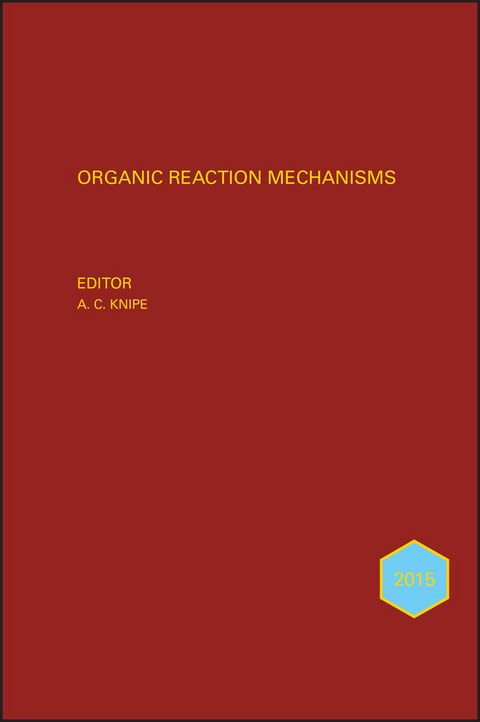
Organic Reaction Mechanisms 2013 (eBook)
John Wiley & Sons (Verlag)
978-1-118-70770-8 (ISBN)
Organic Reaction Mechanisms 2013, the 49th annual volume in this highly successful and unique series, surveys research on organic reaction mechanisms described in the available literature dated 2013.
The following classes of organic reaction mechanisms are comprehensively reviewed:
- Reaction of Aldehydes and Ketones and their Derivatives
- Reactions of Carboxylic, Phosphoric, and Sulfonic Acids and their Derivatives
- Oxidation and Reduction
- Carbenes and Nitrenes
- Nucleophilic Aromatic Substitution
- Electrophilic Aromatic Substitution
- Carbocations
- Nucleophilic Aliphatic Substitution
- Carbanions and Electrophilic Aliphatic Substitution
- Elimination Reactions
- Polar Addition Reactions
- Cycloaddition Reactions
- Molecular Rearrangements
An experienced team of authors compile these reviews every year, so that the reader can rely on a continuing quality of selection and presentation.
Organic Reaction Mechanisms 2013, the 49th annual volume in this highly successful and unique series, surveys research on organic reaction mechanisms described in the available literature dated 2013. The following classes of organic reaction mechanisms are comprehensively reviewed: Reaction of Aldehydes and Ketones and their Derivatives Reactions of Carboxylic, Phosphoric, and Sulfonic Acids and their Derivatives Oxidation and Reduction Carbenes and Nitrenes Nucleophilic Aromatic Substitution Electrophilic Aromatic Substitution Carbocations Nucleophilic Aliphatic Substitution Carbanions and Electrophilic Aliphatic Substitution Elimination Reactions Polar Addition Reactions Cycloaddition Reactions Molecular Rearrangements An experienced team of authors compile these reviews every year, so that the reader can rely on a continuing quality of selection and presentation.
Professor A.C. Knipe, School of BMS, The University of Ulster, Northern Ireland.
1. Reactions of Aldehydes and Ketones and Their Derivatives by B. A. Murray 1
2. Reactions of Carboxylic, Phosphoric, and Sulfonic Acids and Their Derivatives by C. T. Bedford 67
3. Oxidation and Reduction by R. N. Mehrotra 91
4. Carbenes and Nitrenes by E. Gras and S. Chassaing 177
5. Aromatic Substitution by M. R. Crampton 217
6. Carbocations by D. A. Klumpp 273
7. Nucleophilic Aliphatic Substitution by K. C. Westaway 321
8. Carbanions and Electrophilic Aliphatic Substitution by M. L. Birsa 361
9. Elimination Reactions by M. L. Birsa 383
10. Addition Reactions: Polar Addition by P. Ko!covsk´y 393
11. Addition Reactions: Cycloaddition by N. Dennis 483
12. Molecular Rearrangements by J. M. Coxon 519
Author Index 609
Subject Index 651
Chapter 1
Reactions of Aldehydes and Ketones and Their Derivatives
B. A. Murray
Department of Science, Institute of Technology, Tallaght (ITT Dublin), Dublin, Ireland
- Formation and Reactions of Acetals and Related Species
- Reactions of Glucosides
- Reactions of Ketenes
- Formation and Reactions of Nitrogen Derivatives
- Imines: Synthesis, and General and Iminium Chemistry
- Mannich, Mannich-type and Nitro-Mannich Reactions
- Other ‘Name’ Reactions of Imines
- Synthesis of Azacyclopropanes from Imines
- Alkylations and Additions of Other C-Nucleophiles to Imines
- Arylations, Alkenylations and Allylations of Imines
- Miscellaneous Additions to Imines
- Reduction of Imines
- Other Reactions of Imines
- Oximes, Hydrazones and Related Species
- C–C Bond Formation and Fission: Aldol and Related Reactions
- Reviews of Aldols and General Reviews of Asymmetric Catalysis
- Asymmetric Aldols Catalysed by Proline and Its Derivatives
- Asymmetric Aldols Catalysed by Other Organocatalysts
- The Mukaiyama Aldol
- Other Asymmetric Aldols
- The Henry (Nitroaldol) Reaction
- The Baylis–Hillman Reaction and Its Morita-variant
- Other Aldol and Aldol-type Reactions
- Allylation and Related Reactions
- The Horner–Wadsworth–Emmons Reaction and Related Olefinations
- Alkynylations
- Stetter Reaction, Benzoin Condensation and Pinacol Coupling
- Michael Additions
- Miscellaneous Condensations
- Other Addition Reactions
- Enolization, Reactions of Enolates and Related Reactions
- Oxidation and Reduction of Carbonyl Compounds
- Other Reactions
- References
Formation and Reactions of Acetals and Related Species
Equilibria for the formation of hemiacetals from eight isomeric hexanals have been measured in methanol, and compared with the steric environment around the aldehyde.1 Kinetic studies have also been carried out, and these suggest an early TS.
Catalytic asymmetric acetalization of aldehydes has been demonstrated, using large chiral BINOL-derived phosphoric acid catalysts: these are proposed to generate confined chiral microenvironments.2
A new enantioselective arylation of enecarbamates (1) has been developed, using a quinone imine acetal (2) as a functionalized surrogate aromatic, and an axially chiral BINAP-dicarboxylic acid catalyst.3 The useful α-amino-β-aryl ether products (3) are formed in up to 99% ee, and des often >90%, and are further transformable into chiral β-aryl amines and α-aryl esters. Mechanistically revealing observations include: (i) trans-enecarbamate switches the sense of asymmetric induction; (ii) the NH in (1) is critical, presumably for hydrogen bonding to catalyst: the NMe starter fails; and (iii) crossover experiments fail, implicating an intramolecular route. The proposed first step is a highly stereoselective C–C bond formation followed by aromatization (with elimination of R3-OH), then re-addition of R3-OH to the sidechain.
A stable N,N′-diamidocarbene has been used to activate molecules with X–X homonuclear single bonds (where X = Br, O, S, C).4 Br2 yields a substituted tetrahydropyrimidinium salt, benzoyl peroxide yields diamidoacetal product, and various sulfides give the corresponding diamidothioacetals. For X = C, insertion into the (O)C–C(O) bond of diones was observed, and for cyclopropenone, insertion into the (O)–C–C bond occurred.
meta- and para-Substituted benzaldehyde acetals, X-C6H4–CH(OBu)2, have been oxidized by N-bromosuccinimide in acetonitrile, to give the corresponding esters (and alkyl bromide).5 Rates have been measured by the iodometric method, over a range of temperature. A primary kinetic isotope effect, kH/kD, is observed, indicating rate-determining C–H cleavage; a Hammett σ value of 1 · 4 and activation parameters are given.
Kinetics of the oxidation of a range of aromatic acetals by N-chloronicotinamide have been measured in acetonitrile.6
The combination of triethylsilyltriflate with either 2,6-dimethylpyridine (2,6-lutidine) or 2,4,6-trimethylpyridine (2,4,6-collidine) effectively deprotects acetals of aldehydes under mild, neutral conditions, while leaving those of ketones unaffected.7 Pyridinium-type salt intermediates are proposed.
The Prins reaction has been modelled using DFT (density functional theory), using an alkene (RCH=CH2, R = Me or Ph), a formaldehyde dimer, and a proton-water cluster, H3O+(H2O)13. Both alkenes feature a concerted path to give the 1,3-diols. An unprecedented hemiacetal intermediate, HO–CH2–O–CH(R)–CH2CH2–OH, was then identified: it undergoes ring closure to the 1,3-dioxane product.8 Gas-phase Prins reaction of formaldehyde dimer with alkene has been studied computationally: it proceeds via a π-complex (without formation of any intermediate σ-complex).9
DFT calculations have been used to study the kinetic and thermodynamic parameters of the oligomerization of formaldehyde in neutral aqueous solution: linear and cyclic oligomers up to tetramer were examined, and implications for enolization and aldol reactions were also examined.10
A series of new naphtha[1,3]oxazino[2,3-α]isoquinolines (4, R1 = H, Me, Ph, Ar; R2 = H, OMe) have been prepared from 1-aminomethyl-2-naphthols and 3,4-dihydro-isoquinolines.11 The predominant diastereomer is trans- (at the 7a- and 15-positions), but a surprising inversion at nitrogen can be observed by NMR (nuclear magnetic resonance). Computations support ring-opening at the C(7a)-oxygen bond, giving an iminium-phenolate intermediate.
For other reports of acetals, see the section titled ‘Miscellaneous Oxidative Processes’ later.
Reactions of Glucosides
Proton affinities and pKas have been calculated for various tautomers of d-glucose and d-fructose, and compare favourably with experimental measurements of the pH's of sugar solutions in water.12
A review surveys the catalysts and mechanistic approaches to alter the reactivity of hydroxyl groups in carbohydrates, thus facilitating regioselective manipulation.13
exo-Glycals [e.g., (Z)-5 and (E)-5] are glycosides with an exocyclic enol ether next to the oxygen of the ring, are useful synthons, and some have biochemical applications in their own right. However, the (E)-isomers have been inaccessible to date. In a treatment of the (Z)-species with strong base (aimed at further functionalization), t-BuLi at −78 °C surprisingly gave 34% conversion to the (E)-exo-glycal [(E)-5] with no by-products. A vinyl anionic intermediate was confirmed. Optimum isomerization employed 3 mol LiHDMS at ambient temperature for 10 min (to deprotonate), followed by −100 °C for 2 h, which favours the (E)-isomer.14
Several formic acid derivatives of a protected glucose have been prepared: O-perbenzoylated C-(β-d-glucopyranosyl)-formimidate [6, R = C(=NH)OEt], -formamidine [R = C(=NH)–NH2], -formamidrazone [R = C(=NH–NHX)–NH2, X = H or Ts] and -formyl chloride (R = COCl).15 Designed to lead to 1,2,4-triazole derivatives of the sugar, they unexpectedly also gave 1,3,4-oxadiazole derivatives. DFT calculations have been used to investigate the alternative ring-forming pathways.
Chemo- and regio-selective functionalization of non-protected carbohydrates has been developed, allowing selective thiocarbonylation, acylation and sulfonylation of a particular carbohydrate in the presence of structurally similar carbohydrates, for example, anomers.16 For example, sugar anomers (7) can be functionalized in the 6-position in up to 99% yield and 99% β-selectivity, using Me2SnCl2 as catalyst. Just switching the catalyst to Bu2SnCl2 gives comparable yields and α-selectivities in the 2-position. The mechanisms are discussed in terms of the steric approaches of the catalysts at the 1,2- versus 4,6-sites.
A DFT study of the acid catalysis of the mutarotation of erythrose and threose has...
| Erscheint lt. Verlag | 20.9.2016 |
|---|---|
| Reihe/Serie | Organic Reaction Mechanisms |
| Organic Reaction Mechanisms | Organic Reaction Mechanisms |
| Sprache | englisch |
| Themenwelt | Naturwissenschaften ► Chemie ► Organische Chemie |
| Technik | |
| Schlagworte | Chemie • Chemistry • Organic Chemistry • Organic Reaction Mechanisms 2013, Reaction of Aldehydes and Ketones and their Derivatives, Reactions of Carboxylic, Phosphoric, and Sulfonic Acids, Oxidation and Reduction, Carbenes and Nitrenes, Nucleophilic Aromatic Substitution, Electrophilic Aromatic Substitution, Carbocations, Nucleophilic Aliphatic Substitution, Carbanions and Electrophilic Aliphatic Substitution, Elimination Reactions, Polar Addition Reactions, Cycloaddition Reactions, Molecular Rearrangements • Organische Chemie • Physical Chemistry • Physical Organic Chemistry • Physikalische Chemie • Physikalische Organische Chemie |
| ISBN-10 | 1-118-70770-2 / 1118707702 |
| ISBN-13 | 978-1-118-70770-8 / 9781118707708 |
| Informationen gemäß Produktsicherheitsverordnung (GPSR) | |
| Haben Sie eine Frage zum Produkt? |
 EPUB (Adobe DRM)
Kopierschutz: Adobe-DRM
Adobe-DRM ist ein Kopierschutz, der das eBook vor Mißbrauch schützen soll. Dabei wird das eBook bereits beim Download auf Ihre persönliche Adobe-ID autorisiert. Lesen können Sie das eBook dann nur auf den Geräten, welche ebenfalls auf Ihre Adobe-ID registriert sind.
Details zum Adobe-DRM
Dateiformat: EPUB (Electronic Publication)
EPUB ist ein offener Standard für eBooks und eignet sich besonders zur Darstellung von Belletristik und Sachbüchern. Der Fließtext wird dynamisch an die Display- und Schriftgröße angepasst. Auch für mobile Lesegeräte ist EPUB daher gut geeignet.
Systemvoraussetzungen:
PC/Mac: Mit einem PC oder Mac können Sie dieses eBook lesen. Sie benötigen eine
eReader: Dieses eBook kann mit (fast) allen eBook-Readern gelesen werden. Mit dem amazon-Kindle ist es aber nicht kompatibel.
Smartphone/Tablet: Egal ob Apple oder Android, dieses eBook können Sie lesen. Sie benötigen eine
Geräteliste und zusätzliche Hinweise
Buying eBooks from abroad
For tax law reasons we can sell eBooks just within Germany and Switzerland. Regrettably we cannot fulfill eBook-orders from other countries.
aus dem Bereich