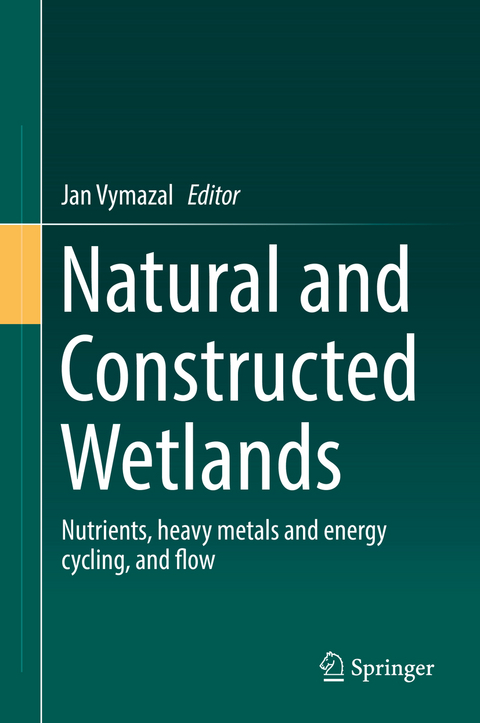
Natural and Constructed Wetlands (eBook)
295 Seiten
Springer International Publishing (Verlag)
978-3-319-38927-1 (ISBN)
The book extends the knowledge on wetland ecosystem services based on the new research. The information combines the achievements gained in carbon sequestration, nutrient accumulation, macrophyte decomposition, wastewater treatment, global warming mitigation in constructed as well as natural wetlands across the globe. The book presents up-to-date results of ongoing research and the content of the book could be used by wetland scientists, researchers, engineers, designers, regulators, decision-makers, universities teachers, landscape engineers and landscape planners as well as by water authorities, water regulatory offices or wastewater treatment research institutions.
Jan Vymazal Czech University of Life Sciences Prague Faculty of Environmental Sciences Prague, Czech Republic
Preface 6
Contents 8
Contributors 12
Chapter 1: Effects of Human Activity on the Processing of Nitrogen in Riparian Wetlands: Implications for Watershed Water Quality 17
1.1 Introduction 18
1.2 Methods 20
1.2.1 Wetland Study Sites 20
1.2.2 Quantifying Anthropogenic Activity Surrounding Wetland Study Sites 21
1.2.3 Field and Laboratory Measurements 25
1.2.3.1 Nitrogen Pools 25
1.2.3.2 Soil Accretion and Carbon Pools 26
1.2.3.3 Hydrologic Metrics 27
1.2.3.4 Data Analysis 27
1.3 Results 28
1.3.1 Nitrogen and Carbon (Soil Properties Important to N Cycling) 29
1.3.2 Hydrology 32
1.4 Summary and Conclusions 35
References 36
Chapter 2: Nutrients Tracking and Removal in Constructed Wetlands Treating Catchment Runoff in Norway 39
2.1 Introduction 40
2.2 Methods 43
2.2.1 Phosphorus Losses from Rural Catchments 43
2.2.2 Phosphorus Losses from On-site Wastewater Treatment Systems 44
2.2.3 Case Study 44
2.2.3.1 Site Description 44
2.2.3.2 Wetland Design 45
2.2.3.3 Source Tracking and Distribution of Pollutants Through the Seasons 46
2.3 Results and Discussion 46
2.3.1 Phosphorus Losses from the Catchments 46
2.3.1.1 Phosphorus Losses from On-site Wastewater Treatment Systems 47
2.3.2 Case Study 48
2.3.2.1 Effect of the Constructed Wetland in the Gryteland Stream 49
2.3.2.2 Faecal Contamination in the Catchment 52
2.4 Conclusions 54
References 55
Chapter 3: Performance of Constructed Wetlands Treating Domestic Wastewater in Norway Over a Quarter of a Century – Options for Nutrient Removal and Recycling 57
3.1 The State of the Art in a Nutshell 58
3.2 General Characteristics and Design Principles 60
3.2.1 Septic Tank 60
3.2.2 Pre-filter/Biofilter 61
3.2.3 Constructed Filter/Wetland Bed 63
3.2.4 Filter Media 64
3.3 Overall Treatment Performance 64
3.4 Recycling Options for Filter Media 66
3.5 Conclusions 69
References 70
Chapter 4: Decomposition of Phragmites australis in Relation to Depth of Flooding 72
4.1 Introduction 73
4.2 Materials and Methods 74
4.3 Results and Discussion 75
4.3.1 Water Chemistry and Water Depth 75
4.3.2 Decomposition of Various Plant Parts 76
4.3.3 Decomposition in Relation to Water Depth 78
4.4 Conclusions 80
References 81
Chapter 5: Distribution of Phosphorus and Nitrogen in Phragmites australis Aboveground Biomass 84
5.1 Introduction 84
5.2 Materials and Methods 85
5.3 Results and Discussion 85
5.3.1 Distribution of Aboveground Biomass of P. australis Between Stems and Leaves 85
5.3.2 Distribution of Phosphorus in Aboveground Biomass 86
5.3.3 Distribution of Nitrogen in Aboveground Biomass 88
5.4 Conclusions 90
References 90
Chapter 6: How Many Samples?! Assessing the Mean of Parameters Important for Denitrification in High and Low Disturbance Headwater Wetlands of Central Pennsylvania 92
6.1 Introduction 93
6.2 Methods 94
6.2.1 Sites 94
6.2.2 Water Quality Analysis 95
6.2.3 Monte Carlo Analysis and Statistical Analyses 95
6.2.4 Literature Review 95
6.3 Results 96
6.4 Discussion 100
6.5 Conclusions 101
References 102
Chapter 7: Indirect and Direct Thermodynamic Effects of Wetland Ecosystems on Climate 106
7.1 Introduction 107
7.2 Solar Energy Striking the Earth’s Surface 107
7.3 Direct Effect of Wetlands on Climate via Evapotranspiration and Other Life Processes 108
7.3.1 Dissolution-Precipitation of Salts 109
7.3.2 Disintegration-Recombination of Water Molecules 110
7.3.3 Evapotranspiration-Condensation 111
7.3.4 Ground Heat Flux and Warming of Biomass 112
7.3.5 Ratio Between the Amount of Energy Bound in Biomass and That Dissipated by Evapotranspiration 112
7.4 Wetland Losses and Consequent Impact on Climate 114
7.5 Indirect Effect of Wetlands on Climate via Greenhouse Gases (GHG) Sink or Source?
7.6 Meaning of Average Temperature in Thermodynamics and the Role of Gradients 117
7.7 Exchange of Water and CO2 in Plant Stands 118
7.8 Surface Temperature Distribution in a Cultural Landscape with Wetlands – An Example 119
7.9 Conclusions 119
References 122
Chapter 8: Application of Vivianite Nanoparticle Technology for Management of Heavy Metal Contamination in Wetland and Linked Mining Systems in Mongolia 124
8.1 Introduction 125
8.2 The Situation 125
8.3 Remediation Options and Recommendations 128
8.4 Conclusions 131
References 131
Chapter 9: Sludge Treatment Reed Beds (STRBs) as a Eco-solution of Sludge Utilization for Local Wastewater Treatment Plants 133
9.1 Introduction 134
9.2 Construction and Design 135
9.3 Operation 137
9.4 Methodology 138
9.4.1 Research Objects 138
9.4.2 Sampling and Analyzes 138
9.5 Results and Disscussion 139
9.5.1 Dry Matter and Organic Matter 139
9.5.2 Nutrients 140
9.5.3 Heavy Metals 141
9.5.4 Pathogenic Microorganisms 141
9.5.5 Hazardous Organic Compounds 142
9.6 Ecological and Economic Aspects of the Integrated Sludge Treatment in STRBs 142
9.7 Conclusions 143
References 143
Chapter 10: Dairy Wastewater Treatment by a Horizontal Subsurface Flow Constructed Wetland in Southern Italy 145
10.1 Introduction 145
10.2 Material and Methods 146
10.3 Results and Discussion 148
10.3.1 Role of Dairy Wastewater on the Mixed Wastewater Composition 148
10.3.2 Start-Up Phase 149
10.3.3 Management Phase 150
10.3.4 Overall Treatment Performance 151
10.4 Conclusions 153
References 153
Chapter 11: Phosphorus Recycling from Waste, Dams and Wetlands Receiving Landfill Leachate – Long Term Monitoring in Norway 154
11.1 Introduction 154
11.2 Results and Discussion 157
11.3 Conclusions 158
References 158
Chapter 12: Application of the NaWaTech Safety and O& M Planning Approach Re-Use Oriented Wastewater Treatment Lines at the Ordnance Factory Ambajhari, Nagpur, India
12.1 Background 161
12.2 Materials and Methods 162
12.2.1 Pilot Systems 162
12.2.2 Safety and O& M Planning
12.3 Results and Discussion 166
12.4 Conclusions 174
References 176
Chapter 13: Clogging Measurement, Dissolved Oxygen and Temperature Control in a Wetland Through the Development of an Autonomous Reed Bed Installation (ARBI) 177
13.1 Introduction 178
13.1.1 General 178
13.1.2 MR Probes for Clogging 179
13.1.3 Heating, Aeration and Step Feeding 179
13.2 Methods 180
13.2.1 Development of MR Sensor for Clog State Measurements 180
13.2.2 Effects of Aeration and Heating on Treatment Wetland Performance 182
13.2.3 Aeration 182
13.2.4 Heating 183
13.2.5 Step Feeding 183
13.3 Results 183
13.3.1 Magnetic Resonance Sensors 183
13.3.2 Unilateral Surface Sensors 183
13.3.3 Helmholtz-Style Permanent Magnet Arrangement 184
13.3.4 Aerated System 185
13.3.5 Heated System 187
13.3.6 Step Feeding 187
13.4 Conclusions 187
References 188
Chapter 14: Constructed Wetlands Treating Municipal and Agricultural Wastewater – An Overview for Flanders, Belgium 190
14.1 Introduction 191
14.1.1 Treatment of Municipal Wastewater 191
14.1.2 Treatment of Agricultural Wastewater 191
14.2 A Database on Constructed Wetlands in Flanders 192
14.2.1 Data Collection 192
14.2.2 Data Processing and Analysis 193
14.3 Location, Number and Types of Constructed Wetlands 194
14.4 Removal of Nutrients from Municipal Wastewater 196
14.4.1 Free Water Surface Wetlands (FWS) 196
14.4.1.1 Nitrogen 197
14.4.1.2 Phosphorus 198
14.4.2 Vertical Flow Systems (VF) 198
14.4.2.1 Nitrogen 199
14.4.2.2 Phosphorus 201
14.4.3 Horizontal Sub-Surface Flow Systems (HSSF) 201
14.4.3.1 Nitrogen 202
14.4.3.2 Phosphorus 203
14.4.4 Combined Wetlands: VF-HSSF 204
14.4.4.1 Nitrogen 205
14.4.4.2 Phosphorus 206
14.4.5 Tertiary Treatment Wetlands: RBC-HSSF and SAF-HSSF 206
14.4.5.1 Nitrogen 208
14.4.5.2 Phosphorus 209
14.5 Agricultural Wastewater N and P Removal 210
14.5.1 Nitrogen 211
14.5.2 Phosphorus 211
14.6 Comparison of the Performance of Constructed Wetlands 212
14.7 Conclusions 216
References 217
Chapter 15: Performance Intensifications in a Hybrid Constructed Wetland Mesocosm 219
15.1 Introduction 220
15.2 Methods and Materials 221
15.2.1 Experimental System 221
15.2.2 Sampling Procedure 226
15.2.3 Wastewater Analysis 226
15.2.4 Statistical Analysis 227
15.3 Results and Discussion 227
15.4 Conclusions and Outlook 232
References 233
Chapter 16: Treatment of Chlorinated Benzenes in Different Pilot Scale Constructed Wetlands 235
16.1 Introduction 236
16.2 Materials and Methods 237
16.2.1 Description of Pilot Scale CWs 237
16.2.2 Sample Collection and Analysis 237
16.2.3 Data Analysis 239
16.3 Results and Discussion 239
16.3.1 MCB Removal 239
16.3.2 DCBs Removal 241
16.3.3 2-Chlorotoluene Removal 243
16.4 Conclusions 244
References 244
Chapter 17: Transformation of Chloroform in Constructed Wetlands 246
17.1 Introduction 247
17.2 Materials and Methods 248
17.2.1 Design and Operation of the SSF CW 248
17.2.2 Sampling Procedure and Analysis of Aqueous, Solid and Gaseous Samples 248
17.3 Results and Discussion 249
17.3.1 Sorption 249
17.3.2 Plant Uptake 250
17.3.3 Volatilization 251
17.3.4 Biodegradation 252
References 253
Chapter 18: Hybrid Constructed Wetlands for the National Parks in Poland – The Case Study, Requirements, Dimensioning and Preliminary Results 255
18.1 Introduction 256
18.2 The Characteristics of Poleski and Roztocza?ski National Parks 257
18.2.1 Roztocza?ski National Park (RPN) 257
18.2.2 Poleski National Park (PNP) 258
18.3 Water and Wastewater Management in the Area of PNP and RNP 258
18.4 The Concept of Hybrid Treatment Wetland Construction for RNP and PNP 259
18.5 Removal Efficiency of HTWs in RNP – Preliminary Results 263
18.5.1 Methods 263
18.6 Results and Discussion 263
18.6.1 Inflow 263
18.6.1.1 TSS 263
18.6.1.2 BOD5 and COD 265
18.6.1.3 Total Nitrogen 265
18.6.1.4 Total Phosphorus 265
18.6.2 Outflow 266
18.6.2.1 TSS 266
18.6.2.2 BOD5 and COD 266
18.6.2.3 Total Nitrogen 266
18.6.2.4 Total Phosphorus 266
18.7 Efficiency of Organic Matter and Biogenic Compounds Removal 267
18.7.1 Efficiency of Microbiological Contamination Removal 268
18.8 Conclusions 269
18.8.1 General 269
18.8.2 Detailed 270
References 271
Chapter 19: Global Warming: Confusion of Cause with Effect? 274
19.1 Introduction 274
19.2 Water and the Global Energy Budget 275
19.3 From Global to Local Scale 276
19.4 Global Warming: Confusion of Cause with Effect? 278
19.5 Sustainable Water Management – Case Studies 281
19.5.1 Case Study 1: UFA-Fabrik in Berlin-Tempelhof 281
19.5.2 Case Study 2: DCI Berlin, Potsdamer Platz 284
19.6 Conclusion 286
References 287
Chapter 20: Abundance and Diversity of Taxa Within the Genus Potamogeton in Slovenian Watercourses 289
20.1 Introduction 289
20.2 Materials and Methods 290
20.2.1 Study Area 290
20.2.2 Macrophyte Survey 290
20.2.3 Environment Assessment 291
20.2.4 Statistical Analysis 291
20.3 Results and Discussion 291
20.4 Conclusions 296
References 296
Index 298
| Erscheint lt. Verlag | 26.8.2016 |
|---|---|
| Zusatzinfo | XV, 295 p. 124 illus., 55 illus. in color. |
| Verlagsort | Cham |
| Sprache | englisch |
| Themenwelt | Naturwissenschaften ► Biologie ► Ökologie / Naturschutz |
| Technik | |
| Schlagworte | Agricultural runoff • Constructed wetlands • Decomposition of macrophyte biomass • Eutrophicated fishponds • Landfill leachate • Nitrogen processing • nutrient cycling • Organic micropollutants • Riparian wetlands • Vivianite nanoparticle technology • Wastewater Treatment • Water Quality and Water Pollution |
| ISBN-10 | 3-319-38927-0 / 3319389270 |
| ISBN-13 | 978-3-319-38927-1 / 9783319389271 |
| Informationen gemäß Produktsicherheitsverordnung (GPSR) | |
| Haben Sie eine Frage zum Produkt? |
 PDF (Wasserzeichen)
DRM: Digitales Wasserzeichen
Dieses eBook enthält ein digitales Wasserzeichen und ist damit für Sie personalisiert. Bei einer missbräuchlichen Weitergabe des eBooks an Dritte ist eine Rückverfolgung an die Quelle möglich.
Dateiformat: PDF (Portable Document Format)
Mit einem festen Seitenlayout eignet sich die PDF besonders für Fachbücher mit Spalten, Tabellen und Abbildungen. Eine PDF kann auf fast allen Geräten angezeigt werden, ist aber für kleine Displays (Smartphone, eReader) nur eingeschränkt geeignet.
Systemvoraussetzungen:
PC/Mac: Mit einem PC oder Mac können Sie dieses eBook lesen. Sie benötigen dafür einen PDF-Viewer - z.B. den Adobe Reader oder Adobe Digital Editions.
eReader: Dieses eBook kann mit (fast) allen eBook-Readern gelesen werden. Mit dem amazon-Kindle ist es aber nicht kompatibel.
Smartphone/Tablet: Egal ob Apple oder Android, dieses eBook können Sie lesen. Sie benötigen dafür einen PDF-Viewer - z.B. die kostenlose Adobe Digital Editions-App.
Buying eBooks from abroad
For tax law reasons we can sell eBooks just within Germany and Switzerland. Regrettably we cannot fulfill eBook-orders from other countries.
aus dem Bereich