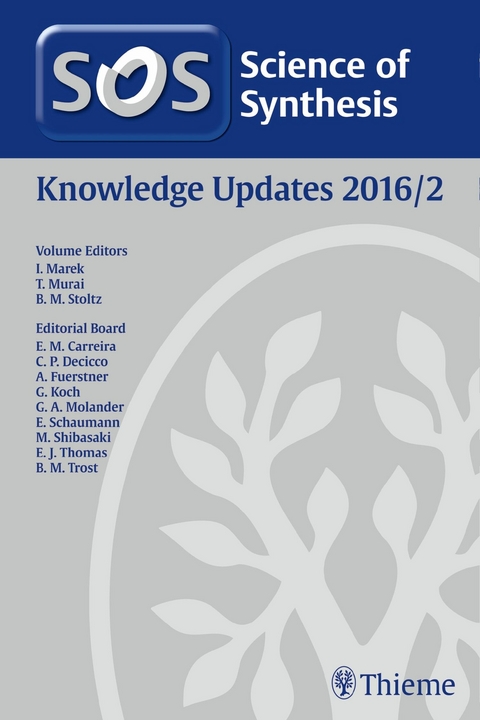
Science of Synthesis Knowledge Updates: 2016/2 (eBook)
Thieme (Verlag)
978-3-13-220901-5 (ISBN)
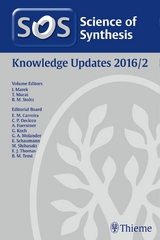
Science of Synthesis: Knowledge Updates 2016/2 1
Title Page 6
Copyright 8
Preface 9
Abstracts 11
Science of Synthesis Knowledge Updates 2016/2 19
Table of Contents 21
1.2.7 Radical-Based Palladium-Catalyzed Bond Constructions 35
1.2.7.1 Method 1: Reactions Involving Palladium(I) Species 35
1.2.7.1.1 Variation 1: Synthesis of Organometallic Palladium(I) Complexes 35
1.2.7.1.2 Variation 2: Reactions Involving Palladium(I) Precatalysts 42
1.2.7.1.3 Variation 3: Cross-Coupling Reactions 50
1.2.7.1.4 Variation 4: Carbonylation Reactions 61
1.2.7.1.5 Variation 5: Cyclization Reactions 76
1.2.7.1.6 Variation 6: Atom-Transfer Reactions 82
1.2.7.2 Method 2: Reactions Involving Palladium(III) Species 96
1.2.7.2.1 Variation 1: Synthesis of Organometallic Palladium(III) Complexes 96
1.2.7.2.2 Variation 2: C—H Activation Reactions Involving Palladium(III) 106
1.2.7.2.3 Variation 3: C—F Bond-Constructing Reactions Involving Palladium(III) 113
1.2.7.2.4 Variation 4: Reactions Involving Phenyl or Benzoyl Radicals 116
1.2.7.2.5 Variation 5: Asymmetric Aza-Claisen Rearrangements 126
1.2.7.3 Method 3: Reactions Involving Palladium(I) and Palladium(III) Species 129
1.2.7.4 Method 4: Miscellaneous Reactions 132
2.11.15 C(sp3)—H Functionalization by Allylic C—H Activation of Zirconocene Complexes 147
2.11.15.1 Method 1: Synthesis of Conjugated Dienes from Nonconjugated Dienes 152
2.11.15.1.1 Variation 1: From Nonheteroatom-Substituted Alkenes 152
2.11.15.1.2 Variation 2: From Nonconjugated Dienes Bearing an Alkoxy Substituent 153
2.11.15.2 Method 2: Synthesis of Trienes 156
2.11.15.3 Method 3: Synthesis of Homoallylic Alcohols 157
2.11.15.3.1 Variation 1: From Acid Chlorides without Ligand Exchange 157
2.11.15.3.2 Variation 2: From Acid Chlorides with Ligand Exchange 158
2.11.15.3.3 Variation 3: From Aldehydes without Ligand Exchange 160
2.11.15.3.4 Variation 4: From Aldehydes with Ligand Exchange 162
2.11.15.4 Method 4: Diastereoselective Synthesis of Homoallylic Amines 163
2.11.15.5 Method 5: Diastereoselective Synthesis of 1,4-Homoallylic Diols 164
2.11.15.5.1 Variation 1: From Grignard Reagents 164
2.11.15.5.2 Variation 2: From Terminal Alkenes 166
2.11.15.6 Method 6: Synthesis of 1,2-Disubstituted Cyclopropanols 167
2.11.15.7 Method 7: Synthesis of Substituted Allylic Derivatives from Unsaturated Fatty Alcohols 167
2.11.15.8 Method 8: Selective Reduction of the Double Bond of ?-Ene Dihydrofurans and Dihydropyrans 169
2.11.15.9 Method 9: Synthesis of Acyclic Fragments Possessing an All-Carbon Quaternary Stereogenic Center 170
2.11.15.9.1 Variation 1: From ?-Ene Cyclopropanes 170
2.11.15.9.2 Variation 2: From Alkylidenecyclopropanes 173
2.11.15.9.3 Variation 3: From ?-Alkenylcyclopropanes Bearing a Leaving Group 176
2.11.16 Synthesis and Reactivity of Heteroatom-Substituted Vinylzirconocene Derivatives and Hetarylzirconocenes 181
2.11.16.1 General Preparation of Vinylzirconocene Derivatives 182
2.11.16.2 General Reactivity of Vinylzirconocene Derivatives 184
2.11.16.3 Preparation of Vinylzirconocene Derivatives from Heteroatom-Substituted Alkenes 185
2.11.16.3.1 Method 1: From Alkenyl Halides 186
2.11.16.3.2 Method 2: From Aryl Halides 188
2.11.16.3.3 Method 3: From Enol Sulfonates 192
2.11.16.3.4 Method 4: From Enol Ethers and Silyl Enol Ethers 194
2.11.16.3.5 Method 5: From Sulfides, Sulfoxides, and Sulfones 196
2.11.16.3.6 Method 6: From Carbamates 200
2.11.16.3.7 Method 7: From Dienyl Systems 202
2.12.17 The Role of Solvents and Additives in Reactions of Samarium(II) Iodide and Related Reductants 211
2.12.17.1 Synthesis of Samarium(II) Reductants 211
2.12.17.1.1 Samarium(II) Iodide 212
2.12.17.1.1.1 Method 1: Synthesis in Tetrahydrofuran from Samarium and 1,2-Diiodoethane 212
2.12.17.1.1.2 Method 2: Synthesis in Tetrahydrofuran from Samarium and Iodine 213
2.12.17.1.1.3 Method 3: Synthesis in Tetrahydropyran 215
2.12.17.1.1.4 Method 4: Synthesis in 1,2-Dimethoxyethane 215
2.12.17.1.1.5 Method 5: Synthesis in Acetonitrile and Other Nitriles 215
2.12.17.1.1.6 Method 6: Synthesis in Benzene/Hexamethylphosphoric Triamide 217
2.12.17.1.2 Samarium(II) Bromide and Samarium(II) Chloride 217
2.12.17.1.2.1 Method 1: Synthesis of Samarium(II) Bromide from Samarium(III) Oxide and Hydrobromic Acid 218
2.12.17.1.2.2 Method 2: Synthesis of Samarium(II) Bromide from Samarium and 1,1,2,2-Tetrabromoethane 218
2.12.17.1.2.3 Method 3: Synthesis of Samarium(II) Bromide from Samarium(II) Iodide and Lithium Bromide 219
2.12.17.1.2.4 Method 4: Synthesis of Samarium(II) Chloride from Samarium(III) Chloride 219
2.12.17.1.2.5 Method 5: Synthesis of Samarium(II) Chloride from Samarium(II) Iodide and Lithium Chloride 220
2.12.17.1.2.6 Method 6: Synthesis of Samarium(II) Chloride in Water from Samarium(III) Chloride and Samarium 220
2.12.17.1.3 Samarium(II) Trifluoromethanesulfonate 221
2.12.17.1.3.1 Method 1: Synthesis from Samarium(III) Trifluoromethanesulfonate, Samarium Metal, and Ethylmagnesium Bromide 221
2.12.17.1.3.2 Method 2: Synthesis from Samarium(III) Trifluoromethanesulfonate and sec-Butyllithium 221
2.12.17.1.3.3 Method 3: Synthesis from Samarium Metal and 1,5-Dithioniabicyclo[ 3.3.0]octane Bis(trifluoromethanesulfonate) 222
2.12.17.1.3.4 Method 4: Mercury-Catalyzed Reduction of Samarium(III) Trifluoromethanesulfonate 223
2.12.17.1.3.5 Method 5: Synthesis from Samarium(III) Trifluoromethanesulfonate and Samarium Metal 223
2.12.17.1.4 Samarium(II) Amides 224
2.12.17.1.5 (?5-Cyclopentadienyl)samarium(II) Complexes 224
2.12.17.1.5.1 Method 1: Synthesis of Bis(?5-cyclopentadienyl)samarium(II) 225
2.12.17.1.5.2 Method 2: Synthesis of Bis(?5-pentamethylcyclopentadienyl) samarium(II) 225
2.12.17.2 Use of Lewis Bases in Samarium(II)-Based Reactions 225
2.12.17.2.1 Hexamethylphosphoric Triamide 226
2.12.17.2.1.1 Method 1: Reduction of Alkyl and Aryl Halides 226
2.12.17.2.1.2 Method 2: Reduction of ?-Oxygenated Carbonyl Compounds 226
2.12.17.2.1.3 Method 3: Reduction of 4-Methylbenzoates 228
2.12.17.2.1.4 Method 4: Grignard and Barbier Reactions 229
2.12.17.2.1.4.1 Variation 1: Intermolecular Samarium Grignard Reactions 230
2.12.17.2.1.4.2 Variation 2: Intermolecular Samarium Barbier Reactions 231
2.12.17.2.1.4.3 Variation 3: Intramolecular Samarium Barbier Reactions 234
2.12.17.2.1.5 Method 5: Reformatsky- and Aldol-Type Reactions 234
2.12.17.2.1.6 Method 6: Halide–Alkene Coupling Reactions 235
2.12.17.2.1.7 Method 7: Spirocyclization via Intramolecular Aryl Iodide Radical Addition 236
2.12.17.2.1.8 Method 8: Carbonyl–Alkene Coupling 237
2.12.17.2.1.8.1 Variation 1: Intramolecular Cyclization of Unactivated Alkenyl Ketones 237
2.12.17.2.1.8.2 Variation 2: Sequential Intramolecular Cyclization with Intermolecular Electrophilic Addition 238
2.12.17.2.1.8.3 Variation 3: Intermolecular Ketone–Allene Coupling 239
2.12.17.2.1.8.4 Variation 4: Sequential Intramolecular Cyclization with Electrophilic Addition to 1H-Indole Derivatives 239
2.12.17.2.1.9 Method 9: Intramolecular Pinacol Coupling of Carbonyl Compounds 240
2.12.17.2.1.10 Method 10: Intramolecular Pinacol-Type Coupling of Ketones and Imines 241
2.12.17.2.1.11 Method 11: Tandem Epoxide-Opening/Cyclization To Afford ?-Lactones 242
2.12.17.2.1.12 Method 12: Tandem Elimination and Coupling of Aliphatic Imides with Carbonyl Compounds 243
2.12.17.2.1.13 Method 13: Intermolecular and Intramolecular Reductive Dimerization 244
2.12.17.2.2 Additives Related to Hexamethylphosphoric Triamide 245
2.12.17.2.2.1 Method 1: Tri(pyrrolidin-1-yl)phosphine Oxide in Reductive Coupling Reactions 246
2.12.17.2.2.2 Method 2: N-Methyl-P,P-di(pyrrolidin-1-yl)phosphinic Amide in Reductive Cyclization Reactions 246
2.12.17.2.2.3 Method 3: Hydroxylated Hexamethylphosphoric Triamide in Reductive Coupling Reactions 247
2.12.17.3 Use of Proton Donors in Samarium(II)-Based Reactions 248
2.12.17.3.1 Water 248
2.12.17.3.1.1 Method 1: Reduction of Alkyl Iodides 248
2.12.17.3.1.2 Method 2: Reduction of Aromatic Carboxylic Acids, Esters, Amides, and Nitriles 249
2.12.17.3.1.3 Method 3: Reduction of Azido Oligosaccharides to Amino Sugars 250
2.12.17.3.1.4 Method 4: Reduction of Six-Membered Lactones 251
2.12.17.3.1.5 Method 5: Reduction of Cyclic Esters 252
2.12.17.3.1.6 Method 6: Reductive Cyclization of Lactones 253
2.12.17.3.1.7 Method 7: Reduction of Sodium S-Alkyl Thiosulfates and Alkyl Thiocyanates 254
2.12.17.3.1.8 Method 8: Reduction of Cyclic 1,3-Diesters 255
2.12.17.3.1.9 Method 9: Cross Coupling of N-Acyloxazolidinones to Acrylamides and Acrylates 256
2.12.17.3.1.10 Method 10: Coupling To Produce ?,?-Disubstituted Pyrrolidin-2-ylmethanols 257
2.12.17.3.1.11 Method 11: Reductive Coupling of Nitrones and Acrylates 257
2.12.17.3.2 Water and Amines 258
2.12.17.3.2.1 Method 1: Reduction of Ketones 259
2.12.17.3.2.2 Method 2: Reduction of ?-Hydroxy Ketones 259
2.12.17.3.2.3 Method 3: Reduction of Alkyl Halides 260
2.12.17.3.2.4 Method 4: Reduction of Double and Triple Bonds in Conjugated Alkenes 261
2.12.17.3.2.5 Method 5: Deprotection of Allyl Ether Protected Alcohols 262
2.12.17.3.2.6 Method 6: Deprotection of Toluenesulfonamides 263
2.12.17.3.2.7 Method 7: Reduction of Nitroalkanes 264
2.12.17.3.2.8 Method 8: Reductive Cleavage of Benzyl–Heteroatom Bonds 265
2.12.17.3.2.9 Method 9: Reduction of Nitriles 266
2.12.17.3.2.10 Method 10: Reduction of Unactivated Esters 267
2.12.17.3.2.11 Method 11: Reduction of Amides to Alcohols 269
2.12.17.3.2.12 Method 12: Reduction of Carboxylic Acids to Alcohols 270
2.12.17.3.2.13 Method 13: Intramolecular Coupling of Aryl Iodides with Alkenyl and Alkynyl Groups 271
2.12.17.3.3 Methanol 272
2.12.17.3.3.1 Method 1: Stereoselective Reduction of ?-Hydroxy Ketones to anti- 1,3-Diols 272
2.12.17.3.3.2 Method 2: Reductive Cyclization of ?-Halo ?,?-Unsaturated Esters 272
2.12.17.3.3.3 Method 3: Ring Expansion of Alkyl (n + 1)-Oxobicyclo[n.1.0]alkane- 1-carboxylates 273
2.12.17.3.3.4 Method 4: Cyclization of ?,?-Unsaturated Ketones To Afford syn-Cyclopentanols 274
2.12.17.3.4 tert-Butyl Alcohol 275
2.12.17.3.4.1 Method 1: Reductive Cyclization of Carbodiimides to Indolin-2-amines 275
2.12.17.3.4.2 Method 2: Cross Coupling of Chiral N-(tert-Butylsulfinyl)imines with Aldehydes 276
2.12.17.3.5 Glycols 277
2.12.17.3.5.1 Method 1: Synthesis of Uracils 277
2.12.17.3.6 2-(Dimethylamino)ethanol 278
2.12.17.3.6.1 Method 1: Reductive Ring Opening of Aziridine-2-carboxylates and Aziridine- 2-carboxamides to ?-Amino Esters and Amides 278
2.12.17.3.6.2 Method 2: Simple Functional Group Reductions Using Samarium(II) Iodide/2-(Dimethylamino)ethanol 279
2.12.17.4 Use of Inorganic Additives in Samarium(II)-Based Reactions 280
2.12.17.4.1 Transition-Metal Additives 281
2.12.17.4.1.1 Method 1: Carbonyl–Alkene Coupling Reactions 281
2.12.17.4.1.2 Method 2: Barbier Coupling Reactions 283
2.12.17.4.2 LithiumHalide Salts 284
2.12.17.4.2.1 Method 1: Intramolecular Coupling of Isocyanates and Cyclic ?,?-Unsaturated Ketones 284
2.12.17.4.2.2 Method 2: Cross Coupling of Nitrones with Allenoates 285
2.12.17.5 Impact of Solvents on Reactivity in Samarium-Mediated Reductions and Coupling Reactions 286
2.12.17.5.1 Coordinating Solvents (Other than Tetrahydrofuran) 286
2.12.17.5.1.1 Method 1: Coupling of Ketones with Acid Chlorides in Tetrahydropyran 286
2.12.17.5.1.2 Method 2: Coupling of Allylic and Benzylic Samarium Compounds with Ketones and Esters in Tetrahydropyran 287
2.12.17.5.1.3 Method 3: Reduction of ?-Hydroxy Ketones in 1,2-Dimethoxyethane 288
2.12.17.5.1.4 Method 4: Reductive Intramolecular Ketyl–Alkene Coupling in Acetonitrile 289
2.12.17.5.1.5 Method 5: 2,3-Wittig Rearrangement by Partial Reduction of Diallyl Acetals in Acetonitrile 290
2.12.17.5.1.6 Method 6: Coupling of ?-Chloro ?,?-Unsaturated Aryl Ketones to Aldehydes in Acetonitrile 291
2.12.17.5.1.7 Method 7: Coupling of Carbonyls in Pivalonitrile 291
2.12.17.5.2 Non-coordinating Solvents 293
2.12.17.5.2.1 Method 1: Barbier-Type Coupling of Aryl Halides and Ketones in Benzene/Hexamethylphosphoric Triamide 293
2.12.17.5.2.2 Method 2: Coupling of Iodoalkynes and Carbonyl Compounds in Benzene/Hexamethylphosphoric Triamide 294
2.12.17.5.2.3 Method 3: Reduction of Dithioacetals to Sulfides in Benzene/Hexamethylphosphoric Triamide 295
2.12.17.5.2.4 Method 4: Reductive Defluorination in Hexane 295
30.1.3 Carbohydrate Derivatives (Including Nucleosides) 301
30.1.3.1 Glycosyl Asparagine Derivatives 302
30.1.3.1.1 Method 1: Synthesis from Glycosyl Imidates 302
30.1.3.1.2 Method 2: Synthesis from Pent-4-enyl Glycosides 304
30.1.3.1.3 Method 3: Synthesis from Thioglycosides 305
30.1.3.1.4 Method 4: Synthesis from Glycals 306
30.1.3.1.4.1 Variation 1: Other C—N Bonds from Glycals 309
30.1.3.1.5 Method 5: Synthesis from Glycosyl Halides 309
30.1.3.1.6 Method 6: Synthesis from Glycosyl Isothiocyanates 310
30.1.3.1.7 Method 7: Synthesis from N-Glycosyl Hydroxylamines 311
30.1.3.1.8 Method 8: Synthesis from Glycosyl Azides 312
30.1.3.2 Ribonucleosides 313
30.1.3.2.1 Method 1: Synthesis from Glycosyl Acetates 314
30.1.3.2.2 Method 2: Synthesis from Glycosyl Halides 316
30.1.3.2.3 Method 3: Synthesis from Glycosyl Imidates 317
30.1.3.2.4 Method 4: Synthesis from Thioglycosides 319
30.1.3.2.5 Method 5: Synthesis from Glycosyl 2-Alk-1-ynylbenzoates 320
30.1.3.2.6 Method 6: Synthesis from Glycosylamines 321
30.1.3.3 2-Deoxyribonucleosides 321
30.1.3.3.1 Method 1: Synthesis from Glycosyl Halides 321
30.1.3.3.2 Method 2: Synthesis from Thioglycosides 322
30.1.3.4 Other Deoxyfuranosides 324
30.1.3.4.1 Method 1: Synthesis from Glycals 324
30.1.3.4.2 Method 2: Synthesis from Thioglycosides 325
30.2.3 O,P-Acetals (Update 2016) 329
30.2.3.1 Method 1: Addition of Phosphorus Compounds to Ketones or Aldehydes 329
30.2.3.1.1 Variation 1: Diastereoselective Hydrophosphonylation 335
30.2.3.1.2 Variation 2: Enantioselective, Metal-Catalyzed Addition of Phosphites to Aldehydes (Pudovik Reaction) 337
30.2.3.1.3 Variation 3: Enantioselective, Organocatalyzed Addition of Phosphites to Aldehydes (Pudovik Reaction) 341
30.2.3.1.4 Variation 4: Enantioselective, Metal-Catalyzed Addition of Phosphites to Ketones (Pudovik Reaction) 345
30.2.3.1.5 Variation 5: Enantioselective, Organocatalyzed Addition of Phosphites to Ketones (Pudovik Reaction) 346
30.2.3.2 Method 2: Kinetic Resolution of ?-Hydroxy Phosphonates 347
30.2.3.3 Method 3: Oxidation of ?,?-Unsaturated Phosphorus Compounds 348
30.2.3.4 Method 4: Addition of Phosphorus Compounds to O,O-Acetals 349
30.2.3.5 Method 5: Reduction/Hydrogenation 350
30.2.3.6 Method 6: Aldol-Type Reactions and Other Reactions Using Carbon Nucleophiles 354
30.3.1.3 Acyclic S,S-Acetals (Update 2016) 363
30.3.1.3.1 Method 1: Thioacetalization of Carbonyl Compounds 363
30.3.1.3.1.1 Variation 1: With Metal Salt Based Lewis Acid Catalysts 363
30.3.1.3.1.2 Variation 2: With Non-Metal Lewis Acid Catalysts 367
30.3.1.3.1.3 Variation 3: With Solid-Supported Lewis Acid Catalysts 369
30.3.1.3.1.4 Variation 4: With Solid Acid Catalysts 372
30.3.1.3.1.5 Variation 5: In Micelles 374
30.3.1.3.1.6 Variation 6: Without Acid Catalysis 374
30.3.1.3.2 Method 2: Conversion of O,O-Acetals 375
30.3.1.3.2.1 Variation 1: In Micelles 375
30.3.1.3.2.2 Variation 2: With Odorless Thiol Equivalents 376
30.3.1.3.3 Method 3: Addition of Thiols to C—C Multiple Bonds 377
30.3.1.3.3.1 Variation 1: Addition to Propargyl Alcohols 377
30.3.1.3.3.2 Variation 2: Addition to Allenes 378
30.3.1.3.3.3 Variation 3: Addition to Alkynes 379
30.3.1.3.4 Method 4: Addition of Disulfides to Methylenecyclopropanes 381
30.3.1.3.5 Method 5: Ring Opening of 1,2-Cyclopropanated 3-Oxo Sugars with Thiols 382
30.3.6.3 Acyclic and Cyclic S,S-Acetal S-Oxides and S,S¢-Dioxides (Update 2016) 385
30.3.6.3.1 Synthesis of Acyclic and Cyclic S,S-Acetal S-Oxides and S,S'-Dioxides 385
30.3.6.3.1.1 Method 1: Reactions of ?-Sulfanyl ?-Sulfinyl Carbanions 385
30.3.6.3.1.1.1 Variation 1: Monoalkylation with Alkyl or Hetaryl Halides, Epoxides, or Enones 385
30.3.6.3.1.1.2 Variation 2: Condensation with Carbonyl Compounds 386
30.3.6.3.1.2 Method 2: Oxidation Reactions 388
30.3.6.3.1.2.1 Variation 1: Oxidation of S,S-Acetals 388
30.3.6.3.1.2.2 Variation 2: Oxidation of Ketene S,S-Acetals 390
30.3.6.3.1.2.3 Variation 3: Oxidation of ?-Sulfanyl Vinyl Sulfenates 392
30.3.6.3.1.3 Method 3: Addition of S,S-Acetal S,S'-Dioxides to Carbonyl Compounds 394
30.3.6.3.1.4 Method 4: Conjugate Addition to Ketene S,S-Acetal S-Oxides and S,S'-Dioxides 395
30.3.6.3.1.6 Method 6: Cross-Coupling of Ketene S,S-Acetal S-Oxides 400
30.3.6.3.2 Applications of Acyclic and Cyclic S,S-Acetal S-Oxides and S,S'-Dioxides in Organic Synthesis 401
30.3.6.3.2.1 Method 1: Synthesis of Aldehydes from S,S-Acetal S,S'-Dioxides 401
30.3.6.3.2.2 Method 2: Synthesis of Carboxylic Acid Derivatives from S,S-Acetal S,S'-Dioxides 402
30.3.6.3.2.3 Method 3: Synthesis of ?-Amino Acid Derivatives 404
30.3.6.3.2.4 Method 4: Synthesis of Heteroaromatic Compounds 405
30.3.6.3.2.5 Method 5: Miscellaneous Reactions of S,S-Acetal S-Oxides and S,S-Acetal S,S'-Dioxides 408
30.5.6 Selenium- and Tellurium-Containing Acetals (Update 2016) 413
30.5.6.1 S,Se- and S,Te-Acetals 413
30.5.6.1.1 Method 1: Reaction between Selenium Dihalides and Divinyl Sulfide or Divinyl Sulfone 413
30.5.6.1.2 Method 2: Selanylation–Deselanylation Process To Introduce a C=C Bond 414
30.5.6.1.3 Method 3: Electrochemical Fluoroselanylation of Vinyl Sulfones 415
30.5.6.2 Se,Se- and Se,Te-Acetals 416
30.5.6.2.1 Method 1: Palladium-Catalyzed Double Hydroselanylation of Alkynes 416
30.5.6.2.2 Method 2: Lewis Acid Catalyzed Conversion of Methylenecyclopropanes into 1,1-Bis(organoselanyl)cyclobutanes 417
30.5.6.2.3 Method 3: Indium/Chlorotrimethylsilane Promoted Selenoacetalization of Aldehydes Using Diorganyl Diselenides 418
30.5.6.2.4 Method 4: Diselanylation of Dihaloalkanes with 1-(Organoselanyl)perfluoroalkanols 418
30.5.6.2.5 Method 5: Diselanylation of Dihaloalkanes Using Selenolate Anions 419
30.5.6.3 Te,Te-Acetals 420
30.5.6.3.1 Method 1: In Situ Generation and Reaction of Tellurocarbamates with Dihaloalkanes 420
30.5.6.4 Se,N-Acetals 421
30.5.6.4.1 Method 1: Phosphoric Acid Catalyzed Addition of Benzeneselenol to an N-Acylimine 421
30.5.6.4.2 Method 2: 1,3-Dipolar Cycloaddition Reactions between Azidomethyl Aryl Selenides and Alkynes (Click Reactions) 421
30.5.6.4.3 Method 3: Base-Promoted Selanylation Using Se-[2-(Trimethylsilyl)ethyl] 4-Methylbenzoselenoate 423
30.5.6.4.4 Method 4: Synthesis of 4'-Selenonucleosides by Pummerer Condensation 424
30.5.6.4.5 Method 5: Synthesis of 3'-Azido-4'-selenonucleosides and Related Derivatives 428
30.5.6.4.6 Method 6: [2 + 2] Cyclization of S,Se-Diphenyl Carbonimidoselenothioates with Ketene Equivalents 430
30.5.6.4.7 Method 7: Reactions of Selenoamide Dianions with N,N-Disubstituted Thio- or Selenoformamides 431
30.5.6.4.8 Method 8: Photoinduced Di-?-methane Rearrangement of 3-(Organoselanyl)- 5H-2,5-methanobenzo[f][1,2]thiazepine 1,1-Dioxide 432
30.5.6.4.9 Method 9: Decarboxylative Selanylation of Acids 432
30.5.6.4.10 Method 10: Base-Promoted Alkylation of ?-Selanyl Nitroalkanes 433
30.5.6.4.11 Method 11: Reaction of Bromoalkanes with Selenium/Sodium Borohydride 433
30.5.6.4.12 Method 12: Selanylation of (Chloromethyl)benzotriazoles 434
30.5.6.4.13 Method 13: Synthesis of (Arylselanyl)methyl-Functionalized Imidazolium Ionic Liquids 434
30.5.6.4.14 Method 14: Application of N-[(Phenylselanyl)methyl]phthalimide as a Reagent for Protecting Alcohols as Phthalimidomethyl Ethers 434
30.5.6.5 Se,P- and Te,P-Acetals 435
30.5.6.5.1 Method 1: Diels–Alder Reaction of Selenoaldehydes and Phosphole Chalcogenides 435
30.5.6.5.2 Method 2: Michaelis–Arbuzov Reaction of Chloromethyl Phenyl Selenide 436
30.5.6.5.3 Method 3: Reaction between a Phosphorylmethyl 4-Toluenesulfonate and Sodium Selenide or Telluride 436
30.5.6.5.4 Method 4: Base-Promoted Reaction between Bis[(diphenylphosphoryl) methyl] Telluride and Chalcones 437
30.7.3 N,P- and P,P-Acetals (Update 2016) 441
30.7.3.1 N,P-Acetals 441
30.7.3.1.1 Synthesis of N,P-Acetals 441
30.7.3.1.1.1 Method 1: Cross Dehydrogenative Coupling of Amines and Phosphonates 441
30.7.3.1.1.1.1 Variation 1: Using a Copper Catalyst under an Oxygen Atmosphere 442
30.7.3.1.1.1.2 Variation 2: Using an Iron Catalyst and tert-Butyl Hydroperoxide as Co-oxidant 442
30.7.3.1.1.2 Method 2: Aldehyde-Induced C—H Substitution with Phosphine Oxides 443
30.7.3.1.1.3 Method 3: Electrophilic Amination 444
30.7.3.1.1.4 Method 4: Aldehyde-Induced Decarboxylative Coupling of ?-Amino Acids and Phosphonates 445
30.7.3.1.1.4.1 Variation 1: Using Copper/N,N-Diisopropylethylamine Catalyst 446
30.7.3.1.1.4.2 Variation 2: Without Catalyst 447
30.7.3.1.1.5 Method 5: Substitution of ?-Hydroxyphosphonates with Amines 447
30.7.3.1.1.5.1 Variation 1: Under Microwave Irradiation 448
30.7.3.1.1.5.2 Variation 2: Using Trifluoromethanesulfonic Acid 448
30.7.3.1.1.6 Method 6: Substitution of ?-Amido Sulfones with Organophosphorus Compounds 449
30.7.3.1.1.7 Method 7: Substitution of Dichloromethane with Tertiary Amines and Organophosphorus Compounds 450
30.7.3.1.1.8 Method 8: Asymmetric Hydrogenation of ?-Enamido Phosphonates 451
30.7.3.1.1.9 Method 9: Reduction of ?-Iminophosphonates 452
30.7.3.1.1.10 Method 10: 1,4-Addition of Aryltrifluoroborates to a-Enamido Phosphonates 453
30.7.3.1.1.11 Method 11: Addition of Carbon Nucleophiles to ?-Iminophosphonates 454
30.7.3.1.1.11.1 Variation 1: Using Terminal Alkynes 454
30.7.3.1.1.11.2 Variation 2: Using Pyruvonitrile 455
30.7.3.1.1.12 Method 12: Hydrophosphorylation of Imines (Pudovik Reaction) 456
30.7.3.1.1.12.1 Variation 1: Using a Chiral Aluminum–Salalen Catalyst 457
30.7.3.1.1.12.2 Variation 2: Using a Chiral Tethered Bis(quinolin-8-olato)aluminum Catalyst 458
30.7.3.1.1.12.3 Variation 3: Using Cinchona Alkaloid Catalysts 459
30.7.3.1.1.12.4 Variation 4: Using a Chiral Copper Catalyst 460
30.7.3.1.1.12.5 Variation 5: Using a Chiral Auxiliary 461
30.7.3.1.1.13 Method 13: Three-Component Coupling Reaction of Amines, Carbonyl Compounds, and Phosphonates (Kabachnik–Fields Reaction) 462
30.7.3.1.1.13.1 Variation 1: Using a Magnesium Perchlorate Catalyst 462
30.7.3.1.1.13.2 Variation 2: Using a Chiral Phosphoric Acid Catalyst 463
30.7.3.1.1.14 Method 14: Reductive Phosphorylation of Amides 465
30.7.3.1.1.15 Method 15: Hydroamination and Hydrophosphorylation of Alkynes 465
30.7.3.1.1.16 Method 16: Asymmetric Isomerization of ?-Iminophosphonates 467
30.7.3.1.1.17 Method 17: Consecutive Reaction of Methyleneaziridines with Organomagnesium Chlorides, Organic Bromides, and Phosphonates 468
30.7.3.1.1.18 Method 18: Three-Component Coupling of ?-Diazophosphonates, Anilines, and Aldehydes 469
30.7.3.1.2 Applications of N,P-Acetals in Organic Synthesis 470
30.7.3.1.2.1 Method 1: Horner–Wadsworth–Emmons Alkenation 470
30.7.3.1.2.2 Method 2: Intramolecular Hydroamination of ?-Aminophosphonates Possessing an Alkynyl Group 471
30.7.3.1.2.2.1 Variation 1: Via 5-exo-dig Cyclization Using a Palladium Catalyst 472
30.7.3.1.2.2.2 Variation 2: Via 6-endo-dig Cyclization Using a Silver Catalyst 472
30.7.3.1.2.3 Method 3: [3 + 2] Cycloaddition with Alkenes 473
30.7.3.2 P,P-Acetals 474
30.7.3.2.1 Synthesis of P,P-Acetals 475
30.7.3.2.1.1 Method 1: Consecutive Phosphorylation of Carbanions 475
30.7.3.2.1.2 Method 2: Phosphorylation of ?-Phosphoryl Carbanions 476
30.7.3.2.1.2.1 Variation 1: Generated from Alkylphosphonates 476
30.7.3.2.1.2.2 Variation 2: Via Phospha-Claisen Condensation 477
30.7.3.2.1.2.3 Variation 3: Generated from Phosphine Sulfides 478
30.7.3.2.1.2.4 Variation 4: Generated from Phosphine–Boranes 480
30.7.3.2.1.3 Method 3: Synthesis from ?-Chloroalkylphosphonates, Organoboranes, and Chlorophosphines 480
30.7.3.2.1.4 Method 4: Substitution of ?-Silylphosphines with Chlorophosphines 482
30.7.3.2.1.5 Method 5: Consecutive Substitution of Dihaloalkanes with Organophosphorus Nucleophiles 483
30.7.3.2.1.5.1 Variation 1: Using Phosphides 483
30.7.3.2.1.5.2 Variation 2: Using Phosphites (Michaelis–Arbuzov Reaction) 485
30.7.3.2.1.6 Method 6: Substitution of Organophosphorus Compounds Possessing a Leaving Group at the ?-Position with Organophosphorus Nucleophiles 485
30.7.3.2.1.6.1 Variation 1: Using Phosphides 486
30.7.3.2.1.6.2 Variation 2: Using Phosphites (Michaelis–Arbuzov Reaction) 487
30.7.3.2.1.7 Method 7: Conjugate Addition to Vinylidenebisphosphonates 487
30.7.3.2.1.7.1 Variation 1: Using Aldehydes in the Presence of an Organocatalyst 488
30.7.3.2.1.7.2 Variation 2: Using Boronic Acids in the Presence of a Copper Catalyst 488
30.7.3.2.2 Applications of P,P-Acetals in Organic Synthesis 489
30.7.3.2.2.1 Method 1: Alkylation of gem-Bisphosphorus Compounds 489
30.7.3.2.2.2 Method 2: Horner–Wadsworth–Emmons Alkenation 490
Author Index 497
Abbreviations 513
Abstracts
1.2.7 Radical-Based Palladium-Catalyzed Bond Constructions
Y. Li, W. Xie, and X. Jiang
Palladium(0) and palladium(II) species are frequently used as catalysts and are considered to be active intermediates in traditional palladium-catalyzed coupling reactions, participating in oxidative addition and reductive elimination via two-electron-transfer processes. Meanwhile, the catalytic modes involving palladium(I) and palladium(III) have been gradually developed. Single-electron-transfer pathways are thought to be involved via related catalytic cycles. Various palladium(I) and palladium(III) complexes have been synthesized and characterized. The palladium(I) precatalysts in Suzuki coupling and Buchwald–Hartwig amination exhibit higher reactivity than traditional palladium(0) and palladium(II) catalysts. Palladium-catalyzed single-electron-transfer conditions allow alkyl halides to participate in a series of cross-coupling, carbonylation, atom-transfer, and cyclization reactions, in which the palladium(I) species and various alkyl radicals are thought to be key intermediates. Palladium(III) species have been proposed as active intermediates in various directed C—H activation reactions. Moreover, it has been proved that palladium(III) intermediates can catalyze C—F bond formation and asymmetric Claisen rearrangement reactions. Beyond these systems, it is thought that palladium(I) and palladium(III) species might take part in the same system. In summary, radical-type palladium-catalyzed systems possess new properties which help to realize various otherwise difficult transformations.
Keywords: bond construction · palladium(I) catalysis · palladium(III) catalysis · radical processes
2.11.15 C(sp3)—H Functionalization by Allylic C—H Activation of Zirconocene Complexes
A. Vasseur and J. Bruffaerts
Zirconocene-assisted allylic C(sp3)—H activation allows the remote functionalization of alkenes through multipositional migration of the olefinic double bond as a communicative process between two distant sites. The transformation involves the successive formation of zirconacyclopropane species along an alkyl chain. This C—H activation promoted migration proceeds rapidly under mild conditions. Moreover, it occurs in a unidirectional manner if associated with thermodynamically favored termination steps such as elimination, selective carbon–carbon bond activation, or ring expansion. The remotely formed zirconocene species can subsequently react with a variety of electrophilic carbon, oxygen, or nitrogen reagents to give a wide range of added-value products from simple substrates. Transmetalation processes further increase the synthetic potential by allowing the remote formation of a new carbon–carbon bond. The global transformation is not only stereo- and regioselective, but also enables the relay of stereochemical information. Alternatively, a ziconacyclopropane/crotylzirconocene hydride equilibrium can be promoted under particular reaction conditions, leading to direct regio- and stereoselective allylation reactions with acid chloride, aldehyde, diketone and imine derivatives.
Keywords: zirconocenes · allylic C—H activation · alkenes · conjugated dienes · trienes · homoallylic alcohols · homoallylic amines · alkenylcyclopropanes · cyclopropanols · diastereoselectivity · quaternary stereocenters
2.11.16 Synthesis and Reactivity of Heteroatom-Substituted Vinylzirconocene Derivatives and Hetarylzirconocenes
J. Bruffaerts and A. Vasseur
Reactive and stereodefined vinylzirconocene derivatives are efficiently prepared from a variety of different heterosubstituted alkenes in the presence of a stoichiometric amount of the Negishi reagent. This chapter describes the synthesis of these compounds along with their applications in the synthesis of various substituted alkenes.
Keywords: organometallic compounds · zirconocenes · alkenes · vinyl compounds · stereoselective synthesis · elimination
2.12.17 The Role of Solvents and Additives in Reactions of Samarium(II) Iodide and Related Reductants
T. V. Chciuk and R. A. Flowers, II
The use of additives with samarium(II) iodide (SmI2) greatly impacts the rate, diastereoselectivity, and chemoselectivity of its reactions. Additives that are commonly utilized with samarium(II) iodide and other samarium(II)-based reductants can be classified into three major groups: (1) Lewis bases such as hexamethylphosphoric triamide (HMPA) and other electron-donor ligands and chelating ethers; (2) proton donors, such as water, alcohols, and glycols; and (3) inorganic additives such as nickel(II) iodide, iron(III) chloride, and lithium chloride. In addition, the solvent milieu can also play an important role in the reactivity of samarium(II) reductants, predominantly through changes in the coordination sphere of the metal. The main focus of this chapter is on the use of additives and solvent milieu to provide selective and efficient reactions, with at least one example being given for each subclass of samarium(II)-promoted reaction.
Keywords: cross-coupling reactions · electron transfer · hexamethylphosphoric triamide · inorganic additives · intramolecular cyclization · Lewis bases · proton donors · reductive coupling · ring expansion · samarium(II) iodide · solvent effects
30.1.3 Carbohydrate Derivatives (Including Nucleosides)
T. Nokami
O,N-Acetals are found in various types of organic molecules and are core motifs in carbohydrates, including nucleosides. This chapter summarizes the synthetic methods to prepare N-linked glycopeptides, ribonucleosides, 2-deoxyribonucleosides, and others. Glycosylation between the anomeric carbon and the nitrogen atom of a nucleophile is a conventional method for the synthesis of these molecules, but stereoselectivity highly depends on the structures of the substrates. Glycosylamines are also important precursors for the stereoselective synthesis of N-linked glycopeptides and ribonucleosides.
Keywords: aminoglycosides · carbohydrates · glycopeptides · glycosylation · nucleosides
30.2.3 O,P-Acetals
K. Murai and H. Fujioka
This chapter is an update to the earlier Science of Synthesis contribution (Section 30.2) describing methods for the synthesis of O,P-acetals. It focuses on the literature published in the period 2006–2015. Key methods covered include the addition of phosphorus compounds to carbonyl groups (including enantioselective variations), kinetic resolution of α-hydroxyphosphonates, oxidation of α,β-unsaturated phosphorus compounds, addition of phosphorus compounds to O,O-acetals, reduction of acylphosphonates and related compounds, and aldol-type reactions of keto phosphonates.
Keywords: O,P-acetals · asymmetric synthesis · diastereoselectivity · enantioselectivity · kinetic resolution · hydrogenation · organocatalysis · oxidation · epoxidation · reduction · phosphorus compounds · Pudovik reaction
30.3.1.3 Acyclic S, S-Acetals
A. Tsubouchi
This chapter is an update to the earlier Science of Synthesis contribution (Section 30.3.1) describing methods for the preparation of acyclic S,S-acetals. It focuses on the literature published in the period 2006–2014, presenting complementary information with respect to new developments and transformations. It also contains an important extension of the coverage of the previous contribution. Key methods covered include the thioacetalization of carbonyl compounds using a variety of catalysts, conversion of O,O-acetals, addition of thiols to C—C multiple bonds, addition of disulfides to methylenecyclopropanes, and ring opening of 1,2-cyclopropanated 3-oxo sugars with thiols.
Keywords: acetals · carbonyl compounds · chemoselectivity · Lewis acid catalysts · S,S-acetals · supported catalysis · surfactants · thiols · ring opening
30.3.6.3 Acyclic and Cyclic S, S-Acetal S-Oxides and S, S′-Dioxides
A. Ishii
This chapter is an update to the earlier Science of Synthesis contribution (Section 30.3.6) published in 2007. S,S-Acetal S-oxides and S,S′-dioxides are synthesized by the reaction of sulfanyl- or sulfinyl-stabilized carbanions with electrophiles or by the (asymmetric) oxidation of S,S-acetals. Reaction of a carbanion with an aldehyde or ketone followed by dehydration provides ketene S,S-acetal oxides. Recent advances in synthetic application have been seen in conjugate additions of nucleophiles or radicals to ketene S,S-acetal oxides and in reactions utilizing reactive sulfonium intermediates generated by treatment with acid anhydrides (Pummerer conditions).
Keywords: sulfur-stabilized carbanions · asymmetric oxidation ·...
| Erscheint lt. Verlag | 21.9.2016 |
|---|---|
| Verlagsort | Stuttgart |
| Sprache | englisch |
| Themenwelt | Naturwissenschaften ► Chemie ► Organische Chemie |
| Technik | |
| Schlagworte | Organic Chemistry • organic reactions • organic synthesis • Organische Chemie • Referenzwerk • Review • Synthese |
| ISBN-10 | 3-13-220901-5 / 3132209015 |
| ISBN-13 | 978-3-13-220901-5 / 9783132209015 |
| Informationen gemäß Produktsicherheitsverordnung (GPSR) | |
| Haben Sie eine Frage zum Produkt? |
 EPUB (Wasserzeichen)
DRM: Digitales Wasserzeichen
Dieses eBook enthält ein digitales Wasserzeichen und ist damit für Sie personalisiert. Bei einer missbräuchlichen Weitergabe des eBooks an Dritte ist eine Rückverfolgung an die Quelle möglich.
Dateiformat: EPUB (Electronic Publication)
EPUB ist ein offener Standard für eBooks und eignet sich besonders zur Darstellung von Belletristik und Sachbüchern. Der Fließtext wird dynamisch an die Display- und Schriftgröße angepasst. Auch für mobile Lesegeräte ist EPUB daher gut geeignet.
Systemvoraussetzungen:
PC/Mac: Mit einem PC oder Mac können Sie dieses eBook lesen. Sie benötigen dafür die kostenlose Software Adobe Digital Editions.
eReader: Dieses eBook kann mit (fast) allen eBook-Readern gelesen werden. Mit dem amazon-Kindle ist es aber nicht kompatibel.
Smartphone/Tablet: Egal ob Apple oder Android, dieses eBook können Sie lesen. Sie benötigen dafür eine kostenlose App.
Geräteliste und zusätzliche Hinweise
Buying eBooks from abroad
For tax law reasons we can sell eBooks just within Germany and Switzerland. Regrettably we cannot fulfill eBook-orders from other countries.
aus dem Bereich