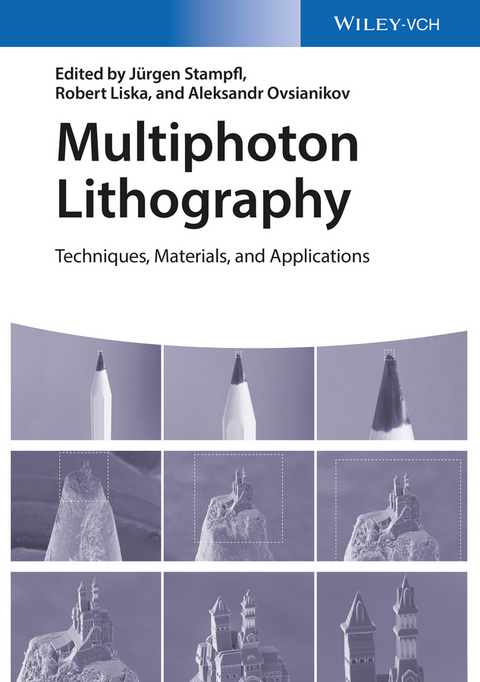
Multiphoton Lithography (eBook)
375 Seiten
Wiley-VCH (Verlag)
978-3-527-68269-0 (ISBN)

Written with both beginners and professionals in mind, this ready reference begins with an introductory section explaining the basics of the various multi-photon and photochemical processes together with a description of the equipment needed. A team of leading international experts provides the latest research results on such materials as new photoinitiators, hybrid photopolymers, and metallic carbon nanotube composites. They also cover promising applications and prospective trends, including photonic crystals, microfluidic devices, biological scaffolds, metamaterials, waveguides, and functionalized hydrogels.
By bringing together the essentials for both industrial and academic researchers, this is an invaluable companion for materials scientists, polymer chemists, surface chemists, surface physicists, biophysicists, and medical scientists working with 3D micro- and nanostructures.
Jürgen Stampfl studied Applied Physics at the University of Technology in Graz (Austria) and received his PhD in Materials Science from the University of Leoben (Austria) in 1996. From 1997 to 2000, he worked as a research associate at the Rapid Prototyping Lab at Stanford University (USA). In 2001, he joined the Institute of Materials Science and Technology at the Vienna University of Technology (Austria), where he was appointed associate professor for Materials Science in 2005. He is head of the working group Functional Non-Metals and since 2012 (together with Robert Liska) head of the Christian Doppler Laboratory for photopolymers in digital and restorative dentistry. His expertise lies in the field of additive manufacturing technologies and the development and characterization of advanced materials.
Robert Liska received his PhD from the Vienna University of Technology (Austria) in 1998. In 2006, he completed his habilitation with a work on the topic of macromolecular chemistry. He is leader of the research group Photopolymerization at the Institute of Applied Synthetic Chemistry at the Vienna University of Technology. In 2012, he became head of the Christian Doppler Laboratory for photopolymers in digital and restorative dentistry and since 2016 he is full professor for organic technology. He is interested in the research topics photoinitiation, photopolymerization, additive manufacturing, and biomedical polymers. Liska is co-author of eight book chapters and of more than 100 peer-reviewed journal articles.
Dr. Aleksandr Ovsianikov is currently an Assistant Professor at Vienna University of Technology (TU Wien, Austria). His research is dealing with the use of additive manufacturing technologies for tissue engineering and regeneration. Dr. Ovsianikov has background in laser physics and material processing with femtosecond lasers. After undergraduate studies at the Vilnius University (Lithuania) he completed his PhD at the Nanotechnology Department of the Laser Zentrum Hannover, and received his degree from the University of Hannover (Germany) in 2008. A particular focus of the current research of Dr. Ovsianikov is the development of multiphoton processing technologies for engineering biomimetic 3D cell culture matrices. In 2012 he was awarded a prestigious Starting Grant from the European Research Council (ERC) for a project aimed at this topic. Since 2004 Dr. Ovsianikov has contributed to over 60 publications in peer-reviewed journals and 5 book chapters.
Jürgen Stampfl studied Applied Physics at the University of Technology in Graz (Austria) and received his PhD in Materials Science from the University of Leoben (Austria) in 1996. From 1997 to 2000, he worked as a research associate at the Rapid Prototyping Lab at Stanford University (USA). In 2001, he joined the Institute of Materials Science and Technology at the Vienna University of Technology (Austria), where he was appointed associate professor for Materials Science in 2005. He is head of the working group Functional Non-Metals and since 2012 (together with Robert Liska) head of the Christian Doppler Laboratory for photopolymers in digital and restorative dentistry. His expertise lies in the field of additive manufacturing technologies and the development and characterization of advanced materials. Robert Liska received his PhD from the Vienna University of Technology (Austria) in 1998. In 2006, he completed his habilitation with a work on the topic of macromolecular chemistry. He is leader of the research group Photopolymerization at the Institute of Applied Synthetic Chemistry at the Vienna University of Technology. In 2012, he became head of the Christian Doppler Laboratory for photopolymers in digital and restorative dentistry and since 2016 he is full professor for organic technology. He is interested in the research topics photoinitiation, photopolymerization, additive manufacturing, and biomedical polymers. Liska is co-author of eight book chapters and of more than 100 peer-reviewed journal articles. Dr. Aleksandr Ovsianikov is currently an Assistant Professor at Vienna University of Technology (TU Wien, Austria). His research is dealing with the use of additive manufacturing technologies for tissue engineering and regeneration. Dr. Ovsianikov has background in laser physics and material processing with femtosecond lasers. After undergraduate studies at the Vilnius University (Lithuania) he completed his PhD at the Nanotechnology Department of the Laser Zentrum Hannover, and received his degree from the University of Hannover (Germany) in 2008. A particular focus of the current research of Dr. Ovsianikov is the development of multiphoton processing technologies for engineering biomimetic 3D cell culture matrices. In 2012 he was awarded a prestigious Starting Grant from the European Research Council (ERC) for a project aimed at this topic. Since 2004 Dr. Ovsianikov has contributed to over 60 publications in peer-reviewed journals and 5 book chapters.
PRINCIPLES OF MULTIPHOTON ABSORPTION
Photochemistry in Multiphoton Processes
Characterization of Two-Photon Absorption Chromophores
Theoretical Calculations on Multiphoton Absorption
Modeling of Polymerization Processes
EQUIPMENT AND TECHNIQUES
Light Sources and Systems for Multiphoton Lithography
Ultra-High-Resolution Multiphoton Lithography
MATERIALS
Photoinitiators for Multiphoton Lithography
Hybrid Photopolymers and Sol-Gel Materials
Biophotopolymers and Hydrogels
Metallic Carbon Nanotube Composites
APPLICATIONS
On-Chip Communication and Waveguides
Photonic Crystals and Metamaterials
Microfluidics, Micro-and Nanomachines
Nano-Replication: Printing and Nano-Surfacing Process
Scaffolds
Functionalization of 3D Structures: Grafting, Uncaging, and In Vivo Writing
List of Contributors
- Nikita Bityurin
- Institute of Applied Physics of Russian Academy of Sciences
- 46, Ul'yanov Street
- 603950 Nizhniy Novgorod
- Russia
- Yaoyu Cao
- Swinburne University of Technology
- Centre for Micro-Photonics (H34)
- John Street
- Hawthorn VIC 3122
- Australia
- Boris Chichkov
- Laser Zentrum Hannover e.V.
- Hollerithallee 8
- D-30419 Hannover
- Germany
- Daniel S. Correa
- National Laboratory for Nanotechnology in Agribusiness (LNNA)
- Embrapa Instrumentation
- 13560-970 São Carlos, SP
- Brazil
- Cole A. DeForest
- University of Washington
- Department of Chemical Engineering
- 4000 15th Ave NE
- Seattle, WA 98195
- USA
- and
- University of Washington
- Department of Bioengineering
- 3720 15th Ave NE
- Seattle, WA 98105
- USA
- and
- University of Washington
- Institute for Stem Cell and Regenerative Medicine
- 850 Republican Street
- Seattle, WA 98109
- USA
- Jennefir L. Digaum
- University of Central Florida
- CREOL, The College of Optics and Photonics
- 4000 Central Florida Blvd.
- Orlando, FL 32816
- USA
- Xuan-Ming Duan
- Chinese Academy of Sciences
- Technical Institute of Physics and Chemistry
- Laboratory of Organic NanoPhotonics and Key Laboratory of Functional Crystals and Laser Technology
- No. 29, Zhongguancun East Road
- Beijing 100190
- PR China
- and
- Chinese Academy of Sciences
- Chongqing Institutes of Green and Intelligent Technology
- No. 266 Fangzheng Ave
- Shuitu Technology Development Zone
- Beibei District
- Chongqing 400714
- PR China
- Maria Farsari
- Institute of Electronic Structure and Laser (IESL)
- Foundation for Research and Technology-Hellas (FORTH)
- N. Plastira 100
- Vassilika Vouton
- 70013 Heraklion Crete Greece
- John T. Fourkas
- University of Maryland
- Department of Chemistry and Biochemistry Institute for Physical Science and Technology
- College Park, MD 20742
- USA
- Zongsong Gan
- Swinburne University of Technology
- Centre for Micro-Photonics (H34)
- John Street
- Hawthorn VIC 3122
- Australia
- Christopher N. Grabill
- University of Central Florida
- Chemistry Department
- 4000 Central Florida Blvd.
- Orlando, FL 32816
- USA
- Min Gu
- Swinburne University of Technology
- Centre for Micro-Photonics (H34)
- John Street
- Hawthorn VIC 3122
- Australia
- and
- Swinburne University of Technology
- Centre for Ultrahigh-Bandwidth Devices for Optical Systems (CUDOS)
- John Street
- Hawthorn VIC 3122
- Australia
- David J. Hagan
- University of Central Florida
- CREOL, The College of Optics and Photonics
- 4304 Scorpius Street
- Orlando, FL 32816-2700
- USA
- Ulf Hinze
- Laser Zentrum Hannover e.V.
- Hollerithallee 8
- D-30419 Hannover
- Germany
- Saulius Juodkazis
- Swinburne University of Technology
- Centre for Micro-Photonics
- Hawthorn VIC 3122
- Australia
- and
- Melbourne Centre for Nanofabrication (MCN)
- Australian National Fabrication Facility (ANFF)
- Clayton VIC 3168
- Australia
- Stephen M. Kuebler
- University of Central Florida
- Chemistry Department
- 4000 Central Florida Blvd.
- Orlando, FL 32816
- USA
- and
- University of Central Florida
- CREOL, The College of Optics and Photonics
- 4000 Central Florida Blvd.
- Orlando, FL 32816
- USA
- and
- University of Central Florida
- Physics Department
- 4000 Central Florida Blvd.
- Orlando, FL 32816
- USA
- Josef Kumpfmüller
- TU Wien
- Institute of Applied Synthetic Chemistry
- Getreidemarkt 9/163
- 1060 Vienna
- Austria
- Christopher N. LaFratta
- Bard College
- Department of Chemistry
- Annandale-on-Hudson New York, NY 12504-5000
- USA
- Samuel Clark Ligon
- TU Wien
- Institute of Applied Synthetic Chemistry
- Getreidemarkt 9/163
- 1060 Vienna
- Austria
- Robert Liska
- TU Wien
- Institute of Applied Synthetic Chemistry
- Getreidemarkt 9/163
- 1060 Vienna
- Austria
- Mangirdas Malinauskas
- Vilnius University
- Laser Research Center
- Department of Quantum Electronics
- Saulėtekio Ave. 10
- 10223 Vilnius
- Lithuania
- Shoji Maruo
- Yokohama National University
- Department of Mechanical Engineering and Materials Science
- 79-5 Tokiwadai, Hodogaya-ku
- Yokohama 240-8501
- Japan
- Cleber R. Mendonça
- Universidade de São Paulo
- Departamento de Física e Ciência dos Materiais
- Instituto de Física de São Carlos
- Av. Trabalhador Sãocarlense
- 400 Centro
- 13566-590 São Carlos, SP
- Brazil
- Adriano J. G. Otuka
- Universidade de São Paulo
- Departamento de Física e Ciência dos Materiais
- Instituto de Física de São Carlos
- Av. Trabalhador Sãocarlense
- 400 Centro
- 13566-590 São Carlos, SP
- Brazil
- Alexander Pikulin
- Institute of Applied Physics of Russian Academy of Sciences
- 46, Ul'yanov Street
- 603950 Nizhniy Novgorod
- Russia
- Niklas Pucher
- TU Wien
- Institute of Applied Synthetic Chemistry
- Getreidemarkt 9/163
- 1060 Vienna
- Austria
- Casey M. Schwarz
- University of Central Florida
- Chemistry Department
- 4000 Central Florida Blvd.
- Orlando, FL 32816
- USA
- and
- University of Central Florida
- CREOL, The College of Optics and Photonics
- 4000 Central Florida Blvd.
- Orlando, FL 32816
- USA
- Alexandros Selimis
- Institute of Electronic Structure and Laser (IESL)
- Foundation for Research and Technology-Hellas (FORTH)
- N. Plastira 100
- Vassilika Vouton
- 70013 Heraklion
- Crete
- Greece
- Gediminas Seniutinas
- Swinburne University of Technology
- Centre for Micro-Photonics
- Hawthorn VIC 3122
- Australia
- and
- Melbourne Centre for Nanofabrication (MCN)
- Australian National Fabrication Facility (ANFF)
- Clayton VIC 3168
- Australia
- Jared A. Shadish
- University of Washington
- Department of Chemical Engineering
- 4000 15th Ave NE
- Seattle, WA 98195
- USA
- Jürgen Stampfl
- Tu Wien
- Institute of Materials Science and Technology
- Getreidemarkt 9 E 308
- 1060 Vienna
- Austria
- Mark W. Tibbitt
- David H. Koch Institute for Integrative Cancer Research
- Massachusetts Institute of Technology
- 500 Main Street
- Cambridge, MA 02139
- USA
- Vinicius Tribuzi
- Universidade de São Paulo
- Departamento de Física e Ciência dos Materiais
- Instituto de Física de São Carlos
- Av. Trabalhador Sãocarlense
- 400 Centro
- 13566-590 São Carlos, SP
- Brazil
- Eric W. Van Stryland
- University of Central Florida
- CREOL, The College of Optics and Photonics
- 4304 Scorpius Street
- Orlando, FL 32816-2700
- USA
- Henry E. Williams
- NanoSpective
- 12565 Research Parkway Suite 390
- Orlando, FL 32826
- USA
- Mei-Ling Zheng
- Chinese Academy of Sciences
- Technical Institute of Physics and Chemistry
- Laboratory of Organic NanoPhotonics and Key Laboratory of Functional Crystals and Laser Technology
- No. 29, Zhongguancun East Road
- Beijing 100190
- PR China
- Albertas Žukauskas
- Vilnius University
- Laser...
| Erscheint lt. Verlag | 12.9.2016 |
|---|---|
| Sprache | englisch |
| Themenwelt | Naturwissenschaften ► Chemie |
| Technik | |
| Schlagworte | characterization of 2PA chromophores • Chemie • Chemistry • Dünne Schichten, Oberflächen u. Grenzflächen • Dünne Schichten, Oberflächen u. Grenzflächen • Electrical & Electronics Engineering • Elektrotechnik u. Elektronik • fabricating microstructures • fabricating nanostructures • Lithographie • Materials Science • Materialwissenschaften • Microstructures • multiphoton lithography • multiphoton polymerization • nanoreplication printing • nanosurface processing • Optical elements • Photochemie • photochemistry • Photonics & Lasers • Photonik • Photonik u. Laser • photopolymers • polymerization process • Thin Films, Surfaces & Interfaces |
| ISBN-10 | 3-527-68269-4 / 3527682694 |
| ISBN-13 | 978-3-527-68269-0 / 9783527682690 |
| Informationen gemäß Produktsicherheitsverordnung (GPSR) | |
| Haben Sie eine Frage zum Produkt? |
 EPUB (Adobe DRM)
Kopierschutz: Adobe-DRM
Adobe-DRM ist ein Kopierschutz, der das eBook vor Mißbrauch schützen soll. Dabei wird das eBook bereits beim Download auf Ihre persönliche Adobe-ID autorisiert. Lesen können Sie das eBook dann nur auf den Geräten, welche ebenfalls auf Ihre Adobe-ID registriert sind.
Details zum Adobe-DRM
Dateiformat: EPUB (Electronic Publication)
EPUB ist ein offener Standard für eBooks und eignet sich besonders zur Darstellung von Belletristik und Sachbüchern. Der Fließtext wird dynamisch an die Display- und Schriftgröße angepasst. Auch für mobile Lesegeräte ist EPUB daher gut geeignet.
Systemvoraussetzungen:
PC/Mac: Mit einem PC oder Mac können Sie dieses eBook lesen. Sie benötigen eine
eReader: Dieses eBook kann mit (fast) allen eBook-Readern gelesen werden. Mit dem amazon-Kindle ist es aber nicht kompatibel.
Smartphone/Tablet: Egal ob Apple oder Android, dieses eBook können Sie lesen. Sie benötigen eine
Geräteliste und zusätzliche Hinweise
Buying eBooks from abroad
For tax law reasons we can sell eBooks just within Germany and Switzerland. Regrettably we cannot fulfill eBook-orders from other countries.
aus dem Bereich