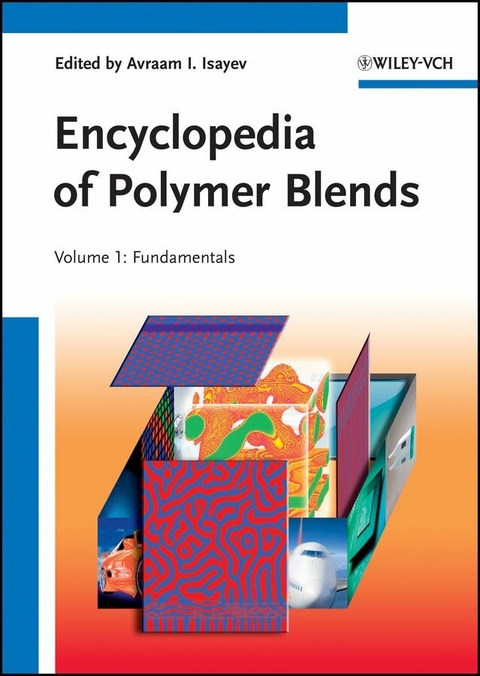
Encyclopedia of Polymer Blends, Volume 1 (eBook)
Wiley-VCH Verlag GmbH & Co. KGaA
978-3-527-80518-1 (ISBN)
Each article is uniformly structured for easy navigation, containing the latest research & development and its basic principles and applications.
Avraam I. Isayev is a Distinguished Professor of Polymer Engineering at the University of Akron. He is a native of Azerbaijan. He received M.Sc. degrees from the Azerbaijan Institute of Oil and Chemistry in Chemical Engineering and the Moscow Institute of Electronic Machine Building in Applied Mathematics and a Ph.D. in Polymer Engineering and Science from the Institute of Petrochemical Synthesis of the USSR Academy of Sciences, Moscow. Before joining the University of Akron in 1983 as an Associate Professor, he was a Senior Research Associate at Cornell University, a Senior Research Fellow at Technion and a Research Associate at the Institute of Petrochemical Synthesis of the USSR Academy of Sciences. He has edited 5 books, published 1 monograph and over 220 journal papers, many book chapters and encyclopedia articles. He has received numerous awards.
Avraam I. Isayev is a Distinguished Professor of Polymer Engineering at the University of Akron. He is a native of Azerbaijan. He received M.Sc. degrees from the Azerbaijan Institute of Oil and Chemistry in Chemical Engineering and the Moscow Institute of Electronic Machine Building in Applied Mathematics and a Ph.D. in Polymer Engineering and Science from the Institute of Petrochemical Synthesis of the USSR Academy of Sciences, Moscow. Before joining the University of Akron in 1983 as an Associate Professor, he was a Senior Research Associate at Cornell University, a Senior Research Fellow at Technion and a Research Associate at the Institute of Petrochemical Synthesis of the USSR Academy of Sciences. He has edited 5 books, published 1 monograph and over 220 journal papers, many book chapters and encyclopedia articles. He has received numerous awards.
Encyclopedia of Polymer Blends 1
Contents 7
Preface 13
List of Contributors 17
1: Molecular Simulation of Polymer Melts and Blends: Methods, Phase Behavior, Interfaces, and Surfaces 19
1.1 Introduction 19
1.2 Molecular Models for Polymers and Monte Carlo Simulations 24
1.2.1 Modeling Polymers in Molecular Simulations 24
1.2.2 Basics of Monte Carlo Simulations 26
1.2.3 Determination of Phase Behavior 27
1.3 Wetting and Phase Diagrams in Confined Geometries 32
1.3.1 Length and Energy Scales of Minimal, Coarse-Grained Models for Polymer–SolidContacts 32
1.3.2 Measuring the Surface Free Energy Difference, ??, by Computer Simulation 36
1.3.3 Application to Polymer–Solvent Mixtures 38
1.4 Molecular Dynamics Method 39
1.4.1 Basic Molecular Dynamics 39
1.4.2 Non-equilibrium Molecular Dynamics Simulations of Coarse-GrainedPolymer Systems 41
1.5 Atomistic Simulation of Polymer Melts and Blends Using Molecular DynamicsTechniques 46
1.5.1 Polymer Melts 46
1.5.2 Polymer Blends 48
1.5.3 Reversible Mapping between Atomistic, Coarse Grained, and Field Models 51
1.5.4 Comparison to Experiment and Future Challenges 52
1.6 Concluding Remarks 53
Symbols 55
References 56
2: Thermodynamics of Flexible and Rigid Rod Polymer Blends 63
2.1 Introduction 63
2.2 Fundamentals of a Nematic Phase 64
2.2.1 Scalar Orientational Order Parameter 64
2.2.2 Free Energy of Rigid Rod Solutions 65
2.2.3 Nematic–Isotropic Phase Separations 69
2.2.4 Entropy- and Energy-Driven Nematic Ordering 72
2.3 Mixtures of a Flexible Polymer and a Rigid Rod 74
2.3.1 Free Energy of Flexible and Rigid Rod Polymer Blends 77
2.3.2 Nematic–Isotropic Phase Transition 81
2.3.3 Landau–de Gennes Expansion of the Free Energy 82
2.3.4 Phase Separations 83
2.3.5 Phase Diagrams in Solutions of Rigid Rod-Like Polymers 88
2.3.6 Smectic-Nematic–Isotropic Phase Separations 89
2.3.7 Conformation of a Polymer Dissolved in a Liquid Crystalline Phase 94
2.4 Phase Separation Dynamics 96
2.4.1 Kinetic Equations 98
2.4.2 Linearized Analysis of Spinodal Decomposition 100
2.4.3 Morphologies 106
2.5 Summary 111
Symbols 112
References 114
3: Amorphous Polymer Blends: Recent Developments 119
3.1 Introduction 119
3.2 Miscible Blend Dynamics and Length Scales of Mixing 120
3.3 Amorphous Biopolymer Blends 126
3.4 Conclusions 127
References 127
4: Phase Field Modeling on Polymer Crystallization and Phase Separation in Crystalline Polymer Blends 131
4.1 Phase Field Theory of Crystal Solidification of a Pure Substance 131
4.2 Phase Field Modeling on Morphology Development 132
4.3 Application of Phase Field Approach to Crystallization of a Homopolymer 140
4.4 Thermodynamics of Crystalline Polymer Solutions and Blends 147
4.4.1 Prigogine's Model 147
4.4.2 Flory Diluent Theory 148
4.5 Phase Diagrams of Crystalline Polymer Blends 150
4.5.1 Phase Diagram Calculation of a Crystalline/Amorphous Polymer Blend 150
4.5.2 Determination of Crystal–Amorphous Interaction in Crystalline/Amorphous Blends 153
4.5.3 Phase Diagram Calculation for Binary Crystalline Polymer Blends 155
4.5.4 Morphology Development in Relation to Phase Diagram of Crystalline/Amorphous Polymer Blends 157
4.5.5 Morphology Development in Relation to the Phase Diagram of Crystalline/Crystalline Polymer Blends 160
4.5.6 Phase Field Modeling on Phase Separation and Morphology Evolution 163
Symbols 166
References 167
5: Miscibility Criterion in Polymer Blends and its Determination 171
5.1 Introduction 171
5.2 Thermodynamics 172
5.3 Glass Transition of Polymer Blends 176
5.3.1 Determination of the Glass Transition of Polymer Blends 178
5.4 Phase Equilibria Methods 180
5.4.1 Scattering Techniques 181
5.4.1.1 Turbidity Measurements and Light Scattering 183
5.4.1.2 Small-Angle Neutron Scattering 186
5.4.1.3 Small-Angle and Wide-Angle X-Ray Scattering 191
5.4.1.4 Neutron Reflectivity 193
5.4.2 Microscopy 194
5.4.2.1 Transmission Electron Microscopy 195
5.4.2.2 Scanning Electron Microscopy 195
5.4.2.3 Scanning Probe Microscopy – Atomic Force Microscopy (AFM) and Scanning Tunneling Microscopy (STM) 196
5.5 Spectroscopic Methods 198
5.5.1 Dynamics above the Glass Transition 198
5.5.2 Sub-Tg Relaxations 203
5.5.3 Infrared and Raman Spectroscopy 204
5.6 Summary and Conclusions 207
Abbreviations and Symbols 207
References 210
6: Physical Aging of Polymer Blends 217
6.1 Introduction to Physical Aging 217
6.2 Experimental Measurements 218
6.2.1 Enthalpy Relaxation 218
6.2.2 Theoretical Approaches 220
6.2.2.1 Phenomenological Models 220
6.2.2.2 Petrie–Marshall and Cowie–Ferguson Models 222
6.2.2.3 Molecular Models 222
6.2.3 Enthalpic Relaxation in Polymer Blends 223
6.2.4 Volume Relaxation 230
6.2.5 Mechanical Relaxation 232
6.2.6 Positron Annihilation Lifetime Spectroscopy 234
6.2.7 Other Spectroscopic Techniques 236
6.2.8 Scattering Techniques 237
6.3 Discussion of Physical Aging in Blends 238
6.3.1 Effect of Intermolecular Interactions 238
6.3.2 Phase Separated Blends 241
6.4 Concluding Comments 241
Abbreviations and Symbols 242
References 244
7: Nanoparticle/Polymer Blends: Theory and Modeling 251
7.1 Introduction 251
7.2 Morphology of Polymer Blends with Nanoparticles 253
7.2.1 Phase Behavior of Binary Polymer Blends 253
7.2.2 Simple Arguments for Nanoparticles as Compatibilizers 255
7.2.3 Influence of Nanoparticles on the Dynamics of Phase Separation in Polymer Blends 257
7.2.4 Thermodynamics of Binary Nanoparticle/Polymer Blends 260
7.2.5 Phase Behavior of Ternary Nanoparticle/Polymer/Polymer Mixtures 263
7.2.6 Phase Behavior of Nanoparticle/Block-Copolymer Mixtures 266
7.2.7 Determination of Polymer–Particle Flory–Huggins Interaction Parameters 272
7.3 Physical Properties of Filled Polymer Blends 273
7.3.1 Mechanical Properties (Modulus, Strength, and Toughness) 273
7.3.2 Electrical Conductivity 275
7.4 Summary and Outlook 278
Abbreviations and Symbols 279
References 281
8: Modeling the Self-Assembly of Ternary Blends that Encompass Photosensitive Chemical Reactions: Creating Defect-Free, Hierarchically Ordered Materials 287
8.1 Introduction 287
8.2 The Model 290
8.3 Results and Discussion 293
8.3.1 Combing with Light: Creating Patterned, Defect-Free Thin Films 293
8.3.2 Modeling the Bulk Behavior of Photosensitive Blends under Non-uniform Illumination 296
8.3.3 Combing Out Defects in Bulk Binary Blends 304
8.3.4 Creating Order within the Ternary Mixtures 308
8.3.5 Relating the Dimensionless Simulation Parameters to Physical Values 311
8.3.6 Using a Single Photomask to Create Multiple Patterns in the Ternary Films 313
8.4 Conclusions 318
Abbreviations and Symbols 321
References 323
Index 325
End User License Agreement 333
| Erscheint lt. Verlag | 13.9.2016 |
|---|---|
| Reihe/Serie | Encyclopedia of Polymer Blends |
| Sprache | englisch |
| Themenwelt | Naturwissenschaften ► Chemie |
| Technik | |
| Schlagworte | ART • article • BASIC • blending • Blends • Chemie • Chemistry • consistent • construction materials • Dependence • fundamentals • Industrial Chemistry • Konstruktionswerkstoffe • Materials Science • Materialwissenschaften • miscibility • Phase • Polymer • Polymer-Blends • Polymergemisch • polymerpolymer • Polymer processing • Polymer Science & Technology • Polymerverarbeitung • Polymerwissenschaft u. -technologie • Principles • Research • rigid • Separation • Technische u. Industrielle Chemie • Temperature • theory • thermodynamics • Timely • Volume |
| ISBN-10 | 3-527-80518-4 / 3527805184 |
| ISBN-13 | 978-3-527-80518-1 / 9783527805181 |
| Informationen gemäß Produktsicherheitsverordnung (GPSR) | |
| Haben Sie eine Frage zum Produkt? |
 PDF (Adobe DRM)
Kopierschutz: Adobe-DRM
Adobe-DRM ist ein Kopierschutz, der das eBook vor Mißbrauch schützen soll. Dabei wird das eBook bereits beim Download auf Ihre persönliche Adobe-ID autorisiert. Lesen können Sie das eBook dann nur auf den Geräten, welche ebenfalls auf Ihre Adobe-ID registriert sind.
Details zum Adobe-DRM
Dateiformat: PDF (Portable Document Format)
Mit einem festen Seitenlayout eignet sich die PDF besonders für Fachbücher mit Spalten, Tabellen und Abbildungen. Eine PDF kann auf fast allen Geräten angezeigt werden, ist aber für kleine Displays (Smartphone, eReader) nur eingeschränkt geeignet.
Systemvoraussetzungen:
PC/Mac: Mit einem PC oder Mac können Sie dieses eBook lesen. Sie benötigen eine
eReader: Dieses eBook kann mit (fast) allen eBook-Readern gelesen werden. Mit dem amazon-Kindle ist es aber nicht kompatibel.
Smartphone/Tablet: Egal ob Apple oder Android, dieses eBook können Sie lesen. Sie benötigen eine
Geräteliste und zusätzliche Hinweise
Buying eBooks from abroad
For tax law reasons we can sell eBooks just within Germany and Switzerland. Regrettably we cannot fulfill eBook-orders from other countries.
aus dem Bereich