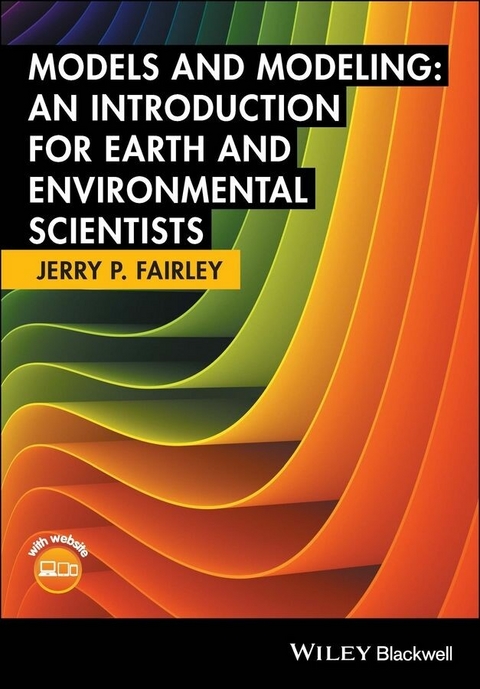
Models and Modeling (eBook)
John Wiley & Sons (Verlag)
978-1-119-13038-3 (ISBN)
An Introduction to Models and Modeling in the Earth and Environmental Sciences
offers students and professionals the opportunity to learn about groundwater modeling, startingfrom the basics. Using clear, physically-intuitive examples, the author systematically takes
us on a tour that begins with the simplest representations of fluid flow and builds through
the most important equations of groundwater hydrology. Along the way, we learn how
to develop a conceptual understanding of a system, how to choose boundary and initial
conditions, and how to exploit model symmetry. Other important topics covered include
non-dimensionalization, sensitivity, and finite differences. Written in an eclectic and readable
style that will win over even math-phobic students, this text lays the foundation for a
successful career in modeling and is accessible to anyone that has completed two semesters
of Calculus.
Although the popular image of a geologist or environmental scientist may be the rugged
adventurer, heading off into the wilderness with a compass and a hand level, the disciplines
of geology, hydrogeology, and environmental sciences have become increasingly quantitative.
Today's earth science professionals routinely work with mathematical and computer models,
and career success often demands a broad range of analytical and computational skills.
An Introduction to Models and Modeling in the Earth and Environmental Sciencesis written forstudents and professionals who want to learn the craft of modeling, and do more than just
run 'black box' computer simulations.
Dr. Jerry P. Fairley received his PhD in Earth Resources Engineering from the University
of California, Berkeley. He was the Chief Hydrologist for Site Characterization on the US-
DOE's Yucca Mountain Project (1993-1995), and worked as a modeler for the Earth Sciences
Division of Lawrence Berkeley National Laboratory. He is currently a Professor of Geology
at the University of Idaho, Department of Geological Sciences.
An Introduction to Models and Modeling in the Earth and Environmental Sciences offers students and professionals the opportunity to learn about groundwater modeling, starting from the basics. Using clear, physically-intuitive examples, the author systematically takes us on a tour that begins with the simplest representations of fluid flow and builds through the most important equations of groundwater hydrology. Along the way, we learn how to develop a conceptual understanding of a system, how to choose boundary and initial conditions, and how to exploit model symmetry. Other important topics covered include non-dimensionalization, sensitivity, and finite differences. Written in an eclectic and readable style that will win over even math-phobic students, this text lays the foundation for a successful career in modeling and is accessible to anyone that has completed two semesters of Calculus. Although the popular image of a geologist or environmental scientist may be the rugged adventurer, heading off into the wilderness with a compass and a hand level, the disciplines of geology, hydrogeology, and environmental sciences have become increasingly quantitative. Today s earth science professionals routinely work with mathematical and computer models, and career success often demands a broad range of analytical and computational skills. An Introduction to Models and Modeling in the Earth and Environmental Sciencesis written for students and professionals who want to learn the craft of modeling, and do more than just run black box computer simulations.
Dr. Jerry P. Fairley received his PhD in Earth Resources Engineering from the University of California, Berkeley. He was the Chief Hydrologist for Site Characterization on the US- DOE's Yucca Mountain Project (1993-1995), and worked as a modeler for the Earth Sciences Division of Lawrence Berkeley National Laboratory. He is currently a Professor of Geology at the University of Idaho, Department of Geological Sciences.
Title Page 5
Copyright Page 6
Contents 9
About the companion website 13
Introduction 15
Chapter 1 Modeling basics 40
Chapter summary 18
1.1 Learning to model 18
1.2 Three cardinal rules of modeling 19
1.2.1 Rule 1: Know your model objective 19
1.2.2 Rule 2: Make your model appropriate for your data 20
1.2.3 Rule 3: Start simple and build complexity 20
1.3 How can I evaluate my model? 21
1.3.1 Test model behavior in the limits 21
1.3.2 Look for behavior congruent with the governing equations 21
1.3.3 Nondimensionalization 22
1.4 Conclusions 22
Chapter 2 A model of exponential decay 23
Chapter summary 23
2.1 Exponential decay 23
2.2 The Bandurraga Basin, Idaho 24
2.3 Getting organized 24
2.3.1 Observable quantities 25
2.3.2 Stating the model objective 25
2.3.3 What data are available? 26
2.3.4 What can we assume? 26
2.3.5 Finding an approach 27
2.3.6 Executing the plan 29
2.4 Nondimensionalization 31
2.5 Solving for ? 33
2.6 Calibrating the model to the data 35
2.6.1 Semilog plots 36
2.6.2 Curve matching 37
2.7 Extending the model 37
2.8 A numerical solution for exponential decay 40
2.9 Conclusions 42
2.10 Problems 43
Notes 44
References 44
Chapter 3 A model of water quality 45
Chapter summary 45
3.1 Oases in the desert 45
3.2 Understanding the problem 46
3.3 Model development 46
3.3.1 Model formulation 47
3.3.2 Nondimensionalization 48
3.3.3 Solving the equation 50
3.4 Evaluating the model 51
3.5 Applying the model 52
3.6 Conclusions 53
3.7 Problems 54
Chapter 4 The Laplace equation 56
Chapter summary 56
4.1 Laplace’s equation 56
4.2 The Elysian Fields 57
4.3 Model development 58
4.4 Quantifying the conceptual model 61
4.5 Nondimensionalization 62
4.6 Solving the governing equation 63
4.7 What does it mean? 64
4.7.1 Considering the solution 64
4.7.2 The Flux, and its meaning 66
4.7.3 Meanwhile, back in the real world… 67
4.8 Numerical approximation of the second derivative 68
4.8.1 Iterative solution methods 69
4.8.2 Direct solution methods 70
4.9 Conclusions 71
4.10 Problems 72
Note 75
References 75
Chapter 5 The Poisson equation 76
Chapter summary 76
5.1 Poisson’s equation 76
5.2 Alcatraz island 77
5.2.1 Early history of Alcatraz island 77
5.2.2 The American Indian occupation 78
5.3 Understanding the problem 79
5.3.1 Developing an approach 79
5.3.2 Questions about coordinates 81
5.3.3 A digression about boundary conditions 82
5.3.4 Considerations of symmetry 86
5.4 Quantifying the conceptual model 88
5.5 Nondimensionalization 90
5.6 Seeking a solution 93
5.6.1 An approximate analytical solution 93
5.6.2 A 2D finite difference operator 95
5.7 An alternative nondimensionalization 96
5.8 Conclusions 98
5.9 Problems 99
Notes 100
References 100
Chapter 6 The transient diffusion equation 101
Chapter summary 101
6.1 The diffusion equation 101
6.2 The Twelve Labors of Hercules 102
6.2.1 The Twelve Labors 102
6.3 The Augean Stables 104
6.3.1 Developing an approach 104
6.4 Carrying out the plan 106
6.4.1 Mass balance and the control volume 106
6.4.2 A brief digression on storage coefficients 109
6.4.3 Completing the governing equation 112
6.4.4 Nondimensionalization 113
6.5 An analytical solution 114
6.5.1 Separation of variables: The basic idea 115
6.5.2 Initial preparations 116
6.5.3 Separation of variables: The method 117
6.5.4 Solving for spatial dependence 118
6.5.5 Solving for temporal dependence 120
6.5.6 Summing up 120
6.5.7 Joseph Fourier and the Augean Stables 121
6.5.8 Orthogonality 121
6.6 Evaluating the solution 123
6.6.1 Behavior in the limits 124
6.6.2 Evaluating the solution 125
6.6.3 Dimensionless time 127
6.7 Transient finite differences 128
6.7.1 The explicit scheme 129
6.7.2 Fully implicit finite differences 129
6.7.3 A generic difference formulation 131
6.8 Conclusions 132
6.9 Problems 133
Notes 134
References 135
Chapter 7 The Theis equation 136
Chapter summary 136
7.1 The Knight of the Sorrowful Figure 136
7.1.1 The Groundwater of La Mancha 137
7.2 Statement of the problem 138
7.3 The governing equation 139
7.4 Boundary conditions 141
7.5 Nondimensionalization 142
7.5.1 Normalizing independent variables the usual way 143
7.5.2 Finding similarity 144
7.5.3 The auxiliary conditions 145
7.6 Solving the governing equation 146
7.7 Theis and the “well function” 148
7.7.1 Evaluating the exponential integral 148
7.8 Back to the beginning 149
7.8.1 Equilibrium: Are we there yet? 149
7.8.2 The shape of time and space 151
7.9 Violating the model assumptions 152
7.10 Conclusions 153
7.11 Problems 154
Notes 154
References 154
Chapter 8 The transport equation 155
8.1 The advection–dispersion equation 155
8.2 The problem child 157
8.3 The Augean Stables, revisited 158
8.4 Defining the problem 158
8.5 The governing equation 160
8.6 Nondimensionalization 162
8.6.1 The dependent variable 162
8.6.2 The independent variables 163
8.6.3 The velocity 164
8.6.4 Making the substitutions 165
8.7 Analytical solutions 166
8.7.1 Steady-state solutions 167
8.7.2 Transient solutions 169
8.7.3 Qualitative behavior of the ADE 176
8.8 Cauchy conditions 179
8.9 Retardation and dispersion 181
8.10 Numerical solution of the ADE 183
8.11 Conclusions 187
8.12 Problems 188
Notes 189
References 190
Chapter 9 Heterogeneity and anisotropy 191
Chapter summary 191
9.1 Understanding the problem 191
9.2 Heterogeneity and the representative elemental volume 193
9.3 Heterogeneity and effective properties 194
9.3.1 Averaging conductivity 195
9.3.2 Some statistical definitions 198
9.3.3 Other effective conductivity results 200
9.4 Anisotropy in porous media 201
9.5 Layered media 202
9.6 Numerical simulation 203
9.7 Some additional considerations 205
9.8 Conclusions 206
9.9 Problems 206
Notes 207
References 208
Chapter 10 Approximation, error, and sensitivity 209
Chapter summary 209
10.1 Things we almost know 209
10.2 Approximation using derivatives 210
10.2.1 Another example 211
10.3 Improving our estimates 211
10.4 Bounding errors 213
10.4.1 Data uncertainty 213
10.4.2 Model uncertainty 214
10.5 Model sensitivity 215
10.5.1 Defining sensitivity 215
10.5.2 Example 1 217
10.5.3 Example 2 218
10.5.4 What good is it? 218
10.6 Conclusions 220
10.7 Problems 221
Notes 222
References 223
Chapter 11 A case study 224
Chapter summary 224
11.1 The Borax Lake Hot Springs 224
11.2 Study motivation and conceptual model 226
11.3 Defining the conceptual model 227
11.4 Model development 229
11.4.1 Fluid flow 230
11.4.2 Heat transport 231
11.4.3 Solving the equation 236
11.4.4 Finding permeability 238
11.5 Evaluating the solution 238
11.5.1 Estimating permeability 239
11.5.2 Checking the limits 240
11.5.3 What permeability is calculated? 241
11.5.4 What are the model sensitivities? 241
11.6 Conclusions 243
11.7 Problems 244
Notes 245
References 246
Chapter 12 Closing remarks 247
12.1 Some final thoughts 247
References 249
Appendix A: A heuristic approach to nondimensionalization 250
Note 251
Appendix B: Evaluating implicit equations 252
B.1 Trial and error 253
B.2 The graphical method 253
B.3 Iteration 254
B.4 Newton’s method 255
References 256
Appendix C: Matrix solution for implicit algorithms 257
C.1 Solution of 1D equations 257
C.2 Solution for higher dimensional problems 258
C.3 The tridiagonal matrix routine TDMA 258
References 260
Index 261
EULA 264
| Erscheint lt. Verlag | 15.9.2016 |
|---|---|
| Sprache | englisch |
| Themenwelt | Mathematik / Informatik ► Mathematik ► Angewandte Mathematik |
| Naturwissenschaften ► Biologie ► Ökologie / Naturschutz | |
| Naturwissenschaften ► Geowissenschaften ► Geologie | |
| Technik | |
| Schlagworte | author • Basics • Conceptual • Conditions • earth • earth sciences • eclectic • Environmental Science • Environmental Studies • Fluid • Geologie u. Geophysik • Geology & Geophysics • Geowissenschaften • Groundwater & Hydrogeology • Grundwasser u. Hydrogeologie • Important topics • Introduction • mathphobic • Model • Models • Nondimensionalization • Opportunity • representations • simplest • students • Style • System • systematically • Tour • Umweltforschung • Umweltwissenschaften • US • Way |
| ISBN-10 | 1-119-13038-7 / 1119130387 |
| ISBN-13 | 978-1-119-13038-3 / 9781119130383 |
| Informationen gemäß Produktsicherheitsverordnung (GPSR) | |
| Haben Sie eine Frage zum Produkt? |
 PDF (Adobe DRM)
Kopierschutz: Adobe-DRM
Adobe-DRM ist ein Kopierschutz, der das eBook vor Mißbrauch schützen soll. Dabei wird das eBook bereits beim Download auf Ihre persönliche Adobe-ID autorisiert. Lesen können Sie das eBook dann nur auf den Geräten, welche ebenfalls auf Ihre Adobe-ID registriert sind.
Details zum Adobe-DRM
Dateiformat: PDF (Portable Document Format)
Mit einem festen Seitenlayout eignet sich die PDF besonders für Fachbücher mit Spalten, Tabellen und Abbildungen. Eine PDF kann auf fast allen Geräten angezeigt werden, ist aber für kleine Displays (Smartphone, eReader) nur eingeschränkt geeignet.
Systemvoraussetzungen:
PC/Mac: Mit einem PC oder Mac können Sie dieses eBook lesen. Sie benötigen eine
eReader: Dieses eBook kann mit (fast) allen eBook-Readern gelesen werden. Mit dem amazon-Kindle ist es aber nicht kompatibel.
Smartphone/Tablet: Egal ob Apple oder Android, dieses eBook können Sie lesen. Sie benötigen eine
Geräteliste und zusätzliche Hinweise
Buying eBooks from abroad
For tax law reasons we can sell eBooks just within Germany and Switzerland. Regrettably we cannot fulfill eBook-orders from other countries.
aus dem Bereich