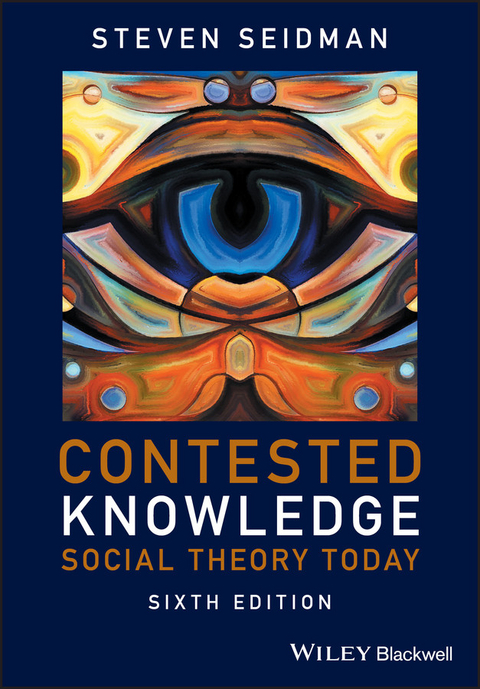
Contested Knowledge (eBook)
John Wiley & Sons (Verlag)
978-1-119-16759-4 (ISBN)
- Responds to current issues, debates, and new social movements
- Reviews sociological theory from a contemporary perspective
- Reveals how the universal theorist and the era of rival schools has been replaced by networks of clustered debates that are relatively 'autonomous' and interdisciplinary
- Features updates and in-depth discussions of the newest clustered debates in social theory-intimacy, postcolonial nationalism, and the concept of 'the other'
- Challenges social scientists to renew their commitment to the important moral and political role social knowledge plays in public life
STEVEN SEIDMAN is Professor of Sociology at the State University of New York at Albany. He is the author and editor of a number of books including Liberalism and the Origins of European Social Theory, The Postmodern Turn, Queer Theory/Sociology, The New Social Theory Reader (with Jeffrey Alexander), and Intimacies.
In the sixth edition of Contested Knowledge, social theorist Steven Seidman presents the latest topics in social theory and addresses the current shift of 'universalist theorists' to networks of clustered debates. Responds to current issues, debates, and new social movements Reviews sociological theory from a contemporary perspective Reveals how the universal theorist and the era of rival schools has been replaced by networks of clustered debates that are relatively 'autonomous' and interdisciplinary Features updates and in-depth discussions of the newest clustered debates in social theory intimacy, postcolonial nationalism, and the concept of 'the other' Challenges social scientists to renew their commitment to the important moral and political role social knowledge plays in public life
STEVEN SEIDMAN is Professor of Sociology at the State University of New York at Albany. He is the author and editor of a number of books including Liberalism and the Origins of European Social Theory, The Postmodern Turn, Queer Theory/Sociology, The New Social Theory Reader (with Jeffrey Alexander), and Intimacies.
Preface vii
Acknowledgments x
Introduction 1
Part I The Rise of the Classical Tradition 7
Introduction to Part I 9
1 The Idea of a Science of Society: The Enlightenment and Auguste Comte 11
2 The Revolutionary Theory of Karl Marx 22
3 The Promise of Sociology: Emile Durkheim 36
4 The Ironic Social Theory of Max Weber 48
Afterword to Part I 61
Part II Rethinking the Classical Tradition: American Sociology 65
Introduction to Part II 67
5 The Grand Theory of Talcott Parsons, Peter Berger, and Thomas Luckmann 70
6 The Scientific Theory of Randall Collins and Peter Blau 86
7 The Moral Sociology of C. Wright Mills and Robert Bellah 97
Afterword to Part II 113
Part III Rethinking the Classical Tradition: European Theory 115
Introduction to Part III 117
8 The Critical Theory of Jürgen Habermas 119
9 Stuart Hall and British Cultural Studies 132
10 The Critical Sociology of Anthony Giddens and Pierre Bourdieu 140
Afterword to Part III 152
Part IV Revisions and Revolts: The Postmodern Turn 155
Introduction to Part IV 157
11 The Postmodern World of Jacques Derrida, Jean-François Lyotard, and Jean Baudrillard 159
12 Michel Foucault's Disciplinary Society 175
13 Zygmunt Bauman's Sociology of Postmodernity 188
Afterword to Part IV 197
Part V Revisions and Revolts: Identity Politics and Theory 201
Introduction to Part V 203
14 Feminist Theory/Masculinity Studies 205
15 Critical Race Theory/White Studies 226
16 Lesbian, Gay, and Queer Theory/Heterosexual Studies 239
17 Colonial Discourse Studies 254
Afterword to Part V 263
Part VI Revisions and Revolts: Theories of World Order 267
Introduction to Part VI 269
18 From Nation to Globe: David Held and Mary Kaldor 271
19 Global Capitalism: Immanuel Wallerstein and Manuel Castells 281
20 The Return of Empire? Michael Hardt and Antonio Negri, David Harvey and Michael Mann 290
Afterword to Part VI 300
Part VII The Rise of Postdisciplinary Theory 303
Introduction to Part VII 305
21 Theorizing Postcolonial Nationalism: A Case of "Domain" Theorizing 308
22 Jeffrey Alexander: Reconstructing Democratic Theory in an Age of Disillusionment 320
23 Nancy Fraser: The Case for Radical Democracy 331
Afterword to Part VII 341
Index 344
Praise for previous edition:
"In this tour de force, Steven Seidman surveys social theory from Auguste Comte to Zygmunt Bauman via feminism, world systems theory, queer theory, post-colonialism and much more. It is not just a survey, but rather a plea for a public sociology that is relevant, committed and morally challenging. In a style of writing that is at once direct, personal and engaging, Seidman provides a penetrating overview of the state of sociology that is critical but optimistic. Contested Knowledge now in its fifth edition gets better with age."
Bryan S. Turner, The City University of New York
"In his spirited defense of theory as a moral enterprise, Steven Seidman offers insightful, penetrating, critical, but always fair assessments of the theoretical contributions of a wide range of theorists past and present.... Written with an enviable clarity, in a style that is at once lucid and engaging."
Peter Kivisto, Augustana College and University of Turku
Introduction
Modern social theory has been inspired by a noble purpose: to advance human freedom. By conceiving of the human condition as fundamentally social and historical, the social sciences anticipated the possibility that societies could rationally fashion their own destiny. If social customs and institutions are understood as products of human actions, not natural or divine law, couldn't they be shaped to benefit all of humanity?
The social scientist was imagined as a public educator whose chief task was public enlightenment. In their quest for truth, social scientists would illuminate the social dangers to freedom and the prospects for progress. The pioneers of the social sciences, thinkers such as Montesquieu, Condorcet, Marx, Comte, Weber, Charlotte Perkins Gilman, and W. E. B. Du Bois, invented new and imaginative ways of understanding the origin and organization of the social world. Their ideas addressed matters of considerable moral and political significance, for example, the origins of inequality, the bureaucratic threat to freedom, the state of the Negro in society, and the exploitation of women. For the founding figures of the social sciences, knowledge was valued as a means of promoting social progress.
Contemporary sociological theory has not abandoned this social purpose. Sociologists continue to provide critical perspectives on the present that aim to enlighten a broad public. Yet sociological theory and, to a lesser extent, sociology in general, have become more and more isolated from public life, to the detriment of both sociology and public life. As sociological theorists have retreated from their role as public educators, their ideas have lost social relevance. Moreover, the general public suffers from theorists’ diminishing social authority. Sociological theory has been a catalyst of public debate and an important provider of critical social perspectives. As theorists and many sociologists become preoccupied with insular disciplinary concerns, public officials, activists, policy‐makers, journalists, and media commentators have assumed the chief role of public intellectuals. Unfortunately, these individuals, though often thoughtful and insightful, are usually focused narrowly on specific issues or political events such as gays in the military or the Middle East conflicts or electoral politics; they are pressured to meet commercial deadlines and standards. Accordingly, their social ideas often lack the conceptual and historical depth that has been part of the social sciences. A vigorous democratic public culture is nourished by the social ideas crafted by sociologists and critical social scientists.
Why has sociological theory become increasingly isolated from public life? Sociology continues to produce theorists of impressive talent, but its culture is more and more removed from a general public culture. The growing insularity of sociological theory reflects, in part, the fact that theorists are often oriented to members of their own expert culture. Much of current sociological theory simply does not speak a broad public language; the conventions and concerns of this disciplinary culture render their ideas either inaccessible to a general public or irrelevant to the ways in which the moral and political issues of the day are discussed in everyday life. The sad truth is that sociological theory, especially in the United States, is hardly read today beyond a small circle of academic theorists.
If sociological theory is in trouble, one reason is the quest for an overarching theory of society and history. From Comte through Parsons, Habermas, and Randall Collins, theorists have tried to discover the underlying principles of social order and social change. These theorists believe that there are very general problems such as the nature of social action and social order or the relationship between the individual and social institutions that are at the core of social knowledge. It is the task of theory to settle these so‐called foundational issues or to uncover the universal principles of social life. A core of theoretical principles would then guide social research and social analysis. Unfortunately, theorists have been unable to achieve anything approaching consensus on the core premises, concepts, and explanatory models of social knowledge. And, sadly, theorists’ aspiration to provide secure foundations for social knowledge has often led them into a series of arcane conceptual and methodological debates that have largely proved fruitless. Sociological theorists are in danger of losing the attention of both researchers and the public.
Sociology needs to recover its role as public educator in order to contribute to a more measured and thoughtful public discussion. In this regard, I would like to see sociological theory regain its focus on issues of broad public significance. Instead of being driven by narrow disciplinary conventions and disputes, theorists should seriously try to address the key social and political debates of our time, and in an accessible language. Theorists need to recover the moral impulse at the heart of social theory, and to see themselves, once again, as public educators engaging the issues of the day. Contested Knowledge is animated by the original promise of modern social thinking: the idea that social theory can produce ideas that would help create a better world.
CONFLICTING VIEWS OF SOCIAL THEORY
Since the Enlightenment, the very meaning of social theory has been debated. Three views of theory have been at the center of debate: theory as scientific, philosophical, and moral.
Scientific social theory assumes that science is the only method capable of achieving reliable social knowledge. Our common‐sense ideas about society as well as the social understandings of poets and novelists, journalists and social commentators, are said to express personal values and opinions. Science tells us what is real and true. The ideal of the social sciences is to discover ideas that mirror the world; by contrast, the ideas of ordinary folk mirror personal beliefs or political ideology.
Scientific theorists aim to discover laws or principles that apply to human behavior in all societies, past and present. For example, Auguste Comte searched and thought he found the laws that govern how societies establish order and change; Marx wanted to uncover the laws of capitalism; the American sociologists Randall Collins and Peter Blau tried to gather together the principles that govern key aspects of social life, for example, social conflict, order, change, peace, and war. For these theorists, the sciences of physics or biology serve as models for social theory. True knowledge requires that observations, research, and facts be organized as general principles or laws that are proven through repeated testing.
Philosophical approaches share with scientific theorists the aim to reveal timeless social truths. In some ways, philosophically oriented theorists are even more ambitious than scientific ones. Not content with uncovering general principles or social laws, philosophical theorists aspire to develop sweeping, overarching theories of human behavior and social evolution. However, instead of developing their ideas from observations and facts, philosophical theorists believe that research must be preceded by rigorous conceptual thinking. Before we can observe and record social life we must have certain ideas about the nature of social life. Do we focus on the individual or on social groups? Are individuals agents who shape society or do individuals mostly adapt to social forces? And, which social forces – religion, the economy, class, or bureaucracy – are the most important in shaping social life? In short, philosophical theorists aim to establish the core categories and ideas about human behavior and social life that would guide researchers. Perhaps the two greatest thinkers in this tradition are Talcott Parsons and Jürgen Habermas. As we'll see, they approach theory as a serious discursive project. Theory involves reasoning about the most basic aspects of social life, for example, how is social order possible or is there a pattern to social change across centuries? The aim of theory, say the philosophical theorists, is to provide the foundational concepts and ideas that will guide the work of researchers and social analysts.
The styles of scientific and philosophical theorists are very different. Scientific theorists work primarily with the observations and facts produced by researchers. They aim to organize empirical research into a set of social principles or laws. By contrast, philosophical theorists spend considerable time thinking about the ideas of other thinkers as they develop their own views about human behavior and social life. Parsons’ major work, The Structure of Social Action, was a study of the ideas of several European thinkers; no research was discussed. His aim was to develop a general theory of social action. Similarly, Habermas's A Theory of Communicative Action is a virtual tour through European and American philosophy and social theory from the mid‐nineteenth century to the present; he aspired to reveal the essential structure of human communication as the foundation for a general theory of society.
Theorists have tried not only to understand but to change society. While many thinkers believe that their social role should be confined to revealing social truths, others maintain that theory should contribute to changing social life. These thinkers endorse a moral vision of social theory. From this point of view, social knowledge is valuable because of its potential to...
| Erscheint lt. Verlag | 15.9.2016 |
|---|---|
| Sprache | englisch |
| Themenwelt | Naturwissenschaften ► Geowissenschaften ► Geografie / Kartografie |
| Sozialwissenschaften ► Ethnologie | |
| Sozialwissenschaften ► Politik / Verwaltung ► Politische Theorie | |
| Sozialwissenschaften ► Soziologie ► Allgemeine Soziologie | |
| Schlagworte | Baudrillard • Citizenship • Foucault • Geographie • Geography • Geschichte u. Philosophie der Geographie • Gesellschaftstheorie • globalization</p> • Habermas • History & Philosophy of Geography • <p>universalist theorist • Political Philosophy & Theory • Political Science • Politikwissenschaft • Politische Philosophie u. Politiktheorie • Social Movements • Social Theory • Sociology • Soziologie |
| ISBN-10 | 1-119-16759-0 / 1119167590 |
| ISBN-13 | 978-1-119-16759-4 / 9781119167594 |
| Informationen gemäß Produktsicherheitsverordnung (GPSR) | |
| Haben Sie eine Frage zum Produkt? |
 EPUB (Adobe DRM)
Kopierschutz: Adobe-DRM
Adobe-DRM ist ein Kopierschutz, der das eBook vor Mißbrauch schützen soll. Dabei wird das eBook bereits beim Download auf Ihre persönliche Adobe-ID autorisiert. Lesen können Sie das eBook dann nur auf den Geräten, welche ebenfalls auf Ihre Adobe-ID registriert sind.
Details zum Adobe-DRM
Dateiformat: EPUB (Electronic Publication)
EPUB ist ein offener Standard für eBooks und eignet sich besonders zur Darstellung von Belletristik und Sachbüchern. Der Fließtext wird dynamisch an die Display- und Schriftgröße angepasst. Auch für mobile Lesegeräte ist EPUB daher gut geeignet.
Systemvoraussetzungen:
PC/Mac: Mit einem PC oder Mac können Sie dieses eBook lesen. Sie benötigen eine
eReader: Dieses eBook kann mit (fast) allen eBook-Readern gelesen werden. Mit dem amazon-Kindle ist es aber nicht kompatibel.
Smartphone/Tablet: Egal ob Apple oder Android, dieses eBook können Sie lesen. Sie benötigen eine
Geräteliste und zusätzliche Hinweise
Buying eBooks from abroad
For tax law reasons we can sell eBooks just within Germany and Switzerland. Regrettably we cannot fulfill eBook-orders from other countries.
aus dem Bereich