Directed Evolution of Selective Enzymes (eBook)
Wiley-VCH Verlag GmbH & Co. KGaA
978-3-527-65549-6 (ISBN)
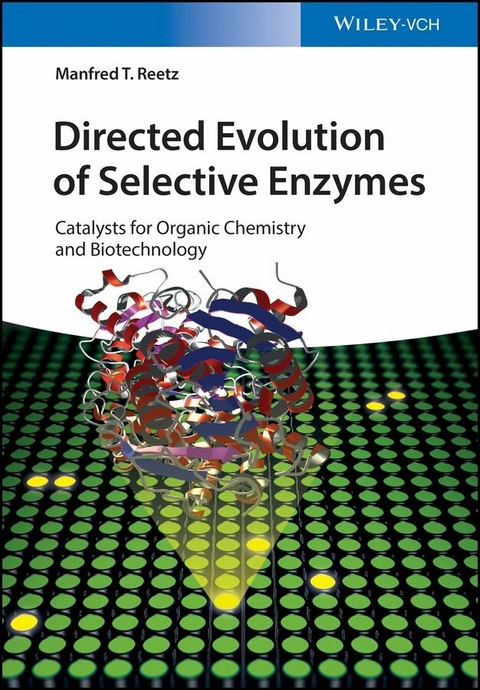
Throughout the text, emphasis is placed on methodology development to maximize efficiency, reliability and speed of the experiments and to provide guidelines for efficient protein engineering. Professor Reetz highlights the application of directed evolution experiments to address limitations in the field of enzyme selectivity, substrate scope, activity and robustness. He critically reviews recent developments and case studies, takes a look at future applications in the field of organic synthesis, and concludes with lessons learned from previous experiments.
Manfred T. Reetz is the current Hans-Meerwein-Research-Professor at the University of Marburg (Germany) and former Director and Professor Emeritus of the Max-Planck-Institut fur Kohlenforschung in Mulheim (Germany). He started his academic career in the US and returned to Germany for his doctorate, which he received in 1969 from the University of Gottingen. He was Professor at several universities in Germany and the USA and received numerous awards, including the Chirality Medal (2014), Otto Hahn Prize (2011), Tetrahedron Prize for Creativity in Organic Chemistry (2011), Arthur C. Cope Award (2009), Karl Ziegler Prize (2005) and the Leibniz Award of the German Research Council (1989). From 2007 to 2011, Reetz was Senator of the German Academy of Sciences Leopoldina. He has authored more than 550 publications, several book chapters and one book about organotitanium reagents in organic synthesis.
Manfred T. Reetz is the current Hans-Meerwein-Research-Professor at the University of Marburg (Germany) and former Director and Professor Emeritus of the Max-Planck-Institut für Kohlenforschung in Mülheim (Germany). He started his academic career in the US and returned to Germany for his doctorate, which he received in 1969 from the University of Göttingen. He was Professor at several universities in Germany and the USA and received numerous awards, including the Chirality Medal (2014), Otto Hahn Prize (2011), Tetrahedron Prize for Creativity in Organic Chemistry (2011), Arthur C. Cope Award (2009), Karl Ziegler Prize (2005) and the Leibniz Award of the German Research Council (1989). From 2007 to 2011, Reetz was Senator of the German Academy of Sciences Leopoldina. He has authored more than 550 publications, several book chapters and one book about organotitanium reagents in organic synthesis.
Cover 1
Title Page 5
Copyright 6
Contents 7
Preface 11
Chapter 1 Introduction to Directed Evolution 13
1.1 General Definition and Purpose of Directed Evolution of Enzymes 13
1.2 Brief Account of the History of Directed Evolution 16
1.3 Applications of Directed Evolution of Enzymes 28
References 29
Chapter 2 Selection versus Screening in Directed Evolution 39
2.1 Selection Systems 39
2.2 Screening Systems 56
2.3 Conclusions and Perspectives 64
References 65
Chapter 3 Gene Mutagenesis Methods 71
3.1 Introductory Remarks 71
3.2 Error-Prone Polymerase Chain Reaction (epPCR) and Other Whole-Gene Mutagenesis Techniques 72
3.3 Saturation Mutagenesis: Away from Blind Directed Evolution 82
3.4 Recombinant Gene Mutagenesis Methods 97
3.5 Circular Permutation and Other Domain Swapping Techniques 103
3.6 Solid-Phase Combinatorial Gene Synthesis for Library Creation 104
3.7 Computational Tools 108
References 113
Chapter 4 Strategies for Applying Gene Mutagenesis Methods 127
4.1 General Guidelines 127
4.2 Rare Cases of Comparative Studies 130
4.3 Choosing the Best Strategy when Applying Saturation Mutagenesis 142
4.3.1 General Guidelines 142
4.3.2 Choosing Optimal Pathways in Iterative Saturation Mutagenesis (ISM) 147
4.3.3 Systematization of Saturation Mutagenesis 154
4.3.4 Single Code Saturation Mutagenesis (SCSM): Use of a Single Amino Acid as Building Block 161
4.3.5 Triple Code Saturation Mutagenesis (TCSM): A Viable Compromise when Choosing the Optimal Reduced Amino Acid Alphabet 163
4.4 Techno-Economical Analyses of Saturation Mutagenesis Strategies 166
4.5 Combinatorial Solid-Phase Gene Synthesis: An Alternative for the Future? 171
References 172
Chapter 5 Selected Examples of Directed Evolution of Enzymes with Emphasis on Stereo- and Regioselectivity, Substrate Scope, and/or Activity 179
5.1 Explanatory Remarks 179
5.2 Collection of Selected Examples from the Literature 2010 up to 2016 201
References 201
Chapter 6 Directed Evolution of Enzyme Robustness 217
6.1 Introduction 217
6.2 Application of epPCR and DNA Shuffling 219
6.3 B-FIT Approach 223
6.4 Iterative Saturation Mutagenesis (ISM) at Protein-Protein Interfacial Sites for Multimeric Enzymes 227
6.5 Ancestral and Consensus Approaches and their Structure-Guided Extensions 228
6.6 Computationally Guided Methods 231
6.6.1 SCHEMA Approach 231
6.6.2 FRESCO Approach 233
6.6.3 FireProt Approach 235
6.6.4 Constrained Network Analysis (CNA) Approach 236
6.6.5 Alternative Approaches 238
References 239
Chapter 7 Directed Evolution of Promiscuity: Artificial Enzymes as Catalysts in Organic Chemistry 249
7.1 Introductory Background Information 249
7.2 Tuning the Catalytic Profile of Promiscuous Enzymes by Directed Evolution 257
7.3 Conclusions and Perspectives 271
References 272
Chapter 8 Learning from Directed Evolution 279
8.1 Background Information 279
8.2 Case Studies Featuring Mechanistic, Structural, and/or Computational Analyses of the Source of Evolved Stereo- and/or Regioselectivity 281
8.2.1 Epoxide Hydrolase 281
8.2.2 Ene-Reductase of the Old Yellow Enzyme (OYE) 285
8.2.3 Esterase 291
8.2.4 Cytochrome P450 Monooxygenase 294
8.3 Additive versus Non-additive Mutational Effects in Fitness Landscapes 299
References 308
Index 315
EULA 321
| Erscheint lt. Verlag | 7.9.2016 |
|---|---|
| Sprache | englisch |
| Themenwelt | Naturwissenschaften ► Chemie |
| Technik | |
| Schlagworte | Biochemie u. Chemische Biologie • Biochemistry (Chemical Biology) • bioorganic synthesis • Biotechnologie i. d. Biowissenschaften • Biotechnology • Biowissenschaften • catalysis • Chemie • Chemistry • Enzyme • Katalyse • Life Sciences • <p>selective enzymes • Methods - Synthesis & Techniques • Organic Chemistry • organic synthesis • Organische Chemie • Organische Chemie / Methoden, Synthesen, Verfahren • Organische Synthese • selective enzymes evolution</p> • synthetic organic approaches |
| ISBN-10 | 3-527-65549-2 / 3527655492 |
| ISBN-13 | 978-3-527-65549-6 / 9783527655496 |
| Informationen gemäß Produktsicherheitsverordnung (GPSR) | |
| Haben Sie eine Frage zum Produkt? |
 PDF (Adobe DRM)
Kopierschutz: Adobe-DRM
Adobe-DRM ist ein Kopierschutz, der das eBook vor Mißbrauch schützen soll. Dabei wird das eBook bereits beim Download auf Ihre persönliche Adobe-ID autorisiert. Lesen können Sie das eBook dann nur auf den Geräten, welche ebenfalls auf Ihre Adobe-ID registriert sind.
Details zum Adobe-DRM
Dateiformat: PDF (Portable Document Format)
Mit einem festen Seitenlayout eignet sich die PDF besonders für Fachbücher mit Spalten, Tabellen und Abbildungen. Eine PDF kann auf fast allen Geräten angezeigt werden, ist aber für kleine Displays (Smartphone, eReader) nur eingeschränkt geeignet.
Systemvoraussetzungen:
PC/Mac: Mit einem PC oder Mac können Sie dieses eBook lesen. Sie benötigen eine
eReader: Dieses eBook kann mit (fast) allen eBook-Readern gelesen werden. Mit dem amazon-Kindle ist es aber nicht kompatibel.
Smartphone/Tablet: Egal ob Apple oder Android, dieses eBook können Sie lesen. Sie benötigen eine
Geräteliste und zusätzliche Hinweise
Buying eBooks from abroad
For tax law reasons we can sell eBooks just within Germany and Switzerland. Regrettably we cannot fulfill eBook-orders from other countries.
aus dem Bereich