Borderlands (eBook)
John Wiley & Sons (Verlag)
978-0-7456-9683-6 (ISBN)
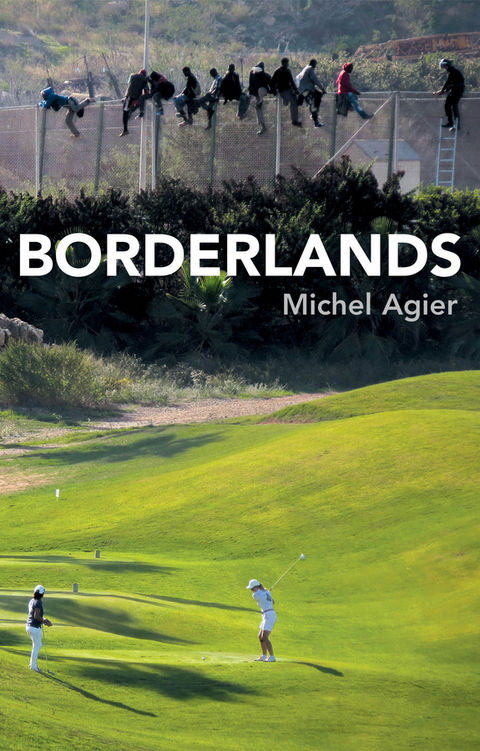
In this timely book, anthropologist Michel Agier addresses these questions and examines the character of the borderlands that emerge on the margins of nation-states. Drawing on his ethnographic fieldwork, he shows that borders, far from disappearing, have acquired a new kind of centrality in our societies, becoming reference points for the growing numbers of people who do not find a place in the countries they wish to reach. They have become the site for a new kind of subject, the border dweller, who is both 'inside' and 'outside', enclosed on the one hand and excluded on the other, and who is obliged to learn, under harsh conditions, the ways of the world and of other people. In this respect, the lives of migrants, even in the uncertainties or dangers of the borderlands, tell us something about the condition in which everyone is increasingly living today, a 'cosmopolitan condition' in which the experience of the unfamiliar is more common and the relation between self and other is in constant renewal.
Michel Agier is Director of the French Institute of Development Research and a Director of Studies at the Ecole des Hautes Etudes en Sciences Sociales (EHESS), Paris
The images of migrants and refugees arriving in precarious boats on the shores of southern Europe, and of the makeshift camps that have sprung up in Lesbos, Lampedusa, Calais and elsewhere, have become familiar sights on television screens around the world. But what do we know about the border places these liminal zones between countries and continents that have become the focus of so much attention and anxiety today, and what do we know about the individuals who occupy these places? In this timely book, anthropologist Michel Agier addresses these questions and examines the character of the borderlands that emerge on the margins of nation-states. Drawing on his ethnographic fieldwork, he shows that borders, far from disappearing, have acquired a new kind of centrality in our societies, becoming reference points for the growing numbers of people who do not find a place in the countries they wish to reach. They have become the site for a new kind of subject, the border dweller, who is both 'inside' and 'outside', enclosed on the one hand and excluded on the other, and who is obliged to learn, under harsh conditions, the ways of the world and of other people. In this respect, the lives of migrants, even in the uncertainties or dangers of the borderlands, tell us something about the condition in which everyone is increasingly living today, a 'cosmopolitan condition' in which the experience of the unfamiliar is more common and the relation between self and other is in constant renewal.
Michel Agier is Director of the French Institute of Development Research and a Director of Studies at the Ecole des Hautes Etudes en Sciences Sociales (EHESS), Paris
?In Borderlands, Michel Agier epitomizes what makes his standing unique in contemporary research: nothing less than the creation of a whole disciplinary field, empirical and theoretical, of urgent importance for our tragic present, the general anthropology of the displaced human in its multiple figures and locations, reversing traditional assessments of mobility and settlement, identity and strangeness, borders and neighbourhoods. He provides the missing link between the cosmopolitisms of yesterday and those we need for tomorrow.?
Etienne Balibar, Universite de Paris X ? Nanterre
INTRODUCTION: THE MIGRANT, THE BORDER AND THE WORLD
Since the late 1990s, migrants originating in Iraq, Afghanistan, Pakistan, Egypt, Libya, Sudan or Eritrea, more recently joined by young Palestinians from Lebanon, have found their way to the port of Patras – a small Greek town on the shore of the Ionian Sea, and the point of departure of cargo boats for Venice, Ancona and Bari in Italy. What the migrants are after here is a crossing to Europe. This is what I saw one February day in 2009, a few metres from the border control.
A group of some twenty Afghans are walking along the edge of the road outside the port. They are waiting, as they do every day, for the lorries moving slowly towards the port, to be loaded into the holds of ships that take them and their goods to Italy. When one of these lorries arrives the young people start running, a couple of them try to open the rear doors of the lorry and, if they manage to do so, hold the doors open while still running as one or two others hurriedly try to climb up. Some shouts, sometimes laughter, as this inevitably becomes almost a game. Certain drivers, annoyed by this daily exercise, sadistically play at accelerating and braking to make the climbers fall off. Stationed on the roadside is a police car, in which four policemen continue to chat as they observe the young people running a few metres away. Finally, on the other side of the road beyond a patch of grass, there is a prestige apartment block whose entire ground floor is occupied by a plate-glass window. Behind the glass you can see a fitness centre, its various apparatuses positioned so that while using them you can see what is happening outside. Side by side on the exercise bikes and treadmills are a dozen people pedalling or running on the spot while placidly watching the young Afghans in their chase behind the lorries. In their field of vision they also have the port, the ships and the sea in the distance – and very likely the police car stationed on the roadside as well.
No word is exchanged between the young Afghans and the fitness practitioners, nor is there any direct contact between the police and these migrants or refugees; the police just study their movements, trying to pick out those in the huddled group who will manage to climb up on the lorries so that when these are on the port parking lot they can make them get out, after crossing the barrier that serves as a border but still in a standby situation awaiting embarkation. There are only looks, with perhaps a few glances exchanged. And the acceleration and braking of the lorry drivers, which tell the young Afghans that they have indeed been seen and that their lives are fragile.
This silent scene has three places, three actors and three gazes. What the sum total of this symbolizes above all is a (non-)relationship and a kind of concentrate of the state of the world.
Blocked at the border
Whether running or strolling, in their wandering these young Afghan migrants embody a new figure of the foreigner, zigzagging between prohibitions. For, if the policemen who watch them seem calm, this is because the port is surrounded by a complex system of very high fences, because the lorries are minutely inspected on the parking lot before embarkation, and because on arrival in Italy those who have succeeded in crossing will be seized and sent back on the return boat. They will find themselves back in the Patras encampment. So it is harder for them to cross than for the goods under which they try to conceal themselves – a fact that we already know, though in a rather abstract way, when we compare the free circulation of goods and capital with the much harder, and sometimes even impossible, circulation of persons.
In July 2012, two dead migrants were found at the port of Venice after a forty-hour crossing in a container lorry in the hold of a ship; they had died of asphyxiation after hiding their faces in plastic bags to conceal the traces of respiration that the police ‘see’ with the aid of breathing detectors.1 Some crossings are successful, despite everything (a handful by sea, others by land routes that are longer and more exhausting), which sustains the desire and energy of those who remain blocked at the border. And for those who fail in the attempt, months and years can pass here, between the port, the encampment, the squats in the town and seasonal work in the region’s orange and olive groves. A whole life is organized in these border places, marked by the uncertainty of the moment and the immediate future, as well as the uncertainty of the gaze directed at them. When they run after the lorries they do not see the middle-class townsfolk watching them with indifference from their fitness centre, or else they make fun of them, as they laugh at the townsfolk who watch them walking along the pavement of the road alongside the port, and joke among themselves without embarrassment when a pretty girl crosses their path. They are easily recognizable by their bodies (tired, damaged, wounded), by their clothing (the impression of dirt encrusted on their clothes by time, by nights spent outdoors, by the smoke of braziers), by their manner of being (slow, almost nonchalant, with a gravity always tinged with humour) and by their odd everyday rhythms – a good deal of waiting and drowsiness until the moment comes to approach the frontier and the arriving lorries.
Indifference and solidarities
As the second actor on the stage we have those townsfolk who spend some leisure time in the fitness centre and while cycling on the spot watch the migrants running after the lorries – apparently embodying the politics of indifference. An indifference to the world that surrounds us and a loss from view of an ‘other’ about whom there seems to be nothing to think, no relationship to symbolize. This conception praises individualism, the defence of bodies, territories and private goods against a world suspected of being wretched and intrusive. The planet does not seem a common world. Most often present as a supposedly heard and shared ‘subtext’ in xenophobic and security discourse, this individual combat against a threatening world is sometimes expressed in the public and political domain in the form of cynical statements such as ‘Someone else’s place, not mine!’, or the famous ‘Not In My Back Yard’ that inspired the NIMBY urban privatization movement in Los Angeles.2
This posture harks back to the model of proprietorial politics, defined in the words of Carl Schmitt as the guarantor of delimitations and ‘spatial orders of the Earth’ along with the sovereignties associated with these: sovereignties and private territories thus found the confrontation between friend and enemy.3 In this conception, a threat is seen as coming from an ‘outside’ that is both absolute and empty, figured in the features of a shadow, that of an abstract ‘foreigner’, demographically surplus, supernumerary, and recognized only in the form of this excess. In every state, space and milieu of the planet that is relatively privileged, this politics of indifference backs up policies that protect privileged groups and dismiss this nameless ‘foreigner’. From this point of view, the same scene could have been described on the small tourist islands of Malta or Lampedusa in the Mediterranean, where welcome tourists cross paths with ‘clandestine’ immigrants, or in the Spanish enclaves of Ceuta and Melilla, or in the surroundings of Jerusalem, now walled in and entrenched from its immediate urban environment, or again somewhere close to the very long barrier between the United States and Mexico, in the towns of El Paso or Tijuana.
Of course, this depiction needs qualification. In actual fact, indifference is not automatically associated with the relatively privileged social and national place of those women and men whom policies of indifference towards displaced persons seek to enlist or claim to represent. Who exactly knows, around the port of Patras, what one of these fitness practitioners may do the next day, or even after going home the same day? In many countries over the last decade, increasingly visible solidarities have been displayed towards so-called ‘clandestine’ foreigners, either individually or by way of voluntary associations, in the form of efforts to help them, to see that they get their proper rights, and to ‘de-diabolize’ them simply by establishing contact with them. This attitude has been legitimized in terms of culture, particularly in the world of science and that of the arts (literature, theatre, cinema), where a number of new works over the last few years have aimed to understand and depict the subjectivity of undesirable foreigners.
This hospitable attitude, in a context that is globally hostile towards ‘foreigners’, is also expressed as a political alternative, even if it remains very much a minority position, in the form of activist mobilizations around asylum, the rights of foreigners, the free circulation of immigrants and their families. These are culturally heterogeneous milieus, whose motives, despite their contradictory character – more or less humanitarian or political, for example – do have effects from the point of view of the protection and integration of foreigners. It is thanks to local mobilization, moreover, and the support of a Greek association in defence of the rights of foreigners, that the Patras encampment has been able to exist for twelve years. Despite being precarious and always threatened with disappearance,...
| Erscheint lt. Verlag | 2.9.2016 |
|---|---|
| Sprache | englisch |
| Themenwelt | Geisteswissenschaften |
| Naturwissenschaften ► Geowissenschaften ► Geografie / Kartografie | |
| Sozialwissenschaften ► Ethnologie | |
| Sozialwissenschaften ► Politik / Verwaltung ► Politische Theorie | |
| Sozialwissenschaften ► Soziologie | |
| Technik | |
| Schlagworte | Anthropologie • Anthropologie / Diaspora, Migrationsforschung, Flüchtlinge • Anthropologie / Diaspora, Migrationsforschung, Flüchtlinge • Anthropology • Anthropology of Diaspora, Forced Migration & Refugeeism • Bevölkerungsentwicklung • Bevölkerungsentwicklung • Cosmopolitanism • Development Studies • Entwicklungsforschung • Entwicklung u. Globalisierung • Geographie • Geographie der Bevölkerungsentwicklung u. Migration • Geographie der Bevölkerungsentwicklung u. Migration • Geography • Geography of Population & Migration • Globalisierung • Globalization & Development • migrant crisis • Migrants • Refugees |
| ISBN-10 | 0-7456-9683-X / 074569683X |
| ISBN-13 | 978-0-7456-9683-6 / 9780745696836 |
| Informationen gemäß Produktsicherheitsverordnung (GPSR) | |
| Haben Sie eine Frage zum Produkt? |
 EPUB (Adobe DRM)
Kopierschutz: Adobe-DRM
Adobe-DRM ist ein Kopierschutz, der das eBook vor Mißbrauch schützen soll. Dabei wird das eBook bereits beim Download auf Ihre persönliche Adobe-ID autorisiert. Lesen können Sie das eBook dann nur auf den Geräten, welche ebenfalls auf Ihre Adobe-ID registriert sind.
Details zum Adobe-DRM
Dateiformat: EPUB (Electronic Publication)
EPUB ist ein offener Standard für eBooks und eignet sich besonders zur Darstellung von Belletristik und Sachbüchern. Der Fließtext wird dynamisch an die Display- und Schriftgröße angepasst. Auch für mobile Lesegeräte ist EPUB daher gut geeignet.
Systemvoraussetzungen:
PC/Mac: Mit einem PC oder Mac können Sie dieses eBook lesen. Sie benötigen eine
eReader: Dieses eBook kann mit (fast) allen eBook-Readern gelesen werden. Mit dem amazon-Kindle ist es aber nicht kompatibel.
Smartphone/Tablet: Egal ob Apple oder Android, dieses eBook können Sie lesen. Sie benötigen eine
Geräteliste und zusätzliche Hinweise
Buying eBooks from abroad
For tax law reasons we can sell eBooks just within Germany and Switzerland. Regrettably we cannot fulfill eBook-orders from other countries.
aus dem Bereich