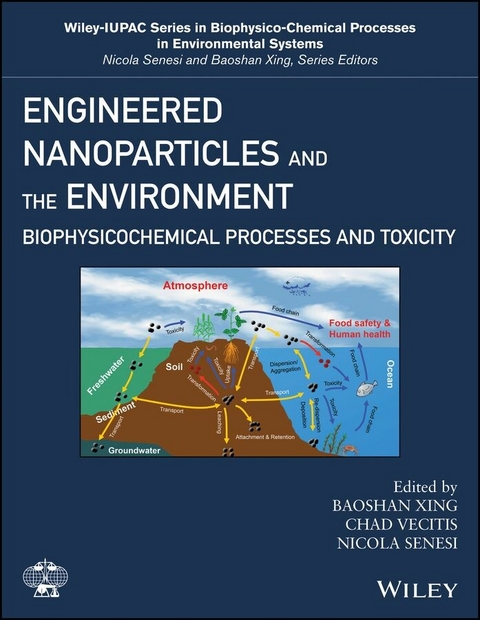
Engineered Nanoparticles and the Environment (eBook)
John Wiley & Sons (Verlag)
978-1-119-27583-1 (ISBN)
- Covers synthesis, environmental application, detection, and characterization of engineered nanoparticles
- Details the toxicity and risk assessment of engineered nanoparticles
- Includes topics on the transport, transformation, and modeling of engineered nanoparticles
- Presents the latest developments and knowledge of engineered nanoparticles
- Written by world leading experts from prestigious universities and companies
Baoshan Xing is Professor of Environmental and Soil Chemistry in Stockbridge School of Agriculture, University of Massachusetts Amherst, where he has been actively involved in teaching and research since 1996. Dr. Xing received his PhD from the University of Alberta, Canada, in 1994. His research work ranks in the top 1% of cited authors for journals in environmental sciences and ecology. Chad Vecitis is an Associate Professor of Environmental Engineering (since 2010) in the Paulson School of Engineering and Applied Sciences, Harvard University. He received his PhD from Caltech in 2009. Along with students and colleagues, he has published over 25 refereed articles. He has been invited to present his research results at many universities and institutions. Nicola Senesi is Professor Emeritus of Soil Chemistry and was Head of the Department of Agroforestal and Environmental Biology and Chemistry of the University of Bari, Bari, Italy, where he has been actively involved in research and teaching (as research assistant, assistant professor, and associate professor) since 1969. He was conferred a Doctorate Honoris Causa by the Institut National Polytechnique de Toulouse, France, in 2000.
Engineered Nanoparticles and the Environment 3
Contents 7
Series Preface 9
Preface 11
List of Contributors 13
PART I Synthesis, Environmental Application, Detection, and Characterization of Engineered Nanoparticles 17
1 Challenges Facing the Environmental Nanotechnology Research Enterprise 19
1.1 Introduction 19
1.1.1 Environmental Applications of Engineered Nanoparticles 19
1.1.2 Environmental Implications of Engineered Nanoparticles 20
1.2 Current Challenges in Environmental Nanotechnology 20
1.2.1 Physicochemical Transformations of Nanomaterials 20
1.2.2 Nanometrology in Environmental Systems 22
1.2.3 Nanotoxicology: Experimental Approaches and Modeling 28
1.2.4 Exposure Modeling for Risk Assessment 29
1.3 Conclusions 30
References 30
2 Engineered Nanoparticles for Water Treatment Application 36
2.1 Introduction: an Emerging Water Problem 36
2.1.1 Global Water Scarcity 36
2.1.2 Global Water Contamination 37
2.2 Water Purification Processes Using Nanoparticles 38
2.2.1 Nano-Sized Adsorbents 38
2.2.2 Adsorption of Water Pollutants Using Nanoparticles 39
2.3 Conclusions and Future Perspectives 42
References 44
3 Mass Spectrometric Methods for Investigating the Influence of Surface Chemistry on the Fate of Core–Shell Nanoparticles in Biological and Environmental Samples 47
3.1 Introduction 47
3.2 Core–Shell Nanoparticles 49
3.2.1 Nanoparticle Definitions 49
3.2.2 Gold Nanoparticle Synthesis 49
3.2.3 Nanoparticle Surface Chemistry Design 51
3.3 Effect of Surface Chemistry on Nanoparticle Uptake 51
3.3.1 Nanoparticle Uptake into Cells 51
3.3.2 Nanoparticle Uptake and Distributions in Fish 54
3.3.3 Nanoparticle Uptake and Distributions in Plants 55
3.4 Laser DesorptionIonization Mass Spectrometry for Tracking Nanoparticles in Complex Mixtures 56
3.4.1 Mass Spectrometry 56
3.4.2 LDI-MS of Nanoparticles 58
3.4.3 Scope of the LDI-MS Method for Detecting Other Core–Shell Nanoparticles 59
3.4.4 Multiplexed Analysis of Nanoparticles by LDI-MS 62
3.4.5 Monitoring Nanoparticle Monolayer Stability in Biological Samples 64
3.5 Summary and Conclusions 65
References 65
4 Separation and Analysis of Nanoparticles (NP) in Aqueous Environmental Samples 69
4.1 Introduction 69
4.2 Major Challenges 70
4.2.1 Low Concentration of Engineered NP 70
4.2.2 Similarity between Engineered, Natural, and Incidential NP 70
4.2.3 Associations of Engineered NP with (Nanoscale) Colloids 71
4.3 Different Approaches to Quantify Engineered NP in Environmental Matrices 71
4.3.1 Combination of “Generic” Analytical Techniques Applied after Enrichment and Separation of Engineered NP 72
4.3.2 Combination of “Specific” Analytical Techniques Applied to Bulk Samples 73
4.4 Initial Sample Preparation for Engineered NP 73
4.4.1 Sedimentation Combined with Stepwise Centrifugation 73
4.4.2 Cross-Flow/Tangential-Flow Filtration 74
4.4.3 Split Flow Thin Cell Fractionation 74
4.5 Sophisticated Sample Preparation for Engineered NP 74
4.5.1 Field-Flow Fractionation 74
4.5.2 Density-Gradient and Analytical Ultracentrifugation 75
4.5.3 Ionic Liquids, Cloud Point Extraction, and Ionic Exchange Resin 75
4.5.4 Chromatographic Methods 76
4.5.5 Electrokinetic Methods 76
4.6 Engineered NP in Different Environmental Compartments (Water, Sludge, Soils, Sediment) 76
4.6.1 Detecting Spiked Engineered NP in Environmental Matrices 76
4.6.2 Detecting “Real” Engineered NP in Environmental Matrices 80
4.7 Future Trends and Demands 81
4.8 List of Abbreviations 82
References 82
5 Nanocatalysts for Groundwater Remediation 91
5.1 Organohalides and Nitrates: Common Grounwater Contaminants 91
5.1.1 Introduction to Groundwater 91
5.1.2 Introduction to Organohalides and Nitrate 91
5.2 Conventional Physicochemical Remediation Methods 92
5.2.1 Pump-and-Treat Ex Situ Methods 92
5.2.2 In Situ Methods 93
5.2.3 Biological Remediation 95
5.3 Nanocatalyzed Degradation of Aqueous Compounds 95
5.3.1 Reductive Nanocatalysts for Aqueous Organohalide and Nitrate Remediation 96
5.3.2 Oxidative Photocatalysts for Aqueous Organohalide Remediation 101
5.4 Future Work and Conclusions 102
5.4.1 Emerging Contaminants to Consider 102
5.4.2 New Catalysts to Meet Emerging Challenges 103
References 103
PART II Environmental Release, Processes, and Modeling of Engineered Nanoparticles 109
6 Properties, Sources, Pathways, and Fate of Nanoparticles in the Environment 111
6.1 Introduction 111
6.2 Nanoparticle Classification 112
6.2.1 Definitions 112
6.2.2 Natural Nanoparticles 112
6.2.3 Engineered Nanoparticles 113
6.3 Sources of Engineered Nanoparticles in the Environment 122
6.4 Behavior and Fate of Engineered Nanoparticles 123
6.4.1 Fate in Water 123
6.4.2 Fate in Soil 125
6.5 Conclusions 126
References 126
7 Environmental Exposure Modeling Methods for Engineered Nanomaterials 134
7.1 Introduction 134
7.1.1 Focus of Chapter 136
7.2 Current Decision Support Guidance and Software: Place of Nanomaterials 136
7.2.1 Case Study 1: European Chemical Agency Guidance and the European Union System for the Evaluation of Substances 137
7.2.2 Case Study 2: Specific Advice on Fulfilling Information Requirements for Nanomaterials under REACH (RIP-oN 2) 137
7.2.3 Case Study 3: Forum for the Co-ordination of Pesticide Fate Models and Their Use Models 140
7.2.4 Regulatory Models: Conclusions 140
7.3 Representation of Nano-Specific Data for Modeling Purposes 140
7.3.1 Initial Material Characteristics 140
7.3.2 Environmental Fate and Behavior 141
7.3.3 Material Characterization at Key Exposure Points 143
7.3.4 Data Handling 143
7.3.5 Variability 143
7.3.6 Uncertainty 143
7.3.7 Unknowns/Data Gaps 144
7.3.8 Categorization 144
7.4 Modeling Techniques: Describing The Fate and Flow of Nanomaterials 144
7.4.1 Material Flow Analysis 145
7.4.2 Chemical Fate Modeling 146
7.4.3 Modeling Techniques: Conclusions 149
7.5 Future Data Requirements for The Exposure Modeling of Nanomaterials 149
7.5.1 Summary and Conclusions 151
References 151
8 Aggregation Kinetics and Fractal Dimensions of Nanomaterials in Environmental Systems 155
8.1 Introduction 155
8.2 Theoretical Framework 156
8.2.1 Collisions Between Uncharged Particles 156
8.2.2 Incorporating Surface Charge in Collision 157
8.2.3 van Der Waals Forces and Attachment 159
8.2.4 DLVO Theory Capturing Charged Particle Aggregation 160
8.2.5 Attachment Efficiency 160
8.2.6 Non-DLVO Interactions 161
8.2.7 Fractal Dimension 161
8.3 Common Experimental Techniques 162
8.3.1 Coulter Counters 163
8.3.2 Scattering Techniques 163
8.4 State of Nanoparticle Aggregation Studies 164
8.4.1 Role of Background Chemistry (Ionic Strength, pH, NOM, Exposure Media) 165
8.4.2 Role of Physical Attributes and Preparation Methods 165
8.4.3 Role of Environmental Transformations 166
8.5 Recent Advances in Aggregation Studies 168
8.5.1 Advances in Theoretical Framework and Molecular Modeling 168
8.5.2 Dynamics of Fractal Dimension 169
8.5.3 Heteroaggregation 169
8.6 Future Challenges and Research Directions 169
8.6.1 Challenges in Aggregation Modeling 170
8.6.2 Challenges from Material Attributes (Shape and Morphology) 170
8.6.3 Nanohybrids and Nanocomposites 170
8.6.4 Soft-Coating Interaction with Bio- and Geomacromolecules 170
8.6.5 Complex Matrices 170
8.6.6 Future Research Directions 170
Acknowledgments 171
Appendix: Symbols 171
References 171
9 Adsorption of Organic Compounds by Engineered Nanoparticles 176
9.1 Introduction 176
9.2 Sorption Characteristics of OCs on Different Types of ENPs 177
9.2.1 Sorption of OCs on Carbon-Based ENPs 177
9.2.2 Sorption of OCs on Other ENPs 179
9.3 The Methods Applied to Study the Adsorption Mechanisms of OCs by ENPs 180
9.3.1 pH-Dependent Sorption Analysis 180
9.3.2 Sorption Experiments in Organic Solvent 181
9.3.3 Model Chemicals and/or ENPs with Certain Structural Features 183
9.4 OC–ENP Interactions in Environment-Relevant Conditions 183
9.4.1 Effect of pH 183
9.4.2 Effect of Ionic Strength 183
9.4.3 Effect of Dissolved Organic Matter 184
9.4.4 Effect of ENPs Aggregation Status 185
9.4.5 Effect of Competing OCs 188
9.5 The Risks of OC–ENP Interaction 189
9.5.1 The Risks of OCs as Affected by ENPs 189
9.5.2 The Risks of ENPs as Affected by OCs 191
9.6 Summary and Future Perspectives 192
Acknowledgments 193
References 193
10 Sorption of Heavy Metals by Engineered Nanomaterials 198
10.1 Introduction 198
10.2 Sorption Mechanisms of Heavy Metals by ENMs 199
10.3 Sorption Kinetics of Heavy Metals by ENMs 200
10.3.1 Lagergren Pseudo First-Order Model 200
10.3.2 Lagergren Pseudo Second-Order Model 200
10.3.3 Elovich Equation 203
10.3.4 Intra-particle Diffusion Model 204
10.4 Sorption Thermodynamics of Heavy Metals by ENMs 205
10.4.1 Thermodynamic Sorption Parameters of Heavy Metals by ENMs 205
10.4.2 Thermodynamic Sorption Models 207
10.5 Factors Influencing Heavy Metal Sorption by ENMs 211
10.5.1 Influence of ENM Properties 211
10.5.2 Influence of Heavy Metal Properties 211
10.5.3 Influence of Solution Properties 213
10.6 Summary and Perspective 215
References 216
11 Emission, Transformation, and Fate of Nanoparticles in the Atmosphere 221
11.1 Introduction 221
11.2 Summary of Previous Review Articles 222
11.3 Physicochemical Characteristics of Atmospheric Nanoparticles 225
11.3.1 Nucleation Mode 225
11.3.2 Aitken Mode 225
11.3.3 Accumulation Mode 225
11.3.4 Coarse Mode 225
11.4 Emissions of Airborne Nanoparticles in Atmospheric Environment 225
11.4.1 Emissions of Naturally Produced Nanoparticles 226
11.4.2 Emissions of Incidentally Produced Nanoparticles 226
11.4.3 Emissions of Intentionally Produced Nanoparticles (ENPs) 228
11.5 Atmospheric Transformation of Natural and Incidental Nanoparticles 230
11.5.1 Through Nucleation 230
11.5.2 Through Coagulation 230
11.5.3 Through Condensation 231
11.5.4 Through Evaporation 231
11.5.5 Through Deposition 231
11.6 Fate of Naturally, Incidentally, and Intentionally Produced Nanoparticles 231
11.7 Summary and Conclusions 233
Acknowledgments 234
References 234
12 Nanoparticle Aggregation and Deposition in Porous Media 240
12.1 Introduction 240
12.2 Colloidal Interactions Governing Nanoparticle Aggregation and Deposition 241
12.2.1 Electric Double Layer Interaction 241
12.2.2 van der Waals Interaction 241
12.2.3 DLVO Theory 242
12.2.4 Non-DLVO Interactions 242
12.2.5 Unique Features of Particle Interactions at Nano-scale 243
12.3 Nanoparticle Aggregation in Aqueous Environment 244
12.3.1 Theoretical Evaluation of Nanoparticle Aggregation 244
12.3.2 Experimental Approaches for Nanoparticle Aggregation 245
12.3.3 Geometric, Environmental, and Other Factors Affecting Nanoparticle Aggregation 245
12.3.4 Environmental Implications of Nanoparticle Aggregation 248
12.4 Nanoparticle Deposition in Porous Media 249
12.4.1 Theoretic Evaluation of Nanoparticle Deposition in Porous Media 249
12.4.2 Experimental Approaches for Nanoparticles Deposition 250
12.4.3 Geometric, Environmental, and Other Factors Affecting Nanoparticle Deposition 251
12.4.4 Environmental Implication of Nanoparticle Deposition 254
12.5 Challenges in Understanding Nanoparticle Transport in Natural Environments 254
12.5.1 Detection and Quantification of Nanoparticles in Environmental Settings 255
12.5.2 Characterization of Nanoparticles in Environmental Settings 255
12.5.3 Naturally Occurring, Incidental, and Engineered Nanoparticles 256
References 256
13 Interfacial Charge Transfers of Surface-Modified TiO2 Nanoparticles in Photocatalytic Water Treatment 261
13.1 Introduction 261
13.2 Degussa P25: Origin of High Photocatalytic Activity 263
13.3 Common Strategies to Improve TiO2 Photocatalytic Activity: Surface Modificaition 265
13.3.1 Doping 265
13.3.2 Coupling with Metal Nanoparticles 267
13.3.3 Fluorination 267
13.3.4 Sensitization 268
13.4 Importance of Interparticle Charge Transfer 269
13.5 Comments on Evaluating Photocatalytic Activity 269
13.6 Conclusions 271
Acknowledgments 271
References 271
14 Chemical Transformations of Metal, Metal Oxide, and Metal Chalcogenide Nanoparticles in the Environment 277
14.1 Introduction 277
14.2 Nanoscale Properties of Materials 278
14.2.1 Surface-to-Volume Ratio 278
14.2.2 Surface Energy 278
14.2.3 Defects 279
14.2.4 Thermodynamically Stable Crystal Phases 280
14.2.5 Electronic Properties 282
14.2.6 Organic Coatings 284
14.3 Dissociative Dissolution 284
14.3.1 Effect of Nanoparticle Size on Dissolution 284
14.3.2 Examples: Zinc Oxide Nanoparticles and Copper Oxide Nanoparticles and Coatings 285
14.4 Redox Reactions 288
14.4.1 Oxidation 288
14.4.2 Reduction 295
14.5 Light-Induced Reactions 296
14.5.1 Photooxidation of Nanoparticles 297
14.5.2 Photoreduction of Nanoparticles 297
14.5.3 Phototransformations of Nanoparticle Ligands 298
14.6 Future Research Needs 298
Acknowledgments 300
References 300
PART III Toxicity of Engineered Nanoparticles and Risk Assessment 309
15 Fate, Behavior, and Biophysical Modeling of Nanoparticles in Living Systems 311
15.1 Introduction 311
15.2 Solubility and Transport of Carbon Nanoparticles in the Aqueous Environment 312
15.2.1 Measurement of Fullerene Solubility in the Presence of Gallic Acid 312
15.2.2 Molecular Dynamics Simulation of Fullerene Solvation in the Presence of Gallic Acid 312
15.2.3 Measurement of Carbon Nanomaterial Solubility in the Presence of Natural Organic Matter 313
15.2.4 Molecular Dynamics Simulations of Carbon Nanomaterial Solubility in the Presence of Natural Organic Matter 314
15.2.5 Molecular Dynamics Simulations of Graphene and Graphene Oxide Binding with Natural Amphiphiles 315
15.3 Fullerene Binding with Nucleic Acids 317
15.3.1 Polymerase Chain Reaction in the Presence of a Fullerene Derivative 317
15.3.2 Molecular Dynamics Simulation of Fullerol Binding with Nucleic Acids 317
15.4 Molecular Dynamics Simulations of DNA Polymerase Inhibition by Fullerene Derivatives 319
15.5 Fullerene Derivatives Interacting with Biomolecular Assemblies: Membranes and Microtubules 320
15.5.1 Simulations of Membrane Translocation of Pristine and Hydroxylated Fullerene 320
15.5.2 Translocation of Fullerene Derivatives Across a Plant Cell Wall 321
15.5.3 Molecular Dynamics Simulations on Microtubule Polymerization Inhibited by Fullerol 322
15.6 Silver Nanoparticle-Ubiquitin Corona 323
15.7 Summary 327
Acknowledgment 327
References 327
16 Subchronic Inhalation Toxicity Study in Rats With Carbon Nanofibers: Need for Establishing a Weight-of-Evidence Approach for Setting no Observed Adverse Effect Levels (NOAELs) 330
16.1 Introduction 330
16.2 Study Design and Material Characterization 330
16.3 Results 331
16.4 Discussion and Conclusions 333
Funding Information 335
Acknowledgments 335
References 335
17 Toxicity of Manufactured Nanomaterials to Microorganisms 336
17.1 Introduction 336
17.1.1 Manufactured Nanomaterials 336
17.1.2 Microorganisms 337
17.1.3 Exposures of Microorganisms to Manufactured Nanomaterials 337
17.1.4 Scope of the Chapter 338
17.2 Mechanisms of Effects of MNMs to Microbial Populations 338
17.2.1 Bacteria 338
17.2.2 Fungi 341
17.2.3 Viruses 343
17.2.4 Protozoa 343
17.2.5 Phytoplankton 344
17.2.6 Symbioses 344
17.3 Exposure and Effects of MNMs to Soil Microbial Communities 344
17.3.1 Soil Microorganisms and Communities 344
17.3.2 Bioavailability in Soil as a Constraint to Chemical Stressor Effects 345
17.3.3 Methods and Evidence in Assessing Effects on Community Structure and Function 345
17.3.4 Distinguishing Direct versus Indirect Toxicity inSoil 347
17.4 Exposure and Effects of MNMs to Aquatic Microbial Communities 348
17.4.1 Aquatic Microorganisms and Communities 348
17.4.2 Microbial Habitats in Aquatic Environments 348
17.4.3 Manufactured Nanomaterials in Aquatic Environments: Exposure Pathways and Expected Concentrations 349
17.4.4 Evidence for MNM Effects on Aquatic Microbial Communities 350
17.5 Ecosystem Consequences of MNM Interactions with Microorganisms 350
17.5.1 Effects of MNMs on Nutrient Cycling 350
17.5.2 Effects of MNMs on Agriculture: Plant–Microbe Symbioses in Soil Fertility 351
17.5.3 Microbe-Initiated MNM Trophic Transfer and Biomagnification 351
17.6 Biological Wastewater Treatment Consequences of MNM Effects on Microorganisms 351
17.7 Human Health Consequences of MNM Effects on Microorganisms 352
17.8 Further Remarks and Summary 353
Acknowledgments 354
References 354
18 Toxicity of Engineered Nanoparticles to Fish 363
18.1 Introduction 363
18.2 Uptake and Bioaccumulation of Engineered Nanoparticles in Fish 364
18.3 Systemic Toxicity of Engineered Nanoparticles to Fish 366
18.3.1 Developmental Toxicity 366
18.3.2 Genotoxicity 369
18.3.3 Immunotoxicity 369
18.3.4 Disruption of Lipid Metabolism 371
18.4 Specific Toxicity of Engineered Nanoparticles to Target Organs in Fish 371
18.4.1 Respiratory Toxicity 371
18.4.2 Hepatotoxicity 371
18.4.3 Hematotoxicity 372
18.4.4 Ocular and Visual System Toxicity 372
18.4.5 Neurotoxicity 372
18.5 The Influencing Factors of Engineered Nanoparticles for Their Toxicities in Fish 373
18.5.1 Nanoparticle Size 373
18.5.2 Nanoparticle Shape 374
18.5.3 Surface Coating 374
18.5.4 Exposure Media and in vivo Microenvironment 374
18.6 Toxicological Mechanism of Engineered Nanoparticles 375
18.6.1 Reactive Oxygen Species 376
18.6.2 Release of Metal Ions 377
18.7 Perspectives 378
References 378
19 Toxicity of Engineered Nanoparticles to Aquatic Invertebrates 383
19.1 Introduction 383
19.2 Silver Nanoparticles—A Matter of Dissolution 384
19.2.1 Different Faces of Silver in the Environment 384
19.2.2 Ecotoxicity of Silver Nanoparticles to Aquatic Invertebrates 385
19.3 Fullerenes—New Materials, New Effects? 386
19.3.1 Aquatic Fate and Behavior of C60 386
19.3.2 Ecotoxicity of C60 to Aquatic Invertebrates 386
19.3.3 Interaction of Fullerenes with Other Pollutants 389
19.4 Titanium Dioxide—Shedding Light on Toxicity 390
19.4.1 Acute Ecotoxicity Tests 391
19.4.2 Chronic Ecotoxicity Tests 391
19.4.3 Influence of Environmental Conditions on Toxicity Testing of TiO2 391
19.4.4 Photocatalytic Activity of TiO2 392
19.4.5 Other Subcellular Effects of TiO2 393
19.5 Role of Aquatic Invertebrates in Bioaccumulation Tests 393
19.5.1 Bioaccumulation of Gold and Metal-Containing Nanoparticles 393
19.5.2 Role of Nanoparticle Coatings and Stabilizers in Bioaccumulation 394
19.5.3 Internalization and Body Burden of Nanoparticles 394
19.6 Summary 395
References 396
20 Effects and Uptake of Nanoparticles in Plants 402
20.1 Introduction 402
20.1.1 Nanotechnology in Agriculture 402
20.1.2 Regulatory Perspective 404
20.2 Phytotoxicity of Engineered Nanoparticles 405
20.2.1 Introduction 405
20.2.2 Assays for Phytotoxicity 405
20.3 Nanoparticle Accumulation 408
20.3.1 Techniques for Detecting NPs in Plants 409
20.3.2 Metal and Metal Oxide Nanoparticle Accumulation 411
20.3.3 Carbon-Based Nanomaterial Accumulation 412
20.4 Trophic Transfer of Engineered Nanomaterials 413
20.5 Secondary Effects from Nanomaterial Exposure 414
20.6 Future Research Needs 416
20.6.1 Second- and Third-Generation NPs 416
20.6.2 Robust Acute and Chronic Toxicity Data 416
References 417
21 Feasibility and Challenges of Human Health Risk Assessment for Engineered Nanomaterials 425
21.1 Introduction 425
21.2 How Are Nanomaterials Regulated? 426
21.2.1 What Is a Nanomaterial and How to Identify It? 427
21.2.2 Relevant Legislation in the EU 427
21.2.3 Relevant Legislation in the USA and Canada 428
21.2.4 Legislation in Other OECD Countries: Australia and Japan 429
21.2.5 International Cooperation 429
21.2.6 Guidance for Nanospecific Risk Assessment 430
21.3 Hazard Identification/Characterization 431
21.4 Integrated (Intelligent) Testing Strategies 433
21.4.1 In Silico Methods 434
21.4.2 Grouping, Read-Across, and Ranking 435
21.4.3 Exposure-Based Adaptation of Hazard Information Requirements 436
21.4.4 InVitro Testing 437
21.4.5 (Optimized) In Vivo Testing 438
21.5 Exposure Assessment 439
21.5.1 Metrics—What Is Desirable? What Is Feasible? 439
21.5.2 Exposure Measurement 440
21.5.3 Exposure Modeling 441
21.5.4 Workplace Exposure 441
21.5.5 Consumer Exposure 442
21.5.6 Exposure via the Environment 442
21.6 Risk Characterization and Risk Management 442
21.6.1 Tiered Approaches 443
21.6.2 Probabilistic Approaches 444
21.6.3 Weight of Evidence 445
21.6.4 Dealing with Uncertainty 445
21.6.5 Control Banding 446
21.6.6 Thresholds of Toxicological Concern 446
21.7 Conclusion and Recommendations 447
Acknowledgments 447
References 448
22 Ecotoxicological Risk of Engineered Nanomaterials (ENMs) for the Health of the Marine Environment 458
22.1 Introduction 458
22.2 Entry of ENMs into the Marine Environment 459
22.2.1 Release Pathways 459
22.2.2 Stabilities and Behaviors of ENMs in Marine Environment 460
22.2.3 Brief Summary 462
22.3 Biotoxicity of ENMs on Marine Organisms 462
22.3.1 Studies in Marine Phytoplankton 462
22.3.2 Studies in Marine Zooplankton 476
22.3.3 Studies in Marine Fish 477
22.3.4 Studies in Marine Benthos 477
22.3.5 Studies in Marine Bacteria 478
22.3.6 Studies in Other Organisms 479
22.3.7 Brief Summary 479
22.4 Bioavailability and Bioaccumulation of ENMs in Marine Environment 480
22.4.1 Accumulation of Metal Oxide ENMs by Marine Biota 480
22.4.2 Accumulation of Metallic ENMs by Marine Biota 481
22.4.3 Accumulation of Carbon ENMs by Marine Biota 482
22.4.4 Brief Summary 483
22.5 Effects of ENMs on the Bioavailability and Toxicity of Coexisting Pollutants 483
22.6 Summary and Perspective 484
Acknowledgments 485
References 485
Index 491
EULA 509
| Erscheint lt. Verlag | 29.8.2016 |
|---|---|
| Reihe/Serie | Wiley-IUPAC Series Biophysico-Chemical Processes in Environmental Systems |
| Wiley-IUPAC Series Biophysico-Chemical Processes in Environmental Systems | Wiley Series Sponsored by IUPAC in Biophysico-Chemical Processes in Environmental Systems |
| Sprache | englisch |
| Themenwelt | Naturwissenschaften ► Chemie ► Organische Chemie |
| Technik ► Umwelttechnik / Biotechnologie | |
| Schlagworte | Arbeitssicherheit u. Umweltschutz i. d. Chemie • Biophysicochemical processes and toxicity • Chemical and Environmental Health and Safety • Chemie • Chemistry • Engineered Nanoparticles • Environment • Environmental Chemistry • Modeling • Nanopartikel • Umweltchemie • Umweltschutz |
| ISBN-10 | 1-119-27583-0 / 1119275830 |
| ISBN-13 | 978-1-119-27583-1 / 9781119275831 |
| Informationen gemäß Produktsicherheitsverordnung (GPSR) | |
| Haben Sie eine Frage zum Produkt? |
 PDF (Adobe DRM)
Kopierschutz: Adobe-DRM
Adobe-DRM ist ein Kopierschutz, der das eBook vor Mißbrauch schützen soll. Dabei wird das eBook bereits beim Download auf Ihre persönliche Adobe-ID autorisiert. Lesen können Sie das eBook dann nur auf den Geräten, welche ebenfalls auf Ihre Adobe-ID registriert sind.
Details zum Adobe-DRM
Dateiformat: PDF (Portable Document Format)
Mit einem festen Seitenlayout eignet sich die PDF besonders für Fachbücher mit Spalten, Tabellen und Abbildungen. Eine PDF kann auf fast allen Geräten angezeigt werden, ist aber für kleine Displays (Smartphone, eReader) nur eingeschränkt geeignet.
Systemvoraussetzungen:
PC/Mac: Mit einem PC oder Mac können Sie dieses eBook lesen. Sie benötigen eine
eReader: Dieses eBook kann mit (fast) allen eBook-Readern gelesen werden. Mit dem amazon-Kindle ist es aber nicht kompatibel.
Smartphone/Tablet: Egal ob Apple oder Android, dieses eBook können Sie lesen. Sie benötigen eine
Geräteliste und zusätzliche Hinweise
Buying eBooks from abroad
For tax law reasons we can sell eBooks just within Germany and Switzerland. Regrettably we cannot fulfill eBook-orders from other countries.
aus dem Bereich