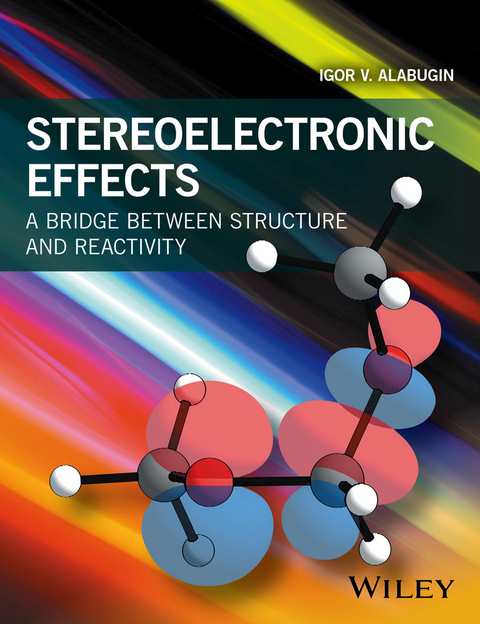
Stereoelectronic Effects illustrates the utility of stereoelectronic concepts using structure and reactivity of organic molecules
- An advanced textbook that provides an up-to-date overview of the field, starting from the fundamental principles
- Presents a large selection of modern examples of stereoelectronic effects in organic reactivity
- Shows practical applications of stereoelectronic effects in asymmetric catalysis, photochemical processes, bioorganic chemistry and biochemistry, inorganic and organometallic reactivity, supramolecular chemistry and materials science
Professor Igor V. Alabugin, Department of Chemistry and Biochemistry, Florida State University, USA
Over the last 12 years, Professor Alabugin has published a body of work dedicated to stereoelectronic effects and applied these concepts in practice to the development of new organic reactions. The wide appeal of these concepts is reflected in a large number citations for his papers on the topic (the top three papers have well over 600 citations). His expertise is in broadly defined computational and experimental organic chemistry and its applications to medicinal chemistry and materials science.
Stereoelectronic Effects illustrates the utility of stereoelectronic concepts using structure and reactivity of organic molecules An advanced textbook that provides an up-to-date overview of the field, starting from the fundamental principles Presents a large selection of modern examples of stereoelectronic effects in organic reactivity Shows practical applications of stereoelectronic effects in asymmetric catalysis, photochemical processes, bioorganic chemistry and biochemistry, inorganic and organometallic reactivity, supramolecular chemistry and materials science
Professor Igor V. Alabugin, Department of Chemistry and Biochemistry, Florida State University, USA Over the last 12 years, Professor Alabugin has published a body of work dedicated to stereoelectronic effects and applied these concepts in practice to the development of new organic reactions. The wide appeal of these concepts is reflected in a large number citations for his papers on the topic (the top three papers have well over 600 citations). His expertise is in broadly defined computational and experimental organic chemistry and its applications to medicinal chemistry and materials science.
1. Introduction
2. Direct Effects of Orbital Overlap on Reactivity
3. Beyond Orbital Overlap: Additional Factors Important For Orbital Interactions
4. Computational and Theoretical Approaches for Studies of Stereoelectronic Effects
5. General Stereoelectronic Trends. Donors, Acceptors and Chameleons
6. Stereoelectronic Effects with Donor and Acceptor Separated By A Single Bond Bridge: The Broad Spectrum of Orbital Contributions to Conformational Analysis
7. Stereoelectronic Effects with Donor and Acceptor Separated By A Vinyl Bridge
8. Remote Stereoelectronic Effects
9. Transition State Stabilization with Stereoelectronic Effects: Stereoelectronic Control of Reaction Bottlenecks
10. Stereoelectronic Effects in Reaction Design
11. Stereoelectronic Effects in Action: The Many Doors Opened By Orbital Interactions
12. Probing Stereoelectronic Effects with Spectroscopic Methods
"This book is highly recommended to every chemist and particularly to every student to work through this book. The higher understanding thus obtained in many chemical fields will be beneficial throughout every phase of chemical education and work. It should furthermore be perfectly suitable as accompanying book for an advanced course on this topic." (Angewandte, 1 February 2017)
1
Introduction
When people thought the earth was flat, they were wrong. When people thought the earth was spherical, they were wrong. But if you think that thinking the earth is spherical is just as wrong as thinking the earth is flat, then your view is wronger than both of them put together. I. Asimov
1.1 Stereoelectronic effects – orbital interactions in control of structure and reactivity
It is easy to believe that the Earth is flat when driving through the Great Plains. Furthermore, the “flat Earth” approximation works quite well in many other aspects of everyday life. Because the small deviation from planarity – only 8 inches per mile – does not make a difference for everyday activities, we can order a cup of coffee or play a game of golf without worrying about the fine details of planetary shapes. However, once one prepares to launch a satellite instead of a golf ball or to navigate “around the globe”, the planet’s curvature becomes crucial. But is Earth a globe? A closer look from space finds that Earth is not a sphere but an “oblate spheroid” that bulges at the equator. Another revision! When should refinements stop and why should a chemist care?
The story of the flat Earth, borrowed from Isaac Asimov,1 reflects the common evolution of scientific models. Sometimes, models are discarded completely (e.g. phlogiston) but, more often, they are refined and taken to the next level of applicability (such as Newton’s theory of gravity paving the way for Einstein’s theory of relativity). How does it apply to organic chemistry? How adequate are the undergraduate organic foundations for the broad understanding of structure and reactivity? Do we really need to go deeper?
The importance of continuous improvement of models is illustrated by the following “diagnostic quiz” given to first-year graduate students at the Florida State University. Take a minute and test yourself.
The answers may or may not be surprising, depending on how far the reader is separated from the undergraduate organic class. For each pair in Figure 1.1, the bottom structure is more stable than the top structure. In particular, the gauche conformation of 1,2-difluoroethane is more stable than the anti conformations; cis-difluoroethene is more stable than the trans-isomer; the equatorial conformers of the two fluoro-substituted oxacyclohexanes are less stable than their axial counterparts; and the diaxial 1,4-difluorocyclohexane is ~1 kcal/mol more stable than the diequatorial conformer. The answer in each case is opposite to expectations based on the steric repulsion – the “flat Earth” models that have served reasonably well as a foundation of undergraduate organic chemistry.
Figure 1.1 Circle the more stable structure in each of the above pairs.
It is not surprising that it is a rare undergraduate student who gives correct answers to all of the above problems. Almost invariably, the correct answers come as a surprise, even to a student with a good mastery of undergraduate organic chemistry. Clearly, a new set of concepts is needed to refine the initial model of organic structure and reactivity. This book aims to introduce these concepts in a way that will provide a logical ascension from a simplified discussion of an undergraduate textbook to a level appropriate for a practicing organic chemist.
Undergraduate organic chemistry lays the foundation of chemical knowledge – a reasonable approximation and a useful and often sufficient way to describe molecules as Lewis structures augmented, as needed, by resonance. However, once one realizes that organic molecules are quantum objects delocalized in space, far from the flat two-dimensional drawings on a sheet of paper or a blackboard, it may not be a complete surprise that this simple concept has its limitations.
The way to get to the next step in understanding molecular structure is to move from the flat Lewis structures on a flat sheet of paper to the 3rd dimension. The elements of stereochemistry are introduced, of course, in undergraduate courses. However, this important step is not enough – when one needs to design, understand, and control new reactions, it is crucial to start thinking about organic molecules as intrinsically delocalized and spatially anisotropic quantum objects. This book focuses on the importance of delocalization – the deviation of real molecules, quantum objects par excellence, from idealized Lewis structures.
The laws of chemical attraction in the world of atoms and molecules are defined by quantum mechanics. Constructive interference of electronic wavefunctions is the quantum essence of chemical bonding that “glues” smaller fragments into larger molecular assemblies. As a result, the chemical world at the molecular level is defined by interactions between atomic and molecular orbitals. Because orbitals and molecules are three-dimensional, such interactions depend on the relative atomic arrangements in space. The modulations of electronic interactions by changes in molecular geometry are generally referred to as stereoelectronic effects. In organic chemistry, stereoelectronic effects can be defined as stabilizing electronic interactions maximized by a particular geometric arrangement which can be traced to a favorable orbital overlap. Stereoelectronic interactions are omnipresent in chemistry, as only a small subgroup of electronic effects, i.e. the long-range2 electrostatic effects, can be considered, with a degree of approximation, as not having a substantial stereoelectronic component.
There is one common misunderstanding that needs to be addressed early: “stereoelectronic” is not the same as “steric + electronic”! By definition, stereoelectronic effects are always stabilizing, reflecting increased delocalization at favorable conformations. Repulsive steric interactions also depend on the arrangement of orbitals in space but, historically, are not included under the umbrella of stereoelectronic effects.
Stereoelectronic factors control interactions between different atoms or molecules and interactions between different parts of a single molecule. Although our focus will be on the latter, we will also briefly illustrate the fundamentals of intermolecular interactions, because they broaden the conceptual foundation for subsequent discussion and illustrate the key patterns for orbital overlap without intramolecular constraints being imposed on the geometries.
Understanding the role of orbital interactions can be beneficial from the practical perspective. For example, the symmetry of frontier molecular orbitals can explain why thermal [2 + 2] cycloaddition fails, whereas the analogous reaction of transition metal alkylidenes, compounds that can be described as having a metal–carbon double bond, proceeds efficiently under mild conditions (Figure 1.2). In this case, an extra orbital node is the difference between a failed reaction and a Nobel Prize!
Figure 1.2 The striking effect of orbital symmetry on [2 + 2] cycloadditions.
1.2 Orbital interactions in theoretical chemistry
The concept of stereoelectronic effects resulted from the cross-pollination of quantum-mechanical ideas (both valence bond, VB and molecular orbital, MO) with the three-dimensional thinking of organic chemists. The involvement of orbitals evolved over the 20th century from the qualitative ideas of Lewis and Pauling through the approximations of Hückel and semi-empirical treatments to the sophisticated accuracy of modern multiconfigurational approaches. However, even the most complex wavefunctions can still be analyzed in terms of individual orbitals using such methods as natural bond orbital (NBO) analysis (introduced in Chapter 4). Such dissection allows one to recover the basic Lewis concepts that seem to be lost in the mathematical jungle and to use them as a foundation for developing the deeper understanding of electronic structure.
In parallel, experimental organic chemistry grew in scope and sophistication. A large body of information was acquired allowing precise measurements of molecular geometries, spectroscopic parameters, and reaction kinetics to provide the necessary basis for the fruitful application of stereoelectronic ideas on a quantitative basis.
The accuracy of computational methods has started to rival experimental measurements, but finding the optimal compromise between computational accuracy and cost is an ever-moving target. Time-resolved experimental techniques allow understanding reactivity on the fly, accessing increasingly exotic and increasingly unstable species with even transition states3 and, more recently, hilltops on potential energy surfaces4 succumbing to experimental scrutiny. This is a productive interplay. Experiments are important for benchmarking and testing theory,5 whereas theory is useful in guiding and streamlining experiments.
1.3 The birth of stereoelectronic concepts in organic chemistry
Initially, even the simple 3D description of molecules was a controversial idea. In fact, Van’t Hoff’s 1874 book La chimie dans l’espace was ridiculed by such eminent chemists as Adolph Kolbe, the editor of the Journal für Praktische Chemie, who stated:
A Dr. H....
| Erscheint lt. Verlag | 23.8.2016 |
|---|---|
| Sprache | englisch |
| Themenwelt | Naturwissenschaften ► Chemie ► Organische Chemie |
| Naturwissenschaften ► Chemie ► Physikalische Chemie | |
| Naturwissenschaften ► Chemie ► Technische Chemie | |
| Technik | |
| Schlagworte | Biomaterial • Biomaterialien • biomaterials • biomedical engineering • Biomedizintechnik • Catalysis • Chemie • Chemistry • conformation • ConjugationHyperconjugation • Functional Group • molecular structure • Pharmaceutical & Medicinal Chemistry • Pharmazeutische u. Medizinische Chemie • Physical Organic Chemistry • Physikalische Organische Chemie • Reactivity • selectivity • spectroscopy • Stereoelectronic Effects • Stereoelektronische Effekte |
| ISBN-13 | 9781118906361 / 9781118906361 |
| Informationen gemäß Produktsicherheitsverordnung (GPSR) | |
| Haben Sie eine Frage zum Produkt? |
 EPUB (Adobe DRM)
Kopierschutz: Adobe-DRM
Adobe-DRM ist ein Kopierschutz, der das eBook vor Mißbrauch schützen soll. Dabei wird das eBook bereits beim Download auf Ihre persönliche Adobe-ID autorisiert. Lesen können Sie das eBook dann nur auf den Geräten, welche ebenfalls auf Ihre Adobe-ID registriert sind.
Details zum Adobe-DRM
Dateiformat: EPUB (Electronic Publication)
EPUB ist ein offener Standard für eBooks und eignet sich besonders zur Darstellung von Belletristik und Sachbüchern. Der Fließtext wird dynamisch an die Display- und Schriftgröße angepasst. Auch für mobile Lesegeräte ist EPUB daher gut geeignet.
Systemvoraussetzungen:
PC/Mac: Mit einem PC oder Mac können Sie dieses eBook lesen. Sie benötigen eine
eReader: Dieses eBook kann mit (fast) allen eBook-Readern gelesen werden. Mit dem amazon-Kindle ist es aber nicht kompatibel.
Smartphone/Tablet: Egal ob Apple oder Android, dieses eBook können Sie lesen. Sie benötigen eine
Geräteliste und zusätzliche Hinweise
Buying eBooks from abroad
For tax law reasons we can sell eBooks just within Germany and Switzerland. Regrettably we cannot fulfill eBook-orders from other countries.
aus dem Bereich