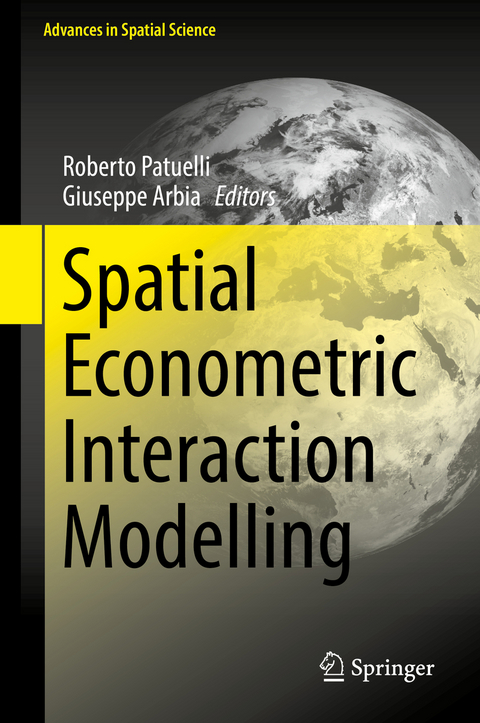
Spatial Econometric Interaction Modelling (eBook)
XI, 468 Seiten
Springer International Publishing (Verlag)
978-3-319-30196-9 (ISBN)

Roberto Patuelli is Associate Professor for Economic Policy in the Department of Economics, University of Bologna, Italy. He holds an M.A. from George Mason University, USA, and a Ph.D. from Vrije Universiteit Amsterdam, Netherlands.
Roberto Patuelli is Associate Professor for Economic Policy in the Department of Economics, University of Bologna, Italy. He holds an M.A. from George Mason University, USA, and a Ph.D. from Vrije Universiteit Amsterdam, Netherlands. Giuseppe Arbia (Ph.D. Cantab) is Full Professor of Economic Statistics in the Department of Statistical Sciences, Università Cattolica del Sacro Cuore Roma, Italy; Lecturer in Statistics at Università della Svizzera Italian, Lugano (CH), and Research Professor at the College of William & Mary, Wiliamsburg, Virginia (US).
Preface 6
Contents 8
Contributors 10
1 Spatial Econometric Interaction Modelling: Where Spatial Econometrics and Spatial Interaction Modelling Meet 13
1.1 The Spatial Interaction Model: An Established Regional Economics Workhorse 13
1.2 Spatial Interaction and Flow Dependence 15
1.3 Towards a New Class of Spatial Interaction Models 16
1.4 The Structure of the Book 19
References 22
Part I General Methodological Issues 25
2 Spatial Regression-Based Model Specifications for Exogenous and Endogenous Spatial Interaction 26
2.1 Introduction 26
2.2 The Log-Normal (Independent) Spatial Interaction Model 28
2.3 Exogenous Versus Endogenous Spatial Interaction Specifications 30
2.3.1 An Endogenous Spatial Interaction Specification 30
2.3.1.1 A Theoretical Motivation for Endogenous Interaction 31
2.3.2 An Exogenous Spatial Interaction Specification 33
2.4 Interpreting Estimates From Spatial Interaction Specifications 34
2.4.1 Interpreting Estimates from Non-Spatial Interaction Specifications 35
2.4.2 Interpreting Estimates from Exogenous Interaction Specifications 38
2.4.3 Interpreting Estimates from Endogenous Interaction Specifications 39
2.5 An Applied Illustration Involving Movement of Teachers Between School Districts 41
2.6 Conclusion 46
References 47
3 Constrained Variants of the Gravity Model and Spatial Dependence: Model Specification and Estimation Issues 48
3.1 Introduction 48
3.2 Unconstrained and Constrained Classes of Gravity Models: The Classical View 51
3.3 Poisson Versions of the Constrained Gravity Models 55
3.4 Accounting for Spatial Dependence in the Model Specifications 58
3.5 Equivalency Relationships Between the Balancing Factors, Fixed Effects, and Random Effects 61
3.5.1 Comparisons Between Balancing Factors and Fixed Effects 61
3.5.2 Comparisons Between Balancing Factors and Random Effects 63
3.6 An Illustrative Example 65
3.6.1 Model Specifications Ignoring Spatial Dependence in origin-destination Flows 66
3.6.2 Spatial Filter Model Specifications Accounting for Spatial Dependence in Flows 71
3.7 Concluding Remarks 75
Appendix: Results for the Estimation of Singly Constrained Random Effects Specifications 75
References 76
4 Testing Spatial Autocorrelation in Weighted Networks: The Modes Permutation Test 78
4.1 Introduction 78
4.2 Spatial Autocorrelation in Weighted Networks 79
4.2.1 Local Covariance and the Exchange Matrix 79
4.2.2 Spatial Filtering and Spatial Modes 80
4.2.3 The Modes Permutation Test 82
4.2.3.1 Heterodasticity of the Spatial Field 82
4.2.3.2 Homoscedaticity of the Spatial Modes 83
4.2.3.3 The Test 83
4.2.4 Illustration: Swiss Migratory and Linguistic Data 85
4.3 Adjacency Graphs and Accessibilities 87
4.3.1 Proposal A: Simple Rescaling with Diagonal Adjustment 87
4.3.2 Proposal B: Time-Embeddable Exchange Matrices 88
4.3.3 Illustration: The Distribution of Blood Group a in Eire 90
4.4 Conclusion 90
Appendix 91
References 92
5 Effects of Scale in Spatial Interaction Models 95
5.1 Introduction 95
5.2 Literature Review 97
5.3 A Formalization of MAUP in Spatial Gravity Models 97
5.3.1 Case a: Ô and D? Are Non Stochastic 99
5.3.2 Case b: Ô and D? Are Stochastic and Independent 100
5.3.3 Case c: Ô and D? Are Stochastic, Spatially Autocorrelated and Mutually Independent 101
5.3.4 Case d: Ô and D? Are Stochastic, Spatially Autocorrelated and Mutually Dependent 102
5.4 Analysis of Artificial Data 104
5.5 Conclusions and Research Priorities 110
References 111
Part II Specific Methodological Issues 112
6 Dealing with Intraregional Flows in Spatial Econometric Gravity Models 113
6.1 Introduction 113
6.2 The Spatial Econometric Gravity Model 114
6.3 Issues with Intraregional Flows 116
6.3.1 Intraregional Distance 116
6.3.2 Unobserved Intraregional Flow Data 117
6.3.2.1 The Heckit-Type Model 117
6.3.2.2 EM Algorithm Model 118
6.4 Empirical Application 119
6.4.1 Data 119
6.4.2 Results 120
6.5 Experimental Analysis of the Difference in Nature 123
6.6 Conclusion 125
References 126
7 A Bayesian Spatial Interaction Model Variant of the Poisson Pseudo-Maximum Likelihood Estimator 128
7.1 Advantages of PPML for Spatial Interaction Modeling 128
7.2 A Spatial Extension of the PPML Model 130
7.3 Estimating the PPML Model 133
7.4 An Application to Commuting Flows 137
7.4.1 Higher-Order Neighbors 144
7.5 Conclusion 148
References 149
8 The Space of Gravity: Spatially Filtered Estimation of a Gravity Model for Bilateral Trade 151
8.1 Introduction 151
8.2 The Gravity Model and Autocorrelation 153
8.2.1 Theoretical Gravity 154
8.2.2 Practical Gravity 155
8.2.3 Consistent Estimation and Autocorrelation 157
8.3 Recent Developments in Estimating the Theoretical Gravity Model of Trade 158
8.4 Proposed Methodology: Spatial Filtering Estimation 159
8.5 Spatial Autocorrelation Diagnostics 162
8.6 Empirical Application 164
8.6.1 Data and Model Specification 164
8.6.2 Estimation Results: Spatial Filtering and Benchmark Models 165
8.6.3 Testing for Spatial Autocorrelation 168
8.7 Conclusions 171
Appendix 172
References 173
9 A Spatial Interaction Model with Spatially Structured Origin and Destination Effects 176
9.1 Introduction 176
9.2 Empirical Modeling of Commodity Flows 179
9.2.1 Conventional Gravity Models 179
9.2.2 A Bayesian Hierarchical Gravity Model 181
9.2.3 Related Spatial Effects Models 184
9.2.4 MCMC Estimation of the Model 185
9.3 A Data Generated Example 188
9.4 An Application to Commodity Flows Between Spanish Regions 190
9.4.1 The Data 191
9.5 Conclusions 199
Appendix: Details Regarding the MCMC Sampler 199
References 201
10 Bayesian Variable Selection in a Large Vector Autoregression for Origin-Destination Traffic Flow Modelling 203
10.1 Introduction 203
10.1.1 A VAR Model for Traffic Flows 205
10.1.2 Bayesian VARs 205
10.1.3 Bayesian Variable Selection 206
10.2 Bayesian Variable Selection in VAR 207
10.2.1 The Model 207
10.2.2 The Latent Binary Selection Vector 211
10.2.3 The Priors 211
10.2.4 The Posterior 214
10.2.5 The Sampling Procedure 215
10.3 A Simulation Study 217
10.4 Concluding Remarks 222
Appendix 1 223
Appendix 2 225
References 226
11 Double Spatial Dependence in Gravity Models: Migration from the European Neighborhood to the European Union 228
11.1 Introduction: 150 Years of Gravity 228
11.2 Theory 232
11.2.1 Origins and Destinations 232
11.2.2 Spatial Gravity 234
11.2.3 Spatial Multilateralism 235
11.3 The Econometrics of Spatial Gravity Modeling 235
11.3.1 Double Spatial Lagged Dependent Variables 235
11.3.2 Spatial Autocorrelation 236
11.3.3 Spatially Robust Standard Errors for Gravity Models 236
11.3.4 Spatial Autoregressive Conditional Heteroskedasticity (SpARCH) 237
11.4 The European Neighborhood 238
11.5 Immigration Theory 240
11.5.1 Stocks and Flows 243
11.5.2 Push and Pull Factors 244
11.6 Results 245
11.7 Conclusions 247
Appendix: Data Sources 248
References 253
12 Multilateral Resistance and the Euro Effects on Trade Flows 255
12.1 Introduction 255
12.2 Literature Review 257
12.3 Cross Sectionally Dependent Panel Gravity Models 259
12.4 Empirical Results 263
12.5 Conclusion 276
12.6 The Data Appendix 276
References 278
Part III Applications 281
13 The Effects of World Heritage Sites on Domestic Tourism: A Spatial Interaction Model for Italy 282
13.1 Introduction 282
13.2 Modelling Tourism Flows: Spatial Interaction Models 285
13.3 Cultural Heritage, WHS Endowment and Tourism: The Evidence 287
13.3.1 Cultural Heritage and Tourism 287
13.3.2 WHS Endowment and Tourism 288
13.4 Model and Estimation Strategy 291
13.4.1 Model 291
13.4.2 Estimation 296
13.4.3 Spatial Sensitivity Analysis: An Interpretative Framework 298
13.5 Empirical Application 301
13.5.1 Data 301
13.5.2 Model Results 303
13.5.3 Spatial Sensitivity Analysis 307
13.6 Conclusions 309
Appendix 311
References 313
14 Testing Transport Mode Cooperation and Competition Within a Country: A Spatial Econometrics Approach 317
14.1 Introduction 317
14.2 Trade, Transport Flows and Logistics 319
14.3 A Conceptual Framework for Competition and Cooperation Between Transport Modes 321
14.3.1 Transport Mode Competition 322
14.3.2 Transport-Mode Cooperation 322
14.4 The Empirical Strategy 324
14.4.1 Transport Mode Competition 327
14.4.1.1 A Basic Gravity Equation for Testing Transport Mode Competition 327
14.4.1.2 An Extended Gravity Equation with Cross-Sectional Dependence 328
14.4.2 Hub-Spoke Structures and Transit Flows 331
14.5 Data 334
14.6 Descriptive Analysis 338
14.7 Econometric Analysis 343
14.7.1 Aggregate Flows by Modes 343
14.7.2 Product-Specific Flows 350
14.8 Conclusions 354
Appendix 355
Comments on the Data 360
First Debugging Procedure for Transport Flows in Tons 361
Estimating Interregional Trade Prices 362
References 362
15 Modeling the Effect of Social-Network on Interregional Trade of Services: How Sensitive Are the Results to Alternative Measures of Social Linkages 365
15.1 Introduction 365
15.2 Trade and Social Networks: Background and Definitions 369
15.3 The Empirical Model 372
15.3.1 Spatial and Demographic Dependence Affecting Gravity-Model Estimates 373
15.3.2 Introducing Spatial and Network Effects in the Gravity Model 374
15.3.3 Alternative Spatial Models for Origin and Destination Flows 375
15.3.3.1 A Spatial Lag Model 376
15.3.3.2 A Spatial Error Model 377
15.3.3.3 A Spatial Durbin Model 378
15.3.3.4 A Spatial General Model 378
15.4 An Application to Spanish Domestic Trade in Certain Service Sectors 379
15.4.1 The Data 379
15.4.2 Alternative Measures for Capturing the Pro-Trade Effect of Social Networks 383
15.4.3 Estimation Results 388
15.4.4 Results Using Alternative Measures for Social Networks 406
15.5 Conclusions 408
Appendix 409
References 413
16 On the Mutual Dynamics of Interregional Gross Migration Flows in Space and Time 415
16.1 Introduction 415
16.2 Neoclassical Migration Model with a Spatial Dimension 416
16.3 Econometric Specification 419
16.4 Data and Regression Results 421
16.4.1 Variable Definition and Data Properties 421
16.4.2 Regression Results, Summary Measures and Multiplier Analysis 426
16.4.3 Robustness Checks 433
16.5 Conclusion 435
Variable Definitions 436
References 438
17 Residential Relocation in a Metropolitan Area: A Case Study of the Seoul Metropolitan Area, South Korea 440
17.1 Introduction 440
17.2 Literature Review 441
17.3 Study Area: The Seoul Metropolitan Area 443
17.4 Methodology 447
17.4.1 Spatial Interaction Models for Residential Relocation 447
17.4.2 Model Specification 449
17.5 Results 452
17.6 Conclusions 458
References 459
18 Conclusions: The Future of Spatial Interaction Modelling 463
18.1 A Reappraisal of the Presented Contributions 463
18.2 Future Roads of Spatial Interaction 464
References 465
| Erscheint lt. Verlag | 25.7.2016 |
|---|---|
| Reihe/Serie | Advances in Spatial Science | Advances in Spatial Science |
| Zusatzinfo | XI, 468 p. 66 illus., 51 illus. in color. |
| Verlagsort | Cham |
| Sprache | englisch |
| Themenwelt | Naturwissenschaften ► Geowissenschaften ► Geografie / Kartografie |
| Technik | |
| Wirtschaft ► Volkswirtschaftslehre | |
| Schlagworte | Economic Geography • Gravity Modeling • Regional Science • spatial analysis • Spatial econometrics • Spatial Interaction |
| ISBN-10 | 3-319-30196-9 / 3319301969 |
| ISBN-13 | 978-3-319-30196-9 / 9783319301969 |
| Informationen gemäß Produktsicherheitsverordnung (GPSR) | |
| Haben Sie eine Frage zum Produkt? |
 PDF (Wasserzeichen)
DRM: Digitales Wasserzeichen
Dieses eBook enthält ein digitales Wasserzeichen und ist damit für Sie personalisiert. Bei einer missbräuchlichen Weitergabe des eBooks an Dritte ist eine Rückverfolgung an die Quelle möglich.
Dateiformat: PDF (Portable Document Format)
Mit einem festen Seitenlayout eignet sich die PDF besonders für Fachbücher mit Spalten, Tabellen und Abbildungen. Eine PDF kann auf fast allen Geräten angezeigt werden, ist aber für kleine Displays (Smartphone, eReader) nur eingeschränkt geeignet.
Systemvoraussetzungen:
PC/Mac: Mit einem PC oder Mac können Sie dieses eBook lesen. Sie benötigen dafür einen PDF-Viewer - z.B. den Adobe Reader oder Adobe Digital Editions.
eReader: Dieses eBook kann mit (fast) allen eBook-Readern gelesen werden. Mit dem amazon-Kindle ist es aber nicht kompatibel.
Smartphone/Tablet: Egal ob Apple oder Android, dieses eBook können Sie lesen. Sie benötigen dafür einen PDF-Viewer - z.B. die kostenlose Adobe Digital Editions-App.
Buying eBooks from abroad
For tax law reasons we can sell eBooks just within Germany and Switzerland. Regrettably we cannot fulfill eBook-orders from other countries.
aus dem Bereich