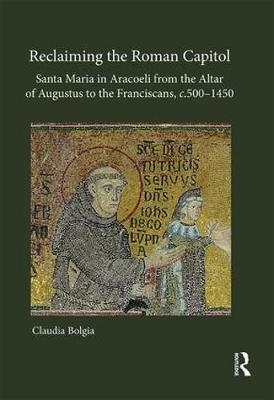
Reclaiming the Roman Capitol: Santa Maria in Aracoeli from the Altar of Augustus to the Franciscans, c. 500–1450
Routledge (Verlag)
978-1-4094-1761-3 (ISBN)
Claudia Bolgia is Senior Lecturer in History of Art at the University of Edinburgh. She has published extensively on medieval Rome and Franciscan Art and Architecture in a range of international peer-reviewed journals. Co-editor, with Rosamond McKitterick and John Osborne, of Rome across Time and Space: Cultural Translation and the Exchange of Ideas, c. 500-1400 (2011), her research has attracted major Fellowships, including Villa I Tatti – The Harvard University Center for Italian Renaissance Studies (2009–10), The British School at Rome (2012–14), CASVA – The Center for Advanced Study in the Visual Arts (2016–17), The Newberry Library (2016–17), and The Leverhulme Trust (2017–18).
Introduction
From Isis to Mary: The Arx and its surroundings from Antiquity to the Middle Ages
1 Before the Franciscans: The previous churches on the site
- Cunctarum prima quae fuit orbe sita: Literary, documentary, and epigraphic evidence from the earliest times to the thirteenth century
- From S. Maria in Capitolio to S. Maria in Aracoeli: the title
- Archaeological evidence from the earliest times to the thirteenth century
- The previous churches and their relationship with the Franciscan building
- Early medieval church furniture
- The obelisk
- The cloisters
- Conclusion
2 The Franciscan ‘appropriation’ of the Arx
- Franciscan foundations in thirteenth- and fourteenth-century Europe
- The Franciscans in Rome and their new headquarters
- The ara coeli
- The monument and its ‘meaning’
- The ara coeli ‘confessio’: Art for the Benedictines or the Franciscans?
- New and old cults before the construction of the new church
3 The New Franciscan Church: Between tradition and innovation
- An architectural analysis of the medieval building
- Nave and aisles
- Transept
- Chapel L9
- Original main chapel
- Façade
- The decoration of the apse and the Franciscan promotion of the legend of Augustus from Rome to Finland
- Marble workshop: Window tracery
- Transmission and reception of formal ideas: Artistic exchanges between Rome and England in the thirteenth century
- The magister principalis and the builders
- The deployment of Spolia and Franciscan ideas
- New and old cults in the new Franciscan church: paths for faithful and pilgrims
4 The ‘extended’ space of the Franciscan church: S. Maria in Aracoeli as a lived social and political place
- The ‘extended’ space of the church exterior
- The original side-entrance and the guardianship of the minors
- Preaching, politics, and religious tribunals
- The ‘extended’ space of the church interior
- Inner appearance and family chapels
- Burying in the Franciscan church
- Between ‘public’ and ‘private’ in the Rome of the popular regime: Francesco Felici’s icon tabernacle and family chapel (1372)
- Beyond Rome: the Legend of Augustus and the Aracoeli icon in Fourteenth- and early Fifteenth-century Siena
Conclusions
Appendix: chart of intercolumniations
| Erscheinungsdatum | 12.07.2017 |
|---|---|
| Zusatzinfo | 34 Line drawings, black and white; 40 Halftones, color; 184 Halftones, black and white; 40 Illustrations, color; 218 Illustrations, black and white |
| Verlagsort | London |
| Sprache | englisch |
| Maße | 174 x 246 mm |
| Gewicht | 1700 g |
| Themenwelt | Kunst / Musik / Theater |
| Schulbuch / Wörterbuch ► Wörterbuch / Fremdsprachen | |
| Geschichte ► Allgemeine Geschichte ► Mittelalter | |
| Geisteswissenschaften ► Geschichte ► Regional- / Ländergeschichte | |
| Naturwissenschaften ► Biologie ► Ökologie / Naturschutz | |
| Technik ► Architektur | |
| ISBN-10 | 1-4094-1761-1 / 1409417611 |
| ISBN-13 | 978-1-4094-1761-3 / 9781409417613 |
| Zustand | Neuware |
| Informationen gemäß Produktsicherheitsverordnung (GPSR) | |
| Haben Sie eine Frage zum Produkt? |
aus dem Bereich