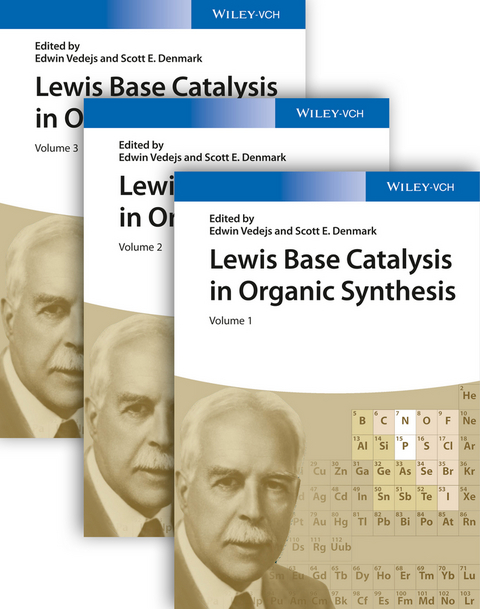
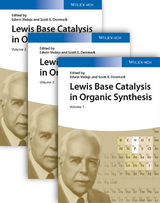
Lewis Base Catalysis in Organic Synthesis (eBook)
Wiley-VCH Verlag GmbH & Co. KGaA
978-3-527-67517-3 (ISBN)
Introductory Price £300 / ?399 / $540, valid until December 31, 2016, thereafter £340 / ?449 / $605
This three-volume set represents the first comprehensive coverage of the rapidly expanding field of Lewis base catalysis that has attracted enormous attention in recent years. Lewis base catalysis is a conceptually novel paradigm that encompasses an extremely wide variety of preparatively useful transformations and is particularly effective for enantioselectively constructing new stereogenic centers. As electron-pair donors, Lewis bases can influence the rate and stereochemical course of myriad synthetic organic reactions. The book presents the conceptual/mechanistic principles that underlie Lewis base catalysis, and then builds upon that foundation with a thorough presentation of many different reaction types. And last but not least, the editors, Prof. Edwin Vedejs and Prof. Scott E. Denmark, are without doubt the leaders in this emerging field and have compiled high quality contributions from an impressive collection of international experts.
Edwin Vedejs was born in 1941 in Riga, Latvia. After completion of his BS (University of Michigan, 1962) and PhD (University of Wisconsin, 1966), he spent a postdoctoral year with E. J. Corey at Harvard. Prof. Vedejs then joined the chemistry faculty at the University of Wisconsin (1967). In 1999, he returned to the University of Michigan as the Moses Gomberg Professor of Chemistry. Work in the Vedejs group combines topics at the interface of methodology, total synthesis, heterocycle chemistry, stereochemistry, and related mechanistic studies. Prof. Vedejs has won several awards: Alexander von Humboldt Senior Scientist Award, 1984; Professore a Contratto, University of Bologna, Italy, 1988; Helfaer Professor, 1991-1996 (UW); Pharmacia&Upjohn Teaching Award, 1996 (Chemistry Dept, UW). Robert M. Bock Professor (UW), 1997-98; Paul Walden Medal, Riga Technical University (1997); H. C. Brown Award for Creative Research in Synthetic Methods, 2004 (ACS). Grand Medal of the Latvian Academy of Sciences, 2005. Order of the Three Stars, Latvia, 2006. Honorary Doctorate, Riga Technical University 2010.
Scott E. Denmark was born in New York on 17 June 1953. He obtained an S. B. degree from M.I.T. in 1975 and a D. Sc. Tech degree in 1980 from the ETH-Zurich under the direction of Professor Albert Eschenmoser. That same year he began his career as assistant professor at the University of Illinois. He was promoted to associate professor in 1986, full professor in 1987 and then in 1991 named the Reynold C. Fuson Professor of Chemistry. Professor Denmark?s research interests focus on the invention of new synthetic reactions and elucidating the origins of stereocontrol in novel, asymmetric transformations. He has pioneered the concept of chiral Lewis base activation of Lewis acids for catalysis in main group chemistry. His group has also developed palladium-catalyzed cross-couplings with organofunctional silicon compounds. In addition he is well-known for the development and application of tandem cycloadditions of nitroalkenes for the synthesis of complex natural and unnatural nitrogen containing compounds. In recent years, his group has investigated the use of chemoinformatics to identify and optimize catalysts for a variety of organic and organometallic reactions. Professor Denmark has won a number of honors for both research and teaching including: an NSF Presidential Young Investigator Award, A. C. Cope Scholar Award (ACS), Alexander von Humboldt Senior Scientist Award, Pedler Lecture and Medal (RSC), the ACS Award for Creative Work in Synthetic Organic Chemistry, the Yamada-Koga Prize, the Prelog Medal (ETH-Zurich), the H. C. Brown Award for Creative Research in Synthetic Methods (ACS), Robert Robinson Lecture and Medal (RSC), the ISHC Senior Award in Heterocyclic Chemistry, Paul Karrer Lectureship (Uni Zurich), the Frederic Stanley Kipping Award for Research in Silicon Chemistry (ACS), and the Harry and Carol Mosher Award (Santa Clara Section, ACS). He is a Fellow of the Royal Society of Chemistry and the American Chemical Society. He edited Volume 85 of Organic Syntheses, was Editor of Volumes 22-25 of Topics in Stereochemistry and was a founding Associate Editor of Organic Letters (1999-2004). After serving on the editorial board from 1994-2003, he became Editor in Chief and President of Organic Reactions, Inc. in 2008.
Edwin Vedejs was born in 1941 in Riga, Latvia. After completion of his BS (University of Michigan, 1962) and PhD (University of Wisconsin, 1966), he spent a postdoctoral year with E. J. Corey at Harvard. Prof. Vedejs then joined the chemistry faculty at the University of Wisconsin (1967). In 1999, he returned to the University of Michigan as the Moses Gomberg Professor of Chemistry. Work in the Vedejs group combines topics at the interface of methodology, total synthesis, heterocycle chemistry, stereochemistry, and related mechanistic studies. Prof. Vedejs has won several awards: Alexander von Humboldt Senior Scientist Award, 1984; Professore a Contratto, University of Bologna, Italy, 1988; Helfaer Professor, 1991-1996 (UW); Pharmacia&Upjohn Teaching Award, 1996 (Chemistry Dept, UW). Robert M. Bock Professor (UW), 1997-98; Paul Walden Medal, Riga Technical University (1997); H. C. Brown Award for Creative Research in Synthetic Methods, 2004 (ACS). Grand Medal of the Latvian Academy of Sciences, 2005. Order of the Three Stars, Latvia, 2006. Honorary Doctorate, Riga Technical University 2010. Scott E. Denmark was born in New York on 17 June 1953. He obtained an S. B. degree from M.I.T. in 1975 and a D. Sc. Tech degree in 1980 from the ETH-Zürich under the direction of Professor Albert Eschenmoser. That same year he began his career as assistant professor at the University of Illinois. He was promoted to associate professor in 1986, full professor in 1987 and then in 1991 named the Reynold C. Fuson Professor of Chemistry. Professor Denmark?s research interests focus on the invention of new synthetic reactions and elucidating the origins of stereocontrol in novel, asymmetric transformations. He has pioneered the concept of chiral Lewis base activation of Lewis acids for catalysis in main group chemistry. His group has also developed palladium-catalyzed cross-couplings with organofunctional silicon compounds. In addition he is well-known for the development and application of tandem cycloadditions of nitroalkenes for the synthesis of complex natural and unnatural nitrogen containing compounds. In recent years, his group has investigated the use of chemoinformatics to identify and optimize catalysts for a variety of organic and organometallic reactions. Professor Denmark has won a number of honors for both research and teaching including: an NSF Presidential Young Investigator Award, A. C. Cope Scholar Award (ACS), Alexander von Humboldt Senior Scientist Award, Pedler Lecture and Medal (RSC), the ACS Award for Creative Work in Synthetic Organic Chemistry, the Yamada-Koga Prize, the Prelog Medal (ETH-Zürich), the H. C. Brown Award for Creative Research in Synthetic Methods (ACS), Robert Robinson Lecture and Medal (RSC), the ISHC Senior Award in Heterocyclic Chemistry, Paul Karrer Lectureship (Uni Zürich), the Frederic Stanley Kipping Award for Research in Silicon Chemistry (ACS), and the Harry and Carol Mosher Award (Santa Clara Section, ACS). He is a Fellow of the Royal Society of Chemistry and the American Chemical Society. He edited Volume 85 of Organic Syntheses, was Editor of Volumes 22-25 of Topics in Stereochemistry and was a founding Associate Editor of Organic Letters (1999-2004). After serving on the editorial board from 1994-2003, he became Editor in Chief and President of Organic Reactions, Inc. in 2008.
Historical Introduction
PRINCIPLES
Definitions, terminology, and orbital treatment
Thermodynamic treatments of Lewis basicity
Kinetic treatments of Lewis basicity and nucleophilicity
MECHANISM AND LEWIS BASE CATALYSIS: NUCLEOPHILICITY IS ONLY PART OF THE STORY
Anhydride activation by 4-dialkylaminopyridines and analogs (n->pi*)
LB catalysis vs. general base catalysis in enantioselective reactions
LB catalyzed-protic acid mediated reactions (n->pi*)
Mechanistic options for the Morita-Baylis-Hillman reaction (n->pi*)
Mechanism of C-Si cleavage using anionic Lewis base (n->sigma*)
LB catalyzed - Lewis Acid mediated reactions (n->sigma*)
Bifunctional LB catalysis with dual activation of R-M and C=O (n->sigma*)
Bifunctional LB catalysis with dual activation of C=O and B H or B C (n->sigma*)
APPLICATIONS: LEWIS BASE CATALYSIS INVOLVING AN n->pi* ACTIVATION STEP
Acyl transfer catalyzed by Lewis bases
Morita-Baylis-Hilman reaction and vinylogous MBH
Beyond MBH
Iminium Catalysis
Enamine Catalysis
APPLICATIONS: ENHANCED NUCLEOPHILICITY BY LEWIS BASE ACTIVATION (n->pi*; n->sigma*)
Si C-X and Si C-EWG as carbanion equivalents under LB catalysis.
LB-Enhanced nucleophilicity for M-M' = Si-Si, Si-B, Sn-Sn, B-B
APPLICATIONS: ENHANCED ELECTROPHILICITY AND DUAL ACTIVATION BY LEWIS BASE (n->sigma*)
LB catalyzed reactions of SiX3-based reagents with C=O, C=N
Aldolization
Reductions using HSiX3-based reagents
Reactions of epoxides
LEWIS BASE CATALYZED GENERATION OF ELECTROPHILIC INTERMEDIATES
Y-X + LB ->¿electrophilic reagents for enantioselective addition to alkenes (n->sigma*)
BIFUNCTIONAL (AND MULTIFUNCTIONAL) CATALYSIS
Bifunctional activation in reactions involving Lewis acid catalysis and Lewis base assisted bond polarization (n->sigma*)
Bifunctional catalysis with Lewis base containing X-H sites that facilitate proton transfer or hydrogen bonding
CARBENES:LEWIS BASE CATALYSIS TRIGGERS MULTIPLE ACTIVATION PATHWAYS
Catalysis with Stable Carbenes
Summation
Preface for Volumes 1–3
This three-volume book originates from a widely cited 2008 review with the same title, Lewis Base Catalysis in Organic Synthesis, coauthored by Denmark and Beutner. Given the interest generated by that article, as well as the explosion of related topics in the literature, a more comprehensive treatment was desired by Wiley-VCH. Scott Denmark declined taking on the current project as sole editor due to extensive prior commitments, but did agree to serve as coeditor in planning the project and determining scientific content. In addition, he edited Chapter 1, authored several of the later chapters, and wrote the Introduction that traces definitions of catalysis from Ostwald to the current era and presents an updated, broadly inclusive definition that is used in the current volumes.
After extensive discussion by both coeditors during the planning stages, the decision was made to emphasize mechanistic aspects of Lewis base catalysis where possible, and to provide broad coverage of the most important preparative advances with sufficient commentary and explanation to facilitate graduate instruction as well as to stimulate new research initiatives. Another important objective was to remind the current generation of the remarkable insight and contributions of G.N. Lewis. He was the first to recognize the possibility of catalysis by electron pair donors, and did so two decades before independent attempts to classify this family of reactions resulted in the alternative terminology “nucleophilic catalysis.” For historical as well as heuristic and conceptual reasons, it is better and more correct to regard this chemistry as Lewis base catalysis.
All of the examples of Lewis base catalysis in these volumes feature activation by a key bonding event between a substrate acceptor orbital (classified as n*, π*, or σ* in chapter headings) and two electrons from a donor orbital in the Lewis base catalyst, but this donor–acceptor interaction is only the appetizer. The main course consists of the stages that follow the Lewis base activation step, and the menu of mechanistic options can be incredibly rich. The options can be very simple, as in halide catalysis (Chapter 1) where a single activation stage by the halide Lewis base is usually followed by a single product-forming stage. However, such mechanistic simplicity is the exception. More often, the mechanisms are deceptively simple, multifaceted, and amazingly subtle. Even that familiar undergraduate-level example of Lewis base catalysis, the venerable benzoin condensation, can be challenging for students who must confront multiple conceptual layers (reversible nucleophilic addition of cyanide; acid–base concepts; carbanion delocalization; leaving group ability) and decipher several steps following the activation stage. It is worth recalling that an earlier mechanism for the benzoin condensation proposed the dimerization of “PhC(OH)” (yes, the hydroxyl carbene tautomer of benzaldehyde!) to the intermediate enediol PhC(OH)=C(OH)Ph (Bredig, 1904). This suggestion was perfectly logical, concise, and plausible at the time, but lasted only until the alternatives were considered and the mechanism was studied. Perhaps a similar fate awaits other plausible mechanisms, a phrase that appears often in these volumes.
By now, many of the fundamental principles underlying Lewis base catalysis have indeed been studied, and several of the most extensively investigated topics are featured in Volume 1. Chapter 1 begins with a historical account tracing key highlights in the development of catalysis, including important contributions by Berzelius, Liebig, Ostwald, and other major figures of nineteenth century chemistry. This chapter also mentions milestones in Lewis base catalysis from 1834 to 1970, and briefly comments on a few more recent developments that await detailed investigation.
Lewis was the first to recognize the electronic features that define Lewis base catalysis (Introduction and Chapter 2). An overview of his profound insight is presented in Chapter 2, which traces the evolution of Lewis's landmark formulation of the electronic theory of structure and bonding to a clear assertion that his (Lewis's) bases possess every property ascribed to Brønsted bases, including their ability to act as catalysts. The Lewis concepts benefited greatly from refinement and popularization by Mulliken and Jensen, who helped to develop the unifying conceptual basis, a classification scheme of reaction types according to relevant orbital interactions, and a generally applicable terminology that serves as the organizational framework for these volumes.
The next two chapters focus on the thermodynamic and kinetic aspects of Lewis base catalysis, respectively. Chapter 3 presents the classical methods that have been used to quantify Lewis basicity of the most important Lewis bases, and defines the concepts of Lewis Affinity and Basicity. Extensive discussion and tables compare Lewis bases using representative affinity parameters, including those for various cations (proton, methyl, lithium) and neutral Lewis acids (BF3, iodine, 4-fluorophenol). Similarly, Chapter 4 quantifies the corresponding kinetic component (nucleophilicity) using the Mayr Scale, introduces the related concepts of electrofugality and nucleofugality, and provides examples of how these concepts are used by synthetic chemists.
The selection of topics for the subsequent chapters of Volume 1 was made according to several criteria: (i) extensive in-depth mechanistic study, (ii) preparative importance, and (iii) mechanistic diversity following attack by the Lewis base. The first of these chapters (Chapter 5) takes on acyl transfer catalysis by pyridine derivatives, a topic that has been studied in sufficient depth to develop a mechanism that is well understood and widely accepted. Perhaps the same can now be said for much of Chapter 6, involving the mechanism for proline-catalyzed carbonyl activation in enantioselective synthesis, but this is complex, broadly applicable chemistry and the evaluation of models for enantioselection often depends on computational methods that are still undergoing refinement. Similar concerns regarding computations arise in reactions where complexity is associated with the timing and nature of proton transfer events, or with the role of various additives. Those scenarios have long confounded attempts to fully understand the mechanism of the Morita–Baylis–Hillman reaction, a topic that is summarized in Chapter 7. Progress has been made using sophisticated mechanistic tools based on kinetics, mass spectroscopy, computation, and acid–base relationships, but developing a generally applicable mechanism has proven to be difficult.
Some of the mechanistically most intriguing examples of Lewis base catalysis are featured in Chapters 8–11 of Volume 1. These chapters describe reactions that begin with a bonding interaction between the Lewis base and the σ* or n* (unoccupied p) orbitals of the electrophile, reactions that proceed with astonishing mechanistic diversification, even in the relatively simple context of Lewis base activation of silicon nucleophiles (Chapter 8). One take-home message is that only by extensive mechanistic investigation of each substrate category is it possible to classify the reactive intermediates as carbon-bound siliconates or as free carbanions. This conclusion would not surprise authors from an earlier era when physical organic chemistry was the central focus of organic chemistry, and it is underscored by the content of Chapters 9–11. Massive mechanistic study and correlation of enantioselectivity data were required to reveal details of how a chiral Lewis base induces the catalytic formation of cationic silicon electrophiles in aldol and related reactions (Chapter 9), or how Noyori's bifunctional Lewis base catalyst converts dimeric organozinc reagents into intermediates having both Lewis base and Lewis acid character (Chapter 10). In the case of Chapter 11, the combination of kinetic isotope effects, computation, and correlation of extensive enantioselectivity data are shown to confirm Corey's insightful dual activation mechanism for borane reduction of ketones catalyzed by oxazaborolidines, catalytically active intermediates that rely on a single B—N subunit in the key role of both Lewis base and Lewis acid. An unexpected bonus from these studies is the entertaining conclusion that those who favored a boat-like six-center transition state were right, but those who preferred a chair-like transition state were also right. The two transition state geometries are similar in terms of free energy, and both predict the same major enantiomer.
In some cases, the topics selected for Volume 1 were so large that most of the applications and preparative chemistry were split into separate chapters and placed in Volume 2 or Volume 3. Several of the Volume 2 and 3 chapters, such as the N-heterocyclic carbene (NHC) chemistry of Chapter 27, could easily have worked as chapters in Volume 1. Indeed, most of the Volume 2 and 3 chapters contain substantial mechanistic discussion, but the primary consideration is the preparative chemistry and, in particular, the enantioselectivity. No simple generalizations can prepare the reader for the exceptional scope of applications that are covered in Volumes 2 and 3, but some examples will be mentioned below due to their historical, preparative, or mechanistic...
| Erscheint lt. Verlag | 3.8.2016 |
|---|---|
| Sprache | englisch |
| Themenwelt | Naturwissenschaften ► Chemie ► Organische Chemie |
| Technik | |
| Schlagworte | Activation • bifunctional</p> • Chemie • Chemistry • electophilicity • Enantioselectivity • Homogene Katalyse • Homogeneous catalysis • Lewis-Base • <p>nucleophilicity • Methods - Synthesis & Techniques • Nachhaltige u. Grüne Chemie • Nachhaltige u. Grüne Chemie • Organische Chemie / Methoden, Synthesen, Verfahren • Organische Synthese • Physical Chemistry • Physikalische Chemie • Reactivity • Sustainable Chemistry & Green Chemistry |
| ISBN-10 | 3-527-67517-5 / 3527675175 |
| ISBN-13 | 978-3-527-67517-3 / 9783527675173 |
| Informationen gemäß Produktsicherheitsverordnung (GPSR) | |
| Haben Sie eine Frage zum Produkt? |
 EPUB (Adobe DRM)
Kopierschutz: Adobe-DRM
Adobe-DRM ist ein Kopierschutz, der das eBook vor Mißbrauch schützen soll. Dabei wird das eBook bereits beim Download auf Ihre persönliche Adobe-ID autorisiert. Lesen können Sie das eBook dann nur auf den Geräten, welche ebenfalls auf Ihre Adobe-ID registriert sind.
Details zum Adobe-DRM
Dateiformat: EPUB (Electronic Publication)
EPUB ist ein offener Standard für eBooks und eignet sich besonders zur Darstellung von Belletristik und Sachbüchern. Der Fließtext wird dynamisch an die Display- und Schriftgröße angepasst. Auch für mobile Lesegeräte ist EPUB daher gut geeignet.
Systemvoraussetzungen:
PC/Mac: Mit einem PC oder Mac können Sie dieses eBook lesen. Sie benötigen eine
eReader: Dieses eBook kann mit (fast) allen eBook-Readern gelesen werden. Mit dem amazon-Kindle ist es aber nicht kompatibel.
Smartphone/Tablet: Egal ob Apple oder Android, dieses eBook können Sie lesen. Sie benötigen eine
Geräteliste und zusätzliche Hinweise
Buying eBooks from abroad
For tax law reasons we can sell eBooks just within Germany and Switzerland. Regrettably we cannot fulfill eBook-orders from other countries.
aus dem Bereich