Multiconfigurational Quantum Chemistry (eBook)
John Wiley & Sons (Verlag)
978-1-119-27787-3 (ISBN)
Björn O. Roos received his PhD inTheoretical Physics and is Professor Emeritus at Lund University. He is a former board member of the Swedish National Research Foundation, a member of the Swedish Royal Academy of Sciences, the Nobel Committee for Chemistry, the International Academy of Quantum Molecular Sciences, and is on the advisory editorial board for Chemical Physics Letter, Molecular Physics, International Journal of Quantum Chemistry, and Chemical Physics Physical Chemistry. Dr. Roos is the author of approximately 300 peer-reviewed articles in international journals, various book chapters, and is editor and co-author of text books for the European Summer School in Quantum Chemistry.
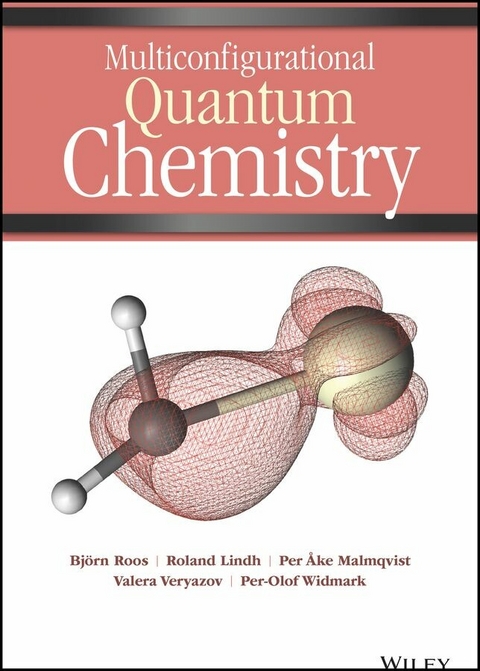
The first book to aid in the understanding of multiconfigurational quantum chemistry, Multiconfigurational Quantum Chemistry demystifies a subject that has historically been considered difficult to learn. Accessible to any reader with a background in quantum mechanics and quantum chemistry, the book contains illustrative examples showing how these methods can be used in various areas of chemistry, such as chemical reactions in ground and excited states, transition metal and other heavy element systems. The authors detail the drawbacks and limitations of DFT and coupled-cluster based methods and offer alternative, wavefunction-based methods more suitable for smaller molecules.
Björn O. Roos received his PhD inTheoretical Physics and is Professor Emeritus at Lund University. He is a former board member of the Swedish National Research Foundation, a member of the Swedish Royal Academy of Sciences, the Nobel Committee for Chemistry, the International Academy of Quantum Molecular Sciences, and is on the advisory editorial board for Chemical Physics Letter, Molecular Physics, International Journal of Quantum Chemistry, and Chemical Physics Physical Chemistry. Dr. Roos is the author of approximately 300 peer-reviewed articles in international journals, various book chapters, and is editor and co-author of text books for the European Summer School in Quantum Chemistry.
Cover 1
Title Page 5
Copyright 6
Contents 7
Preface 11
Dedication 13
Conventions and Units 15
Chapter 1 Introduction 17
1.1 References 20
Chapter 2 Mathematical Background 23
2.1 Introduction 23
2.2 Convenient Matrix Algebra 23
2.3 Many-Electron Basis Functions 27
2.4 Probability Basics 30
2.5 Density Functions for Particles 32
2.6 Wave Functions and Density Functions 33
2.7 Density Matrices 34
2.8 References 38
Chapter 3 Molecular Orbital Theory 39
3.1 Atomic Orbitals 40
3.1.1 The Hydrogen Atom 40
3.1.2 The Helium Atom 42
3.1.3 Many Electron Atoms 44
3.2 Molecular Orbitals 45
3.2.1 The Born-Oppenheimer Approximation 45
3.2.2 The LCAO Method 46
3.2.3 The Helium Dimer 50
3.2.4 The Lithium and Beryllium Dimers 51
3.2.5 The B to Ne Dimers 51
3.2.6 Heteronuclear Diatomic Molecules 53
3.2.7 Polyatomic Molecules 55
3.3 Further Reading 57
Chapter 4 Hartree-Fock Theory 59
4.1 The Hartree-Fock Theory 60
4.1.1 Approximating the Wave Function 60
4.1.2 The Hartree-Fock Equations 61
4.2 Restrictions on The Hartree-Fock Wave Function 65
4.2.1 Spin Properties of Hartree-Fock Wave Functions 66
4.3 The Roothaan-Hall Equations 69
4.4 Practical Issues 71
4.4.1 Dissociation of Hydrogen Molecule 71
4.4.2 The Hartree-Fock Solution 72
4.5 Further Reading 73
4.6 References 74
Chapter 5 Relativistic Effects 75
5.1 Relativistic Effects on Chemistry 75
5.2 Relativistic Quantum Chemistry 78
5.3 The Douglas-Kroll-Hess Transformation 80
5.4 Further Reading 82
5.5 References 82
Chapter 6 Basis Sets 85
6.1 General Concepts 85
6.2 Slater Type Orbitals, STOs 86
6.3 Gaussian Type Orbitals, GTOs 87
6.3.1 Shell Structure Organization 87
6.3.2 Cartesian and Real Spherical Harmonics Angular Momentum Functions 88
6.4 Constructing Basis Sets 88
6.4.1 Obtaining Exponents 89
6.4.2 Contraction Schemes 89
6.4.3 Convergence in the Basis Set Size 93
6.5 Selection of Basis Sets 95
6.5.1 Effect of the Hamiltonian 95
6.5.2 Core Correlation 96
6.5.3 Other Issues 97
6.6 References 97
Chapter 7 Second Quantization and Multiconfigurational Wave Functions 101
7.1 Second Quantization 101
7.2 Second Quantization Operators 102
7.3 Spin and Spin-Free Formalisms 105
7.4 Further Reading 106
7.5 References 107
Chapter 8 Electron Correlation 109
8.1 Dynamical and Nondynamical Correlation 109
8.2 The Interelectron Cusp 110
8.3 Broken Bonds. (??????)2?(???????)2 113
8.4 Multiple Bonds, Aromatic Rings 115
8.5 Other Correlation Issues 116
8.6 Further Reading 118
8.7 References 118
Chapter 9 Multiconfigurational SCF Theory 119
9.1 Multiconfigurational SCF Theory 119
9.1.1 The H2 Molecule 120
9.1.2 Multiple Bonds 123
9.1.3 Molecules with Competing Valence Structures 124
9.1.4 Transition States on Energy Surfaces 125
9.1.5 Other Cases of Near-Degeneracy Effects 126
9.1.6 Static and Dynamic Correlation 127
9.2 Determination of the MCSCF Wave Function 130
9.2.1 Exponential Operators and Orbital Transformations 131
9.2.2 Slater Determinants and Spin-Adapted State Functions 133
9.2.3 The MCSCF Gradient and Hessian 135
9.3 Complete and Restricted Active Spaces, the CASSCF and RASSCF Methods 137
9.3.1 State Average MCSCF 141
9.3.2 Novel MCSCF Methods 141
9.4 Choosing the Active Space 142
9.4.1 Atoms and Atomic Ions 142
9.4.2 Molecules Built from Main Group Atoms 144
9.5 References 146
Chapter 10 The RAS State-Interaction Method 147
10.1 The Biorthogonal Transformation 147
10.2 Common One-Electron Properties 149
10.3 Wigner-Eckart Coefficients for Spin-Orbit Interaction 150
10.4 Unconventional Usage of RASSI 151
10.5 Further Reading 152
10.6 References 152
Chapter 11 The Multireference CI Method 153
11.1 Single-Reference CI. Nonextensivity 153
11.2 Multireference CI 155
11.3 Further Reading 156
11.4 References 156
Chapter 12 Multiconfigurational Reference Perturbation Theory 159
12.1 CASPT2 theory 159
12.1.1 Introduction 159
12.1.2 Quasi-Degenerate Rayleigh-Schrödinger Perturbation Theory 160
12.1.3 The First-Order Interacting Space 161
12.1.4 Multiconfigurational Root States 162
12.1.5 The CASPT2 Equations 164
12.1.6 IPEA, RASPT2, and MS-CASPT2 170
12.2 References 171
Chapter 13 CASPT2/CASSCF Applications 173
13.1 Orbital Representations 174
13.1.1 Starting Orbitals: Atomic Orbitals 178
13.1.2 Starting Orbitals: Molecular Orbitals 180
13.2 Specific Applications 183
13.2.1 Ground State Reactions 183
13.2.2 Excited States-Vertical Excitation Energies 187
13.2.3 Photochemistry and Photophysics 200
13.2.4 Transition Metal Chemistry 210
13.2.5 Spin-Orbit Chemistry 218
13.2.6 Lanthanide Chemistry 223
13.2.7 Actinide Chemistry 225
13.2.8 RASSCF/RASPT2 Applications 228
13.3 References 232
Summary and Conclusion 235
Index 237
EULA 241
| Erscheint lt. Verlag | 3.8.2016 |
|---|---|
| Sprache | englisch |
| Themenwelt | Naturwissenschaften ► Chemie ► Physikalische Chemie |
| Technik | |
| Schlagworte | Chemie • Chemistry • Computational Chemistry & Molecular Modeling • Computational Chemistry u. Molecular Modeling • Multiconfigurational Quantum Chemistry, Bjorn Roos, Roland Lindh, Per Âke Malmqvist, Valera Veryazov, Per-Olof Widmark, chemical reactions in ground and excited states, transition metal, DFT, wavefunction-based methods, computational quantum chemistry • Physical Chemistry • Physics • Physik • Physikalische Chemie • theoretical physics • Theoretische Physik |
| ISBN-10 | 1-119-27787-6 / 1119277876 |
| ISBN-13 | 978-1-119-27787-3 / 9781119277873 |
| Informationen gemäß Produktsicherheitsverordnung (GPSR) | |
| Haben Sie eine Frage zum Produkt? |
 PDF (Adobe DRM)
Kopierschutz: Adobe-DRM
Adobe-DRM ist ein Kopierschutz, der das eBook vor Mißbrauch schützen soll. Dabei wird das eBook bereits beim Download auf Ihre persönliche Adobe-ID autorisiert. Lesen können Sie das eBook dann nur auf den Geräten, welche ebenfalls auf Ihre Adobe-ID registriert sind.
Details zum Adobe-DRM
Dateiformat: PDF (Portable Document Format)
Mit einem festen Seitenlayout eignet sich die PDF besonders für Fachbücher mit Spalten, Tabellen und Abbildungen. Eine PDF kann auf fast allen Geräten angezeigt werden, ist aber für kleine Displays (Smartphone, eReader) nur eingeschränkt geeignet.
Systemvoraussetzungen:
PC/Mac: Mit einem PC oder Mac können Sie dieses eBook lesen. Sie benötigen eine
eReader: Dieses eBook kann mit (fast) allen eBook-Readern gelesen werden. Mit dem amazon-Kindle ist es aber nicht kompatibel.
Smartphone/Tablet: Egal ob Apple oder Android, dieses eBook können Sie lesen. Sie benötigen eine
Geräteliste und zusätzliche Hinweise
Buying eBooks from abroad
For tax law reasons we can sell eBooks just within Germany and Switzerland. Regrettably we cannot fulfill eBook-orders from other countries.
aus dem Bereich