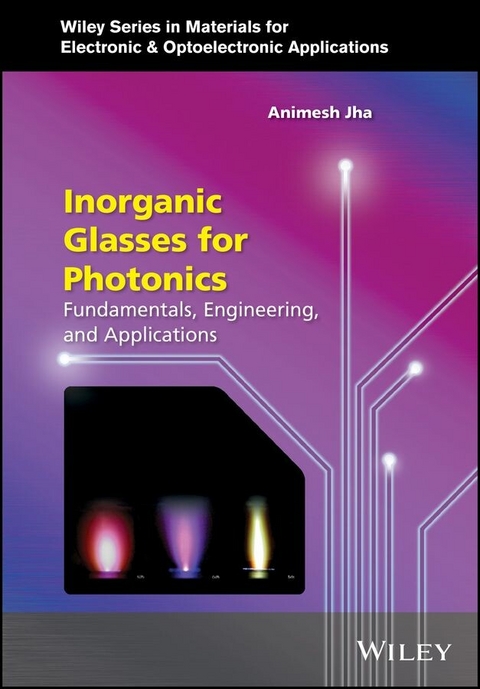
Inorganic Glasses for Photonics (eBook)
John Wiley & Sons (Verlag)
978-1-118-69610-1 (ISBN)
Advanced textbook on inorganic glasses suitable for both undergraduates and researchers.
- Engaging style to facilitate understanding
- Suitable for senior undergraduates, postgraduates and researchers entering material science, engineering, physics, chemistry, optics and photonics fields
- Discusses new techniques in optics and photonics including updates on diagnostic techniques
- Comprehensive and logically structured
Animesh Jha is Professor of Applied Materials Science at the University of Leeds. He is a fellow of the Society of Glass Technology whose research areas include photonic materials, fiber and planar light waveguide devices, spectroscopy of rare-earth and transition metal ions, raman spectroscopy of glass and ceramic materials, minerals and mineralogy.
Advanced textbook on inorganic glasses suitable for both undergraduates and researchers. Engaging style to facilitate understanding Suitable for senior undergraduates, postgraduates and researchers entering material science, engineering, physics, chemistry, optics and photonics fields Discusses new techniques in optics and photonics including updates on diagnostic techniques Comprehensive and logically structured
Animesh Jha is Professor of Applied Materials Science at the University of Leeds. He is a fellow of the Society of Glass Technology whose research areas include photonic materials, fiber and planar light waveguide devices, spectroscopy of rare-earth and transition metal ions, raman spectroscopy of glass and ceramic materials, minerals and mineralogy.
Inorganic Glasses for Photonics: Fundamentals, Engineering and Applications 1
Contents 9
Series Preface 15
Preface 17
1: Introduction 21
1.1 Definition of Glassy States 21
1.2 The Glassy State and Glass Transition Temperature (Tg) 21
1.3 Kauzmann Paradox and Negative Change in Entropy 24
1.4 Glass-Forming Characteristics and Thermodynamic Properties 25
1.5 Glass Formation and Co-ordination Number of Cations 34
1.6 Ionicity of Bonds of Oxide Constituents in Glass-Forming Systems 40
1.7 Definitions of Glass Network Formers, Intermediates and Modifiers and Glass-Forming Systems 43
1.7.1 Constituents of Inorganic Glass-Forming Systems 44
1.7.2 Strongly Covalent Inorganic Glass-Forming Networks 46
1.7.3 Conditional Glass Formers Based on Heavy-Metal Oxide Glasses 49
1.7.4 Fluoride and Halide Network Forming and Conditional Glass-Forming Systems 51
1.7.5 Silicon Oxynitride Conditional Glass-Forming Systems 56
1.7.6 Chalcogenide Glass-Forming Systems 57
1.7.7 Chalcohalide Glasses 65
1.8 Conclusions 66
Selected Bibliography 66
References 66
2: Glass Structure, Properties and Characterization 71
2.1 Introduction 71
2.1.1 Kinetic Theory of Glass Formation and Prediction of Critical Cooling Rates 71
2.1.2 Classical Nucleation Theory 72
2.1.3 Non-Steady State Nucleation 74
2.1.4 Heterogeneous Nucleation 75
2.1.5 Nucleation Studies in Fluoride Glasses 76
2.1.6 Growth Rate 78
2.1.7 Combined Growth and Nucleation Rates, Phase Transformation and Critical Cooling Rate 79
2.2 Thermal Characterization using Differential Scanning Calorimetry (DSC) and Differential Thermal Analysis (DTA) Techniques 82
2.2.1 General Features of a Thermal Characterization 82
2.2.2 Methods of Characterization 83
2.2.3 Determining the Characteristic Temperatures 84
2.2.4 Determination of Apparent Activation Energy of Devitrification 86
2.3 Coefficients of Thermal Expansion of Inorganic Glasses 88
2.4 Viscosity Behaviour in the near-Tg, above Tg and in the Liquidus Temperature Ranges 91
2.5 Density of Inorganic Glasses 95
2.6 Specific Heat and its Temperature Dependence in the Glassy State 96
2.7 Conclusion 97
References 97
3: Bulk Glass Fabrication and Properties 99
3.1 Introduction 99
3.2 Fabrication Steps for Bulk Glasses 100
3.2.1 Chemical Vapour Technique for Oxide Glasses 100
3.2.2 Batch Preparation for Melting Glasses 101
3.2.3 Chemical Treatment Before and During Melting 101
3.3 Chemical Purification Methods for Heavier Oxide (GeO2 and TeO2) Glasses 104
3.4 Drying, Fusion and Melting Techniques for Fluoride Glasses 107
3.4.1 Raw Materials 108
3.4.2 Control of Hydroxyl Ions during Drying and Melting of Fluorides 108
3.5 Chemistry of Purification and Melting Reactions for Chalcogenide Materials 111
3.6 Need for Annealing Glass after Casting 116
3.7 Fabrication of Transparent Glass Ceramics 117
3.8 Sol-Gel Technique for Glass Formation 119
3.8.1 Background Theory 119
3.8.2 Examples of Materials Chemistry and Sol-Gel Forming Techniques 123
3.9 Conclusions 125
References 125
4: Optical Fibre Design, Engineering, Fabrication and Characterization 129
4.1 Introduction to Geometrical Optics of Fibres: Geometrical Optics of Fibres and Waveguides (Propagation, Critical and Acceptance Angles, Numerical Aperture) 129
4.2 Solutions for Dielectric Waveguides using Maxwell's Equation 134
4.2.1 Analysis of Mode Field Diameter in Single Mode Fibres [3–5] 135
4.3 Materials Properties Affecting Degradation of Signal in Optical Waveguides 137
4.3.1 Total Intrinsic Loss 137
4.3.2 Electronic Absorption 138
4.3.3 Experimental Aspects of Determining the Short Wavelength Absorption 141
4.3.4 Scattering 141
4.3.5 Infrared Absorption 144
4.3.6 Characterization of Vibrational Structures using Raman and IR Spectroscopy 146
4.3.7 Experimental Aspects of Raman Spectroscopic Technique 147
4.3.8 Fourier Transform Infrared (FTIR) spectroscopy 148
4.3.9 Examples of the Analysis of Raman and IR spectra 150
4.4 Fabrication of Core-Clad Structures of Glass Preforms and Fibres and their Properties 161
4.4.1 Comparison of Fabrication Techniques for Silica Optical Fibres with Non-silica Optical Fibres 163
4.4.2 Fibre Fabrication using Non-silica Glass Core-Clad Structures 171
4.4.3 Loss Characterization of Fibres 173
4.5 Refractive Indices and Dispersion Characteristics of Inorganic Glasses 178
4.5.1 Experimental Procedure for Measuring Refractive Index of a Glass or Thin Film 183
4.5.2 Dependence of Density on Temperature and Relationship with Refractive Index 186
4.5.3 Effect of Residual Stress on Refractive Index of a Medium and its Effect 189
4.6 Conclusion 190
References 190
5: Thin-film Fabrication and Characterization 198
5.1 Introduction 198
5.2 Physical Techniques for Thick and Thin Film Deposition 199
5.3 Evaporation 199
5.3.1 General Description 199
5.3.2 Technique, Materials and Process Control 199
5.4 Sputtering 201
5.4.1 Principle of Sputtering 201
5.5 Pulsed Laser Deposition 203
5.5.1 Introduction and Principle 203
5.5.2 Process 204
5.5.3 Key Features of PLD process 206
5.5.4 Controlling Parameters and Materials Investigated 207
5.5.5 Fabrication of Thin Film Structures using PLD and Molecular Beam Epitaxy 208
5.6 Ion Implantation 212
5.6.1 Introduction 212
5.6.2 Technique and Structural Changes 212
5.6.3 Governing Parameters for Ion Implantation 213
5.6.4 Materials Systems Investigated 214
5.7 Chemical Techniques 214
5.7.1 Characteristics of Chemical Vapour Deposition Processes 215
5.7.2 Materials System Studied and Applications 216
5.7.3 Molecular Beam Epitaxy (MBE) 216
5.8 Ion-Exchange Technique 217
5.9 Chemical Solution or Sol-Gel Deposition (CSD) 220
5.9.1 Introduction 220
5.9.2 CSD Technique and Materials Deposited 222
5.10 Conclusion 223
References 223
6: Spectroscopic Properties of Lanthanide (Ln3+) and Transition Metal (M3+)-Ion Doped Glasses 229
6.1 Introduction 229
6.2 Theory of Radiative Transition 229
6.3 Classical Model for Dipoles and Decay Process 232
6.4 Factors Influencing the Line Shape Broadening of Optical Transitions 234
6.5 Characteristics of Dipole and Multi-Poles and Selection Rules for Optical Transitions: 238
6.5.1 Analysis of Dipole Transitions Based on Fermi's Golden Rule 239
6.5.2 Electronic Structure and Some Important Properties of Lanthanides [1,5–7] 241
6.5.3 Laporte Selection Rules for Rare-Earth and Transition Metal Ions 244
6.6 Comparison of Oscillator Strength Parameters, Optical Transition Probabilities and Overall Lifetimes of Excited States 247
6.6.1 Radiative and Non-Radiative Rate Equation 251
6.6.2 Energy Transfer and Related Non-Radiative Processes 253
6.6.3 Upconversion Process 257
6.7 Selected Examples of Spectroscopic Processes in Rare-Earth Ion Doped Glasses 258
6.7.1 Spectroscopic Properties of Trivalent Lanthanide (Ln3+)-Doped Inorganic Glasses 259
6.7.2 Brief Comparison of Spectroscopic Properties of Er3+-Doped Glasses 261
6.7.3 Spectroscopic Properties of Tm3+-Doped Inorganic Glasses 267
6.8 Conclusions 277
References 277
7: Applications of Inorganic Photonic Glasses 281
7.1 Introduction 281
7.2 Dispersion in Optical Fibres and its Control and Management 281
7.2.1 Intramodal Dispersion 282
7.2.2 Intermodal Distortion 285
7.2.3 Polarization Mode Dispersion (PMD) 286
7.2.4 Methods of Controlling and Managing Dispersion in Fibres 287
7.3 Unconventional Fibre Structures 289
7.3.1 Fibres with Periodic Defects and Bandgap 289
7.3.2 TIR and Endlessly Single Mode Propagation in PCF with Positive Core-Cladding Difference 292
7.3.3 Negative Core-Cladding Refractive Index Difference 292
7.3.4 Control of Group Velocity Dispersion (GVD) 293
7.3.5 Birefringence in Microstructured Optical Fibres 294
7.4 Optical Nonlinearity in Glasses, Glass-Ceramics and Optical Fibres 295
7.4.1 Theory of Harmonic Generation 295
7.4.2 Nonlinear Materials for Harmonic Generations and Parametric Processes 299
7.4.3 Fibre Based Kerr Media and its Application 305
7.4.4 Resonant Nonlinearity in Doped Glassy Hosts 307
7.4.5 Second Harmonic Generation in Inorganic Glasses 308
7.4.6 Electric-Field Poling and Poled Glass 309
7.4.7 Raman Gain Medium 311
7.4.8 Photo-induced Bragg and Long-Period Gratings in Fibres 312
7.5 Applications of Selected Rare-earth ion and Bi-ion Doped Amplifying Devices 314
7.5.1 Introduction 314
7.5.2 Examples of Three-Level or Pseudo-Three-Level Transitions 316
7.5.3 Examples of Four-Level Laser Systems 320
7.6 Emerging Opportunities for the Future 322
7.7 Conclusions 323
References 324
Supplementary References 331
Symbols and Notations Used 335
Index 337
End User License Agreement 343
"The target audience for this text is graduate students and researchers in functionalizing properties for photonic applications. Anyone concerned with the structure-property relationship of materials, however, will profit from reading this book" The Oprical Society, July 2017
| Erscheint lt. Verlag | 4.8.2016 |
|---|---|
| Reihe/Serie | Wiley Series in Materials for Electronic & Optoelectronic Applications | Wiley Series in Materials for Electronic & Optoelectronic Applications |
| Mitarbeit |
Herausgeber (Serie): Peter Capper, Safa O. Kasap, Arthur Willoughby |
| Sprache | englisch |
| Themenwelt | Naturwissenschaften ► Chemie |
| Naturwissenschaften ► Physik / Astronomie ► Optik | |
| Technik ► Elektrotechnik / Energietechnik | |
| Technik ► Maschinenbau | |
| Schlagworte | Electrical & Electronics Engineering • Elektrotechnik u. Elektronik • Fibre Fabrication • Glas • Glass Fabrication • Inorganic Glasses • Lasers and Amplifiers • Materials Science • Materialwissenschaften • Optical and Non-Linear Optical Materials • Optical and Spectroscopic Properties • Optical Fibres • Optics & Photonics • Optik • Optik u. Photonik • Optische u. Nichtlineare Optische Materialien • Photonic devices • Photonics & Lasers • Photonik • Photonik u. Laser • Physics • Physik • rare-earth ions • Thin Films • Waveguides |
| ISBN-10 | 1-118-69610-7 / 1118696107 |
| ISBN-13 | 978-1-118-69610-1 / 9781118696101 |
| Informationen gemäß Produktsicherheitsverordnung (GPSR) | |
| Haben Sie eine Frage zum Produkt? |
 PDF (Adobe DRM)
Kopierschutz: Adobe-DRM
Adobe-DRM ist ein Kopierschutz, der das eBook vor Mißbrauch schützen soll. Dabei wird das eBook bereits beim Download auf Ihre persönliche Adobe-ID autorisiert. Lesen können Sie das eBook dann nur auf den Geräten, welche ebenfalls auf Ihre Adobe-ID registriert sind.
Details zum Adobe-DRM
Dateiformat: PDF (Portable Document Format)
Mit einem festen Seitenlayout eignet sich die PDF besonders für Fachbücher mit Spalten, Tabellen und Abbildungen. Eine PDF kann auf fast allen Geräten angezeigt werden, ist aber für kleine Displays (Smartphone, eReader) nur eingeschränkt geeignet.
Systemvoraussetzungen:
PC/Mac: Mit einem PC oder Mac können Sie dieses eBook lesen. Sie benötigen eine
eReader: Dieses eBook kann mit (fast) allen eBook-Readern gelesen werden. Mit dem amazon-Kindle ist es aber nicht kompatibel.
Smartphone/Tablet: Egal ob Apple oder Android, dieses eBook können Sie lesen. Sie benötigen eine
Geräteliste und zusätzliche Hinweise
Buying eBooks from abroad
For tax law reasons we can sell eBooks just within Germany and Switzerland. Regrettably we cannot fulfill eBook-orders from other countries.
aus dem Bereich