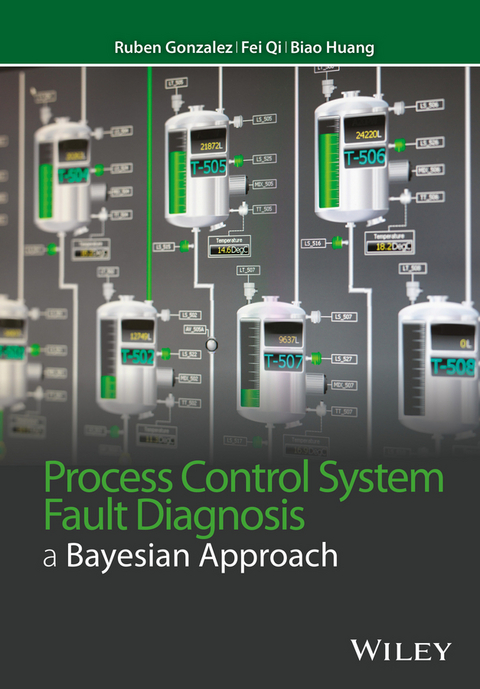
Process Control System Fault Diagnosis (eBook)
John Wiley & Sons (Verlag)
978-1-118-77058-0 (ISBN)
Process Control System Fault Diagnosis: A Bayesian Approach
Ruben T. Gonzalez, University of Alberta, Canada
Fei Qi, Suncor Energy Inc., Canada
Biao Huang, University of Alberta, Canada
Data-driven Inferential Solutions for Control System Fault Diagnosis
A typical modern process system consists of hundreds or even thousands of control loops, which are overwhelming for plant personnel to monitor. The main objectives of this book are to establish a new framework for control system fault diagnosis, to synthesize observations of different monitors with a prior knowledge, and to pinpoint possible abnormal sources on the basis of Bayesian theory.
Process Control System Fault Diagnosis: A Bayesian Approach consolidates results developed by the authors, along with the fundamentals, and presents them in a systematic way. The book provides a comprehensive coverage of various Bayesian methods for control system fault diagnosis, along with a detailed tutorial. The book is useful for graduate students and researchers as a monograph and as a reference for state-of-the-art techniques in control system performance monitoring and fault diagnosis. Since several self-contained practical examples are included in the book, it also provides a place for practicing engineers to look for solutions to their daily monitoring and diagnosis problems.
Key features:
• A comprehensive coverage of Bayesian Inference for control system fault diagnosis.
• Theory and applications are self-contained.
• Provides detailed algorithms and sample Matlab codes.
• Theory is illustrated through benchmark simulation examples, pilot-scale experiments and industrial application.
Process Control System Fault Diagnosis: A Bayesian Approach is a comprehensive guide for graduate students, practicing engineers, and researchers who are interests in applying theory to practice.
Ruben Gonzalez completed his Bachelor's degree in chemical engineering in 2008 at the University of New Brunswick. Under the supervision of Dr. Biao Huang, he completed his Master's degree in 2010 and his Doctorate in 2014, both in chemical engineering, at the University of Alberta. His research interests include Bayesian diagnosis, fault detection and diagnosis, data reconciliation, and applied kernel density estimation.
Fei Qi obtained his Ph.D. degree in Process Control from the University of Alberta, Canada, in 2011. He had his M.Sc. degree (2006) and B.Sc. degree (2003) in Automation from the University of Science and Technology of China. Fei Qi joined Suncor Energy Inc. in 2010 as an Advance Process Control Engineer. He has extensive experiences in applying system identification, model predictive control, and control performance monitoring in real industrial processes. His Ph.D. research was on applying Bayesian statistics to control loop diagnosis. His current research interests include model predictive control, soft sensor, fault detection, and process optimization.
Biao Huang obtained his PhD degree in Process Control from the University of Alberta, Canada, in 1997. He is currently a Professor in the Department of Chemical and Materials Engineering, University of Alberta, NSERC Industrial Research Chair in Control of Oil Sands Processes and AITF Industry Chair in Process Control. He is a Fellow of the Canadian Academy of Engineering, Fellow of the Chemical Institute of Canada, and recipient of numerous awards including Germany's Alexander von Humboldt Research Fellowship, Bantrel Award in Design and Industrial Practice, APEGA Summit Award in Research Excellence, best paper award from Journal of Process Control etc. Biao Huang's main research interests include: Bayesian inference, control performance assessment, fault detection and isolation. Biao Huang has applied his expertise extensively in industrial practice. He also serves as the Deputy Editor-in-Chief for Control Engineering Practice, the Associate Editor for Canadian Journal of Chemical Engineering and the Associate Editor for Journal of Process Control.
Process Control System Fault Diagnosis: A Bayesian Approach Ruben T. Gonzalez, University of Alberta, Canada Fei Qi, Suncor Energy Inc., Canada Biao Huang, University of Alberta, Canada Data-driven Inferential Solutions for Control System Fault Diagnosis A typical modern process system consists of hundreds or even thousands of control loops, which are overwhelming for plant personnel to monitor. The main objectives of this book are to establish a new framework for control system fault diagnosis, to synthesize observations of different monitors with a prior knowledge, and to pinpoint possible abnormal sources on the basis of Bayesian theory. Process Control System Fault Diagnosis: A Bayesian Approach consolidates results developed by the authors, along with the fundamentals, and presents them in a systematic way. The book provides a comprehensive coverage of various Bayesian methods for control system fault diagnosis, along with a detailed tutorial. The book is useful for graduate students and researchers as a monograph and as a reference for state-of-the-art techniques in control system performance monitoring and fault diagnosis. Since several self-contained practical examples are included in the book, it also provides a place for practicing engineers to look for solutions to their daily monitoring and diagnosis problems. Key features: A comprehensive coverage of Bayesian Inference for control system fault diagnosis. Theory and applications are self-contained. Provides detailed algorithms and sample Matlab codes. Theory is illustrated through benchmark simulation examples, pilot-scale experiments and industrial application. Process Control System Fault Diagnosis: A Bayesian Approach is a comprehensive guide for graduate students, practicing engineers, and researchers who are interests in applying theory to practice.
Ruben Gonzalez completed his Bachelor's degree in chemical engineering in 2008 at the University of New Brunswick. Under the supervision of Dr. Biao Huang, he completed his Master's degree in 2010 and his Doctorate in 2014, both in chemical engineering, at the University of Alberta. His research interests include Bayesian diagnosis, fault detection and diagnosis, data reconciliation, and applied kernel density estimation. Fei Qi obtained his Ph.D. degree in Process Control from the University of Alberta, Canada, in 2011. He had his M.Sc. degree (2006) and B.Sc. degree (2003) in Automation from the University of Science and Technology of China. Fei Qi joined Suncor Energy Inc. in 2010 as an Advance Process Control Engineer. He has extensive experiences in applying system identification, model predictive control, and control performance monitoring in real industrial processes. His Ph.D. research was on applying Bayesian statistics to control loop diagnosis. His current research interests include model predictive control, soft sensor, fault detection, and process optimization. Biao Huang obtained his PhD degree in Process Control from the University of Alberta, Canada, in 1997. He is currently a Professor in the Department of Chemical and Materials Engineering, University of Alberta, NSERC Industrial Research Chair in Control of Oil Sands Processes and AITF Industry Chair in Process Control. He is a Fellow of the Canadian Academy of Engineering, Fellow of the Chemical Institute of Canada, and recipient of numerous awards including Germany's Alexander von Humboldt Research Fellowship, Bantrel Award in Design and Industrial Practice, APEGA Summit Award in Research Excellence, best paper award from Journal of Process Control etc. Biao Huang's main research interests include: Bayesian inference, control performance assessment, fault detection and isolation. Biao Huang has applied his expertise extensively in industrial practice. He also serves as the Deputy Editor-in-Chief for Control Engineering Practice, the Associate Editor for Canadian Journal of Chemical Engineering and the Associate Editor for Journal of Process Control.
Cover 1
Title Page 5
Copyright 6
Contents 7
Preface 15
Acknowledgements 19
List of Figures 21
List of Tables 25
Nomenclature 27
Part I Fundamentals 29
Chapter 1 Introduction 31
1.1 Motivational Illustrations 31
1.2 Previous Work 32
1.2.1 Diagnosis Techniques 32
1.2.2 Monitoring Techniques 35
1.3 Book Outline 40
1.3.1 Problem Overview and Illustrative Example 40
1.3.2 Overview of Proposed Work 40
References 44
Chapter 2 Prerequisite Fundamentals 47
2.1 Introduction 47
2.2 Bayesian Inference and Parameter Estimation 47
2.2.1 Tutorial on Bayesian Inference 52
2.2.2 Tutorial on Bayesian Inference with Time Dependency 55
2.2.3 Bayesian Inference vs. Direct Inference 60
2.2.4 Tutorial on Bayesian Parameter Estimation 61
2.3 The EM Algorithm 66
2.4 Techniques for Ambiguous Modes 72
2.4.1 Tutorial on ? Parameters in the Presence of Ambiguous Modes 74
2.4.2 Tutorial on Probabilities Using ? Parameters 75
2.4.3 Dempster-Shafer Theory 76
2.5 Kernel Density Estimation 79
2.5.1 From Histograms to Kernel Density Estimates 80
2.5.2 Bandwidth Selection 82
2.5.3 Kernel Density Estimation Tutorial 83
2.6 Bootstrapping 84
2.6.1 Bootstrapping Tutorial 85
2.6.2 Smoothed Bootstrapping Tutorial 85
2.7 Notes and References 88
References 89
Chapter 3 Bayesian Diagnosis 90
3.1 Introduction 90
3.2 Bayesian Approach for Control Loop Diagnosis 90
3.2.1 Mode M 90
3.2.2 Evidence E 91
3.2.3 Historical Dataset D 92
3.3 Likelihood Estimation 93
3.4 Notes and References 95
References 95
Chapter 4 Accounting for Autodependent Modes and Evidence 96
4.1 Introduction 96
4.2 Temporally Dependent Evidence 96
4.2.1 Evidence Dependence 96
4.2.2 Estimation of Evidence-transition Probability 98
4.2.3 Issues in Estimating Dependence in Evidence 102
4.3 Temporally Dependent Modes 103
4.3.1 Mode Dependence 103
4.3.2 Estimating Mode Transition Probabilities 105
4.4 Dependent Modes and Evidence 109
4.5 Notes and References 110
References 110
Chapter 5 Accounting for Incomplete Discrete Evidence 111
5.1 Introduction 111
5.2 The Incomplete Evidence Problem 111
5.3 Diagnosis with Incomplete Evidence 113
5.3.1 Single Missing Pattern Problem 114
5.3.2 Multiple Missing Pattern Problem 120
5.3.3 Limitations of the Single and Multiple Missing Pattern Solutions 121
5.4 Notes and References 122
References 122
Chapter 6 Accounting for Ambiguous Modes: A Bayesian Approach 124
6.1 Introduction 124
6.2 Parametrization of Likelihood Given Ambiguous Modes 124
6.2.1 Interpretation of Proportion Parameters 124
6.2.2 Parametrizing Likelihoods 125
6.2.3 Informed Estimates of Likelihoods 126
6.3 Fagin-Halpern Combination 127
6.4 Second-order Approximation 128
6.4.1 Consistency of ? Parameters 129
6.4.2 Obtaining a Second-order Approximation 129
6.4.3 The Second-order Bayesian Combination Rule 131
6.5 Brief Comparison of Combination Methods 132
6.6 Applying the Second-order Rule Dynamically 133
6.6.1 Unambiguous Dynamic Solution 133
6.6.2 The Second-order Dynamic Solution 134
6.7 Making a Diagnosis 135
6.7.1 Simple Diagnosis 135
6.7.2 Ranged Diagnosis 135
6.7.3 Expected Value Diagnosis 135
6.8 Notes and References 139
References 139
Chapter 7 Accounting for Ambiguous Modes: A Dempster-Shafer Approach 140
7.1 Introduction 140
7.2 Dempster-Shafer Theory 140
7.2.1 Basic Belief Assignments 140
7.2.2 Probability Boundaries 142
7.2.3 Dempster's Rule of Combination 142
7.2.4 Short-cut Combination for Unambiguous Priors 143
7.3 Generalizing Dempster-Shafer Theory 144
7.3.1 Motivation: Difficulties with BBAs 145
7.3.2 Generalizing the BBA 147
7.3.3 Generalizing Dempster's Rule 150
7.3.4 Short-cut Combination for Unambiguous Priors 151
7.4 Notes and References 152
References 153
Chapter 8 Making Use of Continuous Evidence Through Kernel Density Estimation 154
8.1 Introduction 154
8.2 Performance: Continuous vs. Discrete Methods 155
8.2.1 Average False Negative Diagnosis Criterion 155
8.2.2 Performance of Discrete and Continuous Methods 157
8.3 Kernel Density Estimation 160
8.3.1 From Histograms to Kernel Density Estimates 160
8.3.2 Defining a Kernel Density Estimate 162
8.3.3 Bandwidth Selection Criterion 163
8.3.4 Bandwidth Selection Techniques 164
8.4 Dimension Reduction 165
8.4.1 Independence Assumptions 166
8.4.2 Principal and Independent Component Analysis 167
8.5 Missing Values 167
8.5.1 Kernel Density Regression 168
8.5.2 Applying Kernel Density Regression for a Solution 169
8.6 Dynamic Evidence 170
8.7 Notes and References 171
References 171
Chapter 9 Accounting for Sparse Data Within a Mode 172
9.1 Introduction 172
9.2 Analytical Estimation of the Monitor Output Distribution Function 173
9.2.1 Control Performance Monitor 173
9.2.2 Process Model Monitor 174
9.2.3 Sensor Bias Monitor 176
9.3 Bootstrap Approach to Estimating Monitor Output Distribution Function 178
9.3.1 Valve Stiction Identification 178
9.3.2 The Bootstrap Method 181
9.3.3 Illustrative Example 184
9.3.4 Applications 188
9.4 Experimental Example 192
9.4.1 Process Description 192
9.4.2 Diagnostic Settings and Results 195
9.5 Notes and References 198
References 198
Chapter 10 Accounting for Sparse Modes Within the Data 200
10.1 Introduction 200
10.2 Approaches and Algorithms 200
10.2.1 Approach for Component Diagnosis 201
10.2.2 Approach for Bootstrapping New Modes 204
10.3 Illustration 209
10.3.1 Component-based Diagnosis 212
10.3.2 Bootstrapping for Additional Modes 216
10.4 Application 222
10.4.1 Monitor Selection 223
10.4.2 Component Diagnosis 223
10.5 Notes and References 226
References 227
Part II Applications 229
Chapter 11 Introduction to Testbed Systems 231
11.1 Simulated System 231
11.1.1 Monitor Design 231
11.2 Bench-scale System 233
11.3 Industrial Scale System 235
References 235
Chapter 12 Bayesian Diagnosis with Discrete Data 237
12.1 Introduction 237
12.2 Algorithm 238
12.3 Tutorial 241
12.4 Simulated Case 244
12.5 Bench-scale Case 245
12.6 Industrial-scale Case 247
12.7 Notes and References 248
References 248
Chapter 13 Accounting for Autodependent Modes and Evidence 249
13.1 Introduction 249
13.2 Algorithms 250
13.2.1 Evidence Transition Probability 250
13.2.2 Mode Transition Probability 254
13.3 Tutorial 256
13.4 Notes and References 259
References 259
Chapter 14 Accounting for Incomplete Discrete Evidence 260
14.1 Introduction 260
14.2 Algorithm 260
14.2.1 Single Missing Pattern Problem 260
14.2.2 Multiple Missing Pattern Problem 264
14.3 Tutorial 266
14.4 Simulated Case 269
14.5 Bench-scale Case 270
14.6 Industrial-scale Case 272
14.7 Notes and References 274
References 274
Chapter 15 Accounting for Ambiguous Modes in Historical Data: A Bayesian Approach 275
15.1 Introduction 275
15.2 Algorithm 276
15.2.1 Formulating the Problem 276
15.2.2 Second-order Taylor Series Approximation of p(E|M, ?) 276
15.2.3 Second-order Bayesian Combination 278
15.2.4 Optional Step: Separating Monitors into Independent Groups 280
15.2.5 Grouping Methodology 281
15.3 Illustrative Example of Proposed Methodology 282
15.3.1 Introduction 282
15.3.2 Offline Step 1: Historical Data Collection 283
15.3.3 Offline Step 2: Mutual Information Criterion (Optional) 283
15.3.4 Offline Step 3: Calculate Reference Values 284
15.3.5 Online Step 1: Calculate Support 285
15.3.6 Online Step 2: Calculate Second-order Terms 286
15.3.7 Online Step 3: Perform Combinations 288
15.3.8 Online Step 4: Make a Diagnosis 290
15.4 Simulated Case 293
15.5 Bench-scale Case 296
15.6 Industrial-scale Case 297
15.7 Notes and References 298
References 299
Chapter 16 Accounting for Ambiguous Modes in Historical Data: A Dempster-Shafer Approach 300
16.1 Introduction 300
16.2 Algorithm 300
16.2.1 Parametrized Likelihoods 300
16.2.2 Basic Belief Assignments 301
16.2.3 The Generalized Dempster's Rule of Combination 303
16.3 Example of Proposed Methodology 304
16.3.1 Introduction 304
16.3.2 Offline Step 1: Historical Data Collection 305
16.3.3 Offline Step 2: Mutual Information Criterion (Optional) 305
16.3.4 Offline Step 3: Calculate Reference Value 306
16.3.5 Online Step 1: Calculate Support 307
16.3.6 Online Step 2: Calculate the GBBA 308
16.3.7 Online Step 3: Combine BBAs and Diagnose 311
16.4 Simulated Case 311
16.5 Bench-scale Case 312
16.6 Industrial System 314
16.7 Notes and References 315
References 315
Chapter 17 Making use of Continuous Evidence through Kernel Density Estimation 316
17.1 Introduction 316
17.2 Algorithm 317
17.2.1 Kernel Density Estimation 317
17.2.2 Bandwidth Selection 317
17.2.3 Adaptive Bandwidths 318
17.2.4 Optional Step: Dimension Reduction by Multiplying Independent Likelihoods 319
17.2.5 Optional Step: Creating Independence via Independent Component Analysis 319
17.2.6 Optional Step: Replacing Missing Values 320
17.3 Example of Proposed Methodology 321
17.3.1 Offline Step 1: Historical Data Collection 323
17.3.2 Offline Step 3: Mutual Information Criterion (Optional) 324
17.3.3 Offline Step 4: Independent Component Analysis (Optional) 326
17.3.4 Offline Step 5: Obtain Bandwidths 326
17.3.5 Online Step 1: Calculate Likelihood of New Data 329
17.3.6 Online Step 2: Calculate Posterior Probability 330
17.3.7 Online Step 3: Make a Diagnosis 330
17.4 Simulated Case 330
17.5 Bench-scale Case 332
17.6 Industrial-scale Case 332
17.7 Notes and References 335
References 335
Appendix 336
17.A Code for Kernel Density Regression 336
17.A.1 Kernel Density Regression 336
17.A.2 Three-dimensional Matrix Toolbox 338
Chapter 18 Dynamic Application of Continuous Evidence and Ambiguous Mode Solutions 341
18.1 Introduction 341
18.2 Algorithm for Autodependent Modes 341
18.2.1 Transition Probability Matrix 342
18.2.2 Review of Second-order Method 342
18.2.3 Second-order Probability Transition Rule 343
18.3 Algorithm for Dynamic Continuous Evidence and Autodependent Modes 344
18.3.1 Algorithm for Dynamic Continuous Evidence 344
18.3.2 Combining both Solutions 346
18.3.3 Comments on Usefulness 347
18.4 Example of Proposed Methodology 348
18.4.1 Introduction 348
18.4.2 Offline Step 1: Historical Data Collection 348
18.4.3 Offline Step 2: Create Temporal Data 348
18.4.4 Offline Step 3: Mutual Information Criterion (Optional, but Recommended) 349
18.4.5 Offline Step 5: Calculate Reference Values 350
18.4.6 Online Step 1: Obtain Prior Second-order Terms 350
18.4.7 Online Step 2: Calculate Support 351
18.4.8 Online Step 3: Calculate Second-order Terms 351
18.4.9 Online Step 4: Combining Prior and Likelihood Terms 352
18.5 Simulated Case 353
18.6 Bench-scale Case 354
18.7 Industrial-scale Case 354
18.8 Notes and References 355
References 355
Index 357
EULA 360
| Erscheint lt. Verlag | 21.7.2016 |
|---|---|
| Reihe/Serie | Wiley Series in Dynamics and Control of Electromechanical Systems | Wiley Series in Dynamics and Control of Electromechanical Systems |
| Sprache | englisch |
| Themenwelt | Naturwissenschaften ► Chemie ► Technische Chemie |
| Technik ► Elektrotechnik / Energietechnik | |
| Technik ► Maschinenbau | |
| Schlagworte | Ambiguous Data • Bayesian Methods • Bayessches Verfahren • chemical engineering • Chemische Verfahrenstechnik • Control Performance Assessment • Control Process & Measurements • Control System Monitoring • Control System Safety • Control Systems Technology • Dempster-Shafer Theory • Electrical & Electronics Engineering • Elektrotechnik u. Elektronik • Fault Diagnosis • Information Synthesis • Kernel Density Estimation • Maschinenbau • mechanical engineering • Mess- u. Regeltechnik • missing data • Process Engineering • Prozesssteuerung • Regelungstechnik |
| ISBN-10 | 1-118-77058-7 / 1118770587 |
| ISBN-13 | 978-1-118-77058-0 / 9781118770580 |
| Informationen gemäß Produktsicherheitsverordnung (GPSR) | |
| Haben Sie eine Frage zum Produkt? |
 PDF (Adobe DRM)
Kopierschutz: Adobe-DRM
Adobe-DRM ist ein Kopierschutz, der das eBook vor Mißbrauch schützen soll. Dabei wird das eBook bereits beim Download auf Ihre persönliche Adobe-ID autorisiert. Lesen können Sie das eBook dann nur auf den Geräten, welche ebenfalls auf Ihre Adobe-ID registriert sind.
Details zum Adobe-DRM
Dateiformat: PDF (Portable Document Format)
Mit einem festen Seitenlayout eignet sich die PDF besonders für Fachbücher mit Spalten, Tabellen und Abbildungen. Eine PDF kann auf fast allen Geräten angezeigt werden, ist aber für kleine Displays (Smartphone, eReader) nur eingeschränkt geeignet.
Systemvoraussetzungen:
PC/Mac: Mit einem PC oder Mac können Sie dieses eBook lesen. Sie benötigen eine
eReader: Dieses eBook kann mit (fast) allen eBook-Readern gelesen werden. Mit dem amazon-Kindle ist es aber nicht kompatibel.
Smartphone/Tablet: Egal ob Apple oder Android, dieses eBook können Sie lesen. Sie benötigen eine
Geräteliste und zusätzliche Hinweise
Buying eBooks from abroad
For tax law reasons we can sell eBooks just within Germany and Switzerland. Regrettably we cannot fulfill eBook-orders from other countries.
aus dem Bereich