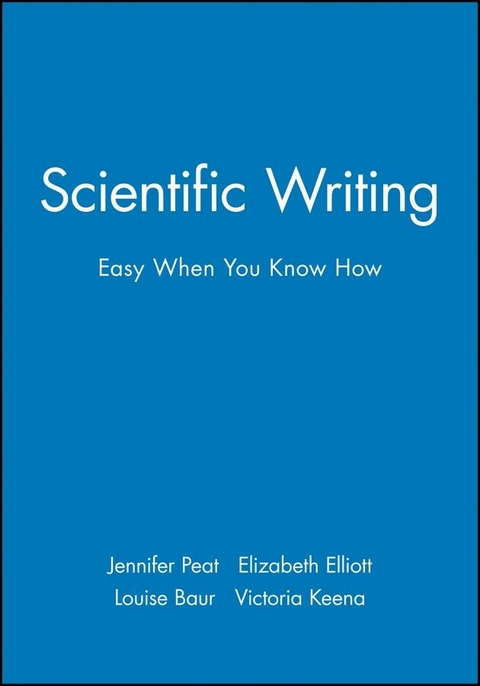
Scientific Writing (eBook)
John Wiley & Sons (Verlag)
978-1-118-70802-6 (ISBN)
Jennifer Peat is Associate Professor in the Department of Paediatrics and Child Health and Senior Hospital Statistician, Clinical Epidemiology Unit at the Children's Hospital at Westmead, NSW Australia,
Elizabeth Elliott is a professor in the Discipline of Paediatrics and Child Health, University of Sydney, The Children's Hospital at Westmead,
Jennifer Peat is Associate Professor in the Department of Paediatrics and Child Health and Senior Hospital Statistician, Clinical Epidemiology Unit at the Children's Hospital at Westmead, NSW Australia. Elizabeth Elliott is a professor in the Discipline of Paediatrics and Child Health, University of Sydney, The Children's Hospital at Westmead.
Introduction.
Skinny writing.
How to get into quadrant two and stay there.
Back to basics.
abstracts - getting it write!
Journal articles.
Report writing.
Grantsmanship.
References - what to cite and how to do it.
Teaching writing skills.
2
Getting started
Scientists who become authors display a rich variety of publication habits. Isaac Newton was famously reluctant to publish and, when he did, to put his name to the work. More recently, and less famously, Yury Struchkov published one paper every 3.9 days for 10 years, while 20 researchers worldwide each published at least once every 11.3 days throughout the decade of the 1980s.
Drummond Rennie1
- plan your paper
- choose an appropriate journal
- prepare your paper in the correct format
- make decisions about authorship
- decide who is a contributor and who should be acknowledged
Journal articles form the most important part of a researcher’s bibliography because they publish the results of their original research. To be published, your paper must be constructed in the approved manner and presented to the highest possible standards.2 If your research is important, then you should plan for your results to reach the widest possible audience. This means constructing your paper well, writing it nicely, and having it accepted in a widely read peer-reviewed journal. Most of this book is dedicated to writing and publishing a journal article. The methods for constructing a paper are discussed in Chapters 3 and 4, and the methods for publishing your paper are discussed in Chapters 5 and 6.
Forming a plan
I want to suggest that to write to your best abilities, it behooves you to construct your own toolbox and then build up enough muscle so you can carry it with you. Then, instead of looking at a hard job and getting discouraged, you will perhaps seize the correct tool and get immediately to work.
Stephen King3
Constructing a paper is easy if you begin with a plan in mind. By using a template to put your paper together and by assembling your thoughts in a logical order, the task becomes much less daunting than you might imagine. You also need to follow some simple rules when planning and writing your paragraphs and then your sentences. It is important that papers are not allowed to meander and grow in an unplanned way. If you were building a house or having a special dinner party, you would work to a plan, so why not do this with something that is as fundamental to your research career as a scientific publication? This chapter will explain how writing using a logical framework helps you to structure your paper correctly, which then helps to prevent your readers and reviewers from getting lost. Once your paper has a logical structure, Chapters 8–11 will help you to improve your writing style.
Throughout the writing process, you must focus on the potential audience for whom you are writing your paper. The editor and external peer reviewers of a journal are the only people whom you have to impress in order to get your work into print, so write explicitly for them. Odds on, if these people think that your work is worth publishing, then the scientific audience that you hope to reach will think so too. If you are writing a postgraduate thesis, then plan to write to impress your examiners. Your examiners may be the only people who ever read your thesis in its entirety, and they have a major influence on whether you receive your degree.
Most writers have access to a computer with word processing software that can speed up the process of writing considerably. However, without proper document planning, the facility to “cut and paste” can often lead to unnecessary and unproductive shuffling of text. Creating a sound structure from the outset can help to avoid this. This makes the writing process more purposeful and circumvents the frustration of having to live through just one or two drafts too many. Some writers still prefer to write by hand, especially in the planning stages of a paper. If you prefer this, then document planning is especially important for you.
If you are using a computer to write your paper, then it is important that you use all of the software facilities that you have at your disposal. Headers and footers can be used to label your paper, number the pages and date the draft on which you are working. Your software can also be used to create standard formats for the major headings, subheadings, and minor headings throughout the document. Your page facility will enable you to set your margins so that they are correct for the journal, and tools such as spell check and word count are invaluable. The efficient use of these tools is both professional and efficient in terms of time management.
Before your fingers even think about approaching the keyboard or picking up a pen, you should have conferred with your authorship team about the specific questions that you will answer in your paper. In an ideal world, you would also have decided to which journal you are going to submit your work and you will have obtained their “Instructions to authors”. Then you can begin.
First, you will need to start the document by inserting the headings and subheadings that you will be using. By forming a framework into which to assemble your aims, your methods, your findings, and your thoughts, you will find that all of your material falls into the correct places. Figure 2.1 shows a plan for putting a paper together and progressing your paper from the initial planning stages to the final document.
In starting your first draft, a divide and conquer approach is best. The best thing about a grotty first draft is that it is a great starting point, giving you something to build later drafts on. In most journals, reporting is usually confined to the IMRAD (introduction, methods, results, and discussion) format, so begin by putting “Introduction” at the top of one page, “Methods” at the top of the next, “Results” at the top of the next, and so on. Next, you begin to fill each section in. Just do one bit at a time starting with the simplest parts such as the methods and the results. Then you have begun.
Approach each section with its length and content in mind. A paper should be no longer than 2000–2500 words, which will occupy only 8–10 double-spaced pages in draft copy. Some journals set limits such as four or six pages for the final published copy, including the tables and figures. Table 2.1 shows the amount of space that each section of an average draft paper should occupy. Do not plan to write more than this. All journals differ in their requirements but few papers are rejected because they are too short.
Figure 2.1 Plan for writing a paper.
Remember that it is neither efficient nor satisfying to write everything you know in 30 or 40 pages, and then have to prune and reorganise it yourself, or ask your reviewers to do this for you. Although this approach may foster creativity and lateral thinking, it is not helpful for the expedient reporting of your results or for the efficient use of your own and your peer reviewers’ time. Keep in mind that your purpose in writing a scientific paper is to answer a specific research question or fulfil a specific research aim. You should provide only sufficient background about why you did the study, sufficient methods to repeat the study, and sufficient data and explanations to understand the results. Do not be tempted to deviate from this path. Readers do not need to know absolutely everything that you know about the research area. Scientific writing is not a competition in comprehensiveness. You must limit yourself to writing only the essential information that your readers need to know about the results that you are reporting.
Table 2.1 Planning a draft paper.
You will need to progress your paper from your grotty first draft to a presentable second draft before you start asking coauthors and coworkers for peer review. There are many checklists available, including checklists for critical appraisal, that are a good guide to the information that you will need to include in each section of your paper.4–7 The BMJ also has excellent checklists for writers, reviewers and statisticians that can be accessed through its web site (www1). Progressing through each draft may take many small rewrites and reorganisations of sentences and paragraphs but it will ensure that the feedback you get is worth having. Once you have a presentable second draft you can sequentially ask for peer review from wider sources to improve your paper. In Chapter 4, we discuss how to manage the peer-review process effectively.
Choosing a journal
Will your message appeal to your reader? Will it be read? I cannot overstate the importance of this invisible bridge. Many important, even vital, messages are lost in the inappropriate translation from author to reader. Above all else, write for your intended reader; all that follows stems from this rapport.
Vincent Fulginiti8
Once you have planned your paper, you will need to choose a journal in which to publish it. This can be a complex decision. Over 4500 journals in 30 languages are currently listed in Index Medicus (www2) and more than 150 scientific journal articles are published each day. Despite these daunting statistics, it is always best to write with a specific journal in mind. The first question to ask yourself is what type of audience you want to reach. It is important to make an initial decision about whether you want to publish in a general, clinical, or speciality journal, or in a journal that publishes the results of basic science. For example, the journal Diabetes Care publishes papers about the diagnosis and treatment...
| Erscheint lt. Verlag | 1.7.2013 |
|---|---|
| Sprache | englisch |
| Themenwelt | Schulbuch / Wörterbuch ► Wörterbuch / Fremdsprachen |
| Geisteswissenschaften ► Sprach- / Literaturwissenschaft ► Literaturwissenschaft | |
| Geisteswissenschaften ► Sprach- / Literaturwissenschaft ► Sprachwissenschaft | |
| Medizin / Pharmazie ► Allgemeines / Lexika | |
| Medizin / Pharmazie ► Medizinische Fachgebiete | |
| Naturwissenschaften | |
| Schlagworte | Basics • broad • brush • CITE • clear • Enjoyable • Examples • experienced • explanations • Giants • Good • grammar • helpful • Krankenpflege • Medical Science • Medical Writing • Medizin • nursing • Practical • Quadrant • Quotes • Scientific • two • Verfassen medizinischer Texte |
| ISBN-10 | 1-118-70802-4 / 1118708024 |
| ISBN-13 | 978-1-118-70802-6 / 9781118708026 |
| Informationen gemäß Produktsicherheitsverordnung (GPSR) | |
| Haben Sie eine Frage zum Produkt? |
 EPUB (Adobe DRM)
Kopierschutz: Adobe-DRM
Adobe-DRM ist ein Kopierschutz, der das eBook vor Mißbrauch schützen soll. Dabei wird das eBook bereits beim Download auf Ihre persönliche Adobe-ID autorisiert. Lesen können Sie das eBook dann nur auf den Geräten, welche ebenfalls auf Ihre Adobe-ID registriert sind.
Details zum Adobe-DRM
Dateiformat: EPUB (Electronic Publication)
EPUB ist ein offener Standard für eBooks und eignet sich besonders zur Darstellung von Belletristik und Sachbüchern. Der Fließtext wird dynamisch an die Display- und Schriftgröße angepasst. Auch für mobile Lesegeräte ist EPUB daher gut geeignet.
Systemvoraussetzungen:
PC/Mac: Mit einem PC oder Mac können Sie dieses eBook lesen. Sie benötigen eine
eReader: Dieses eBook kann mit (fast) allen eBook-Readern gelesen werden. Mit dem amazon-Kindle ist es aber nicht kompatibel.
Smartphone/Tablet: Egal ob Apple oder Android, dieses eBook können Sie lesen. Sie benötigen eine
Geräteliste und zusätzliche Hinweise
Buying eBooks from abroad
For tax law reasons we can sell eBooks just within Germany and Switzerland. Regrettably we cannot fulfill eBook-orders from other countries.
aus dem Bereich