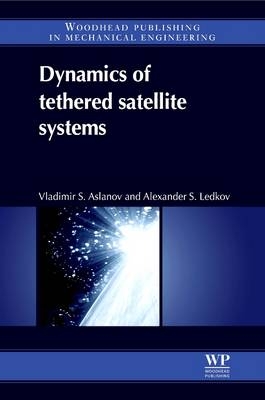
Dynamics of Tethered Satellite Systems
Woodhead Publishing Ltd (Verlag)
978-0-08-101607-7 (ISBN)
- Keine Verlagsinformationen verfügbar
- Artikel merken
Professor Vladimir S. Aslanov graduated from the Kuibyshev Aviation Institute, Kuibyshev, USSR (KuAI) in 1972 as a specialty Aircraft Engineer. In 1974 he entered postgraduate school of the Kuibyshev Aviation Institute and in 1977 received his PhD. In the period 1978-1982 Aslanov worked as an assistant professor in the KuAI. In 1990 he defended his doctoral dissertation at the Moscow Aviation Institute, Moscow/USSR, on the motion of a rigid body in the atmosphere. Since 1989 Prof. Aslanov is the head of the Department of Theoretical Mechanics of Samara State Aerospace University, Samara, Russia. Prof. Aslanov’s scientific interests are classical mechanics, nonlinear oscillations and chaotic dynamics, mechanics of space flight, dynamics of gyrostats, dynamicsof tethered satellite systems and spacecraft stability. Dr Alexander Ledkov is Ph. D associate professor of the Theoretical Mechanics Department of Samara State Aerospace University. He has many years experience working in the field of mechanics of space flight.
List of figures
List of tables
About the authors
Introduction
Chapter 1: Space tether systems: review of the problem
Abstract:
1.1 Application of space tether systems
1.2 Chronology of experiments with the use of space tethers
1.3 Materials for tether production
1.4 Study of space tether dynamics: state of the problem
Chapter 2: Mathematical models of space tether systems
Abstract:
2.1 Simple models of STS consisting of two point masses connected by a massless tether
2.2 Simple model of a STS consisting of two point masses connected by a heavy tether
2.3 Model of a STS with a ponderous flexible tether
2.4 Model of a STS consisting of a point mass connected by a heavy tether with a rigid body
2.5 Model of a STS consisting of two rigid bodies connected by a heavy elastic multipoint tether
Chapter 3: Motion of a spacecraft with a tethered payload
Abstract:
3.1 Mathematical model of a base spacecraft with a tethered payload
3.2 Analytical solution in case of a slow changing of the parameters
3.3 The approximate analytical solutions in the variables of the amplitude–phase
3.4 Analytical solutions for small oscillations
3.5 Estimation of the microaccelerations level on board the spacecraft
3.6 Motion of the spacecraft with a propulsion system
3.7 Motion of a spacecraft around its centre of mass in a circular orbit with a vertically deployed elastic tether
Chapter 4: Delivery of a payload from an orbit by means of a space tether
Abstract:
4.1 Tether deployment schemes
4.2 Project YES2
4.3 Modelling of the YES2 tether deployment
4.4 Abnormal situations during tether deployment
Chapter 5: Use of methods of chaotic dynamics for the analysis of tether system motion
Abstract:
5.1 Some elements of chaotic dynamics
5.2 The chaotic approach in STS dynamics
Conclusion
Index
| Erscheinungsdatum | 07.07.2016 |
|---|---|
| Verlagsort | Cambridge |
| Sprache | englisch |
| Gewicht | 500 g |
| Themenwelt | Naturwissenschaften ► Physik / Astronomie ► Astronomie / Astrophysik |
| Technik ► Fahrzeugbau / Schiffbau | |
| Technik ► Luft- / Raumfahrttechnik | |
| Technik ► Maschinenbau | |
| ISBN-10 | 0-08-101607-7 / 0081016077 |
| ISBN-13 | 978-0-08-101607-7 / 9780081016077 |
| Zustand | Neuware |
| Informationen gemäß Produktsicherheitsverordnung (GPSR) | |
| Haben Sie eine Frage zum Produkt? |
aus dem Bereich