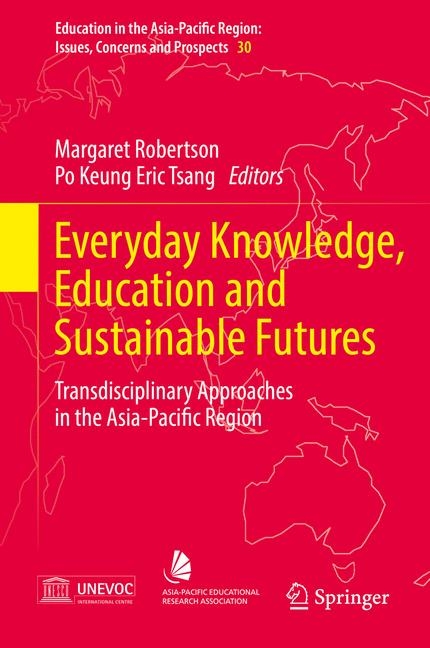
Everyday Knowledge, Education and Sustainable Futures (eBook)
XX, 265 Seiten
Springer Singapore (Verlag)
978-981-10-0216-8 (ISBN)
Everyday knowledge offers opportunities for better understanding of significant issues of our times. Reflecting these themes this book places emphasis on community wisdom. The underpinning argument is that our instinctive urge for survival may not be enough if we do not share our collective knowledge and learn more about the everyday habits, beliefs and actions of communities spread across the region. Contributions from researchers active within local communities help build knowledge capacity and support for collaborative research.
Margaret Robertson is Professor of Education at La Trobe University. Teaching interests in geographical education and innovative pedagogy complement long-standing research interests in youth studies and cross-cultural differences. Outreach interests include membership of the Steering Committee for the International Year of Global Understanding project which is an initiative of the International Geographical Union.Eric Po Keung Tsang is an Associate Professor at the Hong Kong Institute of Education specialising in feasibility and environmental impact assessment studies. He also acts as the associate director of the UNEVOC Centre (HK), China and chairman of Green Power a major green group in Hong Kong. He is also a panel member of the Advisory Council on the Environment HKSAR and the International Year of Global Understanding, initiated by the International Geographical Union(IGU).
1 Introduction and Overview.- 2 Knowledge, Change and Everyday Living.- 3 Conversation about the Politics of Everyday Knowledge at the Institute of Postcolonial Studies on 14th August 2014.- 4 Negotiating Chineseness and Capitalising on Resources through Learning Chinese Heritage Language: Habitus and Capital in Fields.- 5 Matariki Tāpuapua: Pools of Traditional Knowledge and Currents of Change.- 6 Transformative Maternities: Indigenous Stories as Resistance and Reclamation in Aotearoa, New Zealand.- 7 Mongolian Nomads: Effects of Globalisation and Social Change.- 8 Everyday Knowledge and Disaster Management: The Role of Social Media.- 9 Challenges to the Democratisation of Knowledge: Status Hierarchies and Emerging Inequalities in Educational Opportunities amongst Oil Palm Settlers in Papua New Guinea.- 10 Sustainability In and Through Lifelong Learning: Making Space for Everyday Knowledge and Regionalism in a Globalising World.- 11 Global Agendas versus Local Needs in Educational Development: The Barefoot College's Solar Night Schools Program in India.- 12 Developing Curriculum Leadership among Teachers for School-Based Curriculum Innovation in Hong Kong: A Distributed and Problem Solving Approach.- 13 Creating an Ecology of Affordance to Allow Australian Pre-service Teachers to get to Know and Make Sense of China.- 14 Post-Carbon Futures for Geography Education?.- 15 The Stuff That Matters to Me: An Exploration of Melbourne's Peri-urban Fringe from the Perspectives of Young People.- 16 Everyday Political Knowledge and the Construction of Regional Identity: The East Asian Experience.- 17 The Everyday Dynamic in Space and Place.
| Erscheint lt. Verlag | 1.6.2016 |
|---|---|
| Reihe/Serie | Education in the Asia-Pacific Region: Issues, Concerns and Prospects | Education in the Asia-Pacific Region: Issues, Concerns and Prospects |
| Zusatzinfo | XX, 265 p. 16 illus., 12 illus. in color. |
| Verlagsort | Singapore |
| Sprache | englisch |
| Themenwelt | Geisteswissenschaften |
| Naturwissenschaften ► Biologie ► Ökologie / Naturschutz | |
| Sozialwissenschaften ► Pädagogik ► Bildungstheorie | |
| Schlagworte | capacity building • Citizenship in a globalised world • collective knowledge • Cultural understandings • Educational Policy • Education and development • Education and sustainability • Education in the Asia Pacific Region • Environmental change • Everyday knwoledge • Global science • Local community wisdom |
| ISBN-10 | 981-10-0216-9 / 9811002169 |
| ISBN-13 | 978-981-10-0216-8 / 9789811002168 |
| Informationen gemäß Produktsicherheitsverordnung (GPSR) | |
| Haben Sie eine Frage zum Produkt? |
 PDF (Wasserzeichen)
DRM: Digitales Wasserzeichen
Dieses eBook enthält ein digitales Wasserzeichen und ist damit für Sie personalisiert. Bei einer missbräuchlichen Weitergabe des eBooks an Dritte ist eine Rückverfolgung an die Quelle möglich.
Dateiformat: PDF (Portable Document Format)
Mit einem festen Seitenlayout eignet sich die PDF besonders für Fachbücher mit Spalten, Tabellen und Abbildungen. Eine PDF kann auf fast allen Geräten angezeigt werden, ist aber für kleine Displays (Smartphone, eReader) nur eingeschränkt geeignet.
Systemvoraussetzungen:
PC/Mac: Mit einem PC oder Mac können Sie dieses eBook lesen. Sie benötigen dafür einen PDF-Viewer - z.B. den Adobe Reader oder Adobe Digital Editions.
eReader: Dieses eBook kann mit (fast) allen eBook-Readern gelesen werden. Mit dem amazon-Kindle ist es aber nicht kompatibel.
Smartphone/Tablet: Egal ob Apple oder Android, dieses eBook können Sie lesen. Sie benötigen dafür einen PDF-Viewer - z.B. die kostenlose Adobe Digital Editions-App.
Buying eBooks from abroad
For tax law reasons we can sell eBooks just within Germany and Switzerland. Regrettably we cannot fulfill eBook-orders from other countries.
aus dem Bereich