Recent Developments in Braiding and Narrow Weaving (eBook)
VIII, 175 Seiten
Springer International Publishing (Verlag)
978-3-319-29932-7 (ISBN)
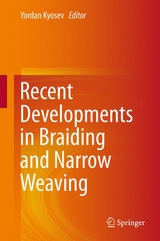
This book discusses the latest developments in narrow fabrics from research institutions, machinery building companies and producers of such products, presented during the International Week of Narrow Fabrics in March 2016 in Mönchengladbach, Germany. It also demonstrates different applications of braided and woven fabrics. Braided and woven narrow products are produced using completely different techniques, but have a lot of similarities in their applications - they are used as belts, ropes and tubes in areas ranging from medical textiles, cables, technical and home applications to large-scale transport belts and long tubes for transporting oil from the bottom of the ocean.
Professor Yordan Kyosev is professor at the Hochschule Niederrhein at the Faculty of Textile and Clothing Technology.
This faculty is the only one in the world, where traditionally the narrow textiles are covered as several courses in the high school level - bachelor and master courses and is a traditional meeting point of specialists in these areas.
Professor Yordan Kyosev is professor at the Hochschule Niederrhein at the Faculty of Textile and Clothing Technology.This faculty is the only one in the world, where traditionally the narrow textiles are covered as several courses in the high school level – bachelor and master courses and is a traditional meeting point of specialists in these areas.
Preface 5
Contents 7
Part I New Machines 9
1 Over-braiding or Overweaving—An Alternative Covering Process 10
Abstract 10
Introduction 10
“Prozessorientierte Synthesemethodik” Based on the Technological Synthesis 11
Laying of Threads During Braiding in the System “D-3F” 15
Recombination of Sub-functions and Sub-function Carriers 16
Synthesis Model and Synchronization 18
Conclusions 20
References 21
2 Multi Bifurcation Branch Braided Structures on a Herzog Variation Braiding Machine 22
Abstract 22
Introduction 22
Implementation 23
Results 25
Conclusion 26
References 27
Part II Modelling and Testing 28
3 Geometrical Modelling of Tubular and Flat Braids Within the Jamming Limits—Verification and Limitations 29
Abstract 29
Introduction 29
Geometry 30
Flexibility and Jamming States for Tubular Braid 31
Flexibility and Jamming States for Flat Braid 34
Further Applications 35
Limitations of the Geometrical Models 36
Conclusions 37
References 37
4 Geometrical Modeling of Tubular Braided Structures Overbraiding Polygonal Prism Based on the Intersection of Surfaces 38
Abstract 38
Introduction 38
Motion Analysis of Braiding Process 40
Decomposition of Strand Motions 40
Re-composition of Sub-motions and Two Kinds of Surfaces 41
Geometrical Modeling of Braided Structures of Regular Polygonal Tube 42
Geometrical Modeling of Braided Structures of Combined Polygonal Tube 45
Discussion 48
Conclusion 49
References 49
5 Investigation of the Bending Rigidity of Double Braided Ropes 51
Abstract 51
Introduction 51
General Bending Theory 52
Experimental Setup and Deflection Equation 54
Discussion of Results 57
Conclusions 60
References 61
6 Tensile Properties of Double Braided Flax Fiber Ropes 62
Abstract 62
Introduction 63
Experiment 64
Production of Braided Preforms 64
Tensile Test Performance 65
Model Validation 65
Results and Discussion 66
Conclusions 69
References 70
7 The Numerical Prediction of the Tensile Behaviour of Multilayer Woven Tapes Made by Multifilament Yarns 71
Introduction 71
Modelling Steps 72
Woven Fabric Topology (Weave) 72
Fabric Parameters 73
Yarn Parameters and Force—Elongation Curve 75
Yarn Lateral Compression 76
Yarn Bending Rigidity 77
Numerical Investigation 78
Conclusions 81
Acknowledgements 81
References 81
Part III Technical Applications 83
8 End Fasteners of High Performance Fibre Ropes 84
Investigation of Commonly Used End Fasteners 85
Bionical Approach to End Fasteners 89
References 91
9 Influence of Braid Carrier Tension on Carbon Fibre Braided Preforms 92
Introduction 92
The ‘Chinese Finger Trap’ Principle 93
Tow Tension at Carrier and Braid Fell Point 94
Braiding Carrier Tension and Applied Pressure 95
Prediction for Applied Pressure Generated by an Interlacing Point of a Biaxial Braid 96
Measurement of Braid Parameters 98
Effect of Tow Tension Change on Braided Preform 99
Influence of Tension on Braided Composite Tubes 101
Conclusion 102
References 103
10 Sensor Integration in Carbon Fiber Reinforced Plastics (CFRP) to Detect Tension Differences 104
Abstract 104
State of Art 104
Processing 105
Results 107
Conclusion 110
References 111
11 Investigation of the Relations Between the Parameters in the Radial Braiding Process 112
Introduction 112
Motivation 114
Approach 115
Results and Discussion 117
Acknowledgement 120
References 120
12 Narrow Woven Fabrics Applied for Conveyor Facilities 122
Introduction 122
Motivation 123
Warp Direction Development of a Mulitiple-Fuctional Narrow Fabric 123
Dimensioning of the Functional Elements 124
Construction of the Narrow Fabric 124
Manufacture of a Multi-Functional Narrow Fabric 125
Example of Application 125
Weft Direction Development of a Narrow Fabric as a Part of a Mechanism 126
Construction of the Narrow Fabric 126
Example of Application 127
Conclusions 128
References 128
13 Multilayer Textile-Based Woven Batteries 129
Abstract 129
Introduction 129
Experimental 130
Materials 130
Electrode Materials 130
Gel-like Electrolytes 131
Methods 132
Assembly of Cells 132
Measurements of Current and Voltage 133
Results and Discussion 133
Conclusion and Outlook 135
Acknowledgement 135
References 135
Part IV Materials and Modifications 137
14 Chinese HMPE Fibers in Textile Semi-finished Parts—A Competitve Price–Performance Analysis 138
Abstract 138
Introduction 138
Tensile Tests on Filament Yarns 139
Yarn-on-Yarn Abrasion Tests 140
Tensile Tests on Braided Fiber Ropes 141
CBOS Tests on Braided Fiber Ropes 142
Thermosetting of Braided HMPE Fiber Ropes 144
Price–Performance Analysis 145
Summary 146
References 147
15 Natural Materials for Surface Modification of Cellulosic Narrow Woven Fabrics—Strides Towards Fully Bio-based Composites 148
Introduction 148
Experimental 150
Results 151
Conclusion 153
References 153
16 Overview of the Sustainable Materials for Composites and Their Industrial Adaptability 154
Abstract 154
Introduction 154
Biodegradable Polymeric Matrix Materials 156
Starch-Based Biopolymers (TPS) 156
Plant Oil-Derived Proteins 158
From Animal Derived Proteins 158
Polyactid Acid (PLA) 159
Polyhydroxalkanotates (PHA) 160
Petroleum-Based Biodegradable Polyesters 161
Comparison of Biopolymers 162
Market Overview for Biocomposites 162
Natural Cellulose Fiber Reinforcement Materials 164
Natural Cellulose Fiber Disposal 167
Industrial Adaptability of Bio- and Green Composites on the Example of Already Established Products 168
Automobile Industry 168
Constructions 169
Sport 169
Consumer Products 170
Conclusion 170
References 171
17 Erratum to: Influence of Braid Carrier Tension on Carbon Fibre Braided Preforms 175
Erratum to: Chapter ‘Influence of Braid Carrier Tension on Carbon Fibre Braided Preforms’ in: Y. Kyosev (ed.), Recent Developments in Braiding and Narrow Weaving, DOI 10.1007/978-3-319-29932-7_9 175
| Erscheint lt. Verlag | 14.3.2016 |
|---|---|
| Zusatzinfo | VIII, 175 p. 103 illus., 28 illus. in color. |
| Verlagsort | Cham |
| Sprache | englisch |
| Themenwelt | Naturwissenschaften ► Chemie |
| Technik ► Bauwesen | |
| Technik ► Maschinenbau | |
| Schlagworte | Braiding Technology • Composites • Medical Textiles • Narrow Fabrics • Narrow Woven Products • textile engineering |
| ISBN-10 | 3-319-29932-8 / 3319299328 |
| ISBN-13 | 978-3-319-29932-7 / 9783319299327 |
| Informationen gemäß Produktsicherheitsverordnung (GPSR) | |
| Haben Sie eine Frage zum Produkt? |
 PDF (Wasserzeichen)
DRM: Digitales Wasserzeichen
Dieses eBook enthält ein digitales Wasserzeichen und ist damit für Sie personalisiert. Bei einer missbräuchlichen Weitergabe des eBooks an Dritte ist eine Rückverfolgung an die Quelle möglich.
Dateiformat: PDF (Portable Document Format)
Mit einem festen Seitenlayout eignet sich die PDF besonders für Fachbücher mit Spalten, Tabellen und Abbildungen. Eine PDF kann auf fast allen Geräten angezeigt werden, ist aber für kleine Displays (Smartphone, eReader) nur eingeschränkt geeignet.
Systemvoraussetzungen:
PC/Mac: Mit einem PC oder Mac können Sie dieses eBook lesen. Sie benötigen dafür einen PDF-Viewer - z.B. den Adobe Reader oder Adobe Digital Editions.
eReader: Dieses eBook kann mit (fast) allen eBook-Readern gelesen werden. Mit dem amazon-Kindle ist es aber nicht kompatibel.
Smartphone/Tablet: Egal ob Apple oder Android, dieses eBook können Sie lesen. Sie benötigen dafür einen PDF-Viewer - z.B. die kostenlose Adobe Digital Editions-App.
Buying eBooks from abroad
For tax law reasons we can sell eBooks just within Germany and Switzerland. Regrettably we cannot fulfill eBook-orders from other countries.
aus dem Bereich