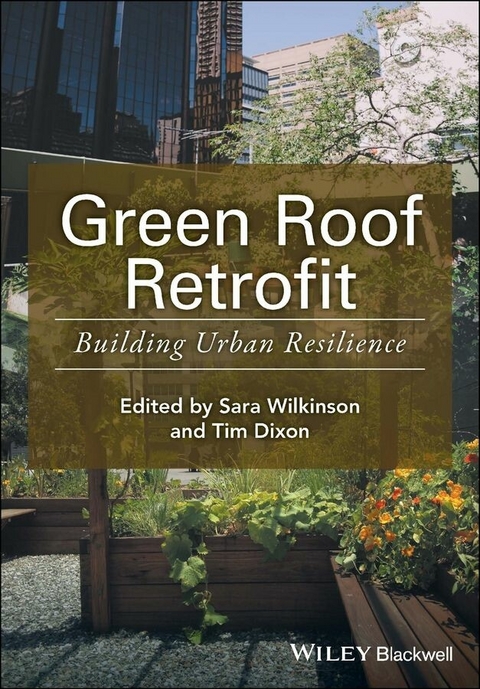
Green Roof Retrofit (eBook)
John Wiley & Sons (Verlag)
978-1-119-05560-0 (ISBN)
Sara Wilkinson - Associate Professor in Property and Construction, University of Technology, Sydney. Sara has a combination of professional industry and academic experience spanning more than 30 years. Sara's research focus is building adaptation within the context of sustainability, and represents areas of professional practice prior to becoming an academic. Her PhD examined building adaptation and the relationship to property attributes, whilst her MPhil explored the conceptual understanding of green buildings. Sara is a member of the RICS Oceania Sustainability Working Group. She is the International Federation of Surveyors (FIG) Vice-Chair of Commission 10 'Construction Management & Construction Economics'. Sara is also author of eight books/book chapters and was awarded the RICS COBRA Conference Best Paper Award in 2012 for her paper. The increasing importance of environmental attributes in commercial building retrofits. RICS COBRA Las Vegas USA. September 2012.
Tim Dixon - Chair in Sustainable Futures in the Built Environment, University of Reading Tim joined the School of Construction Management and Engineering, University of Reading in 2012. He was formerly was Director of OISD and Professor of Real Estate (2005-2012) at Oxford Brookes University. He is former Director of Research at the College of Estate Management, Reading (1998-2005). With more than 25 years' experience of research, education and professional practice in the built environment he is a fellow of the RICS and of the Higher Education Academy; a trained RICS APC assessor; and a former member of SEEDA's South East Excellence Advisory Board. He is also a member of the editorial boards of four leading international real estate journals (Journal of Property Investment and Finance, the Journal of Property Management, the Journal of Building Appraisal and Journal of Sustainable Real Estate); a member of the Advisory Board for Local Economy-; and a member of the review panel of the RICS Research Paper Series. He is a regular contributor to professional journals such as Estates Gazette and he is a regular columnist with Newzeye's 'Property Forecast'. He is also a member of the CORENET Sustainability Working Group and RICS Sustainability Group. In 2009 he was awarded Honorary Fellow status of the Institute of Green Professionals, which seeks to recognise pre-eminent individuals who exemplify academic and/or professional excellence, and serve as examples of scholarship and leadership for the global sustainability community and the public. He was formerly a member of the Oxford Futures Development Group, and carried out a peer review of the Qatar National Plan, funded by Ministry of Qatar (2010). He has recently worked on a range of funded sustainability-based research programmes, including European Investment Bank EIBURS (social sustainability and urban renewal), RICS (sustainability indicators - 'Green Gauge' project), and RICS Education Trust/Kajima Foundation ('A Comparative Study of UK-Japan Brownfields'). He also contributed to the evidence review for the DIUS Foresight Land Use Futures programme. He is currently working on the RICS 'Green Gauge' project and 'Low Carbon UK Cities' projects and EPSRC RETROFIT 2050 project (a major four year funded programme of research). He is also working in the University in a consultancy role with a number of key players in the property sector to operationalise the measurement of social sustainability in property development and regeneration projects, building on the OISD's EIB work, which he developed and led. The EIB work led to the book, 'Urban Regeneration and Social Sustainability' in which he was principal co-author.
A deep understanding of the implications of green roof retrofit is required amongst students and practitioners to make the decisions and take the actions needed to mitigate climate changes. Green Roof Retrofit: building urban resilience illustrates the processes undertaken to develop this new knowledge and thereby embed a deeper level of understanding in readers.Illustrative case studies and exemplars are drawn from countries outside of the core researched areas to demonstrate the application of the knowledge more broadly. Examples are used from the Americas (North and South and Canada), Oceania, Asia and other European countries.The book describes the multiple criteria which inform decision making and how this provides a way forward for making better decisions about green roof retrofit in different countries and climates.
Sara Wilkinson - Associate Professor in Property and Construction, University of Technology, Sydney. Sara has a combination of professional industry and academic experience spanning more than 30 years. Sara's research focus is building adaptation within the context of sustainability, and represents areas of professional practice prior to becoming an academic. Her PhD examined building adaptation and the relationship to property attributes, whilst her MPhil explored the conceptual understanding of green buildings. Sara is a member of the RICS Oceania Sustainability Working Group. She is the International Federation of Surveyors (FIG) Vice-Chair of Commission 10 "Construction Management & Construction Economics". Sara is also author of eight books/book chapters and was awarded the RICS COBRA Conference Best Paper Award in 2012 for her paper. The increasing importance of environmental attributes in commercial building retrofits. RICS COBRA Las Vegas USA. September 2012. Tim Dixon - Chair in Sustainable Futures in the Built Environment, University of Reading Tim joined the School of Construction Management and Engineering, University of Reading in 2012. He was formerly was Director of OISD and Professor of Real Estate (2005-2012) at Oxford Brookes University. He is former Director of Research at the College of Estate Management, Reading (1998-2005). With more than 25 years' experience of research, education and professional practice in the built environment he is a fellow of the RICS and of the Higher Education Academy; a trained RICS APC assessor; and a former member of SEEDA's South East Excellence Advisory Board. He is also a member of the editorial boards of four leading international real estate journals (Journal of Property Investment and Finance, the Journal of Property Management, the Journal of Building Appraisal and Journal of Sustainable Real Estate); a member of the Advisory Board for Local Economy-; and a member of the review panel of the RICS Research Paper Series. He is a regular contributor to professional journals such as Estates Gazette and he is a regular columnist with Newzeye's 'Property Forecast'. He is also a member of the CORENET Sustainability Working Group and RICS Sustainability Group. In 2009 he was awarded Honorary Fellow status of the Institute of Green Professionals, which seeks to recognise pre-eminent individuals who exemplify academic and/or professional excellence, and serve as examples of scholarship and leadership for the global sustainability community and the public. He was formerly a member of the Oxford Futures Development Group, and carried out a peer review of the Qatar National Plan, funded by Ministry of Qatar (2010). He has recently worked on a range of funded sustainability-based research programmes, including European Investment Bank EIBURS (social sustainability and urban renewal), RICS (sustainability indicators - 'Green Gauge' project), and RICS Education Trust/Kajima Foundation ('A Comparative Study of UK-Japan Brownfields'). He also contributed to the evidence review for the DIUS Foresight Land Use Futures programme. He is currently working on the RICS 'Green Gauge' project and 'Low Carbon UK Cities' projects and EPSRC RETROFIT 2050 project (a major four year funded programme of research). He is also working in the University in a consultancy role with a number of key players in the property sector to operationalise the measurement of social sustainability in property development and regeneration projects, building on the OISD's EIB work, which he developed and led. The EIB work led to the book, 'Urban Regeneration and Social Sustainability' in which he was principal co-author.
1
Building Resilience in Urban Settlements Through Green Roof Retrofit
Tim Dixon1 and Sara Wilkinson2
1 University of Reading, UK
2 UTS, Australia
1.0 Introduction
The ‘challenge of achieving sustainable development in the 21st century [will] be won or lost in the world’s urban areas’ (Newton and Bai, 2008: 4) and a major issue is the contribution that the built environment makes to greenhouse gas (GHG) emissions and global warming. Typically each year 1–2% of new buildings are added to the total stock; it follows that informed decision‐making in respect of sustainable adaptation of existing stock is critical to deliver emissions reductions. Within cities, local government authorities are encouraging building adaptation to lower building‐related energy consumption and associated GHG emissions. Examples include San Francisco in the USA and Melbourne in Australia. For example, the City of Melbourne aims to retrofit 1200 commercial central business district (CBD) properties before 2020 as part of their strategy to become carbon neutral (Lorenz and Lützkendorf, 2008). Office property contributes around 12% of all Australian GHG emissions and adaptation of this stock is a vital part of the policy (Garnaut, 2008). Whilst Australian cities date from the early 19th century, the concepts of adaptation and evolution of buildings and suburbs are not as well developed or entrenched as in other continents like Europe. However, the issue of the sustainable adaptation of existing stock is a universal problem, which increasing numbers of local and state governments will endeavour to address within the short to medium term. In most developed countries we now spend more on building adaptation than we do on new construction. Clearly there is a need for greater knowledge and awareness of what happens to commercial buildings over time.
There are a range of definitions for ‘urban resilience’, and a marked lack of agreement as to what the concept means. However, there is an underlying meaning which covers the ability to bounce back from external shocks, and Meerow’s et al’s (2016: 39) definition provides a comprehensive and up to date focus: ‘Urban resilience refers to the ability of an urban system….to maintain or rapidly return to desired functions in the face of a disturbance, to adapt to change, and to quickly transform systems that limit current of future adaptive capacity’. Green roofs therefore not only offer an important element in developing urban resilience across a range of scales (building, neighbourhood and city), but also in helping create adaptive capacity to deal with future environmental disturbances, both of which are key themes explored throughout this book.
This book is intended to make a significant contribution to our understanding of best practice in sustainable adaptations to existing commercial buildings in respect of green roof retrofit by offering new knowledge‐based theoretical and practical insights, and models grounded in results of empirical research conducted within eight collaborative construction project team settings in Australia, the UK and Brazil (see Section 1.6 below). The results clearly demonstrate that the new models can assist with informed decision‐making in adaptations that challenge some of the prevailing solutions based on empirical approaches, which do not appreciate and accommodate the sustainability dimension. Hence, the studies collectively offer guidance towards a balanced approach to decision‐making in respect of green roof retrofit that incorporates sustainable and optimal approaches towards effective management of sustainable adaptation of existing commercial buildings; from strategic policy‐making level to individual building level.
1.1 Background and Context: Green Infrastructure
Green infrastructure (GI) is a term used to describe all green and blue spaces in and around our towns and cities, and as such is very much a collective term embracing parks, gardens, agricultural fields, hedges, trees, woodland, green roofs, green walls, rivers and ponds (RTPI, 2013). The concept evolved for thinking in the USA and the ‘greenway’ movement, which highlighted the importance of using networks to manage green space and achieve multiple aims and objectives (Roe and Mell, 2013). In the North American context, therefore, GI was originally based around conservationist principles, and in Europe it has evolved into a holistic and cross‐cutting agenda. In the UK, GI principles have now flowed into a range of policy, practice and guidance for built environment professionals. In England, national planning policy (through the National Planning Policy Framework, NPPF) (Communities and Local Government, 2012) places an emphasis on local planning authorities to plan strategically for networks of green infrastructure, and to take account of the benefits of GI in reducing the risks posed by climate change. The NPPF defines GI as: ‘a network of multi‐functional green space, urban and rural, which is capable of delivering a wide range of environmental and quality of life benefits for local communities’ (Communities and Local Government, 2012: 52). Similarly, the UK’s natural environment white paper (HM Government, 2011) offers explicit support for green infrastructure as an effective tool in managing environmental risks such as flooding and heatwaves.
GI is seen very much as a multi‐functional asset therefore and so relates to making the best use of land to provide a range of valuable goods and services (see Table 1.1). GI is also underpinned by the concept of ‘ecosystem services’, which are provided by the range of GI assets. Work by the UK National Ecosystems Assessment, for example, includes the following as key ecosystem services:
- Supporting services – those necessary for all other ecosystem services such as soil formation and photosynthesis.
- Provisioning services – such as food, fibre and fuel.
- Regulating services – including air quality and climate.
- Cultural services – such as recreational activities and wellbeing, aesthetic values and sense of place.
Table 1.1 Examples of GI assets (TCPA, 2012)
| Natural and semi‐natural rural and urban green spaces | Including woodland and scrub, grassland (e.g., downland and meadow), heath and moor, wetlands, open and running water, brownfield sites, bare rock habitats (e.g., cliffs and quarries), coasts, beaches and community forests. |
| Parks and gardens | Urban parks, country and regional parks, formal and private gardens, institutional grounds (e.g., at schools and hospitals). |
| Amenity green space | Informal recreation spaces, play areas, outdoor sports facilities, housing green spaces, domestic gardens, community gardens, roof gardens, village greens, commons, living roofs and walls, hedges, civic spaces, highway trees and verges. |
| Allotments, city farms, orchards, suburban and rural farmland |
| Cemeteries and churchyards |
| Green corridors | Rivers and canals (including their banks), road verges and rail embankments, cycling routes and rights of way. |
| Sites selected for their substantive nature conservation value | Sites of Special Scientific Interest and Local Sites (Local Wildlife Sites and Local Geological Sites); Nature Reserves (statutory and non‐statutory). |
| Green space designations | Selected for historic significance, beauty, recreation, wildlife or tranquillity. |
| Archaeological and historic sites |
| Functional green space | Such as sustainable drainage schemes (SuDS) and flood storage areas. |
| Built structures | Green (or living) roofs and walls, bird and bat boxes, roost sites within existing and new‐build developments. |
By thinking in this way about assets and services, it requires us to think more closely about the overall costs and benefits of GI as a service‐producing infrastructure (UKGBC, 2015). One of the key attractions of GI is its multi‐functionality, or its ability to perform several functions and provide several benefits on the same spatial area (EC, 2012). These functions can be environmental, such as conserving biodiversity or adapting to climate change, social, such as providing water drainage or green space, and economic, such as jobs creation or increasing property prices for owners.
As the European Commission (EC, 2012) suggests, a good example of this multi‐functionality is provided by the urban GI of a green roof, which reduces stormwater runoff and the pollutant load of the water, but also helps reduce the urban heat effect, improves the insulation of the building and provides increased biodiversity habitat for a range of species. Thus it is this multi‐functionality of GI that sets it apart from the majority of its ‘grey’ counterparts, which tend to be designed to perform one function, such as transport or drainage without contributing to the broader environmental, social and economic context (Naumann et al., 2011; EC, 2012). In this way GI has the potential to offer ‘no regrets’ solutions by dealing with...
| Erscheint lt. Verlag | 2.6.2016 |
|---|---|
| Reihe/Serie | Innovation in the Built Environment |
| Innovation in the Built Environment | Innovation in the Built Environment |
| Sprache | englisch |
| Themenwelt | Naturwissenschaften ► Biologie ► Ökologie / Naturschutz |
| Technik ► Bauwesen | |
| Wirtschaft ► Volkswirtschaftslehre | |
| Schlagworte | air quality • animal biodiversity • animal habitat • Attenuation • Baubetrieb • Bauingenieur- u. Bauwesen • biodiversity • Biodiversity conservation • building cooling • building scale • carbon food miles • Carbon Footprint • city scale • Civil Engineering & Construction • Construction Management • Construction: Sustainability • Contamination • cooling loads • Cool Roof Paint • Delivery • Drainage • Eastern Suburbs Banksia Scrub • Economic Benefits • eco-system services green roof retrofit • Endangered Species • Environmental sustainability • extensive green roofs • Green Corridors • Green Infrastructure • green roof cooling mechanisms • green roof modular systems • green roof retrofit • housing temperatures • Insulation • intensive green roofs • invertebrate species • Maintenance • microclimate effects • mitigating contamination • model implementation • Nachhaltiges Bauen • particle pollution migration • permaculture • Plant species • Plant Variety • Pluvial Flooding • Productivity • promotion of bio-diversity • Roof structure • rooftop garden • Social engagement • Social Sustainability • species conversation • Specifications • Stadtentwässerung • Stadtentwässerung • Stakeholders • stormwater attenuation • stormwater run-off • structural capacity • Sustainable Adaptation • Thermal performance • UHI mitigation • urban biodiversity • urban conservation • Urban Drainage Engineering • urban food production • Urban Heat Island (UHI) • waterproof membranes • white roofs |
| ISBN-10 | 1-119-05560-1 / 1119055601 |
| ISBN-13 | 978-1-119-05560-0 / 9781119055600 |
| Informationen gemäß Produktsicherheitsverordnung (GPSR) | |
| Haben Sie eine Frage zum Produkt? |
 EPUB (Adobe DRM)
Kopierschutz: Adobe-DRM
Adobe-DRM ist ein Kopierschutz, der das eBook vor Mißbrauch schützen soll. Dabei wird das eBook bereits beim Download auf Ihre persönliche Adobe-ID autorisiert. Lesen können Sie das eBook dann nur auf den Geräten, welche ebenfalls auf Ihre Adobe-ID registriert sind.
Details zum Adobe-DRM
Dateiformat: EPUB (Electronic Publication)
EPUB ist ein offener Standard für eBooks und eignet sich besonders zur Darstellung von Belletristik und Sachbüchern. Der Fließtext wird dynamisch an die Display- und Schriftgröße angepasst. Auch für mobile Lesegeräte ist EPUB daher gut geeignet.
Systemvoraussetzungen:
PC/Mac: Mit einem PC oder Mac können Sie dieses eBook lesen. Sie benötigen eine
eReader: Dieses eBook kann mit (fast) allen eBook-Readern gelesen werden. Mit dem amazon-Kindle ist es aber nicht kompatibel.
Smartphone/Tablet: Egal ob Apple oder Android, dieses eBook können Sie lesen. Sie benötigen eine
Geräteliste und zusätzliche Hinweise
Buying eBooks from abroad
For tax law reasons we can sell eBooks just within Germany and Switzerland. Regrettably we cannot fulfill eBook-orders from other countries.
aus dem Bereich