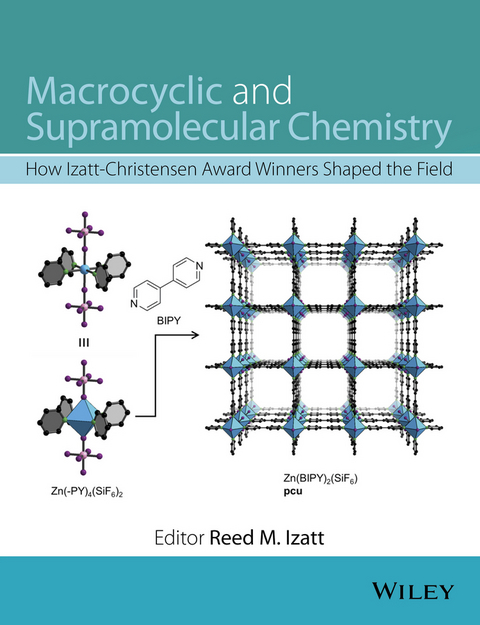
Macrocyclic and Supramolecular Chemistry (eBook)
This book commemorates the 25th anniversary of the International Izatt-Christensen Award in Macrocyclic and Supramolecular Chemistry. The award, one of the most prestigious of small awards in chemistry, recognizes excellence in the developing field of macrocyclic and supramolecular chemistry Macrocyclic and Supramolecular Chemistry: How Izatt-Christensen Award Winners Shaped the Field features chapters written by the award recipients who provide unique perspectives on the spectacular growth in these expanding and vibrant fields of chemistry over the past half century, and on the role of these awardees in shaping this growth. During this time there has been an upsurge of interest in the design, synthesis and characterization of increasingly more complex macrocyclic ligands and in the application of this knowledge to understanding molecular recognition processes in host-guest chemistry in ways that were scarcely envisioned decades earlier.In October 2016, Professor Jean-Pierre Sauvage and Sir J. Fraser Stoddart (author for chapter 22 "e;Contractile and Extensile Molecular Systems: Towards Molecular Muscles"e; by Jean -Pierre Sauvage, Vincent Duplan, and Fr d ric Niess and 20 "e;Serendipity"e; by Paul R. McGonigal and J. Fraser Stoddart respectively) were awarded the Nobel Prize in Chemistry alongside fellow Wiley author Bernard Feringa, for the design and synthesis of molecular machines.
Dr. Reed M. Izatt, Charles E. Maw Professor of Chemistry (Emeritus), Brigham Young University, U.S.A. Reed M. Izatt received a BS degree in Chemistry from Utah State University (1951) and a PhD degree in Chemistry from Pennsylvania State University (1954). After post-doctoral work at Mellon Institute of Industrial Research, he embarked on an academic career at Brigham Young University retiring as Charles E. Maw Professor of Chemistry (1993). He is the author or co-author of over 550 publications. Reed has edited several books, contributed numerous chapters in books, written many journal and review articles and presented plenary, invited, and regular lectures at universities worldwide; regional, national, and international chemistry conferences; and government laboratories. Reed has been involved in research in macrocyclic chemistry since the late 1960s. Together with James Christensen, he organized the first Symposium on Macrocyclic Chemistry in Provo, Utah in 1977. This Symposium has thrived and was one of the major precursors of the present ISMSC.
1
The Izatt–Christensen Award in Macrocyclic and Supramolecular Chemistry: A 25-Year History (1991–2016)
Reed M. Izatt,1,2 Jerald S. Bradshaw,1,2 Steven R. Izatt,1 and Roger G. Harrison2
1 IBC Advanced Technologies, Inc., American Fork, UT, USA
2 Department of Chemistry and Biochemistry, Brigham Young University, Provo, UT, USA
1.1 Introduction
The Izatt–Christensen Award (I–C Award) recognizes excellence in macrocyclic and supramolecular chemistry. It has been presented annually since 1991 by the International Symposium on Macrocyclic and Supramolecular Chemistry (ISMSC). A common theme to both of these fields is molecular recognition. The search for underlying principles governing molecular recognition or how molecules recognize each other began in earnest in the early 1960s. Working independently, several individuals who later became prominent in the emerging fields of macrocyclic chemistry and supramolecular chemistry, made important early contributions to molecular recognition. Four of these were Charles J. Pedersen (1904–1989), Daryle H. Busch, Jean-Marie Lehn, and Donald J. Cram (1919–2001). Prior to the 1960s, no concentrated effort had been made to investigate chemical selectivity involving macrocyclic compound interactions with metal ions or other guest molecules [1].
Charles Pedersen while employed at du Pont serendipitously discovered the compound that later came to be known as dibenzo-18-crown-6 (DBl8C6). Pedersen isolated DBI8C6 in a 0.4% yield from a “brownish goo” while attempting to prepare a completely different compound[2]. The decision to expend the effort needed to isolate, purify, and characterize the compound that became known as DBl8C6 represents a true example of scientific creativity and luck. The story of Pedersen’s discovery, reported in 1967, his identification of the many new cyclic polyether macrocyclic compounds he synthesized, his characterization of their selective complexation with alkali metal ions, and his own account of the events surrounding the discovery make fascinating reading [2, 3].
Daryle Busch remembers that his first ideas of synthesizing macrocycles occurred while a graduate student with John Bailar at the University of Illinois in the early1950s. His account of these first ideas of forming macrocycles from bidentate amines involved in copper(II) chelation illustrates the workings of a creative mind. It was several years later in 1962, as a Professor of Inorganic Chemistry at Ohio State University, that he reported the first synthesis of a macrocycle using a metal template [1, 5] He received the I–C Award in 1994 and is the author of a chapter in this book [4], in which he gives a first-hand account of his work.
Jean-Marie Lehn reported the synthesis of macrobicyclic polyethers containing three polyether strands joined by two bridgehead nitrogen atoms [6] in 1969, shortly after Pedersen’s initial paper. Lehn later coined the term, “supramolecular chemistry,” to describe the broadening of the scope of host–guest chemistry which he and his research group had spearheaded [7]. To quote Professor Lehn, “Beyond molecular chemistry, supramolecular chemistry aims at constructing highly complex, functional chemical systems from components held together by intermolecular forces.” These components can be visualized as host–guest systems bonded by intermolecular forces, which are much weaker than covalent chemical bonds. The guest systems may include organic guests as well as metal ions. The number and variety of hosts synthesized has expanded far beyond macrocyclic compounds. Lehn has provided an account of his early work [7].
Donald Cram was a prominent organic chemist in the 1960s. John Sherman [8], one of his Ph.D. students, describes him as “definitely old school. Eccentric. Hard driven. Strong-willed. Spirited. Fearless.” Cram’s accomplishments included a major research program in organic chemistry, co-author of three major organic chemistry textbooks, and instructor at UCLA of several generations of organic chemistry students. His first acquaintance with macrocyclic chemistry was recorded by Roeland Nolte who remembers [9] that during a stay as a visiting scientist in Cram’s laboratory at UCLA in 1981, Cram told him “after reading Pedersen’s paper he had become so excited that he had made the decision to completely change his research program.” Nolte goes on to say, “After having seen the potential of host–guest chemistry and the way it was approached by Cram, i.e., by designing compounds with the help of space-filling (CPK) models, we became fascinated and concluded that we should start a line of research in the Netherlands in which this new type of chemistry was incorporated.” This attitude was contagious, and transfer of the excitement to others was responsible for the explosion of interest in macrocyclic chemistry, which characterized the field in the 1970s and 1980s.
As was the case with Nolte, many of the I–C Award winners spent time in the laboratories of Donald Cram, Daryle Busch, or Jean-Marie Lehn. A number of researchers, including one of us (RMI) and James J. Christensen, had close contact with Charles Pedersen, who influenced our early work in macrocyclic chemistry [10]. The influence of these early pioneers on the field through their own work and the work they inspired in others has been remarkable. The list of I–C Award recipients includes many of the early workers in the field who had close association with these individuals.
1.2 International Izatt–Christensen Award in Macrocyclic and Supramolecular Chemistry
In 1991, Jerald S. Bradshaw and Steven R. Izatt, President of IBC Advanced Technologies, Inc. (IBC), conceived the idea that it would be appropriate to initiate an annual award, titled the Izatt–Christensen Award, recognizing the vision of Reed M. Izatt and James J. Christensen in organizing the First Symposium on Macrocyclic Chemistry in 1977. From 1977 to 1991, the field had broadened, resulting in the design, synthesis and characterization of increasingly more complex organic ligands and their application to new fields of chemistry that were scarcely envisioned decades earlier. This trend is illustrated by the titles of the lectures presented by the I–C awardees.
The I–C Award was instituted in 1991 by IBC. This competitive annual award recognizes excellence in macrocyclic chemistry and is given to individuals who have not received a major award in chemistry. The awardee receives a small honorarium and a travel grant, provided by IBC, and is expected to present an invited lecture at the Symposium in the year of the award. The recipients of the I–C Award from 1991 through 2016 are listed in Table 1.1, together with the locations and titles of their Award lectures.
Table 1.1 Izatt–Christensen Awardees in Macrocyclic and Supramolecular Chemistry 1991–2016
| Year | Awardee | Location | Title of Award Lecture |
| 1991 | Jean-Pierre Sauvage | Sheffield, UK | Synthetic Molecular Knots |
| 1992 | Eiichi Kimura | Provo, Utah | Role of Zinc(II) in Zinc Enzymes |
| 1993 | J. Fraser Stoddart | Enschede, The Netherlands | Self-Assembly in Unnatural Product Synthesis |
| 1994 | Daryle H. Busch | Lawrence, Kansas | A Sampling of Multi-receptor Supramolecular Systems |
| 1995 | David N. Reinhoudt | Jerusalem, Israel | Synthesis and Self-assembly of Supramolecular Structures for Switches and Sensors |
| 1996 | George W. Gokel | Montecatini, Terme, Italy | Synthetic Models for Cation Channel Function |
| 1997 | Alan M. Sargeson | Seoul, Korea | Outer-sphere Electron Transfer Reactions of Macro-bicyclic Complexes |
| 1998 | Seiji Shinkai | Turtle Bay, Oahu, Hawaii | Dynamic Control of Ion and Molecule Recognition Processes in Macrocyclic Host–guest Systems |
| 1999 | Fritz Vögtle | Barcelona, Spain | Rotaxanes, Catenanes, Pretzelanes–Template Synthesis and Chirality |
| 2000 | Jerry L. Atwood | St. Andrews, UK | Macrocycles as Building Blocks for Large Supramolecular Assemblies |
| 2001 | Jonathan L. Sessler | Fukuoka, Japan | Novel Polypyrrole Macrocycles |
| 2002 | C. David Gutsche | Park City, Utah | The Cornucopia of Calixarene Chemistry |
| 2003 | Jeremy K. M. Sanders | Gdansk, Poland | The Ins and Outs of Templating: A Dynamic Future for Macrocyclic Chemistry |
| 2004 | Makoto Fujita | Cairns, Australia | Self-assembly and Function of Metal-linked Macrocyclic and Cage-like Molecular... |
| Erscheint lt. Verlag | 31.5.2016 |
|---|---|
| Sprache | englisch |
| Themenwelt | Naturwissenschaften ► Chemie ► Organische Chemie |
| Naturwissenschaften ► Chemie ► Physikalische Chemie | |
| Technik | |
| Schlagworte | Anorganische Chemie • Biochemie • Biochemie u. Chemische Biologie • Biochemistry (Chemical Biology) • Chemie • Chemistry • Inorganic Chemistry • International Symposium on Macrocyclic and Supramolecular Chemistry (ISMSC) • Izatt-Christensen Award • Macrocyclic Chemistry • Makrocyklische Verbindungen • supramolecular chemistry • Supramolekulare Chemie |
| ISBN-13 | 9781119053866 / 9781119053866 |
| Informationen gemäß Produktsicherheitsverordnung (GPSR) | |
| Haben Sie eine Frage zum Produkt? |
 EPUB (Adobe DRM)
Kopierschutz: Adobe-DRM
Adobe-DRM ist ein Kopierschutz, der das eBook vor Mißbrauch schützen soll. Dabei wird das eBook bereits beim Download auf Ihre persönliche Adobe-ID autorisiert. Lesen können Sie das eBook dann nur auf den Geräten, welche ebenfalls auf Ihre Adobe-ID registriert sind.
Details zum Adobe-DRM
Dateiformat: EPUB (Electronic Publication)
EPUB ist ein offener Standard für eBooks und eignet sich besonders zur Darstellung von Belletristik und Sachbüchern. Der Fließtext wird dynamisch an die Display- und Schriftgröße angepasst. Auch für mobile Lesegeräte ist EPUB daher gut geeignet.
Systemvoraussetzungen:
PC/Mac: Mit einem PC oder Mac können Sie dieses eBook lesen. Sie benötigen eine
eReader: Dieses eBook kann mit (fast) allen eBook-Readern gelesen werden. Mit dem amazon-Kindle ist es aber nicht kompatibel.
Smartphone/Tablet: Egal ob Apple oder Android, dieses eBook können Sie lesen. Sie benötigen eine
Geräteliste und zusätzliche Hinweise
Buying eBooks from abroad
For tax law reasons we can sell eBooks just within Germany and Switzerland. Regrettably we cannot fulfill eBook-orders from other countries.
aus dem Bereich