


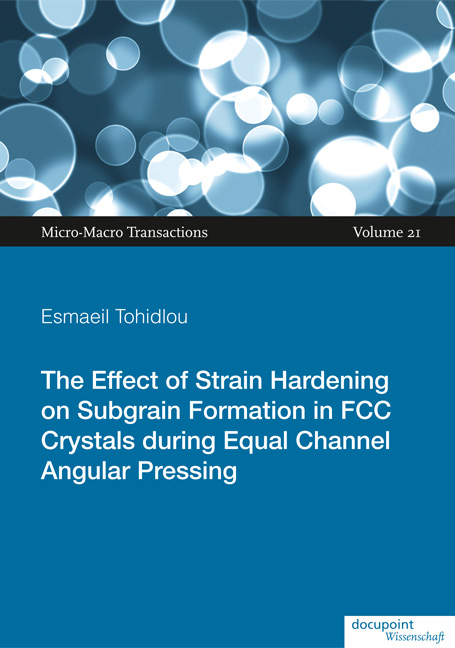
The Effect of Strain Hardening on Subgrain Formation in FCC Crystals during Equal Channel Angular Pressing
Micro-Macro Transactions Vol. 21
Seiten
2016
|
1. Aufl.
docupoint (Verlag)
978-3-86912-120-8 (ISBN)
docupoint (Verlag)
978-3-86912-120-8 (ISBN)
The grain size of materials plays an important role for the mechanical properties of crystalline materials. It is well known that the strength of crystalline materials can be improved by reducing the grain size. For this reason, the Equal Channel Angular Pressing (ECAP) is employed to modify the microstructure of metallic materials. It is clear that there is a connection between the microstructure and texture evolution with the constitutive behavior during the deformation process. Accordingly, the effect of strain hardening, latent hardening, and initial orientation on the grain refinement and texture evolution during the ECAP extrusion are studied. To bridge the connection between strain hardening and microstructural features, a rate-dependent elasto-viscoplastic material model based on theory of materials
with isomorphic elastic ranges is applied. The shear strain rate of the slip systems is assumed to follow Hutchinson’s flow rule. A three-dimensional finite element mode of the ECAP process has been implemented in Abaqus standard. Various hardening models are used in the material model. The least square method with the Levenberg-Marquardt algorithm has been applied to identify the optimal parameters for these hardening models.
...
The grain size of materials plays an important role for the mechanical properties of crystalline materials. It is well known that the strength of crystalline materials can be improved by reducing the grain size. For this reason, the Equal Channel Angular Pressing (ECAP) is employed to modify the microstructure of metallic materials. It is clear that there is a connection between the microstructure and texture evolution with the constitutive behavior during the deformation process. Accordingly, the effect of strain hardening, latent hardening, and initial orientation on the grain refinement and texture evolution during the ECAP extrusion are studied. To bridge the connection between strain hardening and microstructural features, a rate-dependent elasto-viscoplastic material model based on theory of materials
with isomorphic elastic ranges is applied. The shear strain rate of the slip systems is assumed to follow Hutchinson’s flow rule. A three-dimensional finite element mode of the ECAP process has been implemented in Abaqus standard. Various hardening models are used in the material model. The least square method with the Levenberg-Marquardt algorithm has been applied to identify the optimal parameters for these hardening models.
...
with isomorphic elastic ranges is applied. The shear strain rate of the slip systems is assumed to follow Hutchinson’s flow rule. A three-dimensional finite element mode of the ECAP process has been implemented in Abaqus standard. Various hardening models are used in the material model. The least square method with the Levenberg-Marquardt algorithm has been applied to identify the optimal parameters for these hardening models.
...
The grain size of materials plays an important role for the mechanical properties of crystalline materials. It is well known that the strength of crystalline materials can be improved by reducing the grain size. For this reason, the Equal Channel Angular Pressing (ECAP) is employed to modify the microstructure of metallic materials. It is clear that there is a connection between the microstructure and texture evolution with the constitutive behavior during the deformation process. Accordingly, the effect of strain hardening, latent hardening, and initial orientation on the grain refinement and texture evolution during the ECAP extrusion are studied. To bridge the connection between strain hardening and microstructural features, a rate-dependent elasto-viscoplastic material model based on theory of materials
with isomorphic elastic ranges is applied. The shear strain rate of the slip systems is assumed to follow Hutchinson’s flow rule. A three-dimensional finite element mode of the ECAP process has been implemented in Abaqus standard. Various hardening models are used in the material model. The least square method with the Levenberg-Marquardt algorithm has been applied to identify the optimal parameters for these hardening models.
...
| Erscheinungsdatum | 31.05.2016 |
|---|---|
| Verlagsort | DE |
| Sprache | englisch |
| Einbandart | Paperback |
| Themenwelt | Naturwissenschaften ► Chemie ► Physikalische Chemie |
| ISBN-10 | 3-86912-120-3 / 3869121203 |
| ISBN-13 | 978-3-86912-120-8 / 9783869121208 |
| Zustand | Neuware |
| Informationen gemäß Produktsicherheitsverordnung (GPSR) | |
| Haben Sie eine Frage zum Produkt? |
Mehr entdecken
aus dem Bereich


aus dem Bereich
200 Aufgaben zum sicheren Umgang mit Quellen ionisierender Strahlung
Buch | Hardcover (2023)
Hanser, Carl (Verlag)
CHF 48,95
Quantenmechanik | Spektroskopie | Statistische Thermodynamik
Buch | Softcover (2024)
De Gruyter (Verlag)
CHF 83,90


