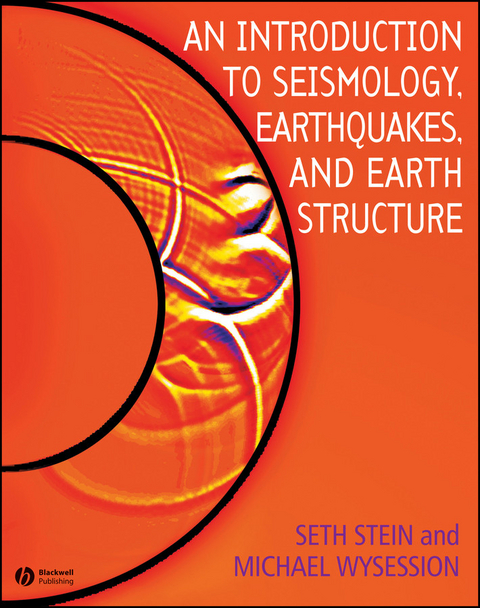
An Introduction to Seismology, Earthquakes, and Earth Structure (eBook)
512 Seiten
Wiley-Blackwell (Verlag)
9781118687451 (ISBN)
The fundamentals of seismic wave propagation are developed using a physical approach and then applied to show how refraction, reflection, and teleseismic techniques are used to study the structure and thus the composition and evolution of the earth. The book shows how seismic waves are used to study earthquakes and are integrated with other data to investigate the plate tectonic processes that cause earthquakes. Figures, examples, problems, and computer exercises teach students about seismology in a creative and intuitive manner. Necessary mathematical tools including vector and tensor analysis, matrix algebra, Fourier analysis, statistics of errors, signal processing, and data inversion are introduced with many relevant examples. The text also addresses the fundamentals of seismometry and applications of seismology to societal issues. Special attention is paid to help students visualize connections between different topics and view seismology as an integrated science.
An Introduction to Seismology, Earthquakes, and Earth Structure gives an excellent overview for students of geophysics and tectonics, and provides a strong foundation for further studies in seismology.
- Multidisciplinary examples throughout the text - catering to students in varied disciplines (geology, mineralogy, petrology, physics, etc.).
- Most up to date book on the market - includes recent seismic events such as the 1999 Earthquakes in Turkey, Greece, and Taiwan).
- Chapter outlines - each chapter begins with an outline and a list of learning objectives to help students focus and study.
- Essential math review - an entire section reviews the essential math needed to understand seismology. This can be covered in class or left to students to review as needed.
- End of chapter problem sets - homework problems that cover the material presented in the chapter. Solutions to all odd numbered problem sets are listed in the back so that students can track their progress.
- Extensive References - classic references and more current references are listed at the end of each chapter.
Seth Stein is Professor of Geological Sciences at Northwestern University. He has received the James B Macelwane Medal of the American Geophysical Union, been elected a Fellow of the American Geophysical Union and Geological Society of America, and named to the Institute for Scientific Information Highly Cited Researchers list. He served as Scientific Director of the University Navstar Consortium and on the Incorporated Research Institutions for Seismology's Executive Committee, and started Northwestern's Environmental Science program.
Michael Wysession is an Associate Professor in the Department of Earth and Planetary Sciences at Washington University. He is the recipient of the Packard Foundation and NSF Presidential Faculty Fellowships for his research into the structure of the Earth's deep interior.
Seth Stein is Professor of Geological Sciences at Northwestern University. He has received the James B Macelwane Medal of the American Geophysical Union, been elected a Fellow of the American Geophysical Union and Geological Society of America, and named to the Institute for Scientific Information Highly Cited Researchers list. He served as Scientific Director of the University Navstar Consortium and on the Incorporated Research Institutions for Seismology's Executive Committee, and started Northwestern's Environmental Science program. Michael Wysession is an Associate Professor in the Department of Earth and Planetary Sciences at Washington University. He is the recipient of the Packard Foundation and NSF Presidential Faculty Fellowships for his research into the structure of the Earth's deep interior.
Preface.
Acknowledgments.
1 Introduction.
2 Basic Seismological Theory.
3 Seismology and Earth Structure.
4 Earthquakes.
5 Seismology and Plate Tectonics.
6 Seismograms as Signals.
7 Inverse Problems.
Appendix: Mathematical and Computational Background.
Reference.
Solutions to selected odd-numbered problems.
Index.
"This outstanding book is without equal, and it will endure for
many years as an indispensable reference for earth scientists and
engineers as well as a great resource for students."
(Choice, April 2003)
"An Introduction to Seismology, Earthquakes, and Earth
Structure belongs on the shelf of every seismologist...a
fantastic resource for interesting examples, challenging problems,
added coverage for selected topics, and as a general reference
resource. This book is destined to become a classic."
--Clifford Thurber, University of Wisconsin, Madison, EOS
Transactions, June 2003
"All in all, it is an indispensable reference for serious
students of solid-Earth geophysics."
--Heidi Houston, UCLA, Physics Today, October 2003
"...the authors' methodical approach and transition through the
subject make it a suitable text with which to build on
undergraduate studies...If you have found seismology and earth
structure an interesting aspect of your earth science studies this
book is a valuable next step, supporting the authors' contention
that seismology should be part of the education of every solid
earth scientist." (The Open University Geological Society
Journal, May 2004)
"There is no doubt that the publication is a valuable learning
tool for advanced undergraduate and beginning graduate students and
a useful reference book not only for seismologists but also for
solid earth scientists in general." (The Eggs.org (Newsletter of
the EGU), September 2004)
"This is an extremely well-written, innovative and well-received
overview-cum-textbook for use by first-year graduate students. The
approach is more modern and useful than other available seismology
textbooks." (Natural Hazards, April 2005)
"In spite of the fact that the book has been written as a
textbook, it also makes a good addition to any geophysicist's
bookshelf as a 'quick reference' as the clear writing makes it easy
to absorb information quickly when reading out of sequence."
(Surveys in Geophysics)
2
Basic Seismological Theory
A very interesting example of sound waves in a solid, both longitudinal and transverse, are waves in the solid earth. Inside the earth, from time to time, there are earthquakes so sound waves travel around in the earth. Therefore if we place a seismograph at some location and watch the way the thing jiggles after there has been an earthquake somewhere else, we might get a jiggling, and a quieting down, and another jiggling … By using a large number of observations of many earthquakes at different places, we know what is inside the earth.
Richard Feynman, The Feynman Lectures on Physics, 1963
2.1 Introduction
We begin the study of seismic waves in the earth by addressing two basic questions. First, what in the physics of the solid earth allows waves to propagate through it? Second, how does the propagation of seismic waves depend on the nature of the material within the earth?
We will see that seismic waves propagate through the earth because the material within it, though solid, can undergo internal deformation. As a result, earthquakes and other disturbances generate seismic waves, which give information about both the source of the waves and the material they pass through.
To motivate these ideas, we first discuss a stretched string, a simple physical system that gives rise to waves analogous to seismic waves in the earth. As for the solid earth, deforming the string causes displacements that are functions of space and time satisfying the wave equation. The velocity of the propagating waves depends on the physical properties of the string in a way similar to that for waves in the earth, and the waves respond to changes in the physical properties of the string in ways analogous to what occurs for waves in the earth.
After discussing the string, we develop basic ideas about the mechanics of the solid earth. We introduce the stress tensor, which describes the forces acting within a deformable solid material, and the strain tensor, which describes the deformation. We then explore the relation between these tensors, and show that the displacements within the material can be described as functions of position and time satisfying the wave equation. Specifically, we will see how two types of seismic waves, P and S, propagate.
We then introduce concepts of wave propagation in the earth, with emphasis on how waves behave when they encounter changes in physical properties. These ideas give us the tools for Chapter 3, which discusses how seismic waves are used to study the interior of the earth, and Chapter 4, where we discuss how seismic waves are used to study earthquakes.
Although we focus on seismic waves, many of the concepts are similar to ones for other types of waves, so we will sometimes draw analogies to familar behavior of light, water, and sound waves.
2.2 Waves on a string
2.2.1 Theory
We consider an idealized mathematical string that extends in the x direction. Initially the string is straight in response to a tension force τ exerted along it, so u, the displacement from the equilibrium position in the y direction, is zero everywhere. After the string is plucked, portions of the string are displaced from their equilibrium positions and disturbances move along the string.
Our goal is to describe the displacement u(x, t) as a function of both position along the string and of time. To do this, we apply Newton’s second law of motion, F = ma, which states that the force vector equals the mass times the acceleration vector,1 to a segment dx of the string. Once the string segment is displaced, the string is stretched and the tension directed along the string gives rise to forces (Fig. 2.2-1) in the y direction of τ sin θ2 and –τ sin θ1 at the ends of the segment. The net force in the y direction equals the inertial term, which is the acceleration (second time derivative of the displacement) times the mass, where the mass is the product of the density ρ and dx. Hence, the vector equation F = ma becomes the scalar equation
Fig. 2.2-1 Geometry of a segment of a string subject to a tension τ. A slight difference in the angles θ1 and θ2 provides a net force in the y direction of F = τ sin θ2 – τ sin θ1, which accelerates the string.
If the angles θ are small, sin θ ≈ θ ≈ tan θ can be approximated by the slope, so
which can be expanded by forming a Taylor series and discarding the higher-order terms:
(3)
yielding the wave equation:
where v = (τ/ρ)1/2.
This equation gives the relationship between the time and space derivatives of the displacement u(x, t) along the string. We will see that the coupling between the two partial derivatives gives rise to waves propagating along the string with a velocity v. Because (4) describes the propagation of the scalar quantity u(x, t) in one space dimension, it is called the onedimensional scalar wave equation.
Fig. 2.2-2 “Snapshots” of a string showing a pulse f(x – 2t) traveling to the right in the +x direction. Because the velocity is 2, the pulse moves two distance units during each time unit. This pulse is one of many forms a traveling wave can take.
The wave equation is easily solved, because any function with the form u(x, t) = f(x ± vt) is a solution. To show this, note that the partial derivatives are
(5)
where f″ is the second derivative of f with respect to its argument. Thus, although we often think of solutions to the wave equation as sines and cosines, any function whose argument is (x ± vt) is a solution.
To see that a function f(x – vt) describes a propagating wave, consider how it varies in space and time. As time increases by an increment dt, the argument stays constant provided that the distance increases by vdt. Because the function’s value stays the same when its argument is constant, f(x – vt) describes a wave of constant shape propagating with velocity v in the positive x direction (Fig. 2.2-2). Similarly, because (x + vt) is constant if x decreases as time increases, f(x + vt) describes a wave propagating with velocity v in the –x direction. The sign relating the x and t terms thus shows which way the wave travels. We follow seismological convention and use the vector term “velocity” for v, although it is a scalar and thus better termed a “speed.”
The velocity v = (τ/ρ)1/2 at which the waves propagate depends on two physical properties of the string: the tension with which it is stretched and its density. Equation 1 shows how these properties interact. Because the tension provides the force that tends to restore any displacement to the equilibrium position, greater tension gives higher acceleration and thus faster wave propagation. In contrast, because the density appears in the inertial term, higher density gives lower acceleration and slower wave propagation.
The fact that the velocity depends on the density illustrates one of the reasons why the string is a useful analogy for seismic waves in the earth. One goal of seismology is to study the composition of the earth. For this purpose, we measure the time that waves take to travel between sources and receivers, find the velocity at which the waves propagated, and thus learn about the properties of the earth.
2.2.2 Harmonic wave solution
Any function of the form f(x ± vt) describes a propagating wave as a function of time and distance. A particularly useful form is a harmonic or sinusoidal wave2
A harmonic wave is characterized by its amplitude A and two parameters, ω and k, which we will discuss shortly. Substituting into the wave equation (4) and canceling the exponential and constant show that the wave velocity is the ratio
Although the exponential function u(x, t) in Eqn 6 is complex, the physical displacement must be real. We thus describe the displacement as the real part of u(x, t). The complex exponential form can be used for most purposes, because when a complex exponential appears in the solution of a physical problem, its conjugate also appears, so their sum yields a real displacement.
To understand the harmonic wave solution, consider the wave given by the real part of u(x, t), which is A cos (ωt – kx). Figure 2.2-3 shows how this function varies with both distance and time. The value of u is constant when the phase (ωt – kx) remains constant, as for a crest or a trough. Such lines of constant phase...
| Erscheint lt. Verlag | 30.5.2013 |
|---|---|
| Sprache | englisch |
| Themenwelt | Naturwissenschaften ► Geowissenschaften ► Geologie |
| Naturwissenschaften ► Geowissenschaften ► Geophysik | |
| Naturwissenschaften ► Physik / Astronomie | |
| Technik | |
| Schlagworte | Approach • Book • Composition • Data • earth • earthquakes • earth sciences • Evolution • Geologie u. Geophysik • Geology & Geophysics • Geophysics • Geophysik • Geowissenschaften • graduate • Introduction • Physical • propagation • refraction • Sciences • Seismic • Seismologie • Structure • Structures • students • techniques • teleseismic • undergraduate • Wave |
| ISBN-13 | 9781118687451 / 9781118687451 |
| Informationen gemäß Produktsicherheitsverordnung (GPSR) | |
| Haben Sie eine Frage zum Produkt? |
 EPUB (Adobe DRM)
Kopierschutz: Adobe-DRM
Adobe-DRM ist ein Kopierschutz, der das eBook vor Mißbrauch schützen soll. Dabei wird das eBook bereits beim Download auf Ihre persönliche Adobe-ID autorisiert. Lesen können Sie das eBook dann nur auf den Geräten, welche ebenfalls auf Ihre Adobe-ID registriert sind.
Details zum Adobe-DRM
Dateiformat: EPUB (Electronic Publication)
EPUB ist ein offener Standard für eBooks und eignet sich besonders zur Darstellung von Belletristik und Sachbüchern. Der Fließtext wird dynamisch an die Display- und Schriftgröße angepasst. Auch für mobile Lesegeräte ist EPUB daher gut geeignet.
Systemvoraussetzungen:
PC/Mac: Mit einem PC oder Mac können Sie dieses eBook lesen. Sie benötigen eine
eReader: Dieses eBook kann mit (fast) allen eBook-Readern gelesen werden. Mit dem amazon-Kindle ist es aber nicht kompatibel.
Smartphone/Tablet: Egal ob Apple oder Android, dieses eBook können Sie lesen. Sie benötigen eine
Geräteliste und zusätzliche Hinweise
Buying eBooks from abroad
For tax law reasons we can sell eBooks just within Germany and Switzerland. Regrettably we cannot fulfill eBook-orders from other countries.
aus dem Bereich