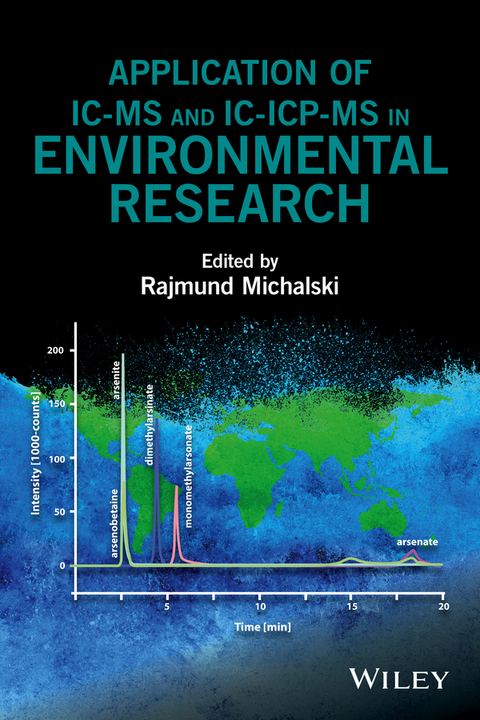
Application of IC-MS and IC-ICP-MS in Environmental Research (eBook)
John Wiley & Sons (Verlag)
978-1-119-08547-8 (ISBN)
- Covers the importance of species analysis and hyphenated methods in ion chromatography
- Includes practical applications of IC-MS and IC-ICP-MS in environmental analysis
- Details sample preparation methods for ion chromatography
- Discusses hyphenated methods IC-MS and IC-ICP-MS used in determining both the total element contents and its elements
- Details speciation analysis used in studying biochemical cycles of selected chemical compounds; determining toxicity and ecotoxicity of elements; food and pharmaceuticals quality control; and in technological process control and clinical analytics
Rajmund Michalski works at the Institute of Environmental Engineering of Polish Academy of Sciences. He has authored/edited a dozen of books and over 250 publications about applications of ion chromatography in environmental samples analysis, as well as application of modern analytical methods and techniques for environmental protection and assessment. Since 2005 he has annually organized the since international ion chromatography conference in Poland.
Introduces the reader to the field of ion chromatography, species analysis and hyphenated methods IC-MS and IC-ICP-MS including the theory and theirs applications Covers the importance of species analysis and hyphenated methods in ion chromatography Includes practical applications of IC-MS and IC-ICP-MS in environmental analysis Details sample preparation methods for ion chromatography Discusses hyphenated methods IC-MS and IC-ICP-MS used in determining both the total element contents and its elements Details speciation analysis used in studying biochemical cycles of selected chemical compounds; determining toxicity and ecotoxicity of elements; food and pharmaceuticals quality control; and in technological process control and clinical analytics
Rajmund Michalski works at the Institute of Environmental Engineering of Polish Academy of Sciences. He has authored/edited a dozen of books and over 250 publications about applications of ion chromatography in environmental samples analysis, as well as application of modern analytical methods and techniques for environmental protection and assessment. Since 2005 he has annually organized the since international ion chromatography conference in Poland.
CHAPTER 1
PRINCIPLES AND APPLICATIONS OF ION CHROMATOGRAPHY
Rajmund Michalski
Institute of Environmental Engineering, Polish Academy of Sciences, M. Skłodowskiej-Curie 34, 41-819, Zabrze, Poland
1.1 PRINCIPLES OF ION CHROMATOGRAPHY
1.1.1 Introduction
The history ofchromatography as a separation method began in 1903 when Mikhail Semyonovich Tsvet (a Russian biochemist working at the Department of Chemistry of the Warsaw University) separated plant dyes using adsorption in a column filled with calcium carbonate and other substances [1]. After extraction with the petroleum ether, he obtained clearly separated colorful zones. To describe this method, he used Greek words meaning color (ρωμα) and writing (γραϕω) and coined a new word, chromatography, which literally meant writing colors. At present, chromatographic methods are among the most popular instrumental methods in the analytical chemistry as they offer quick separation and determination of substances, including complex matrix samples.
Chromatographic methods are used widely on both the preparative and analytical scales. They help to separate and determine polar and nonpolar components; acidic, neutral, and alkaline compounds; organic and inorganic substances; monomers, oligomers, and polymers. It is necessary to use an appropriate chromatography type, which depends on the physicochemical properties of the examined sample and its components. Gas chromatography (GC) and liquid chromatography (LC) can be used to separate and determine approximately 20% and 80% of the known compounds, respectively. Ion chromatography (IC) is a part of high-performance liquid chromatography used to separate and determine anions and cations and also other substances after converting them into the ionic forms. In the literature, the term ion-exchange chromatography (I-EC) is found. It differs from ion chromatography even though both types are based on the widely known ion-exchange processes. Ion chromatography originates from ion-exchange chromatography. It uses high-performance analytical columns that are usually filled with homogenous particles with small diameters and most often conductometric detection. When compared to the classic ion-exchange chromatography, it is more efficient, faster, and more sensitive. It also offers very good repeatability of the obtained results. The ion-exchange chromatography term was used until 1975, when the first commercial ion chromatograph was available. At present, most analyses of ionic substances conducted with chromatographic techniques are performed with ion chromatography.
In the last 40 years, there were many state-of-the-art monographs that described the ion chromatography theory and applications in detail [2–5]. Some of these studies have already been republished. At present, there are three main separation methods in ion chromatography. They are based on different properties of substances used in the column phases and the resulting ion capacity. They include the following:
- Ion chromatography (IC) and can be either suppressed or nonsuppressed
- Ion exclusion chromatography (IEC)
- Ion pair chromatography (IPC).
The block diagram of an ion chromatograph (cation-exchange and anion-exchange types), together with ion-exchange reactions for the most popular suppressed ion chromatography, can be seen in Figure 1.1.
Figure 1.1 Block diagram of an ion chromatograph with a conductometric detector.
The anion separation proceeds according to the following principle: analyte ions (e.g., Cl−) together with eluent ions pass through the analytical column in which the following ion-exchange reaction takes place:
The affinity of the analyte ions toward the stationary phase is diverse. Consequently, the ions are separated and leached out from the analytical column within different retention times against the background of weakly dissociated NaHCO3. Afterward, they are transported into the suppressor with high-capacity sulfonic cation exchanger. The following reaction takes place:
The NaHCO3 eluent ions are transformed into weakly dissociated carbonic acid due to the occurring reactions. The analyte ions (e.g., Cl−) react in accordance with the following formula:
Due to the reactions taking place in the analytical column and the suppressor, the analyte ions reach the detector in the form of strongly dissociated acids against the background of weakly dissociated carbonic acid. The obtained signal related to the conductivity of the analyte ions (the analyte forms a well-dissociated salt after the reactions) is high enough to use the conductometric detector to record the peaks of separated anions against the background of a weak signal related to the low eluent conductivity (forming weakly dissociated carbonic acid). Parallel reactions are observed when cations are determined. The cation-exchange column is filled with a cation exchanger with sulfonic groups. Eluent consists of water solution of, for example, hydrochloric acid. The analyte ions (e.g., Na+) together with the eluent ions pass through the analytical column in which the following ion-exchange reaction takes place:
The affinity of the analyte ions toward the stationary phase is diverse. Consequently, the cations are separated and leached out from the analytical column within different retention times against the background of strongly dissociated HCl. Afterward, the ions are transported into the suppressor with high-capacity anion exchanger (e.g., with quaternary ammonium groups as functional groups). The following chemical reaction occurs:
The HCl eluent ions are transformed into water due to the reactions in the suppressor, whereas the analyte ions (Na+) react with the exchanger in the suppression column according to the following formula:
Due to the chemical reactions in the analytical column and suppressor, the analyte ions reach the detector in the form of highly dissociated hydroxides against the water background, which allows analysis in the conductometric detector.
Ion exclusion chromatography (IEC) is a comparatively old technique, which uses the Gibbs–Donnan effect. A porous ionic-exchanger functions as a semipermeable membrane separating two water phases (mobile and stationary) contained in the exchanger pores. The membrane is only permeable for nonionized or weakly ionized substances. They are separated between two water phases, whereas their migration through the column is delayed. The ionized substances do not penetrate the inside of the pores. In I-EC cation exchanger, and occasionally anion exchanger, has generally been used for I-EC separations. They are not held in the column and leave it first. IEC is mainly used for separating weak inorganic acids, organic acids, alcohols, aldehydes, amino acids, and also for the group separation of ionic and nonionic substances [5, 6].
As an alternative to conventional ion chromatography, anions and cations can be separated on a standard reversed-phase column of the type used for HPLC. Several names have been applied for this type of separation, such as the following: ion-interaction chromatography, mobile-phase ion chromatography, and mostly IPC. In ion-pair chromatography, the X substance ions react with the lipophilic L ions (constituting the eluent component) and form the XL complex. The complex can be bound to the nonpolar surface of the stationary S phase in a reversible way. The S phase makes a reversible phase, as its polarity is lower than that of the eluent. It forms the XLS complex. The separated sample ions (XL complexes) have different retention times in the column. The retention times result from different affinities that the ions have toward the nonpolar stationary-phase surface, which causes the separation. According to the alternative model, the lipophilic eluent ions are adsorbed on the stationary-phase surface and form the LS complex. As a result, an ion exchanger forms on the nonpolar stationary-phase surface. The ions of the solved X substance react with this exchanger. The hydrophobic ions (e.g., alkyl and aryl sulfonates) may penetrate the inside of the layer formed by the LS complex. Their retention time is decided by the adsorption phenomenon. More hydrophilic ions penetrate only the external zone. Their retention time in the column is decided by the ion-exchange mechanism. This chromatography type is mainly used to determine ions such as sulfates, sulfonates, alkaloids, barbiturates, fatty acid derivatives, and selected metal ion complexes [7]. Besides these three main types, reversed-phase liquid chromatography (RPLC) [8] and hydrophilic interaction liquid chromatography (HILIC) [9] can also be used to separate selected ions.
Ion determination methods used before 1975 (gravimetric, titration, spectrometric, electrolytic, and other methods) were inexpensive and easily available; however, they were also time-consuming and required large amounts of expensive and (frequently) toxic reagents. On the other hand, the chromatographic methods used at that time were mostly applied for separation and determination of organic compounds.
The chromatographic method applications for separating metal ions were intensively investigated during WWII, when the atomic bomb was constructed (Manhattan Project). Nonetheless, the real breakthrough took place in 1971 when Small and his colleagues from Dow Physical Research Laboratory (Midland, MI) examined and proposed a chromatographic method for determination of lithium, sodium, and potassium with ion exchange and...
| Erscheint lt. Verlag | 17.5.2016 |
|---|---|
| Sprache | englisch |
| Themenwelt | Naturwissenschaften ► Chemie ► Analytische Chemie |
| Technik | |
| Schlagworte | Chemie • Chemistry • Chromatographie • Chromatographie / Trennverfahren • Chromatography / Separation Techniques • Environmental Analysis • Environmental research • hyphenated methods • Ion chromatography • Mass Spectrometry • Pharmaceutical & Medicinal Chemistry • Pharmazeutische u. Medizinische Chemie • species analysis • Umweltanalytik |
| ISBN-10 | 1-119-08547-0 / 1119085470 |
| ISBN-13 | 978-1-119-08547-8 / 9781119085478 |
| Informationen gemäß Produktsicherheitsverordnung (GPSR) | |
| Haben Sie eine Frage zum Produkt? |
 EPUB (Adobe DRM)
Kopierschutz: Adobe-DRM
Adobe-DRM ist ein Kopierschutz, der das eBook vor Mißbrauch schützen soll. Dabei wird das eBook bereits beim Download auf Ihre persönliche Adobe-ID autorisiert. Lesen können Sie das eBook dann nur auf den Geräten, welche ebenfalls auf Ihre Adobe-ID registriert sind.
Details zum Adobe-DRM
Dateiformat: EPUB (Electronic Publication)
EPUB ist ein offener Standard für eBooks und eignet sich besonders zur Darstellung von Belletristik und Sachbüchern. Der Fließtext wird dynamisch an die Display- und Schriftgröße angepasst. Auch für mobile Lesegeräte ist EPUB daher gut geeignet.
Systemvoraussetzungen:
PC/Mac: Mit einem PC oder Mac können Sie dieses eBook lesen. Sie benötigen eine
eReader: Dieses eBook kann mit (fast) allen eBook-Readern gelesen werden. Mit dem amazon-Kindle ist es aber nicht kompatibel.
Smartphone/Tablet: Egal ob Apple oder Android, dieses eBook können Sie lesen. Sie benötigen eine
Geräteliste und zusätzliche Hinweise
Buying eBooks from abroad
For tax law reasons we can sell eBooks just within Germany and Switzerland. Regrettably we cannot fulfill eBook-orders from other countries.
aus dem Bereich