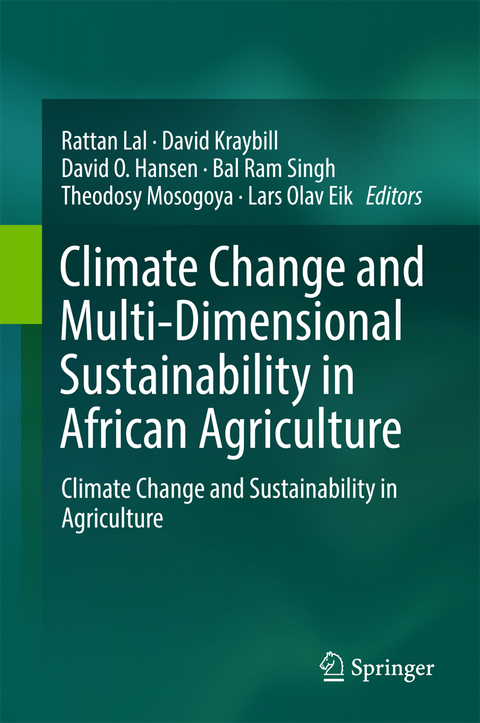
Climate Change and Multi-Dimensional Sustainability in African Agriculture
Springer International Publishing (Verlag)
978-3-319-41236-8 (ISBN)
Rattan Lal , Ph.D., is a Distinguished University Professor of Soil Science and Director of the Carbon Management and Sequestration Center, The Ohio State University, and an Adjunct Professor of University of Iceland. His current research focus is on climate-resilient agriculture, soil carbon sequestration, sustainable intensification, enhancing use efficiency of agroecosystems, and sustainable management of soil resources of the tropics. He received honorary degree of Doctor of Science from Punjab Agricultural University (2001), the Norwegian University of Life Sciences, Aas (2005), and Alecu Russo Balti State University, Moldova (2010). He was president of the World Association of the Soil and Water Conservation (1987-1990), the International Soil Tillage Research Organization (1988-91), the Soil Science Society of America (2005-2007), and is President Elect of International Union of Soil Science. He was a member of the Federal Advisory Committee on U.S. National Assessment of Climate Change-NCADAC (2010-2013), member of the SERDP Scientific Advisory Board of the US-DOE (2011-), Senior Science Advisor to the Global Soil Forum of Institute for Advanced Sustainability Studies, Potsdam, Germany (2010-), member of the Advisory Board of Joint Program Initiative of Agriculture, Food Security and Climate Change (FACCE-JPI) of the European Union (2013-), and Chair of the Advisory Board of Institute for Integrated Management of Material Fluxes and Resources of the United Nation University (UNU-FLORES), Dresden, Germany (2014-2017). Prof. Lal was a lead author of IPCC (1998-2000). He has mentored 102 graduate students and 54 postdoctoral researchers, and hosted 140 visiting scholars. He has authored /co-authored 780 refereed journal articles, has written 19 and edited / co-edited 63 books. In 2015, Reuter Thomson listed him among the world's most influential scientific minds and having citations of publications among top 1% of scientists in agricultural sciences. Bal Ram Singh is a professor in the Department of Environmental Sciences at the Norwegian University of Life Sciences (UMB). He earned his M.Sc. degree from the Indian Agricultural Research Institute, New Delhi, and his Ph.D. degree from G.B. Pant University of Agriculture & Technology, Pantnagar, India. His program focuses on bioavailability and mobility of heavy metals in the soil and plant system, fertility management and agricultural sustainability in soils of the tropics and on carbon sequestration in soils under different land uses. He has served as chair of the program board "Soils and Plants" of the Research Council of Norway and the Research and Higher Education Committee in the department. He was chair of the Cost Action FA0905 on" Mineral Improved Cop Production for Healthy Food and Feed. Dr. Singh is a fellow of ASA and SSSA and a recipient of International SSSA award. Dr. David Kraybill currently serves as project director for the USAID-funded Innovative Agricultural Research Project in Tanzania. His primary research interest is economic development. His work focuses on regional and spatial development processes that interact with markets and national government policies to determine the economic and social wellbeing of individuals, households, and communities. Dr. Kraybill's recent research includes studies of household poverty, household savings, governmental decentralization, primary and secondary education, and adaptation to climate change. Fluent in French and a Swahili speaker, he has lived in Africa a total of five years, including a sabbatical year as Fulbright Scholar at Makerere University in Uganda. Kraybill has served as Associate Editor or member of editorial boards of seven academic journals. He has received research and advising awards at Ohio St
Foreword.- Preface.- Section I. Multi-Dimensional Sustainability.- Environmental Sustainability.- 2. Economic Sustainability.- 3. Institutional Sustainability in the Face of Climate Change: Empirical Insights from Irrigation Institutions in Iringa Rural District, Tanzania.- 4. Climate Change and Social Sustainability: A Case for Polycentric Sustainabilities.- Section II. Sustainable Management of Natural Resources.- 5. Land degradation neutrality: Will Africa achieve it? Institutional solutions to land degradation and restoration in Africa.- 6. Extent of salt affected soils and their effects in irrigated and lowland rain-fed rice growing areas of South Western Tanzania.- 7. Sustainability of intensification in smallholder maize production in Tanzania.- 8. Potentials for Rehabilitating Degraded Land in Tanzania.- 9. Economic aspects of genetic resources in addressing agricultural productivity in the context of climate change.- 10. Soil and nutrient losses and the role of gender inland degradation in Southwestern Uganda.- 11. The social dimension of water management in an era of increasing water scarcity.- Section III. Integrated Management of Natural Resources and Value Chains.- 12. Managing Landscapes for Environmental Sustainability.- 13. Economic Impact of Drip Irrigation regimes on Sorghum production in Semi Arid Areas of Tanzania.- 14. Social Aspects of Water Governance in the Context of Climate Change and Agriculture.- 15. Assessment of Climate Change Impacts on Common Bean (Phaseolus vulgaris Savi, L.) Production in Tanzania.- 16. Institutional water resources management and livelihood adaptation A case from Kilombero rural areas, Tanzania.- 17. Institutional aspects of genetic resources in respect of climate change in Sub-Saharan Africa.- 18. Crop adaptation to climate change in SSA: the role of genetic resources and seed systems.- 19. Updating legacy soil maps for climate resilient agriculture: A case of Kilombero Valley, Tanzania.- 20. Measuring Agricultural Sustainability in Agroforestry Systems.- 21. Experiences with adopting the Catchment Approach in Sustainable Land Management: The case of Kagera TAMP Tanzania.- 22. Sustainable intensification in mixed crop-livestock agro-ecosystems in the face of climate change: The case for landscapes in Tanzania.- 23. Smart strategies for enhanced agricultural resilience and food security under a changing climate in sub-Saharan Africa.- Section IV. Outreach and Extension.- 24. Globalizing Environmental Sustainability:"2015International Year of Soil" Transitioning to "2015-2024 International Decade of Soil".- 25. From Ujamaa to Big Results Now: Sustainable Transformation of Tanzanian Agriculture in the frame of climate change.- Section V. Private Sector Solutions.- 26. Effect of improved plant nutrition on maize (Zea mays) and rice (Oriza sativa) grain chemical nutrient content under smallholder farming systems in Tanzania.- 27. Public-private partnership for sustainableproduction and marketing of goat milk in light of climate change.- 28. Private Sector Actions to Enable Climate-Smart Agriculture in Small-Scale Farming in Tanzania.- 29. The role of selected Agroforestry trees in Temperature Adaptation on Coffea arabica: A case study of Moshi District, Tanzania.- Section VI. Agricultural Risk, Insurance and Policy.- 30. Addressing Climate Change through Risk Mitigation: Welfare Implications of Index Insurance in Northeastern Tanzania.- 31. Assessing the Economic Value of El Niño-based seasonal climate forecasts for smallholder farmers in Zimbabwe.- Section VII. Agricultural Research for Sustainability.- 32. Kinds of Research: relationship with agricultural research for sustainability.- 33. Biological Inoculants for Sustainable Intensification of Agriculture in the Sub-Saharan Africa Smallholder Farming Systems.- 34. The Economics of Conservation Agriculture in Africa: Implications of Climate Change.- 35. Research and Development Priorities.- Appendix.-
| Erscheinungsdatum | 11.11.2016 |
|---|---|
| Zusatzinfo | XXIV, 717 p. 165 illus., 144 illus. in color. |
| Verlagsort | Cham |
| Sprache | englisch |
| Maße | 155 x 235 mm |
| Themenwelt | Naturwissenschaften ► Biologie ► Ökologie / Naturschutz |
| Weitere Fachgebiete ► Land- / Forstwirtschaft / Fischerei | |
| Schlagworte | Agriculture • Biomedical and Life Sciences • climate change • Economic Sustainability • Emerging concepts on sustainability • Environmental sustainability • Institutional Sustainability • Private sector engagement • Social Sustainability • Sub-Saharan Africa • sustainable development • Tanzania • Technology adoption • U.N. Sustainable Development Goals • Water Management |
| ISBN-10 | 3-319-41236-1 / 3319412361 |
| ISBN-13 | 978-3-319-41236-8 / 9783319412368 |
| Zustand | Neuware |
| Informationen gemäß Produktsicherheitsverordnung (GPSR) | |
| Haben Sie eine Frage zum Produkt? |
aus dem Bereich