Global Dynamics (eBook)
John Wiley & Sons (Verlag)
978-1-118-93747-1 (ISBN)
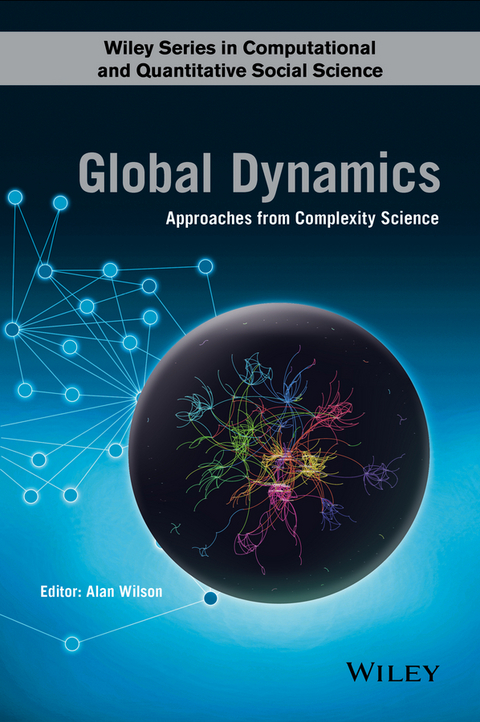
A world model: economies, trade, migration, security and development aid.
This bookprovides the analytical capability to understand and explore the dynamics of globalisation. It is anchored in economic input-output models of over 200 countries and their relationships through trade, migration, security and development aid. The tools of complexity science are brought to bear and mathematical and computer models are developed both for the elements and for an integrated whole. Models are developed at a variety of scales ranging from the global and international trade through a European model of inter-sub-regional migration to piracy in the Gulf and the London riots of 2011. The models embrace the changing technology of international shipping, the impacts of migration on economic development along with changing patterns of military expenditure and development aid. A unique contribution is the level of spatial disaggregation which presents each of 200+ countries and their mutual interdependencies - along with some finer scale analyses of cities and regions. This is the first global model which offers this depth of detail with fully work-out models, these provide tools for policy making at national, European and global scales.
Global dynamics:
- Presents in depth models of global dynamics.
- Provides a world economic model of 200+ countries and their interactions through trade, migration, security and development aid.
- Provides pointers to the deployment of analytical capability through modelling in policy development.
- Features a variety of models that constitute a formidable toolkit for analysis and policy development.
- Offers a demonstration of the practicalities of complexity science concepts.
This book is for practitioners and policy analysts as well as those interested in mathematical model building and complexity science as well as advanced undergraduate and postgraduate level students.
A world model: economies, trade, migration, security and development aid. This bookprovides the analytical capability to understand and explore the dynamics of globalisation. It is anchored in economic input-output models of over 200 countries and their relationships through trade, migration, security and development aid. The tools of complexity science are brought to bear and mathematical and computer models are developed both for the elements and for an integrated whole. Models are developed at a variety of scales ranging from the global and international trade through a European model of inter-sub-regional migration to piracy in the Gulf and the London riots of 2011. The models embrace the changing technology of international shipping, the impacts of migration on economic development along with changing patterns of military expenditure and development aid. A unique contribution is the level of spatial disaggregation which presents each of 200+ countries and their mutual interdependencies along with some finer scale analyses of cities and regions. This is the first global model which offers this depth of detail with fully work-out models, these provide tools for policy making at national, European and global scales. Global dynamics: Presents in depth models of global dynamics. Provides a world economic model of 200+ countries and their interactions through trade, migration, security and development aid. Provides pointers to the deployment of analytical capability through modelling in policy development. Features a variety of models that constitute a formidable toolkit for analysis and policy development. Offers a demonstration of the practicalities of complexity science concepts. This book is for practitioners and policy analysts as well as those interested in mathematical model building and complexity science as well as advanced undergraduate and postgraduate level students.
Alan Wilson, Centre for Advanced Spatial Analysis, University College London, UK. His research interests have been concerned with many aspects of mathematical modelling and the use of models in planning in relation to all aspects of cities and regions - including demography, economic input-output modelling, transport and locational structures. He was responsible for the introduction of a number of model building techniques which are now in common use internationally. These models have been widely used in areas such as transport planning. He made important contributions through the rigorous deployment of accounts' concepts in demography and economic modelling. In recent years he has been particularly concerned with applications of dynamical systems theory in relation to the task of modelling the evolution of urban structure -- initially described in Catastrophe theory and bifurcation: applications to urban and regional systems. His current research, supported by ESRC and EPSRC grants of around ?3M, is on the evolution of cities and the dynamics of global trade and migration.
Notes on Contributors
Peter Baudains is a Research Associate at the UCL Department of Security and Crime Science. He obtained his PhD in Mathematics from UCL in 2015 and worked for five years on the EPSRC-funded ENFOLDing project, contributing to a wide range of research projects. His research interests are in the development and application of novel analytical techniques for studying complex social systems, with a particular attention on crime, rioting and terrorism. He has authored research articles appearing in journals such as Criminology, Applied Geography, Policing and the European Journal of Applied Mathematics.
Janina Beiser obtained her PhD in the department of Political Science at University College London. During her PhD, she was part of the security workstream of the ENFOLDing project at the UCL's Centre for Advanced Spatial Analysis for three years. Her research is concerned with the contagion of armed civil conflict as well as with government repression. She is now a Research Fellow in the Department of Government at the University of Essex.
Jyoti Belur is a Senior Research Associate and Senior Teaching Fellow. She served as a senior officer of the Indian Police Service for several years. Her experience and understanding of policing has contributed to her research interests in various aspects of policing, counter-terrorism, crime prevention in the United Kingdom and overseas. She has conducted research on a wide variety of topics including police use of deadly force, police investigations, police misconduct, policing left-wing extremism and crimes against women and has published a book titled Permission to Shoot? Police Use of Deadly Force in Democracies, as well as a number of journal articles and book chapters.
Steven Bishop is a Professor of Mathematics at UCL where he has been since arriving in 1984 as a post-doctoral researcher. He published over 150 academic papers, edited books and has had appearances on television and radio. Historically, his research investigated topics such as chaos theory, reducing vibrations of engineering structures and how sand dunes are formed, but has more recently worked on ‘big data’ and the modelling of social systems. Steven held a prestigious, ‘Dream’ Fellowship funded by the UK Research Council (EPSRC) until December 2013 allowing him to consider creative ways to arrive at scientific narratives. He was influential in the formation of a European network of physical and social scientists in order to investigate how decision-support systems can be developed to assist policy-makers and, to drive this, has organised conferences in the United Kingdom and European Parliaments. He has been involved in several European Commission funded projects and has helped to forge a research agenda which looks at behaviour of systems that cross policy domains and country borders.
Alex Braithwaite is an Associate Professor in the School of Government and Public Policy at the University of Arizona, as well as a Senior Research Associate in the School of Public Policy at University College London. He obtained a PhD in Political Science from the Pennsylvania State University in 2006 and has since held academic positions at Colorado State University, UCL, and the University of Arizona. He was a Co-Investigator on the EPSRC-funded ENFOLDing project between 2010 and 2013, contributing to a wide range of projects under the ‘security’ umbrella. His research interests lie in the causes and geography of violent and nonviolent forms of political conflict and have been published in journals such as Journal of Politics, International Studies Quarterly, British Journal of Political Science, Journal of Peace Research, Criminology and Journal of Quantitative Criminology.
Simone Caschili has a PhD in Land Engineering and Urban Planning, and after being a Research Associate at Centre for Advanced Spatial Analysis (UCL) and Senior Fellow of the UCL QASER Lab, he is currently an Associate at LaSalle Investment Management, London. His research interest covers the modelling of urban and regional systems, property market, spatio-temporal and economic networks and policy evaluation for planning in both transport and environmental governance.
Adam Dennett is a Lecturer in Urban Analytics in the Centre for Advanced Spatial Analysis at University College London. He is a geographer and fellow of the Royal Geographical Society and has worked for a number of years in the broad area of population geography, applying quantitative techniques to the understanding of human populations; much of this involving the use of spatial interaction models to understand the migration flows of people around the United Kingdom, Europe and the world. A former secondary school teacher, Adam arrived at UCL in 2010 after completing a PhD at the University of Leeds.
Robert J. Downes is a MacArthur Fellow in Nuclear Security working at the Centre for Science and Security Studies at the Department of War Studies, King's College London. Trained as a mathematician, Rob received his PhD in mathematics from UCL in 2014; he studied the interplay between geometry and spectral theory with applications to physical systems and gravitation. He also holds an MSc in Mathematics with Theoretical Physics awarded by UCL. As a Postdoctoral Research Associate on the ENFOLDing project at The Bartlett Centre for Advanced Spatial Analysis, Rob studied the structure and dynamics of global socio-economic systems using ideas from complexity science, with particular emphasis on national economic structure and development aid.
Shane Johnson is a Professor in the Department of Security and Crime Science at University College London. He has worked within the fields of criminology and forensic psychology for over 15 years and has particular interests in complex systems, patterns of crime and insurgent activity, event forecasting and design against crime. He has published over 100 articles and book chapters.
Rob Levy is a researcher at the Centre for Advanced Spatial Analysis at University College London. He has a background in quantitative economics, database administration, coding and visualisation. His first love was Visual Basic but now writes Python and Javascript, with some R when there is no way to avoid it.
Elio Marchione is a Consultant for Ab Initio Software Corporation. Elio was Research Associate at the Centre for Advanced Spatial Analysis at University College London (UK). He obtained his PhD at the University of Surrey (UK) at the Centre for Research in Social Simulation; MSc in Applied Mathematics at the University of Essex (UK); MEng at the University of Naples (ITA). His current role consists, among others, in designing and building scalable architectures addressing parallelism, data integration, data repositories and analytics while developing heavily parallel CPU-bound applications in a dynamic, high-volume environment. Elio's academic interests are in designing and/or modelling artificial societies or distributed intelligent systems enabled to produce novelty or emergent behaviour.
Francesca Romana Medda is a Professor in Applied Economics and Finance at University College London (UCL). She is the Director of the UCL QASER (Quantitative and Applied Spatial Economics Research) Laboratory. Her research focuses on project finance, financial engineering and risk evaluation in different infrastructure sectors such as the maritime industry, energy innovation and new technologies, urban investments (smart cities), supply chain provision and optimisation and airport efficiency.
Pablo Mateos is Associate Professor at the Centre for Research and Advanced Studies in Social Anthropology (CIESAS) in Guadalajara, México. He is honorary lecturer in the Department of Geography, University College London (UCL), in the United Kingdom where he was Lecturer in Human Geography from 2008 to 2012. At UCL, he was a member of the Migration Research Unit (MRU) and Research Fellow of the Centre for Research and Analysis of Migration (CReAM). His research focuses on ethnicity, migration and citizenship in the United Kingdom, Spain, the United States and Mexico. He has published over 40 articles and book chapters, and a book monograph titled Names, Ethnicity and Populations: Tracing Identity in Space published by Springer in 2014.
Thomas Oléron Evans is a Research Associate in the Centre for Advanced Spatial Analysis at University College London, where he has been working on the ENFOLDing project since 2011. In 2015, he completed a PhD in Mathematics, on the subject of individual-based modelling and game theory. He attained a Masters degree in Mathematics from Imperial College London in 2007, including one year studying at the École Normale Supérieure in Lyon, France. He is also an ambassador for the educational charity, Teach First, having spent two years teaching mathematics at Bow School in East London, gaining a Postgraduate Certificate in Education from Canterbury Christ Church University in 2010.
Alan Wilson FBA, FAcSS, FRS is Professor of Urban and Regional Systems in the Centre for Advanced Spatial Analysis at University College London. He is Chair of the Home Office Science Advisory Council and of the Lead Expert Group for the GO-Science Foresight Project on the Future of Cities. He was responsible for the introduction of a number of model building techniques which are now in common use – including ‘entropy’ in building spatial interaction models. His current research, supported by ESRC and EPSRC grants, is on the evolution of...
| Erscheint lt. Verlag | 9.5.2016 |
|---|---|
| Reihe/Serie | Wiley Series in Computational and Quantitative Social Science |
| Wiley Series in Computational and Quantitative Social Science | Wiley Series in Computational and Quantitative Social Science |
| Sprache | englisch |
| Themenwelt | Mathematik / Informatik ► Mathematik ► Algebra |
| Mathematik / Informatik ► Mathematik ► Analysis | |
| Mathematik / Informatik ► Mathematik ► Angewandte Mathematik | |
| Mathematik / Informatik ► Mathematik ► Statistik | |
| Mathematik / Informatik ► Mathematik ► Wahrscheinlichkeit / Kombinatorik | |
| Naturwissenschaften ► Geowissenschaften ► Geografie / Kartografie | |
| Technik | |
| Wirtschaft ► Volkswirtschaftslehre | |
| Schlagworte | Ãkonomie in Städten, ländlichen Räumen u. Regionen • Complexity Science • Economics • Geographie • Geographie der Bevölkerungsentwicklung u. Migration • Geographie der Bevölkerungsentwicklung u. Migration • Geography • Geography of Population & Migration • Komplexes System • mathematical and computer modelling • Network Theory • Ökonomie in Städten, ländlichen Räumen u. Regionen • policy and planning • policy development • Social Science • Statistical Physics • Statistics • Statistics for Social Sciences • Statistik • Statistik in den Sozialwissenschaften • Systems Theory • Urban, Rural & Regional Economics • Volkswirtschaftslehre |
| ISBN-10 | 1-118-93747-3 / 1118937473 |
| ISBN-13 | 978-1-118-93747-1 / 9781118937471 |
| Informationen gemäß Produktsicherheitsverordnung (GPSR) | |
| Haben Sie eine Frage zum Produkt? |
 EPUB (Adobe DRM)
Kopierschutz: Adobe-DRM
Adobe-DRM ist ein Kopierschutz, der das eBook vor Mißbrauch schützen soll. Dabei wird das eBook bereits beim Download auf Ihre persönliche Adobe-ID autorisiert. Lesen können Sie das eBook dann nur auf den Geräten, welche ebenfalls auf Ihre Adobe-ID registriert sind.
Details zum Adobe-DRM
Dateiformat: EPUB (Electronic Publication)
EPUB ist ein offener Standard für eBooks und eignet sich besonders zur Darstellung von Belletristik und Sachbüchern. Der Fließtext wird dynamisch an die Display- und Schriftgröße angepasst. Auch für mobile Lesegeräte ist EPUB daher gut geeignet.
Systemvoraussetzungen:
PC/Mac: Mit einem PC oder Mac können Sie dieses eBook lesen. Sie benötigen eine
eReader: Dieses eBook kann mit (fast) allen eBook-Readern gelesen werden. Mit dem amazon-Kindle ist es aber nicht kompatibel.
Smartphone/Tablet: Egal ob Apple oder Android, dieses eBook können Sie lesen. Sie benötigen eine
Geräteliste und zusätzliche Hinweise
Buying eBooks from abroad
For tax law reasons we can sell eBooks just within Germany and Switzerland. Regrettably we cannot fulfill eBook-orders from other countries.
aus dem Bereich