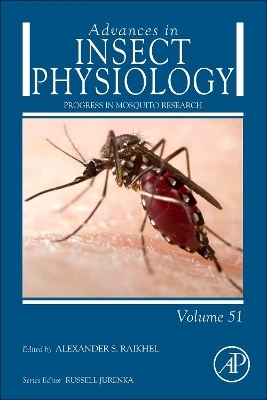
Progress in Mosquito Research
Academic Press Inc (Verlag)
9780128024577 (ISBN)
Alexander S. Raikhel is a distinguished professor at the University of California Riverside. He is a graduate of St. Petersburg (formerly Leningrad) State University and the Zoological Institute of the Russian Academy of Sciences, where he worked on ticks in the laboratory of the renowned acarologist professor Yu. S. Balashov. Following immigration to the United States, Raikhel began studies on mosquito reproduction. Throughout the years, his research has focused on regulatory pathways controlling various aspects of mosquito reproductive biology and has contributed significantly to the understanding of vitellogenesis in mosquitoes at cell biological, biochemical and molecular levels. He and his laboratory personnel have investigated juvenile hormone and ecdysone signaling in mosquitoes, and have uncovered the role of nutritional signaling—the amino acid-TOR (Target of Rapamycin) pathway—in mosquito adaptations for obligatory blood feeding. Work from Raikhel's laboratory has added to the knowledge of mosquito metabolism. Raikhel was among the first to establish genetic transformation in the mosquito Aedes aegypti. He and his co-workers instituted the Aedes aegypti mosquito binary Gal4-UAS system that enables researchers to study cell/tissue-, stage- and sex-specific expression of mosquito genes. These studies have opened the door for the refinement of genetics tools to investigate mosquito-vector interactions. Exploration of immunity in Raikhel’s laboratory was initiated by creating transgenic mosquitoes with altered elements of innate immunity. This provided insight into the Toll and IMD pathways as well as melanization in the mosquito Aedes aegypti. Small non-coding RNAs, microRNAs, are known to control developmental timing, stem cell maintenance and other developmental processes in animals in plants. Work from the Raikhel laboratory has identified microRNAs that play significant roles regulating vital functions of mosquitoes, such as blood digestion and egg maturation. Raikhel's accomplishments in science have earned him honors, including the 2001 Entomological Society of America Award in Insect Physiology, Biochemistry, and Toxicology and a 2002 National Institutes of Health MERIT Award. In 2009, he was elected a Fellow of the Entomological Society of America and to the National Academy of Sciences.
Contributors
Preface
Chapter One: Progress in Gene Editing Transgenesis Genome Manipulation in Mosquitoes
Chapter Two: Sex Determination in Mosquitoes
Chapter Three: Sexual Selection and the Evolution of Mating Systems in Mosquitoes
Chapter Four: The Role of Juvenile Hormone in Mosquito Development and Reproduction
Chapter Five: Regulation of Reproductive Processes in Female Mosquitoes
Chapter Six: Mosquito Peptide Hormones: Diversity, Production, and Function
Chapter Seven: Functions of Small RNAs in Mosquitoes
Chapter Eight: The Complement System of Malaria Vector Mosquitoes
Chapter Nine: Influences of the Mosquito Microbiota on Vector Competence
Chapter Ten: Mosquito Sensory Systems
Chapter Eleven: Molecular Physiology of Mosquito Diapause
Chapter Twelve: Nitrogen Metabolism in Mosquitoes: New Insights into the Nitrogen Metabolism in Blood-Fed Mosquitoes
Chapter Thirteen: Renal Excretory Processes in Mosquitoes
Index
| Erscheinungsdatum | 07.09.2016 |
|---|---|
| Reihe/Serie | Advances in Insect Physiology |
| Verlagsort | San Diego |
| Sprache | englisch |
| Maße | 152 x 229 mm |
| Gewicht | 640 g |
| Themenwelt | Naturwissenschaften ► Biologie ► Zoologie |
| ISBN-13 | 9780128024577 / 9780128024577 |
| Zustand | Neuware |
| Informationen gemäß Produktsicherheitsverordnung (GPSR) | |
| Haben Sie eine Frage zum Produkt? |
aus dem Bereich