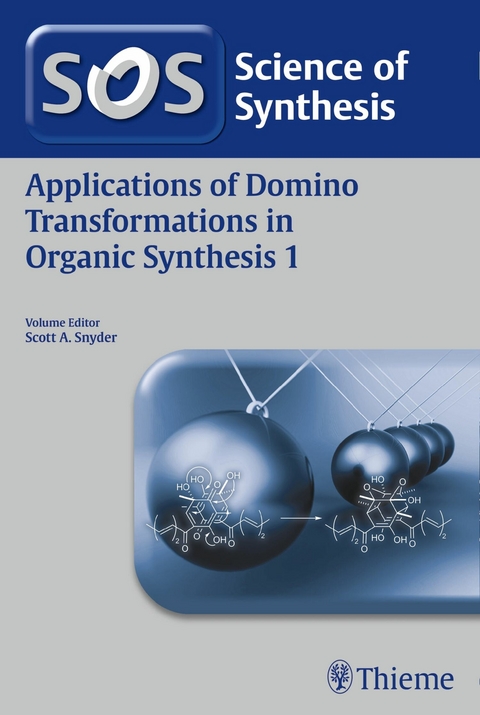
Applications of Domino Transformations in Organic Synthesis, Volume 1 (eBook)
732 Seiten
Georg Thieme Verlag KG
978-3-13-202851-7 (ISBN)
Science of Synthesis Applications of Domino Transformations in Organic Synthesis 1 1
Title Page 7
Copyright 8
Preface 9
Science of Synthesis Reference Library 11
Volume Editor's Preface 13
Abstracts 15
Applications of Domino Transformations in Organic Synthesis 1 23
Table of Contents 25
Introduction 37
1.1 Polyene Cyclizations 49
1.1.1 Cationic Polyene Cyclizations Mediated by Brønsted or Lewis Acids 50
1.1.1.1 Most Used Cationic Polyene Cyclization Methods 51
1.1.1.1.1 Polyene Cyclization via Biomimetic Heterolytic Opening of Epoxides by Alkylaluminum Lewis Acids 51
1.1.1.1.2 Polyene Cyclization Mediated by Carbophilic Lewis Acids 53
1.1.1.2 Recent Advances in Cationic Polycyclization: Halonium-Initiated Polycyclization 53
1.1.1.3 Other Common Cationic Polyene Cyclization Methods 55
1.1.1.3.1 Catalytic, Enantioselective, Protonative Polycyclization 55
1.1.1.3.1.1 Chiral Transfer from a Brønsted Acid 55
1.1.1.3.1.2 Chiral Transfer from (R)-2,2'-Dichloro-1,1'-bi-2-naphthol–Antimony(V) Chloride Complex 55
1.1.1.3.1.3 Chiral Transfer via Nucleophilic Phosphoramidites 56
1.1.1.3.2 Polyene Cyclization Initiated by Unsaturated Ketones and Mediated by Aluminum Lewis Acids 57
1.1.1.3.3 Gold-Mediated Enantioselective Polycyclization 58
1.1.1.3.4 Polycyclization Initiated by an Episulfonium Ion 59
1.1.1.3.5 Polycyclization Initiated by a p-Lewis Acidic Metal 59
1.1.1.3.6 Enantioselective Polyene Cyclization Mediated by Chiral Scalemic Iridium Complexes 60
1.1.1.3.7 Acyliminium-Initiated Polyene Cyclization Mediated by Thioureas 60
1.1.1.3.8 Tail-to-Head Polycyclization 61
1.1.2 Radical Polyene Cyclizations 62
1.1.2.1 Most Used Radical Polycyclization Methods 62
1.1.2.1.1 Cyclization of Mono-and Polyunsaturated ß-Oxo Esters Mediated by Manganese(III) Acetate 62
1.1.2.1.2 Titanocene-Catalyzed Polycyclization 63
1.1.2.2 Recent Advances in Radical Polycyclization 64
1.1.2.2.1 Manganese- and Cobalt-Catalyzed Cyclization 64
1.1.2.2.2 Manganese-Catalyzed Hydrogenative Polycyclization 65
1.1.2.2.3 Radical Isomerization, Cycloisomerization, and Retrocycloisomerization with a Cobalt–salen Catalyst 66
1.1.2.3 Other Examples of Radical Polycyclization 67
1.1.2.3.1 Radical Polycyclization via Photoinduced Electron Transfer 67
1.1.2.3.2 Polycyclization via Organo-SOMO Catalysis 67
1.1.2.3.3 Polyene Radical Cascades in Complex Molecule Synthesis 67
1.1.3 Polyene Cyclization via Reductive Elimination from a Metal Center or Metathesis 68
1.1.3.1 Most Used Polycyclization Methods via Reductive Elimination 68
1.1.3.1.1 Palladium Zipper Cyclization Cascades 68
1.1.3.1.2 Polycyclization Cascades via Metathesis 69
1.1.3.2 Other Polycyclization Methods via Reductive Elimination 70
1.1.3.2.1 Cyclization via p-Allylpalladium Complexes 70
1.1.3.2.2 Palladium-Catalyzed Ene–Yne Cycloisomerization 71
1.1.3.2.3 Cycloisomerization in Complex Molecule Synthesis 71
1.1.4 Anionic Polyene Cyclizations 72
1.1.4.1 Examples of Anionic Polyene Cyclizations 73
1.1.4.1.1 Stereoselective Polycyclization via Intramolecular Diels–Alder Cycloaddition Followed by Aldol Condensation 73
1.1.4.1.2 Transannular Double Michael Cyclization Cascades 74
1.2 Cation–p Cyclizations of Epoxides and Polyepoxides 79
1.2.1 exo-Selective Polyepoxide Cascades 79
1.2.1.1 Brønsted Acid Promoted Cascades 79
1.2.1.2 Brønsted Base Promoted Cascades 81
1.2.1.3 Oxocarbenium-Initiated Cascades via Photooxidative Cleavage 82
1.2.2 endo-Selective Polyepoxide Cascades 83
1.2.2.1 Lewis Acid Activation 83
1.2.2.1.1 Alkyl-Directed Cascades 83
1.2.2.2 Brønsted Base Activation 87
1.2.2.2.1 Trimethylsilyl-Directed Cascades 87
1.2.2.3 Distal Electrophilic Activation 88
1.2.2.3.1 Bromonium-Initiated Cascades 88
1.2.2.3.2 Oxocarbenium-Initiated Cascades via Photooxidative Cleavage 90
1.2.2.3.3 Carbocation-Initiated Cascades via Halide Abstraction 91
1.2.2.4 Water-Promoted Cascades 92
1.2.2.4.1 Cascades of Diepoxides Templated by a Tetrahydropyran 92
1.2.2.4.2 Cascades of Diepoxides Templated by a Dioxane 93
1.2.2.4.3 Cascades of Triepoxides Templated by a Tetrahydropyran 93
1.2.3 Epoxide Cascades with C—C p-Bonds 94
1.2.3.1 Cascades Terminated by Alkenes and Alkynes 94
1.2.3.2 Cascades Terminated by Arenes 96
1.2.3.3 Cascades Terminated by Protected Phenols 99
1.3 Metathesis Reactions 103
1.3.1 Enyne-Metathesis-Based Domino Reactions in Natural Product Synthesis 103
1.3.1.1 Mechanism 107
1.3.1.1.1 Alkylidene Carbene Catalyzed Reactions 107
1.3.1.1.2 p-Lewis Acid Catalyzed Reactions 111
1.3.1.1.3 Metallotropic [1,3]-Shift 111
1.3.1.2 Selectivity 112
1.3.1.2.1 Regioselectivity in Cross Metathesis 112
1.3.1.2.2 exo/endo-Mode Selectivity in Ring-Closing Metathesis 114
1.3.1.2.3 Stereoselectivity in Cross Metathesis and Ring-Closing Metathesis 115
1.3.1.2.4 Regioselectivity in Metallotropic [1,3]-Shift 116
1.3.1.3 Applications in Natural Product Synthesis 122
1.3.1.3.1 Simple Enyne Metathesis 124
1.3.1.3.1.1 Enyne Cross Metathesis 124
1.3.1.3.1.2 Enyne Ring-Closing Metathesis for Small Rings 128
1.3.1.3.2 Domino Enyne Metathesis 135
1.3.1.3.2.1 Double Ring-Closing Metathesis with Dienynes 135
1.3.1.3.2.2 Domino Ring-Closing Metathesis/Cross Metathesis, Cross Metathesis/Ring-Closing Metathesis, and Cross Metathesis/Cross Metathesis Sequences 148
1.3.1.3.3 Enyne Metathesis/Metallotropic [1,3]-Shift Sequences 156
1.3.1.3.4 Enyne Metathesis/Diels–Alder Reaction Sequences 159
1.3.1.3.5 Enyne Metathesis with p-Lewis Acids 164
1.3.1.4 Conclusions 166
1.3.2 Domino Metathesis Reactions Involving Carbonyls 171
1.3.2.1 Two-Pot Reactions 172
1.3.2.1.1 Reaction with In Situ Generated Titanium–Alkylidene Complexes Followed by Metathesis 173
1.3.2.2 One-Pot Reactions 175
1.3.2.2.1 Reaction with Bis(.5-cyclopentadienyl)methylenetitanium(IV)-Type Complexes 175
1.3.2.2.2 Reaction with In Situ Generated Titanium–Alkylidene Complexes 179
1.3.2.2.3 Reaction with Stoichiometric Molybdenum or Tungsten Complexes 184
1.3.2.2.4 Organocatalytic Reactions 186
1.4 Radical Reactions 193
1.4.1 Peroxy Radical Additions 193
1.4.1.1 Initiation from a Preexisting Hydroperoxide 193
1.4.1.1.1 Using Peroxide Initiators 194
1.4.1.1.2 Using Copper(II) Trifluoromethanesulfonate/Oxygen 197
1.4.1.1.3 Using Samarium(II) Iodide/Oxygen 198
1.4.1.2 Initiation by Metal-Catalyzed Hydroperoxidation 199
1.4.1.2.1 The Mukaiyama Hydration/Hydroperoxidation 199
1.4.1.2.2 Hydroperoxidation-Initiated Domino Transformations 200
1.4.1.2.3 Manganese-Catalyzed Domino Hydroperoxidation 202
1.4.1.3 Initiation by Radical Addition/Oxygen Quenching 204
1.4.1.3.1 Thiyl Radical Initiation 204
1.4.1.3.1.1 Thiol–Alkene Co-oxygenation Reactions 204
1.4.1.3.1.2 Domino Transformations of Vinylcyclopropanes 207
1.4.1.3.2 Carbon-Centered Radical Additions 209
1.4.1.3.2.1 By C—H Abstraction 210
1.4.1.3.2.2 Manganese(III)-Mediated Oxidation of 1,3-Dicarbonyls 211
1.4.1.4 Heteroatom Oxidation/Cyclopropane Cleavage Pathways 213
1.4.1.5 Radical Cation Intermediates 214
1.4.1.5.1 1,2-Diarylcyclopropane Photooxygenation 215
1.4.1.5.2 Alkene/Oxygen [2 + 2 + 2] Cycloaddition 216
1.4.2 Radical Cyclizations 223
1.4.2.1 Tin-Mediated Radical Cyclizations 224
1.4.2.1.1 Tin-Mediated Synthesis of Hexahydrofuropyrans 224
1.4.2.1.2 Tin-Mediated Radical [3 + 2] Annulation 227
1.4.2.2 Reductive Radical Domino Cyclizations 229
1.4.2.2.1 Samarium(II) Iodide Mediated Radical Cyclizations 229
1.4.2.2.2 Samarium(II) Iodide Mediated Radical–Anionic Cyclizations 232
1.4.2.3 Oxidative Radical Cyclizations 234
1.4.2.3.1 Organo-SOMO-Activated Polyene Cyclization 234
1.4.2.3.2 Oxidative Rearrangement of Silyl Bis(enol ethers) 237
1.4.2.3.3 Diastereoselective Oxidative Rearrangement of Silyl Bis(enol ethers) 240
1.4.2.4 Visible-Light-Mediated Reactions 243
1.4.2.4.1 Light-Mediated Radical Cyclization/Divinylcyclopropane Rearrangement 243
1.4.2.4.2 Visible-Light-Mediated Radical Fragmentation and Bicyclization 247
1.4.3 Tandem Radical Processes 253
1.4.3.1 General and Specialized Reviews on Radical Cyclization Reactions 253
1.4.3.2 A Brief History of Tandem Radical Cyclization Chemistry 254
1.4.3.2.1 The Tandem Radical Cyclization Concept: Fused Rings 254
1.4.3.2.2 The Biomimetic Tandem Radical Cyclization Postulate 255
1.4.3.2.3 A Vinyl Radical Tandem Radical Cyclization: A Product with Linked Rings 255
1.4.3.2.4 Introduction to Selectivity: A Bridged Ring System 256
1.4.3.3 Alternative Reagents for Cascade Initiation: Getting Away from Tin, 2,2'-Azobisisobutyronitrile, and Peroxides 257
1.4.3.3.1 The Manganese(III) System 257
1.4.3.3.2 The Titanium(III) System 258
1.4.3.3.3 Using Silanes Rather than Stannanes 258
1.4.3.3.3.1 Carboxyarylation 258
1.4.3.3.3.2 Reactions Terminated by Azide 259
1.4.3.3.4 Reactions with Borane Initiators 261
1.4.3.3.4.1 Tin Hydrides with Triethylborane for Initiation and Fragmentation with Samarium(II) Iodide 261
1.4.3.3.4.2 Triethylborane-Mediated Atom Transfer and Cobaloxime-Initiated Reductive Tandem Cyclization 263
1.4.3.3.4.3 Tri-sec-butylborane/Oxygen/Tris(trimethylsilyl)silane Induced Reductive Cyclization 264
1.4.3.4 Nitrogen- and Oxygen-Centered Radicals 265
1.4.3.5 Intramolecular Plus Intermolecular Pathways 267
1.4.3.5.1 Cyclization/Trapping 267
1.4.3.5.2 Trapping/Cyclization 272
1.4.3.6 Intermolecular Trapping/Trapping Pathways 273
1.4.3.7 Conclusions 274
1.5 Non-Radical Skeletal Rearrangements 279
1.5.1 Protic Acid/Base Induced Reactions 279
1.5.1.1 Intramolecular Epoxide-Opening Cyclizations 280
1.5.1.1.1 Protic Acid Induced Intramolecular Epoxide Openings 281
1.5.1.1.1.1 exo Epoxide Ring Expansions 282
1.5.1.1.1.2 endo Epoxide Ring Expansions 284
1.5.1.1.2 Base-Induced Intramolecular Epoxide Openings 286
1.5.1.2 Carbocyclic Ring Expansions/Ring Contractions 288
1.5.1.2.1 Acid-Induced Carbocyclic Ring Expansions/Ring Contractions 288
1.5.1.2.1.1 Wagner–Meerwein Rearrangements 290
1.5.1.2.1.1.1 Ring-Expansion Rearrangements 290
1.5.1.2.1.1.2 Ring-Contraction Rearrangements 291
1.5.1.2.1.2 Pinacol Rearrangements 292
1.5.1.2.1.3 Semipinacol Rearrangements 294
1.5.1.2.2 Base-Induced Carbocyclic Ring Expansions/Ring Contractions 295
1.5.1.2.2.1 Benzilic Acid Rearrangements 295
1.5.1.2.2.2 Retro-Benzilic Acid Rearrangements 296
1.5.1.2.2.3 Favorskii Rearrangements 297
1.5.1.2.2.3.1 Homo-Favorskii Rearrangements 299
1.5.1.2.2.4 a-Hydroxy Ketone Rearrangements 299
1.5.2 Lewis Acid/Base Induced Reactions 305
1.5.2.1 Ring Expansions 305
1.5.2.1.1 Semipinacol Rearrangement of 2,3-Epoxy Alcohols and Their Derivatives 305
1.5.2.1.2 Reductive Rearrangement of 2,3-Epoxy Alcohols with Aluminum Triisopropoxide 308
1.5.2.1.3 Tandem Semipinacol/Schmidt Reaction of a-Siloxy Epoxy Azides 309
1.5.2.1.4 Prins–Pinacol Rearrangement 313
1.5.2.2 Ring Contractions 318
1.5.2.2.1 Rearrangement of Epoxides 318
1.5.2.2.2 Favorskii Rearrangement and Quasi-Favorskii Rearrangement 322
1.5.2.3 Ring Closures 325
1.5.2.3.1 Induction by an Electrophilic Step 325
1.5.2.3.1.1 Initiation by Epoxide Ring Opening 326
1.5.2.3.1.1.1 Termination with a Carbon Nucleophile 326
1.5.2.3.1.1.2 Termination with an Oxygen Nucleophile 333
1.5.2.3.1.1.3 Termination with a Rearrangement 336
1.5.2.3.1.1.4 Termination with a Pericyclic Reaction 341
1.5.2.3.1.2 Initiation with a Carbonyl and Its Derivatives 342
1.5.2.3.1.2.1 Termination with a Nucleophile 343
1.5.2.3.1.2.2 Termination with a Rearrangement 352
1.5.2.3.1.3 Initiation by Activation of a p-Bond 354
1.5.2.3.1.3.1 Initiation by a Lewis Acid 354
1.5.2.3.1.3.2 Initiation by a p-Acid 357
1.5.2.3.1.3.2.1 Activation of Alkenes 357
1.5.2.3.1.3.2.2 Activation of Alkynes 364
1.5.2.3.2 Induction by a Pericyclic Reaction 374
1.5.2.3.3 Induction by a Nucleophilic Step 380
1.5.3 Brook Rearrangement as the Key Step in Domino Reactions 391
1.5.3.1 1,2-Brook Rearrangement 392
1.5.3.1.1 1,2-Brook Rearrangement with Aldehydes, Ketones, or Acyl Chlorides 392
1.5.3.1.2 1,2-Brook Rearrangement with Acylsilanes 394
1.5.3.1.2.1 Domino Reactions of Acylsilanes by Addition of Nucleophiles 394
1.5.3.1.2.2 Domino Reactions of Acylsilanes Initiated by Nucleophiles Acting as Catalysts 413
1.5.3.1.2.3 Domino Reactions of Acylsilanes Initiated by Enolization 416
1.5.3.1.3 1,2-Brook Rearrangement with a-Silyl Carbinols 417
1.5.3.1.4 1,2-Brook Rearrangement with Epoxy Silanes 418
1.5.3.1.5 Miscellaneous Examples of 1,2-Brook Rearrangement 422
1.5.3.1.6 Retro-1,2-Brook Rearrangement 423
1.5.3.2 1,3-Brook Rearrangement 428
1.5.3.2.1 Addition of Silyl-Substituted Stabilized Organolithium Agents to Carbonyl Groups 429
1.5.3.2.2 1,3-Brook Rearrangement at sp2-Hybridized Carbon Atoms 435
1.5.3.2.3 1,3-Brook Rearrangement Accompanied by ß-Elimination 435
1.5.3.2.4 Carbon to Nitrogen Rearrangement 436
1.5.3.2.5 Carbon to Sulfur Rearrangement 437
1.5.3.2.6 Retro-1,3-Brook Rearrangement 438
1.5.3.3 1,4-Brook Rearrangement 439
1.5.3.3.1 1,4-Brook Rearrangement of Silyl-Substituted Carbanions with Epoxides 440
1.5.3.3.2 1,4-Brook Rearrangement with Dihalosilyl-Substituted Methyllithium 452
1.5.3.3.3 1,4-Brook Rearrangement with Allylsilanes 453
1.5.3.3.4 1,4-Brook Rearrangement with Silylated Benzaldehydes 458
1.5.3.3.5 1,4-Brook Rearrangement with Vinylsilanes 462
1.5.3.3.6 Sulfur to Oxygen Rearrangement 466
1.5.3.3.7 Retro-1,4-Brook Rearrangement 467
1.5.3.4 Applications in the Total Synthesis of Natural Products 468
1.5.3.4.1 The 1,2-Brook Rearrangement in Natural Product Synthesis 468
1.5.3.4.2 The 1,4-Brook Rearrangement in Natural Product Synthesis 469
1.5.3.4.2.1 Synthesis of Polyketides 469
1.5.3.4.2.2 Synthesis of Terpenes 478
1.5.3.4.2.3 Synthesis of Alkaloids 478
1.5.3.5 Conclusions 480
1.6 Metal-Mediated Reactions 485
1.6.1 Palladium-Mediated Domino Reactions 485
1.6.1.1 Reactions Initiating with Alkenylpalladium Intermediates 485
1.6.1.2 Reactions Initiating with Arylpalladium Species 509
1.6.1.3 Reactions Initiating with Allylpalladium Intermediates 527
1.6.1.4 Reactions Initiating with Allenylpalladium Intermediates 532
1.6.1.5 Reactions Initiating with Alkylpalladium Intermediates 534
1.6.1.6 Conclusions 541
1.6.2 Dirhodium-Catalyzed Domino Reactions 547
1.6.2.1 1-Sulfonyl-1,2,3-triazoles as (Azavinyl)carbene Precursors in Domino Reactions 548
1.6.2.2 Dirhodium(II)-Catalyzed Generation of Rhodium–Carbenes from Cyclopropenes and Their Subsequent Reactions 552
1.6.2.3 Dirhodium(II)-Catalyzed Carbene/Alkyne Metathesis 557
1.6.2.4 Nitrene Cascade Reactions Catalyzed by a Dirhodium Complex 563
1.6.2.5 Conclusions 568
1.6.3 Gold-Mediated Reactions 571
1.6.3.1 Gold-Catalyzed Annulations 571
1.6.3.1.1 Using ortho-Alkynylbenzaldehydes 571
1.6.3.1.2 Using Arylimines and Alkynes 574
1.6.3.1.3 Using Alcohols and Dienes 574
1.6.3.1.4 Using Carbonyl Compounds, Alkynes, and Nitrogen-Containing Compounds 576
1.6.3.2 Gold-Catalyzed Domino Reactions via Addition of Carbon Nucleophiles to p-Electrophiles 578
1.6.3.2.1 1,n-Enynes 578
1.6.3.2.2 1,n-Diynes 581
1.6.3.2.3 1,n-Allenenes 585
1.6.3.2.4 1,n-Allenynes 586
1.6.3.3 Gold-Catalyzed Domino Reactions via Addition of Heteroatom Nucleophiles to p-Electrophiles 587
1.6.3.3.1 Addition of Nitrogen Nucleophiles to Alkynes 587
1.6.3.3.2 Addition of Oxygen Nucleophiles to Alkynes and Allenes 588
1.6.3.3.2.1 Alcohols as Nucleophiles 588
1.6.3.3.2.2 Epoxides as Nucleophiles 589
1.6.3.3.3 Addition of Heteroatom Nucleophiles to Alkenes 591
1.6.3.4 Gold-Catalyzed Domino Reactions Involving the Rearrangement of Propargyl Esters 593
1.6.3.4.1 Synthesis of a-Ylidene ß-Diketones 593
1.6.3.4.2 Synthesis of Dienes 594
1.6.3.4.3 Synthesis of a-Substituted Enones 597
1.6.3.4.3.1 Synthesis of a-Halo-Substituted Enones 597
1.6.3.4.3.2 Synthesis of a-Aryl-Substituted Enones 598
1.6.3.4.4 Synthesis of Cyclopentenones 599
1.6.3.4.5 Acetate Migration and Reaction with p-Electrophiles 600
1.6.3.4.5.1 Acetate Migration and Reaction with Alkynes 600
1.6.3.4.5.2 Acetate Migration and Reaction with Alkenes 601
1.6.3.4.6 Acetate Migration and Ring-Opening Reactions 602
1.6.3.4.6.1 Cyclopentannulations 602
1.6.3.4.6.2 Cyclohexannulations 604
1.6.3.4.6.3 Cycloheptannulations 605
1.6.4 Rare Earth Metal Mediated Domino Reactions 613
1.6.4.1 Addition to C=O or C=C—C=O as a Primary Step 614
1.6.4.1.1 Aldol-Type Reactions 614
1.6.4.1.2 1,4-Addition Reactions 618
1.6.4.2 Addition to C=N or C=C—C=N as a Primary Step 619
1.6.4.2.1 Strecker-Type Reactions 619
1.6.4.2.2 Other Reactions Initiated by Imine Formation 620
1.6.4.3 Enamine Formation as a Primary Step 625
1.6.4.3.1 Enamines from ß-Keto Esters 625
1.6.4.3.2 Enamines from Alkynes 626
1.6.4.4 Ring-Opening or Ring-Closing Reactions as a Primary Step 628
1.6.4.4.1 Ring-Opening Reactions 628
1.6.4.4.2 Ring-Closing Reactions 630
1.6.4.5 Rearrangement Reactions 632
1.6.4.6 Miscellaneous Reactions 634
1.6.4.6.1 Domino Reactions with Transition-Metal Catalysts 634
1.6.5 Cobalt and Other Metal Mediated Domino Reactions: The Pauson–Khand Reaction and Its Use in Natural Product Total Synthesis 637
1.6.5.1 Enyne-Based Pauson–Khand Reactions 642
1.6.5.1.1 A Short Synthesis of Racemic 13-Deoxyserratine 642
1.6.5.1.2 Total Synthesis of Paecilomycine A 642
1.6.5.1.3 Stereoselective Total Syntheses of (–)-Magellanine, (+)-Magellaninone, and (+)-Paniculatine 643
1.6.5.1.4 Concise, Enantioselective Total Synthesis of (–)-Alstonerine 644
1.6.5.1.5 Pauson–Khand Approach to the Hamigerans 645
1.6.5.1.6 Enantioselective Synthesis of (–)-Pentalenene 646
1.6.5.1.7 Formal Synthesis of (+)-Nakadomarin A 647
1.6.5.1.8 Diastereoselective Total Synthesis of Racemic Schindilactone A 648
1.6.5.1.9 Asymmetric Total Synthesis of (–)-Huperzine Q 650
1.6.5.1.10 Total Synthesis of (–)-Jiadifenin 651
1.6.5.1.11 Total Synthesis of Penostatin B 653
1.6.5.1.12 Total Synthesis of Racemic Pentalenolactone A Methyl Ester 653
1.6.5.1.13 Asymmetric Total Synthesis of (+)-Fusarisetin A 654
1.6.5.2 Heteroatom-Based Pauson–Khand Reaction 655
1.6.5.2.1 Total Synthesis of Physostigmine 656
1.6.5.2.2 Asymmetric Total Synthesis of Racemic Merrilactone A 657
1.6.5.3 Allenic Pauson–Khand Reaction 658
1.6.5.3.1 Total Synthesis of (+)-Achalensolide 659
1.6.5.3.2 Synthesis of 6,12-Guaianolide 660
1.6.5.3.3 Stereoselective Total Syntheses of Uncommon Sesquiterpenoids 661
1.6.5.3.4 14-Step Synthesis of (+)-Ingenol from (+)-3-Carene 662
1.6.5.4 Conclusions 663
Keyword Index 669
Author Index 705
Abbreviations 729
Abstracts
1.1 Polyene Cyclizations
R. A. Shenvi and K. K. Wan
A domino transformation consists of a first chemical reaction enabling a second reaction, which can then effect a third reaction, and so on, all under the same reaction conditions. A polyene cyclization is defined as a reaction between two or more double bonds contained within the same molecule to form one or more rings via one or more C—C bond-forming events. Herein, domino polyene cyclizations are discussed, with an emphasis on operationally simple methods of broad utility. From the perspective of synthesis theory, polyene cyclizations are a powerful approach for the efficient generation of both complexity and diversity, with the potential for a single synthetic route to generate a series of both constitutional and stereochemical isomers. However, with some noteworthy exceptions, the ability to controllably cyclize a linear chain to multiple products with high selectivity still generally eludes synthetic chemists and represents a significant chemical frontier for further development.
Keywords: polyenes · cyclization · carbocations · radicals · polycycles
1.2 Cation–π Cyclizations of Epoxides and Polyepoxides
K. W. Armbrust, T. Halkina, E. H. Kelley, S. Sittihan, and T. F. Jamison
This chapter describes the formation of complex polycyclic fragments from linear epoxide and polyepoxide precursors via domino reactions. Depending on the reaction conditions employed, either exo or endo epoxide opening can be selectively achieved. Applications of these domino reactions toward the synthesis of complex natural products are discussed.
Keywords: oxiranes · cascades · natural products · marine ladder polyethers · ionophores · ethers · oxygen heterocycles · tetrahydrofurans · tetrahydropyrans · oxepanes
1.3.1 Enyne-Metathesis-Based Domino Reactions in Natural Product Synthesis
D. Lee and M. O'Connor
Enyne-metathesis-based domino processes are highlighted in the context of natural product synthesis; these include domino double ring-closing metathesis, enyne metathesis/metallotropic [1,3]-shifts, enyne metathesis/Diels–Alder reaction, and other variations of their domino combinations. Issues regarding selectivity and mechanism are also discussed.
Keywords: enyne metathesis · π-bond exchange · domino transformations · natural products · total synthesis
1.3.2 Domino Metathesis Reactions Involving Carbonyls
H. Renata and K. M. Engle
This review describes different methods to perform net carbonyl–alkene metathesis. Reactions of this type generally involve domino transformations employing organometallic reagents. Different conditions and procedures are surveyed and strategic applications of carbonyl–alkene metathesis in the synthesis of natural products are highlighted.
Keywords: metathesis · alkenylation · carbonyl compounds · alkenes · ring closure · transition metals · titanium complexes · organometallic reagents · organocatalysts
1.4.1 Peroxy Radical Additions
X. Hu and T. J. Maimone
In this chapter, radical addition reactions involving peroxy radical intermediates are reviewed. These transformations typically generate a carbon radical intermediate which then reacts with molecular oxygen forming a peroxy radical species. Following peroxy radical cyclization, various endoperoxide rings are constructed. Two major classes of reactions are discussed: (1) radical additions to alkenes and quenching with molecular oxygen, and (2) radical formation from the opening of cyclopropanes and incorporation of molecular oxygen. Various methods for radical initiation that are compatible with the presence of molecular oxygen are described.
Keywords: peroxide synthesis · endoperoxides · cyclic peroxides · radical addition · peroxy radicals · thiyl radicals · hydroperoxidation · cyclopropane cleavage · 1,2-dioxolanes · 1,2-dioxanes · 1,2-dioxepanes
1.4.2 Radical Cyclizations
J. J. Devery, III, J. J. Douglas, and C. R. J. Stephenson
This chapter details recent examples of domino radical reactions that are initiated via an intramolecular radical cyclization.
Keywords: radicals · domino reactions · cyclization · tin · samarium · organo-SOMO · ammonium cerium(IV) nitrate (CAN) · visible light
1.4.3 Tandem Radical Processes
K. A. Parker
This review presents selected examples of regio- and stereospecific domino radical reactions developed in the context of total synthesis studies. The underlying strategies demonstrate the variety of connectivity patterns that can be generated by cascades of intraand intermolecular bond-forming steps.
Keywords: tandem radical cyclization · radical domino cyclization · radical cascade cyclization · intermolecular reactions · radical trapping · manganese(III) acetate · titanocene dichloride · tris(trimethylsilyl)silane · triethylborane · tri-sec-butylborane · TEMPO · 1,1,3,3-tetramethylguanidine · samarium(II) iodide · cobaloxime
1.5.1 Protic Acid/Base Induced Reactions
D. Adu-Ampratwum and C. J. Forsyth
This chapter covers synthetic domino processes that are induced by protic acid or base. They are broadly classified into those that capitalize upon the release of oxirane ring strain under acidic or basic conditions, and carbocyclic ring expansions and contractions under protic acid or basic conditions. The focus here is upon single substrate, monocomponent domino processes, rather than multicomponent variants.
Keywords: carbocyclic compounds · cyclization · epoxy compounds · ethers · Favorskii rearrangement · intramolecular reactions · Nazarov cyclization · pinacol rearrangement · ring contraction · ring expansion · tandem reactions · Wagner–Meerwein rearrangement
1.5.2 Lewis Acid/Base Induced Reactions
S.-H. Wang, Y.-Q. Tu, and M. Tang
The efficient construction of complex molecular skeletons is always a hot topic in organic synthesis, especially in the field of natural product synthesis, where many cyclic structural motifs can be found. Under the assiduous efforts of synthetic chemists, more and more methodologies are being developed to achieve the construction of cyclic skeletons. In particular, the beauty and high efficiency of organic synthesis are expressed vividly among those transformations realized through a domino strategy. Based on these important methodologies, selected Lewis acid/base induced domino reactions leading to ring expansions, contractions, and closures are presented in this chapter.
Keywords: tandem reactions · Lewis acid · Lewis base · ring expansion · ring contraction · ring closure
1.5.3 Brook Rearrangement as the Key Step in Domino Reactions
A. Kirschning, F. Gille, and M. Wolling
The Brook rearrangement has lost its Cinderella status over the past twenty years since being embedded into cascade reaction sequences. The powerful formation of carbanions through silyl migration has been exploited for the development of many new methodologies and has been used as a key transformation in complex natural product syntheses. Now, the Brook rearrangement belongs to the common repertoire of synthetic organic chemists.
Keywords: Brook rearrangement · domino reactions · migration · organosilicon chemistry · total synthesis
1.6.1 Palladium-Mediated Domino Reactions
E. A. Anderson
Palladium catalysis offers excellent opportunities to engineer domino reactions, due to the ability of this transition metal to engage with a variety of electrophiles and to effect stereocontrolled bond formations in complex settings. This review covers palladium-catalyzed domino processes, categorized according to the initiating species (alkenyl-, aryl-, allyl-, allenyl-, or alkylpalladium complexes), with a particular focus on applications in natural product synthesis that exemplify more general methodology.
Keywords: palladium · domino · cascade · total synthesis
1.6.2 Dirhodium-Catalyzed Domino Reactions
X. Xu, P. Truong, and M. P. Doyle
With dirhodium carbenes generated from diazocarbonyl compounds, 1-sulfonyl-1,2,3-triazoles, or cyclopropenes, a subsequent intramolecular cyclization forms a reactive intermediate that undergoes a further transformation that usually terminates the reaction process. Commonly, the electrophilic dirhodium carbene adds intramolecularly to a C≡C bond to provide a second rhodium carbene. Catalytically generated dirhodiumbound nitrenes initiate domino reactions analogously, and recent examples (nitrene to carbene to product) have also been documented.
Keywords: α-carbonyl carbenes ·...
| Erscheint lt. Verlag | 11.5.2016 |
|---|---|
| Verlagsort | Stuttgart |
| Sprache | englisch |
| Themenwelt | Naturwissenschaften ► Chemie ► Organische Chemie |
| Technik | |
| Schlagworte | cascade-based transformation • Chemie • Chemische Synthese • chemistry of organic compound • chemistry organic reaction • chemistry reference work • chemistry synthetic methods • domino transformation • Organic Chemistry • organic chemistry reactions • organic chemistry review • organic chemistry synthesis • organic method • organic reaction • Organic Syntheses • organic synthesis • organic synthesis reference work • Organisch-chemische Synthese • Organische Chemie • reference work • review organic synthesis • review synthetic methods • Synthese • Synthetic Methods • Synthetic Organic Chemistry • synthetic transformation |
| ISBN-10 | 3-13-202851-7 / 3132028517 |
| ISBN-13 | 978-3-13-202851-7 / 9783132028517 |
| Informationen gemäß Produktsicherheitsverordnung (GPSR) | |
| Haben Sie eine Frage zum Produkt? |
 EPUB (Wasserzeichen)
DRM: Digitales Wasserzeichen
Dieses eBook enthält ein digitales Wasserzeichen und ist damit für Sie personalisiert. Bei einer missbräuchlichen Weitergabe des eBooks an Dritte ist eine Rückverfolgung an die Quelle möglich.
Dateiformat: EPUB (Electronic Publication)
EPUB ist ein offener Standard für eBooks und eignet sich besonders zur Darstellung von Belletristik und Sachbüchern. Der Fließtext wird dynamisch an die Display- und Schriftgröße angepasst. Auch für mobile Lesegeräte ist EPUB daher gut geeignet.
Systemvoraussetzungen:
PC/Mac: Mit einem PC oder Mac können Sie dieses eBook lesen. Sie benötigen dafür die kostenlose Software Adobe Digital Editions.
eReader: Dieses eBook kann mit (fast) allen eBook-Readern gelesen werden. Mit dem amazon-Kindle ist es aber nicht kompatibel.
Smartphone/Tablet: Egal ob Apple oder Android, dieses eBook können Sie lesen. Sie benötigen dafür eine kostenlose App.
Geräteliste und zusätzliche Hinweise
Buying eBooks from abroad
For tax law reasons we can sell eBooks just within Germany and Switzerland. Regrettably we cannot fulfill eBook-orders from other countries.
aus dem Bereich