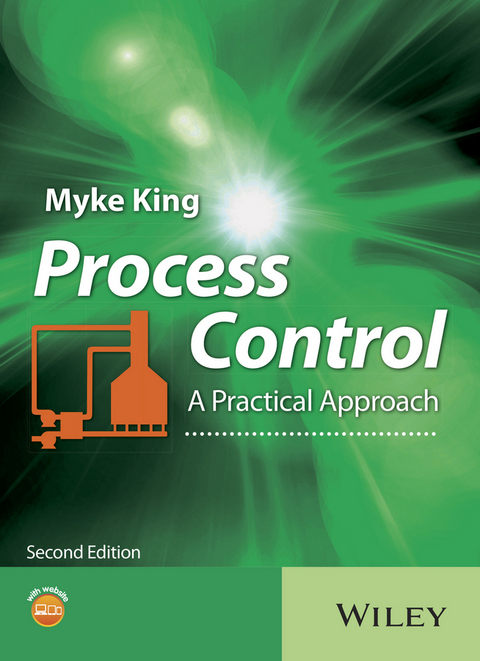
Process Control (eBook)
John Wiley & Sons (Verlag)
978-1-119-15776-2 (ISBN)
This expanded new edition is specifically designed to meet the needs of the process industry, and closes the gap between theory and practice.
- Back-to-basics approach, with a focus on techniques that have an immediate practical application, and heavy maths relegated to the end of the book
- Written by an experienced practitioner, highly regarded by major corporations, with 25 years of teaching industry courses
- Supports the increasing expectations for Universities to teach more practical process control (supported by IChemE)
Myke King is Director of Whitehouse Consulting which provides process control consulting and training services. He has been running courses for industry covering all aspects of process control for the past 30 years (over 150 courses to over 1,500 delegates).
Myke graduated from Cambridge University in 1974 with a master's degree in Chemical Engineering. After University he joined Exxon to work as control engineer in their oil refinery in the UK, later managing the process control section. In 1983 he co-founded the consulting company KBC Process Automation, which was later sold to Honeywell. He thus has about 40 years of relevant experience - working in over 30 countries providing services to over 100 companies.
This expanded new edition is specifically designed to meet the needs of the process industry, and closes the gap between theory and practice. Back-to-basics approach, with a focus on techniques that have an immediate practical application, and heavy maths relegated to the end of the book Written by an experienced practitioner, highly regarded by major corporations, with 25 years of teaching industry courses Supports the increasing expectations for Universities to teach more practical process control (supported by IChemE)
Myke King is Director of Whitehouse Consulting which provides process control consulting and training services. He has been running courses for industry covering all aspects of process control for the past 30 years (over 150 courses to over 1,500 delegates). Myke graduated from Cambridge University in 1974 with a master's degree in Chemical Engineering. After University he joined Exxon to work as control engineer in their oil refinery in the UK, later managing the process control section. In 1983 he co-founded the consulting company KBC Process Automation, which was later sold to Honeywell. He thus has about 40 years of relevant experience - working in over 30 countries providing services to over 100 companies.
Preface
So why write yet another book on process control? There are already many published. But they are largely written by academics and intended mainly to support courses taught at universities. Excellent as some of these books are in meeting that aim, the content of many academic courses has only limited relevance to control design in the process industry. There are a few books that take a more practical approach but these usually provide only an introduction to the technologies. They contain enough detail if used as part of a wider engineering course but not enough for the practitioner. This book aims more to meet the needs of industry.
So why write a second edition? Most of the process control techniques covered in the first edition have been in use for decades and will continue to be so for decades to come. While there are ongoing developments in the hardware of control, there is little drive to move away from well-established techniques. What prompted the second edition was the seemingly never-ending desire of control engineers to better understand the subject and to explore new ways of applying these techniques. Almost none of the material in the first edition has been deleted; most of it has been expanded with improved explanations and, where valuable, greater depth.
Most engineers responsible for the design and maintenance of control applications find daunting much of the theoretical mathematics that is common in the academic world. In this book we have aimed to keep the mathematics to a minimum. For example, Laplace transforms are only included so that the reader may relate what is in this book to what will be found in most theoretical texts and in the documentation provided by many DCS (distributed control system) vendors. They are not used in any of the control design techniques. And while we present the mathematical derivation of these techniques, to show that they have a sound engineering basis, the reader can skip these if too daunting and simply apply the end result.
This edition has two substantial new chapters. These were added with some trepidation. They appear to be in conflict with the objective of minimising the use of more advanced mathematics. Indeed they have doubled the total number of equations in the book. While the reader may be unfamiliar with some of the mathematical symbols, supporting explanations have been kept simple as possible. These, together with the examples of practical application, should help the more determined readily apply the methods. Those less enthusiastic can however skip these chapters and still be very competent control engineers.
The book aims to present techniques that have an immediate practical application. In addition to the design methods, it describes any shortcuts that can be taken and how to avoid common pitfalls. The methods have been applied on many processes to a wide range of controllers. They should work.
In addition to providing effective design methods, this book should improve the working practices of many control engineers. For example, the majority still prefer to tune PID (proportional, integral, derivative) controllers by trial-and-error. This is time-consuming and rarely leads to controllers performing as well as they should. This might be because of a justified mistrust of published tuning methods. Most do have serious limitations. This book addresses this and offers a method proven to be effective in terms of both controller performance and engineering effort.
DCS include a wide array of control algorithms with many additional engineer-definable parameters. The DCS vendors are poor at explaining the purpose of these algorithms with the result that the industry is rife with misinterpretation of their advantages and disadvantages. These algorithms were included in the original system specification by engineers who knew their value. But this knowledge has not passed to the industry. The result is that there are substantial improvements that can be made on almost every process unit, surpassing what the control engineer is even aware of – let alone know how to implement. This book addresses all the common enhancements.
This book takes a back-to-basics approach. The use of MPC (multivariable process control, or multivariable predictive control) is widespread in industry. Control engineering staff and their contractors have invested thousands of man-hours in the necessary plant testing and commissioning. Improving the basic controls is not usually an option once the MPC is in place. Improvements are likely to change the process dynamics and would thus involve substantial re-engineering of the MPC. Thus poor basic control remains the status quo and becomes the accepted standard to the point where it is not addressed even when the opportunity presents itself. This book raises the standard of what might be expected from the performance of basic controls.
Before MPC, ARC (advanced regulatory control) was commonplace. MPC has rightly replaced many of the more complex ARC techniques. But it has been used by too many as the panacea to any control problem. There remain many applications where ARC outperforms MPC; but appreciation of its advantages is now hard to find in industry. The expertise to apply it is even rarer. This book aims to get the engineer to reconsider where ARC should be applied and to help develop the necessary implementation skills.
However, due credit must be given to MPC as a major step forward in the development of APC (advanced process control) techniques. This book focuses on how to get the best out of its application, rather than replicate the technical details that appear in many text books, papers and product documentation.
The layout of the book has been designed so that the reader can progress from relatively straightforward concepts through to more complex techniques applied to more complex processes. It is assumed that the new reader is comfortable with mathematics up to a little beyond high school level. As the techniques become more specific some basic knowledge of the process is assumed, but introductory information is included – particularly where it is important to control design. Heavily mathematical material, daunting to novices and not essential to successful implementation, has been relegated to the end of the book.
SI units have been mainly used throughout but, where important and practical, conversion to imperial units is given in the text. Methods published in non-SI units have been included without change if doing so would make them too complex.
The book is targeted primarily for use in the continuous process industry. But even predominantly batch plants have continuous controllers and often have sections of the process which are continuous. My experience is mainly in the oil and petrochemicals industries and, despite every effort being taken to make the process examples as generic as possible, it is inevitable that this will show through. However, this should not be seen as a reason for not applying the techniques in other industries. Many started there and have been applied by others to a wide range of processes.
Academic institutions are beginning to appreciate the need to make their courses more relevant to the process industry. These institutions are traditionally ranked according to degree results and research work. Now they are becoming increasingly dependent on being selected by students based on their reputation for supplying industry with appropriately educated engineers. While there has been some progress, practitioners still perceive a huge gulf between theory and practice. Of course there is a place for the theory. Many of the modern control technologies now applied in the process industry are developed from it. And there are other industries, such as aerospace, where it is essential.
The debate is what should be taught as part of chemical engineering. Very few chemical engineers benefit from the theory traditionally included. Indeed the risk is that many potentially excellent control engineers do not enter the profession because of the poor image that theoretical courses create. Further, those that do follow a career in process control, can find themselves working in an organisation managed by a chemical engineering graduate who has no appreciation of what process control technology can do and its importance to the business. The challenge for the academic world is to not only recognise the need to change course content but to find lecturers that have extensive industrial experience. While not a substitute for experience, this book goes a long way towards addressing this need and indeed has been adopted by several university chemical engineering departments.
It is the nature of almost any engineering subject that the real gems of useful information get buried in amongst the background detail. Listed here are the main items worthy of special attention by the engineer because of the impact they can have on the effectiveness of control design.
- Understanding the process dynamics is essential to the success of almost every process control technique. These days there is very little excuse for not obtaining these by plant testing or from historically collected data. There are a wide range of model identification products available plus enough information is given in Chapter 2 for a competent engineer to develop a simple spreadsheet-based application.
- Often overlooked is the impact that apparently unrelated controllers can have on process dynamics. Their tuning and whether they are in service or not, will affect the result of step-tests and hence the design of the controller. Any changes made later can then severely disrupt...
| Erscheint lt. Verlag | 5.5.2016 |
|---|---|
| Sprache | englisch |
| Themenwelt | Naturwissenschaften ► Chemie ► Technische Chemie |
| Technik ► Elektrotechnik / Energietechnik | |
| Technik ► Umwelttechnik / Biotechnologie | |
| Schlagworte | chemical engineering • Chemical Engineering Fundamentals • Chemische Verfahrenstechnik • Combustion Control • Compressor Control • controller tuning • Control Process & Measurements • Control Systems Technology • Distillation Control • Electrical & Electronics Engineering • Elektrotechnik u. Elektronik • Feedforward Control • Grundlagen der Chemischen Verfahrenstechnik • level control • Maschinenbau • mechanical engineering • Mess- u. Regeltechnik • Multivariable Control • PID algorithm • Process Control • Process dynamics • Prozesssteuerung • Regelungstechnik • Verfahrenstechnik |
| ISBN-10 | 1-119-15776-5 / 1119157765 |
| ISBN-13 | 978-1-119-15776-2 / 9781119157762 |
| Informationen gemäß Produktsicherheitsverordnung (GPSR) | |
| Haben Sie eine Frage zum Produkt? |
 EPUB (Adobe DRM)
Kopierschutz: Adobe-DRM
Adobe-DRM ist ein Kopierschutz, der das eBook vor Mißbrauch schützen soll. Dabei wird das eBook bereits beim Download auf Ihre persönliche Adobe-ID autorisiert. Lesen können Sie das eBook dann nur auf den Geräten, welche ebenfalls auf Ihre Adobe-ID registriert sind.
Details zum Adobe-DRM
Dateiformat: EPUB (Electronic Publication)
EPUB ist ein offener Standard für eBooks und eignet sich besonders zur Darstellung von Belletristik und Sachbüchern. Der Fließtext wird dynamisch an die Display- und Schriftgröße angepasst. Auch für mobile Lesegeräte ist EPUB daher gut geeignet.
Systemvoraussetzungen:
PC/Mac: Mit einem PC oder Mac können Sie dieses eBook lesen. Sie benötigen eine
eReader: Dieses eBook kann mit (fast) allen eBook-Readern gelesen werden. Mit dem amazon-Kindle ist es aber nicht kompatibel.
Smartphone/Tablet: Egal ob Apple oder Android, dieses eBook können Sie lesen. Sie benötigen eine
Geräteliste und zusätzliche Hinweise
Buying eBooks from abroad
For tax law reasons we can sell eBooks just within Germany and Switzerland. Regrettably we cannot fulfill eBook-orders from other countries.
aus dem Bereich