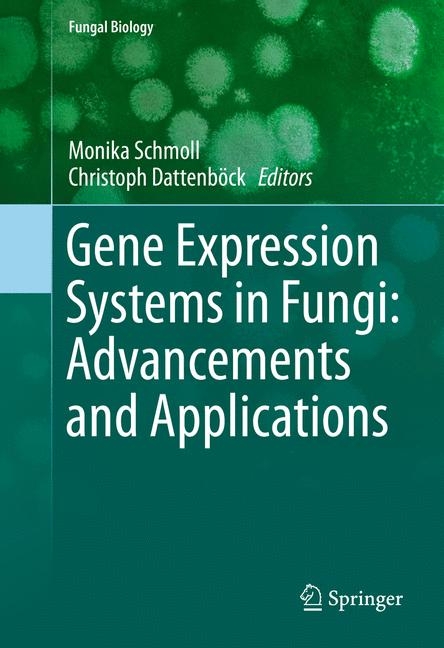
Gene Expression Systems in Fungi: Advancements and Applications (eBook)
XV, 499 Seiten
Springer-Verlag
978-3-319-27951-0 (ISBN)
Dr. Monika Schmoll received her degree and Ph. D. on the topic of “Regulation of cellulase expression and signal transduction in the filamentous fungus Hypocrea jecorina (Trichoderma reesei)” at the Vienna University of Technology, Austria. Besides gaining postdoctoral experience and building her own group at the Vienna University of Technology, she has been a visiting scientist in the laboratory of Professor N. Louise Glass (Department of Plant and Microbial Biology, University of California, Berkeley, USA), the University of Rome La Sapienza and the University of Szeged, Hungary. In 2012, Dr. Schmoll moved to the Austrian Institute of Technology (AIT) in Tulln, Austria, where she is now group leader and senior scientist. In march 2013 she completed her habilitation at the Vienna University of Technology in the field of “Molecular Genetics and Genomics”. The primary research field of Dr. Schmoll is the interconnection between light response, sexual development and metabolism, with an emphasis on effects on cellulase gene expression in the filamentous fungus Trichoderma reesei. She showed for the first time that cellulase gene expression is modulated by light in T. reesei and could since then elucidate important mechanistic details on the underlying mechanism. Her group discovered the sexual cycle in the biotechnological workhorseTrichoderma, which had previously been considered asexual. Recently, her group also showed that communication upon sexual development is mediated by regulation of secondary metabolism. Her work with Trichoderma is complemented by contributions to genome annotation of several fungi (Trichoderma spp., Aspergillus nidulans, Postia placenta, Ceriporiopsis subvermispora, Phlebiopsis gigantea), especially in the field of signal transduction.
Gene expression by yeasts versus filamentous fungi – perspectives and challenges.- Ascomycetes as fungal workhorses for industry.- Industrial uses of Zygomycetes.- Biotechnological application of basidiomycetes.- Mining fungal genomes for improvement of gene expression.- Targets of strain improvement in fungi.- Sexual development for strain improvement of fungi.- Using chromatin modification in biotechnology.- Awakening silent clusters for expression secondary metabolites.- High throughput construction of genetically modified fungi.- Regulatory mechanisms in enzyme production by fungi.- Regulatory mechanisms in production of metabolites by fungi.- Production of enzymes and performance proteins in Trichoderma reesei.- Aspergilli – versatile producers of proteins and metabolites.- Fungal gene expression systems for antibiotics production.- Novel fungal gene expression systems for the future of biotechnology.- Designing the ideal production host – strategies and challenges in strain improvement.- Challenges and perspectives in expression of enzymes and performance proteins.- Exploiting natural selection – are novel fungal isolates the future of industrial biotechnology?.- Targeted genetic modification of organisms versus random mutagenesis – will societal acceptance influence industrial strategies?.
| Erscheint lt. Verlag | 4.4.2016 |
|---|---|
| Reihe/Serie | Fungal Biology | Fungal Biology |
| Zusatzinfo | XV, 499 p. 38 illus., 19 illus. in color. |
| Verlagsort | Cham |
| Sprache | englisch |
| Themenwelt | Naturwissenschaften ► Biologie ► Genetik / Molekularbiologie |
| Technik | |
| Schlagworte | Antibiotics • enzyme production • Fungal Biotechnology • heterologous protein production • Secondary Metabolite Production |
| ISBN-10 | 3-319-27951-3 / 3319279513 |
| ISBN-13 | 978-3-319-27951-0 / 9783319279510 |
| Informationen gemäß Produktsicherheitsverordnung (GPSR) | |
| Haben Sie eine Frage zum Produkt? |
 PDF (Wasserzeichen)
DRM: Digitales Wasserzeichen
Dieses eBook enthält ein digitales Wasserzeichen und ist damit für Sie personalisiert. Bei einer missbräuchlichen Weitergabe des eBooks an Dritte ist eine Rückverfolgung an die Quelle möglich.
Dateiformat: PDF (Portable Document Format)
Mit einem festen Seitenlayout eignet sich die PDF besonders für Fachbücher mit Spalten, Tabellen und Abbildungen. Eine PDF kann auf fast allen Geräten angezeigt werden, ist aber für kleine Displays (Smartphone, eReader) nur eingeschränkt geeignet.
Systemvoraussetzungen:
PC/Mac: Mit einem PC oder Mac können Sie dieses eBook lesen. Sie benötigen dafür einen PDF-Viewer - z.B. den Adobe Reader oder Adobe Digital Editions.
eReader: Dieses eBook kann mit (fast) allen eBook-Readern gelesen werden. Mit dem amazon-Kindle ist es aber nicht kompatibel.
Smartphone/Tablet: Egal ob Apple oder Android, dieses eBook können Sie lesen. Sie benötigen dafür einen PDF-Viewer - z.B. die kostenlose Adobe Digital Editions-App.
Buying eBooks from abroad
For tax law reasons we can sell eBooks just within Germany and Switzerland. Regrettably we cannot fulfill eBook-orders from other countries.
aus dem Bereich