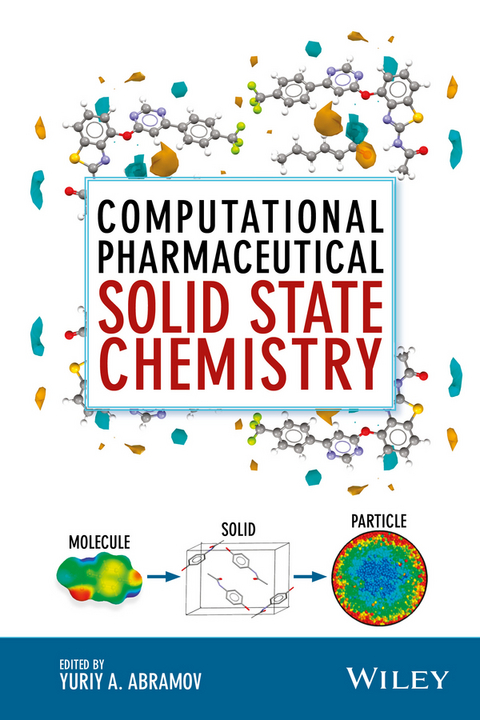
Computational Pharmaceutical Solid State Chemistry (eBook)
424 Seiten
Wiley (Verlag)
978-1-119-22917-9 (ISBN)
The book is intended to be used as a professional reference to researchers in Pharmaceutical industry and in academia and potentially as a text book reference for undergraduate, graduate and postgraduate students in the field of Computational Chemistry, Solid State Chemistry, Pharmaceutical Science and Material Science.
Yuriy A. Abramov, PhD, is a Senior Principal Scientist with over 14 years of experience in computational sciences in drug discovery and development with Pfizer, Inc., in Groton, CT, USA. He holds a PhD in Physical Chemistry from the D. Mendeleev University of Chemical Technology of Russia and Karpov Institute of Physical Chemistry in Moscow.
1
COMPUTATIONAL PHARMACEUTICAL SOLID-STATE CHEMISTRY: AN INTRODUCTION
Yuriy A. Abramov
Pfizer Worldwide Research & Development, Groton, CT, USA
1.1 INTRODUCTION
Traditionally, pharmaceutical industry is focusing on discovery and manufacturing of small-molecule drug compounds. Pharmaceutical industry workflow is characterized by two somewhat overlapping stages—Drug Discovery and Drug Development. At the first stage, a new chemical entity (drug candidate molecule for clinical development) is being discovered and tested on animals. At the end of this stage it is important to make sure that the selected molecule passes preclinical testing such as in vivo biological activity in animal models, in vitro metabolism, pharmacokinetic profiling in animals, and animal toxicology studies. The drug candidate progresses into an early development stage to pass proof of concept (POC), which refers to early clinical studies on human divided into Phase I and Phase IIa. At this step the candidate molecule becomes an active pharmaceutical ingredient (API) of drug product and is typically formulated in a solid form. The subsequent Drug Development process is focused on drug product and process development to ensure reliable performance, manufacturing, and storage.
Along the pharmaceutical industry workflow path, a drug substance undergoes a significant physical transformation (Fig. 1.1). It starts in early Drug Discovery as a single molecule (ligand) binding to a receptor in order to activate or inhibit the receptor’s associated biochemical pathway. Then the drug molecule becomes a biologically active component of a typically solid-state (e.g., crystalline or amorphous) formulation in early Drug Development. Finally, the drug molecule acts as an API of the solid particles of the drug product at the later stages of Drug Development. This transformational pathway reflects the complex nature of the drug design workflow and dictates a diversity of experimental and especially computational methods, which are applied to support Drug Discovery and Drug Development.
Figure 1.1 Physical transformation of a drug substance along the pharmaceutical industry workflow.
The pharmaceutical industry as a whole has faced many challenges in recent years in addition to patent expirations of blockbuster drugs. In particular, the Drug Development branch faces challenges of accelerated development under a high regulatory pressure. An ability to rationalize and guide Drug Development process has become crucial [1]. Computational chemistry methods have become deeply integrated into Drug Discovery over the past 30 years [2, 3]. However, the computational support of Drug Development has emerged only in recent years and is now tasked with the whole spectrum of Drug Development fields including drug formulation and product design, process chemistry, chemical engineering and analytical research and development. This chapter provides a high-level overview of pharmaceutical solid-state landscape and introduces a field of computational modeling in Drug Development, hereinafter called computational pharmaceutical solid-state chemistry (CPSSC).
1.2 PHARMACEUTICAL SOLID-STATE LANDSCAPE
1.2.1 Some Definitions
Approximately 70% of the drug products marketed worldwide are formulated in oral solid dosage forms [4]. The pharmaceutical solid state may be characterized by molecular arrangement displaying long-range order in all directions (crystalline), long-range order in one or two directions (liquid crystals), or only close-range order (amorphous). An overall pharmaceutical solid-state landscape is presented in Figure 1.2. The advantage of formulation of drug substances in crystalline form is dictated by more desirable manufacturing properties: superior stability, purity, and manufacturability relative to amorphous and liquid form formulations. All solid drugs can be subclassified as single- (anhydrous) and multicomponent compounds. Multicomponent substances can be crystalline solvates (including solid hydrates) [5, 6], cocrystals (or co-crystals) [7], and salts [8]. Solid solvates (also named pseudopolymorphs or solvatomorphs) represent crystal structures in which solvent molecules are integrated into the crystal lattice. Solid hydrates are the most common pharmaceutical pseudopolymorphs. Pharmaceutical cocrystals are defined as stoichiometric multicomponent crystals formed by an API (or an intermediate compound) with at least one cocrystal former (coformer), which is solid at ambient temperature. Within the family of solvates, hydrates, and cocrystals, the components are neutral. Pharmaceutical salts are multicomponent materials in which components are ionized via proton transfer and are involved in ionic interactions with each other.
Figure 1.2 A typical pharmaceutical solid-state landscape.
Different crystalline structures of one substance (single- or multicomponent) are named polymorphs [9, 10]. Polymorphism, which exists as a result of different crystal packing of rigid molecules, is called a packing polymorphism. Conformational polymorphism is a more common phenomenon for typically flexible drug-like molecules and results from crystallization of different conformers of the same molecule. At a given environmental conditions (temperature, humidity, pressure, etc.) only one solid form is thermodynamically stable (lowest free energy), while all other forms are considered metastable.
The solid-state complexity of a typical distribution of pharmaceutical solid forms was reflected in a recent analysis of 245 polymorph screens performed at Solid State Chemical Information (SSCI) (http://www.ssci-inc.com) [11]. It was demonstrated that about 90% of the compounds screened exhibited multiple crystalline and noncrystalline forms. About half of the compounds screened were polymorphic, and about a third of the compounds exist in hydrated and solvated forms. In cases where cocrystals were attempted for a particular API, 61% of these were able to form cocrystals.
1.2.2 Impact of Solid-State Form on API and Product Properties
Variations of pharmaceutical solid form can result in alternations of physicochemical properties of drug product, which may affect drug performance, safety, and processing [12]. Therefore, solid form selection is strongly regulated by the Food and Drug Administration according to guidelines outlined in an International Conference on Harmonisation (ICH; http://www.ich.org) [13] as well as by other regulatory agencies around the world. Table 1.1 summarizes major properties that may be affected by crystal form change, a selection of these properties are discussed in more detail later.
Table 1.1 Properties Which May be Impacted by Solid Form Variation
| Chemical | Physical | Mechanical | Surface | Thermodynamic | Kinetic |
| Chemical stability/reactivity | Stability | Compactability | Surface free energy | Solubility | Dissolution rate |
| Photochemical reactivity | Hygroscopicity | Hardness | Stickiness | Free energy of fusion | Nucleation and crystal growth rates |
| Morphology | Powder flow | Interfacial tensions | Melting point | Solid-state reaction rate |
| Density | Tableting | Surface area | Heat of fusion |
| Color | Tensile strength | Vapor pressure |
| Refractive index | Cleavage |
Solubility and dissolution rate are the key properties of drug product, which are directly related to bioavailability and are often vital for the drug performance. These two properties display a strong dependence on the solid form selected. The largest difference in solubility is observed between crystalline and amorphous pharmaceutical materials and may be as high as several hundred times [14, 15]. Solid crystalline hydrates are known to drop the solubility of the drug relative to its anhydrous form up to 10 times [16]. On the contrary, solid solvates formed from water-miscible solvents are typically more soluble in water than the corresponding nonsolvated form. Generally, dissolution rate is increased significantly in salt and cocrystal solid formulations predominantly due to favorable hydration free energies of counter ion and cocrystal former, respectively [17, 18]. Therefore, salt or cocrystal formulations are the most popular strategies for improving the solubility (dissolution) of poorly soluble drugs [19].
Thermodynamic solubility of a crystalline compound decreases with increased stability (lower free energy) of its polymorphic form. It has been reported that there is a 95% probability that a thermodynamic solubility ratio between a pair of polymorphs is less than twofold [20], although in certain cases it may reach much higher values. At first glance an impact of change of polymorphic form on the solubility and dissolution rate may seem to be less problematic in comparison with amorphous to crystalline or...
| Erscheint lt. Verlag | 27.4.2016 |
|---|---|
| Sprache | englisch |
| Themenwelt | Naturwissenschaften ► Chemie ► Technische Chemie |
| Technik | |
| Schlagworte | Biotechnologie • Biotechnologie i. d. Biowissenschaften • Biotechnology • Biowissenschaften • Chemie • Chemistry • Computational Chemistry • Computational Chemistry & Molecular Modeling • Computational Chemistry u. Molecular Modeling • Festkörperchemie • Festkörperchemie • Life Sciences • Pharmaceutical & Medicinal Chemistry • Pharmazeutische u. Medizinische Chemie |
| ISBN-10 | 1-119-22917-0 / 1119229170 |
| ISBN-13 | 978-1-119-22917-9 / 9781119229179 |
| Informationen gemäß Produktsicherheitsverordnung (GPSR) | |
| Haben Sie eine Frage zum Produkt? |
 EPUB (Adobe DRM)
Kopierschutz: Adobe-DRM
Adobe-DRM ist ein Kopierschutz, der das eBook vor Mißbrauch schützen soll. Dabei wird das eBook bereits beim Download auf Ihre persönliche Adobe-ID autorisiert. Lesen können Sie das eBook dann nur auf den Geräten, welche ebenfalls auf Ihre Adobe-ID registriert sind.
Details zum Adobe-DRM
Dateiformat: EPUB (Electronic Publication)
EPUB ist ein offener Standard für eBooks und eignet sich besonders zur Darstellung von Belletristik und Sachbüchern. Der Fließtext wird dynamisch an die Display- und Schriftgröße angepasst. Auch für mobile Lesegeräte ist EPUB daher gut geeignet.
Systemvoraussetzungen:
PC/Mac: Mit einem PC oder Mac können Sie dieses eBook lesen. Sie benötigen eine
eReader: Dieses eBook kann mit (fast) allen eBook-Readern gelesen werden. Mit dem amazon-Kindle ist es aber nicht kompatibel.
Smartphone/Tablet: Egal ob Apple oder Android, dieses eBook können Sie lesen. Sie benötigen eine
Geräteliste und zusätzliche Hinweise
Buying eBooks from abroad
For tax law reasons we can sell eBooks just within Germany and Switzerland. Regrettably we cannot fulfill eBook-orders from other countries.
aus dem Bereich