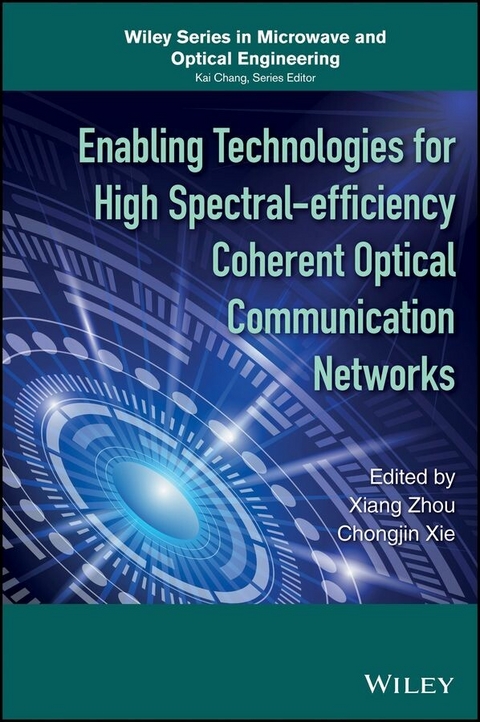
Enabling Technologies for High Spectral-efficiency Coherent Optical Communication Networks (eBook)
John Wiley & Sons (Verlag)
978-1-119-07825-8 (ISBN)
Presents the technological advancements that enable high spectral-efficiency and high-capacity fiber-optic communication systems and networks
This book examines key technology advances in high spectral-efficiency fiber-optic communication systems and networks, enabled by the use of coherent detection and digital signal processing (DSP). The first of this book's 16 chapters is a detailed introduction. Chapter 2 reviews the modulation formats, while Chapter 3 focuses on detection and error correction technologies for coherent optical communication systems. Chapters 4 and 5 are devoted to Nyquist-WDM and orthogonal frequency-division multiplexing (OFDM). In chapter 6, polarization and nonlinear impairments in coherent optical communication systems are discussed. The fiber nonlinear effects in a non-dispersion-managed system are covered in chapter 7. Chapter 8 describes linear impairment equalization and Chapter 9 discusses various nonlinear mitigation techniques. Signal synchronization is covered in Chapters 10 and 11. Chapter 12 describes the main constraints put on the DSP algorithms by the hardware structure. Chapter 13 addresses the fundamental concepts and recent progress of photonic integration. Optical performance monitoring and elastic optical network technology are the subjects of Chapters 14 and 15. Finally, Chapter 16 discusses spatial-division multiplexing and MIMO processing technology, a potential solution to solve the capacity limit of single-mode fibers.
• Contains basic theories and up-to-date technology advancements in each chapter
• Describes how capacity-approaching coding schemes based on low-density parity check (LDPC) and spatially coupled LDPC codes can be constructed by combining iterative demodulation and decoding
• Demonstrates that fiber nonlinearities can be accurately described by some analytical models, such as GN-EGN model
• Presents impairment equalization and mitigation techniques
Enabling Technologies for High Spectral-efficiency Coherent Optical Communication Networks is a reference for researchers, engineers, and graduate students.
Xiang Zhou is a Tech Lead within Google Platform Advanced Technology. Before joining Google, he was with AT&T Labs, conducting research on various aspects of optical transmission and photonics networking technologies. Dr. Zhou is an OSA fellow and an associate editor for Optics Express. He has extensive publications in the field of optical communications.
Chongjin Xie is a senior director at Ali Infrastructure Service, Alibaba Group. Before joining Alibaba Group, he was a Distinguished Member of Technical Staff at Bell Labs, Alcatel-Lucent. Dr. Xie is a fellow of OSA and senior member of IEEE. He is an associate editor of the Journal of Lightwave Technology and has served in various conference committees.
Xiang Zhou is a Tech Lead within Google Platform Advanced Technology. Before joining Google, he was with AT&T Labs, conducting research on various aspects of optical transmission and photonics networking technologies. Dr. Zhou is an OSA fellow and an associate editor for Optics Express. He has extensive publications in the field of optical communications.
Chongjin Xie is a senior director at Ali Infrastructure Service, Alibaba Group. Before joining Alibaba Group, he was a Distinguished Member of Technical Staff at Bell Labs, Alcatel-Lucent. Dr. Xie is a fellow of OSA and senior member of IEEE. He is an associate editor of the Journal of Lightwave Technology and has served in various conference committees.
Enabling Technologies for High Spectral-efficiency Coherent Optical Communication Networks Presents the technological advancements that enable high spectral-efficiency and high-capacity fiber-optic communication systems and networks This book examines key technology advances in high spectral-efficiency fiber-optic communication systems and networks, enabled by the use of coherent detection and digital signal processing (DSP). The first of this book s 16 chapters is a detailed introduction. Chapter 2 reviews the modulation formats, while Chapter 3 focuses on detection and error correction technologies for coherent optical communication systems. Chapters 4 and 5 are devoted to Nyquist-WDM and orthogonal frequency-division multiplexing (OFDM). In chapter 6, polarization and nonlinear impairments in coherent optical communication systems are discussed. The fiber nonlinear effects in a non-dispersion-managed system are covered in chapter 7. Chapter 8 describes linear impairment equalization and Chapter 9 discusses various nonlinear mitigation techniques. Signal synchronization is covered in Chapters 10 and 11. Chapter 12 describes the main constraints put on the DSP algorithms by the hardware structure. Chapter 13 addresses the fundamental concepts and recent progress of photonic integration. Optical performance monitoring and elastic optical network technology are the subjects of Chapters 14 and 15. Finally, Chapter 16 discusses spatial-division multiplexing and MIMO processing technology, a potential solution to solve the capacity limit of single-mode fibers. Contains basic theories and up-to-date technology advancements in each chapter Describes how capacity-approaching coding schemes based on low-density parity check (LDPC) and spatially coupled LDPC codes can be constructed by combining iterative demodulation and decoding Demonstrates that fiber nonlinearities can be accurately described by some analytical models, such as GN-EGN model Presents impairment equalization and mitigation techniques Enabling Technologies for High Spectral-efficiency Coherent Optical Communication Networks is a reference for researchers, engineers, and graduate students.
Xiang Zhou is a Tech Lead within Google Platform Advanced Technology. Before joining Google, he was with AT&T Labs, conducting research on various aspects of optical transmission and photonics networking technologies. Dr. Zhou is an OSA fellow and an associate editor for Optics Express. He has extensive publications in the field of optical communications. Chongjin Xie is a Senior Director at Ali Infrastructure Service, Alibaba Group. Before joining Alibaba Group, he was a Distinguished Member of Technical Staff at Bell Labs, Alcatel-Lucent. Dr. Xie is a fellow of OSA and senior member of IEEE. He is an associate editor of the Journal of Lightwave Technology and has served in various conference committees.
CHAPTER 1
INTRODUCTION
Xiang Zhou1 and Chongjin Xie2
1Platform advanced technology, Google Inc, Mountain View, CA, USA
2R&D Lab, Ali Infrastructure Service, Alibaba Group, Santa Clara, CA, USA
1.1 HIGH-CAPACITY FIBER TRANSMISSION TECHNOLOGY EVOLUTION
Since the first demonstration of an optical fiber transmission system in 1977 [1], the demands for higher capacity and longer reach have always been the dominant driver behind the evolution of this new communication technology. In less than four decades, single-fiber transmission capacity has increased by more than five orders of magnitude, from the early 45 Mb/s, using direct modulation and direct detection [2], to more than 8.8 Tb/s by using the digital coherent optical transmission technology [3]. In the meantime, optical transmission reach has increased from only a few kilometers to more than 10,000 km [4]. Such dramatic growth in capacity and reach has been enabled by a series of major breakthroughs in device, subsystem, and system techniques, including lasers, modulators, fibers, optical amplifiers, and photodetectors, as well as various modulation, coding, and channel impairment management methods.
The first generation of optical fiber communications was developed during the late 1970s, operating near 0.8 µm using GaAs semiconductor lasers [2] and multimode fibers (MMF). Although the total capacity of the first commercial system was only running at 45 Mb/s, with an optical reach or repeater spacing of 10 km, this capacity is now much greater than that of comparable coax systems (assuming identical reach or repeater spacing).
With breakthroughs in InGaAsP semiconductor lasers/photodetectors and single-mode fiber manufacturing technologies, the second generation shifted the wavelength to 1.3 µm by taking advantage of the low attenuation (<1 dB/km) and low dispersion of single-mode fibers. A laboratory experiment in 1981 demonstrated transmission at 2 Gb/s over 44 km of single-mode fiber [5]. By 1987, second-generation optical fiber communication systems, operating at bit rates of up to 1.7 Gb/s with a repeater spacing of about 50 km, were commercially available.
The optical transmission reach of second-generation fiber communication systems was limited by fiber losses at the operating wavelength of 1.3 µm (typically 0.5 dB/km). Losses of silica fibers approached minimum near 1.55 µm. Indeed, a 0.2-dB/km loss was realized in 1979 in this spectral region [6]. However, the introduction of third-generation systems operating at 1.55 µm was delayed by large fiber dispersion near 1.55 µm. Conventional InGaAsP semiconductor lasers (with Fabry–Perot type resonators) could not be used because of pulse spreading occurring as a result of simultaneous oscillation in several longitudinal modes. Two methods were developed to overcome the dispersion problem: (i) a dispersion-shifted fiber was designed to minimize the dispersion near 1.55 µm and (ii) a single longitudinal mode laser, that is the widely used distributed feedback (DFB) laser, was developed to limit the spectral width. By using these two methods together, bit rates up to 4 Gb/s over distances in excess of 100 km were successfully demonstrated in 1985 [7]. Third-generation fiber communication systems operating at 2.5 Gb/s became available commercially in 1990 with a typical optical reach of 60–70 km. Such systems are capable of operating at a bit rate of up to 10 Gb/s [8].
To further increase optical transmission reach and reduce the number of costly optical–electrical–optical (O–E–O) repeaters for long distance transmission, efforts were focused on coherent optical transmission technology during the late 1980s. The purpose was to improve optical receiver sensitivity by using a local oscillator (LO) to amplify the received optical signal. The potential benefits of coherent transmission technology were demonstrated in many system experiments [9]. However, commercial introduction of such systems was postponed with the advent of erbium-doped fiber amplifiers (EDFAs) in 1989. The fourth generation of fiber communication systems makes use of optical amplification for increasing O–E–O repeater spacing and of wavelength-division multiplexing (WDM) for increasing total capacity. The advent of the WDM technique in combination with EDFAs started a revolution that resulted in doubling of the system capacity every 6 months or so and led to optical communication systems operating at >1 Tb/s by 2001. In most WDM systems, fiber losses are compensated for by spacing EDFAs 60–80 km apart. EDFAs were developed after 1985 and became available commercially by 1990. A 1991 experiment showed the possibility of data transmission over 21,000 km at 2.5 Gb/s, and over 14,300 km at 5 Gb/s, using a recirculating-loop configuration [10]. This performance proved that an amplifier-based, all-optical, submarine transmission system was feasible for intercontinental communications. By 1996, not only had transmission over 11,300 km at a bit rate of 5 Gb/s been demonstrated by using actual submarine cables [11], but commercial trans-Atlantic and trans-Pacific cable systems also became available. Since then, a large number of submarine fiber communication systems have been deployed worldwide.
In the late 1990s and early 2000s, several efforts were made to further increase single-fiber capacity. The first effort focused on increasing system capacity by transmitting more and more channels through WDM. This was mainly achieved by reducing channel bandwidth through (i) better control of the laser wavelength stability and (ii) development of dense wavelength multiplexing and demultiplexing devices. At the same time, new kinds of amplification schemes had also been explored, as the conventional EDFA wavelength window, known as the C band, only covers the wavelength range of 1.53–1.57 µm. The amplifier bandwidth was extended on both the long- and short-wavelength sides, resulting in the L and S bands, respectively. The Raman amplification technique, which can be used to amplify signals in all S, C, and L wavelength bands, had also been intensely investigated. The second effort attempted to increase the bit rate of each channel within the WDM signal. Starting in 2000, many experiments used channels operating at 40 Gb/s. Such systems require high-performance optical modulator as well as extremely careful management of fiber chromatic dispersion (CD), polarization-mode dispersion (PMD) and fiber nonlinearity [12]. To better manage fiber CD, dispersion compensating fiber (DCF) has been developed and various dispersion management methods have also been explored to better manage fiber nonlinearity. These efforts led in 2000 to a 3.28-Tb/s experiment in which 82 channels, each operating at 40 Gb/s, were transmitted over 3000 km. Within a year, the system capacity was increased to nearly 11 Tb/s (273 WDM channels, each operating at 40 Gb/s) but the transmission distance was limited to 117 km [13]. In another record experiment, 300 channels, each operating at 11.6 Gb/s, were transmitted over 7380 km [14]. Commercial terrestrial systems with the capacity of 1.6 Tb/s were available by the end of 2000.
Until early 2000s, all the commercial optical transmission systems used the same direct modulation and direct detection on/off keying non-return-to-zero (NRZ) modulation format. The impressive fiber capacity growth was mainly achieved by advancement in photonics technologies, although forward error correction (FEC) coding also played a significant role in extending the reach for 10 Gb/s per channel WDM systems. Starting from 40 Gb/s per channel WDM systems, it became evident that more spectrally efficient modulation formats were needed to further increase the fiber capacity to meet the ever-growing bandwidth demands.
High spectral-efficiency (SE) modulation formats can effectively increase the aggregate capacity without resorting to expanding the optical bandwidth, which is largely limited by optical amplifier bandwidth. Using high-SE modulation formats also help reduce transceiver speed requirements. Furthermore, high-SE systems are generally more tolerant of fiber CD and PMD, since they use smaller bandwidths for the same bit rate. CD and PMD tolerance are particularly attractive for high-bit-rate transmission, since dispersion tolerance is reduced by a factor of 4 for a factor-of-2 increase in bit-per-symbol [15].
Early efforts in achieving high SE used direct detection. The first widely investigated modulation format with SE > 1 bit/symbol was the optical differential quaternary phase-shift keying (DQPSK) with differential detection. This is a constant intensity modulation format, which can transmit 2 bits/symbol, corresponding to a theoretical SE of 2 bits/s/Hz [16, 17]. This modulation format also exhibits excellent fiber nonlinearity tolerance due to the nature of constant intensity. To go beyond 2 bit/s/Hz, polarization-division multiplexing (PDM) has been suggested to further increase SE in combination with DQPSK [18]. However, as the state of polarization of the light wave is not preserved during transmission, dynamic polarization control is required at the receiver to recover the transmitted signals.
The need for higher SE and the advancement in digital signal processing (DSP) eventually revives coherent optical communication. The concept of digital coherent communication was proposed by several research groups around 2004–2005 [19–22]. Quickly, this technology was recognized as the best technology for 40 Gb/s, 100 Gb/s and beyond WDM transmission systems, mostly due to the...
| Erscheint lt. Verlag | 29.4.2016 |
|---|---|
| Reihe/Serie | Wiley Series in Microwave and Optical Engineering |
| Wiley Series in Microwave and Optical Engineering | Wiley Series in Microwave and Optical Engineering |
| Sprache | englisch |
| Themenwelt | Naturwissenschaften ► Physik / Astronomie ► Mechanik |
| Technik ► Elektrotechnik / Energietechnik | |
| Technik ► Nachrichtentechnik | |
| Schlagworte | Communication technology • Electrical & Electronics Engineering • Elektrotechnik u. Elektronik • Kommunikationstechnik • Optical Communications • Optics & Photonics • Optik • Optik u. Photonik • Optische Nachrichtentechnik • Physics • Physik |
| ISBN-10 | 1-119-07825-3 / 1119078253 |
| ISBN-13 | 978-1-119-07825-8 / 9781119078258 |
| Informationen gemäß Produktsicherheitsverordnung (GPSR) | |
| Haben Sie eine Frage zum Produkt? |
 EPUB (Adobe DRM)
Kopierschutz: Adobe-DRM
Adobe-DRM ist ein Kopierschutz, der das eBook vor Mißbrauch schützen soll. Dabei wird das eBook bereits beim Download auf Ihre persönliche Adobe-ID autorisiert. Lesen können Sie das eBook dann nur auf den Geräten, welche ebenfalls auf Ihre Adobe-ID registriert sind.
Details zum Adobe-DRM
Dateiformat: EPUB (Electronic Publication)
EPUB ist ein offener Standard für eBooks und eignet sich besonders zur Darstellung von Belletristik und Sachbüchern. Der Fließtext wird dynamisch an die Display- und Schriftgröße angepasst. Auch für mobile Lesegeräte ist EPUB daher gut geeignet.
Systemvoraussetzungen:
PC/Mac: Mit einem PC oder Mac können Sie dieses eBook lesen. Sie benötigen eine
eReader: Dieses eBook kann mit (fast) allen eBook-Readern gelesen werden. Mit dem amazon-Kindle ist es aber nicht kompatibel.
Smartphone/Tablet: Egal ob Apple oder Android, dieses eBook können Sie lesen. Sie benötigen eine
Geräteliste und zusätzliche Hinweise
Buying eBooks from abroad
For tax law reasons we can sell eBooks just within Germany and Switzerland. Regrettably we cannot fulfill eBook-orders from other countries.
aus dem Bereich