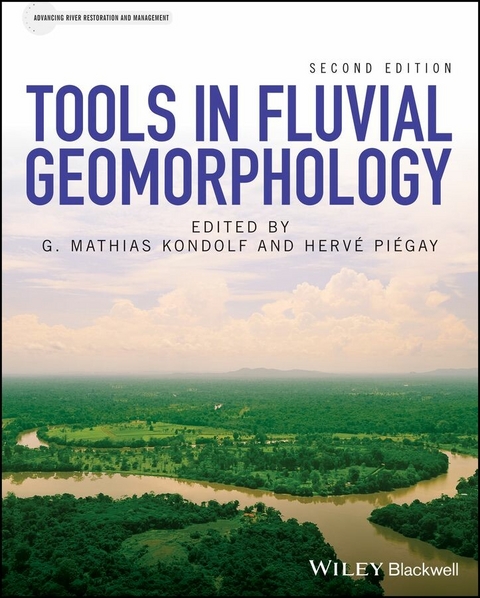
Tools in Fluvial Geomorphology (eBook)
John Wiley & Sons (Verlag)
978-1-118-64857-5 (ISBN)
Fluvial Geomorphology studies the biophysical processes acting in rivers, and the sediment patterns and landforms resulting from them. It is a discipline of synthesis, with roots in geology, geography, and river engineering, and with strong interactions with allied fields such as ecology, engineering and landscape architecture. This book comprehensively reviews tools used in fluvial geomorphology, at a level suitable to guide the selection of research methods for a given question. Presenting an integrated approach to the interdisciplinary nature of the subject, it provides guidance for researchers and professionals on the tools available to answer questions on river restoration and management.
Thoroughly updated since the first edition in 2003 by experts in their subfields, the book presents state-of-the-art tools that have revolutionized fluvial geomorphology in recent decades, such as physical and numerical modelling, remote sensing and GIS, new field techniques, advances in dating, tracking and sourcing, statistical approaches as well as more traditional methods such as the systems framework, stratigraphic analysis, form and flow characterisation and historical analysis.
This book:
- Covers five main types of geomorphological questions and their associated tools: historical framework; spatial framework; chemical, physical and biological methods; analysis of processes and forms; and future understanding framework.
- Provides guidance on advantages and limitations of different tools for different applications, data sources, equipment and supplies needed, and case studies illustrating their application in an integrated perspective.
It is an essential resource for researchers and professional geomorphologists, hydrologists, geologists, engineers, planners, and ecologists concerned with river management, conservation and restoration. It is a useful supplementary textbook for upper level undergraduate and graduate courses in Geography, Geology, Environmental Science, Civil and Environmental Engineering, and interdisciplinary courses in river management and restoration.
Mathias (Matt) Kondolf, Professor of Environmental Planning, University of California Berkeley, USA
Professor Kondolf is a fluvial geomorphologist specializing in environmental river management and restoration. At Berkeley he teaches courses in hydrology, river restoration, and environmental science. His research focuses on human-river interactions, with emphasis on managing of flood-prone lands, managing sediment in rivers and reservoirs, and river restoration, and he has published extensively on these topics. He has served as advisor to US and state agencies on river management and restoration, and provided expert testimony before the US Congress, the California Legislature, and the International Court of Justice and International Court of Arbitration in the Hague.
Hervé Piégay, Research Director at CNRS - National Centre of Scientific Research, ENS of Lyon, France
Professor Piégay is involved in integrated sciences for rivers, and works closely with practitioners, providing knowledge for river management, planning and restoration and methodological frameworks and tools, especially using GIS and remote sensing. As scientific director of the Rhône Observatory of Human and Environment Interactions, he leads an interdisciplinary scientific team conducting research on the Rhône valley, to inform management of the river, its floodplain, and tributaries. He has contributed to more than 200 papers in peer-reviewed journals and book chapters, and has coordinated several edited books.
Fluvial Geomorphology studies the biophysical processes acting in rivers, and the sediment patterns and landforms resulting from them. It is a discipline of synthesis, with roots in geology, geography, and river engineering, and with strong interactions with allied fields such as ecology, engineering and landscape architecture. This book comprehensively reviews tools used in fluvial geomorphology, at a level suitable to guide the selection of research methods for a given question. Presenting an integrated approach to the interdisciplinary nature of the subject, it provides guidance for researchers and professionals on the tools available to answer questions on river restoration and management. Thoroughly updated since the first edition in 2003 by experts in their subfields, the book presents state-of-the-art tools that have revolutionized fluvial geomorphology in recent decades, such as physical and numerical modelling, remote sensing and GIS, new field techniques, advances in dating, tracking and sourcing, statistical approaches as well as more traditional methods such as the systems framework, stratigraphic analysis, form and flow characterisation and historical analysis. This book: Covers five main types of geomorphological questions and their associated tools: historical framework; spatial framework; chemical, physical and biological methods; analysis of processes and forms; and future understanding framework. Provides guidance on advantages and limitations of different tools for different applications, data sources, equipment and supplies needed, and case studies illustrating their application in an integrated perspective. It is an essential resource for researchers and professional geomorphologists, hydrologists, geologists, engineers, planners, and ecologists concerned with river management, conservation and restoration. It is a useful supplementary textbook for upper level undergraduate and graduate courses in Geography, Geology, Environmental Science, Civil and Environmental Engineering, and interdisciplinary courses in river management and restoration.
Mathias (Matt) Kondolf, Professor of Environmental Planning, University of California Berkeley, USA Professor Kondolf is a fluvial geomorphologist specializing in environmental river management and restoration. At Berkeley he teaches courses in hydrology, river restoration, and environmental science. His research focuses on human-river interactions, with emphasis on managing of flood-prone lands, managing sediment in rivers and reservoirs, and river restoration, and he has published extensively on these topics. He has served as advisor to US and state agencies on river management and restoration, and provided expert testimony before the US Congress, the California Legislature, and the International Court of Justice and International Court of Arbitration in the Hague. Hervé Piégay, Research Director at CNRS - National Centre of Scientific Research, ENS of Lyon, France Professor Piégay is involved in integrated sciences for rivers, and works closely with practitioners, providing knowledge for river management, planning and restoration and methodological frameworks and tools, especially using GIS and remote sensing. As scientific director of the Rhône Observatory of Human and Environment Interactions, he leads an interdisciplinary scientific team conducting research on the Rhône valley, to inform management of the river, its floodplain, and tributaries. He has contributed to more than 200 papers in peer-reviewed journals and book chapters, and has coordinated several edited books.
Chapter 1
Tools in fluvial geomorphology: problem statement and recent practice
G. Mathias Kondolf1 and Hervé Piégay2
1University of California, Berkeley, CA, USA
2Université de Lyon, UMR 5600 CNRS, Lyon, France
Let the punishment fit the crime.Popular saying invoked by the late M.G. Wolman during drafting of the first edition of Tools in Fluvial Geomorphology to capture the idea that the tools should be selected based on the problem to be solved.
1.1 Introduction
As noted by Wolman (1995), in his essay Play: the handmaiden of work, much geomorphological research is applied. The spatial and temporal scales of geomorphic analysis can provide insights for the management of risk from natural hazards, solving problems in river engineering (Giardino and Marston 1999) and river ecology (Brookes and Shields 1996), with recent developments in river restoration in terms of assessment, design and monitoring (Morandi et al. 2014). As do all scientists, fluvial geomorphologists employ tools in their research, but the range of tools is probably broader in this field than others because of its position at the intersection of geology, geography and river engineering, which draws upon fields such as hydrology, chemistry, physics, ecology and human and natural history. Increasingly, the tools of fluvial geomorphology have been adopted, used and sometimes modified by non-geomorphologists, such as scientists in allied fields seeking to incorporate geomorphic approaches in their work, managers who prescribe a specific tool be used in a given study, and consultants seeking to package geomorphology in an easy-to-swallow capsule for their clients.
Frequently, a lack of geomorphic perspective shows in the questions posed, which are often at spatial and temporal scales smaller than the underlying cause of the problem. For example, to address complaints about bank erosion problem, we have frequently seen costly structures built to alter flow patterns within the channel. Although the designers may have employed hydraulic formulae to design the structures, they may have neglected to look at geomorphic processes at the basin scale, even at reach scale, so that the driving factors are not well identified. Intervening on the symptoms rather than on the underlying disease itself is usually not the best option to solve problems. In such a case, controlling bank erosion through mechanical means will at best provide only temporary and local relief from a system-wide trend. Moreover, it is now well understood that bank erosion and deposition are essential processes to create the complex and diverse channel (Florsheim et al. 2008) and floodplain (Stanford et al. 2005) habitats needed by many valued species. Thus, what is seen locally as a problem by a riparian landowner may simply be part of the naturally dynamic river behaviour that supports river ecology, and if bank erosion has increased due to catchment-wide changes, even applying geomorphic tools at the site scale only will ultimately prove ineffective (or at least not sustainable) and ecologically detrimental, because the question was poorly posed at the outset without any robust diagnosis and geomorphic expertise based on the range of available tools.
The purpose of this book is to review the range of tools employed by geomorphologists and to link clearly the choice of tools to the question posed, thereby providing guidance to scientists in allied fields and to practitioners about the sorts of methods available to address questions in the field and the relative advantages and disadvantages of each. This book is the result of a collective effort, involving contributors with diverse ages, disciplinary expertise, professional experience and geographic origins to illustrate the range of tools in the field and their application to problems in other fields or management problems. This second edition has incorporated substantial updates, involving new authors with significant contributions to the field over the past decade.
1.2 Tools and fluvial geomorphology: the terms
Webster's Dictionary defines a tool as anything used for accomplishing a task or purpose (Random House 1996). By a tool, we refer comprehensively to concepts, theories, methods and techniques. The distinction among these terms is not always clear, depending on the level of thinking and abstraction. Moreover, definitions vary somewhat with dictionaries (e.g. Merriam 1959 versus Random House 1996) and definitions of one term may include the other terms. In our usage, a concept is defined as a mental representation of a reality and a theory is an explicit formulation of relationships among concepts. Both are tools because they provide the framework within which problems are approached and techniques and methods deployed. A method involves an approach, a set of steps taken to solve a problem and would often include more than one technique. As suggested by Webster's Dictionary (Random House 1996), it is an orderly procedure, or process, regular way or manner of doing something. Techniques are the most concrete and specific tools, referring to discrete actions that yield measurements, observations or analyses.
As an illustration, a researcher can base his approach on the fluvial system theory and, within this general framework, one of the field's seminal concepts, the notion of bankfull discharge as being the dominant/geomorphic discharge. To test the relation between bankfull discharge and dominant discharge, he can proceed step by step, identifying a general methodological protocol, first to determine what is the bankfull discharge, then its frequency. He may survey channel slope and cross-sectional geometry and measure water flow and velocity, or, if field measurements of flow were not possible, he might estimate flow characteristics from the surveyed geometry and hydraulic equations. In the general case, measuring flow in the field can be undertaken using several methods, such as applying a portable weir, salt dilution or current meter method, but the former are normally better suited for lower flows than the bankfull discharge being studied. The current meter method could be based on various techniques, such as those to measure flow depth and velocity (e.g. using Pryce AA or other current meters, wading with top-setting wading rods or suspending the meter from a cableway or bridge), mechanically improving the cross-section for measurement, accounting for flow angles and sources of turbulence when placing the current meter in the water and estimating the precision of the measurement. Also, given that channel capacity should be related to the long-term flow frequency (Wharton et al. 1989), the researcher would normally analyse long-term gauging data (if available for the river being studied), or synthesize from nearby gauges in the region.
Whereas some tools are specific to fluvial geomorphology, others are borrowed from sister disciplines and some (such as mathematical modelling, statistical analysis and inductive or hypothetico-deductive reasoning) are used by virtually all sciences (Bauer 1996; Osterkamp and Hupp 1996). Compared with many other disciplines, fluvial geomorphology has had a strong basis in field observation and measurement. Even with increased reliance on remote sensing and laboratory analysis, the field component is likely to remain critically important to fluvial geomorphology. In this book, our aim is not to describe generic tools, but to focus on tools currently used by fluvial geomorphologists.
We define fluvial geomorphology in its broadest sense, considering channel forms and processes and interactions among channel, floodplain, network and catchment. A catchment-scale perspective, at least at a network level, is needed to understand channel form and adjustments over time. Of particular relevance are links among various components of the fluvial system, controlling the transfer of water and sediment, states of equilibrium or disequilibrium, reflecting changes in climate, tectonic activity and human effects, over time-scales from Pleistocene (or earlier) to the present. Accordingly, to understand rivers can involve multiple questions and require the application of multiple methods and data sources. As a consequence, we consider fluvial geomorphology at different spatial and temporal scales, within a nested systems perspective (Schumm 1977). Analysis of fluvial geomorphology can involve the application of various approaches from reductionism to a holistic perspective, two extremes of a continuum of underlying scientific approach along which the scientist can choose tools according to the question posed.
1.3 What is a tool in fluvial geomorphology?
Roots and tools
Fluvial geomorphology being at the frontier of several disciplines, the choice of tools is fairly large and benefits from the multiple influences of the training of the investigators. The geologically trained fluvial geomorphologist may be more likely to apply tools such as new techniques of dating such as OSL (optical stimulated luminescence) or isotopes (U/Th isotopic ratios, 14C, 137Cs and 210Pb) and techniques that provide subsurface information (e.g. ground-penetrating radar). By contrast, the investigator trained in river hydraulics and physics is more likely to apply tools such as numerical modelling, flume experiment and mechanics. Some geographers focus on spatial complexity, interactions of fluvial forms and processes according to the characters of the basin or bioclimatic regions within which they are observed, the influence of human activities, vegetation cover, or geological settings, employing tools such as remote...
| Erscheint lt. Verlag | 28.4.2016 |
|---|---|
| Reihe/Serie | Advancing River Restoration and Management |
| Advancing River Restoration and Management | Advancing River Restoration and Management |
| Sprache | englisch |
| Themenwelt | Naturwissenschaften ► Geowissenschaften ► Geologie |
| Technik | |
| Schlagworte | basin research • basin science • earth sciences • Environmental Science • Environmental Studies • fluvial geomorphology, fluvial science • Geology • Geomorphologie • geomorphology • Geophysics • Geowissenschaften • hydrogeology • Hydrological Sciences • Hydrologie • Hydrology • Limnology • River Management • River Science • sedimentary basins • Sedimentology • Stratigraphy • Umweltforschung • Umweltwissenschaften • watershed • watershed maintenance |
| ISBN-10 | 1-118-64857-9 / 1118648579 |
| ISBN-13 | 978-1-118-64857-5 / 9781118648575 |
| Informationen gemäß Produktsicherheitsverordnung (GPSR) | |
| Haben Sie eine Frage zum Produkt? |
 EPUB (Adobe DRM)
Kopierschutz: Adobe-DRM
Adobe-DRM ist ein Kopierschutz, der das eBook vor Mißbrauch schützen soll. Dabei wird das eBook bereits beim Download auf Ihre persönliche Adobe-ID autorisiert. Lesen können Sie das eBook dann nur auf den Geräten, welche ebenfalls auf Ihre Adobe-ID registriert sind.
Details zum Adobe-DRM
Dateiformat: EPUB (Electronic Publication)
EPUB ist ein offener Standard für eBooks und eignet sich besonders zur Darstellung von Belletristik und Sachbüchern. Der Fließtext wird dynamisch an die Display- und Schriftgröße angepasst. Auch für mobile Lesegeräte ist EPUB daher gut geeignet.
Systemvoraussetzungen:
PC/Mac: Mit einem PC oder Mac können Sie dieses eBook lesen. Sie benötigen eine
eReader: Dieses eBook kann mit (fast) allen eBook-Readern gelesen werden. Mit dem amazon-Kindle ist es aber nicht kompatibel.
Smartphone/Tablet: Egal ob Apple oder Android, dieses eBook können Sie lesen. Sie benötigen eine
Geräteliste und zusätzliche Hinweise
Buying eBooks from abroad
For tax law reasons we can sell eBooks just within Germany and Switzerland. Regrettably we cannot fulfill eBook-orders from other countries.
aus dem Bereich