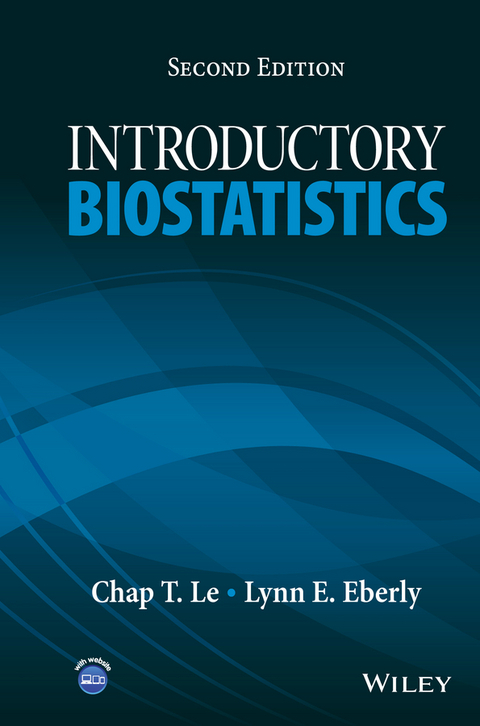
Introductory Biostatistics (eBook)
John Wiley & Sons (Verlag)
978-1-118-59607-4 (ISBN)

Maintaining the same accessible and hands-on presentation, Introductory Biostatistics, Second Edition continues to provide an organized introduction to basic statistical concepts commonly applied in research across the health sciences. With plenty of real-world examples, the new edition provides a practical, modern approach to the statistical topics found in the biomedical and public health fields.
Beginning with an overview of descriptive statistics in the health sciences, the book delivers topical coverage of probability models, parameter estimation, and hypothesis testing. Subsequently, the book focuses on more advanced topics with coverage of regression analysis, logistic regression, methods for count data, analysis of survival data, and designs for clinical trials. This extensive update of Introductory Biostatistics, Second Edition includes:
• A new chapter on the use of higher order Analysis of Variance (ANOVA) in factorial and block designs
• A new chapter on testing and inference methods for repeatedly measured outcomes including continuous, binary, and count outcomes
• R incorporated throughout along with SAS®, allowing readers to replicate results from presented examples with either software
• Multiple additional exercises, with partial solutions available to aid comprehension of crucial concepts
• Notes on Computations sections to provide further guidance on the use of software
• A related website that hosts the large data sets presented throughout the book
Introductory Biostatistics, Second Edition is an excellent textbook for upper-undergraduate and graduate students in introductory biostatistics courses. The book is also an ideal reference for applied statisticians working in the fields of public health, nursing, dentistry, and medicine.
Chap T. Le, PhD, is Distinguished Professor of Biostatistics and Director of Biostatistics and Bioinformatics at the University of Minnesota Masonic Cancer Center. He has provided statistical consulting for a variety of biomedical research projects, and he has worked on collaborations focusing on the analyses of survival and categorical data and, currently, in the areas of cancer and tobacco research. Dr. Le is the author of Health and Numbers: A Problems-Based Introduction to Biostatistics, Third Edition; Applied Categorical Data Analysis and Translational Research, Second Edition; and Applied Survival Analysis, all published by Wiley.
Lynn E. Eberly, PhD, is Associate Professor in the Division of Biostatistics at the University of Minnesota. The author of more than 100 journal articles, Dr. Eberly has been a statistical collaborator in biomedical and public health research for more than 18 years. Her current research interests include methods for and applications to correlated data in neurodegenerative conditions, endocrinology, psychiatry/psychology, and cancer research.
Chap T. Le, PhD, is Distinguished Professor of Biostatistics and Director of Biostatistics and Bioinformatics at the University of Minnesota Masonic Cancer Center. He has provided statistical consulting for a variety of biomedical research projects, and he has worked on collaborations focusing on the analyses of survival and categorical data and, currently, in the areas of cancer and tobacco research. Dr. Le is the author of Health and Numbers: A Problems-Based Introduction to Biostatistics, Third Edition; Applied Categorical Data Analysis and Translational Research, Second Edition; and Applied Survival Analysis, all published by Wiley. Lynn E. Eberly, PhD, is Associate Professor in the Division of Biostatistics at the University of Minnesota. The author of more than 100 journal articles, Dr. Eberly has been a statistical collaborator in biomedical and public health research for more than 18 years. Her current research interests include methods for and applications to correlated data in neurodegenerative conditions, endocrinology, psychiatry/psychology, and cancer research.
1
DESCRIPTIVE METHODS FOR CATEGORICAL DATA
Most introductory textbooks in statistics and biostatistics start with methods for summarizing and presenting continuous data. We have decided, however, to adopt a different starting point because our focused areas are in the biomedical sciences, and health decisions are frequently based on proportions, ratios, or rates. In this first chapter we will see how these concepts appeal to common sense, and learn their meaning and uses.
1.1 PROPORTIONS
Many outcomes can be classified as belonging to one of two possible categories: presence and absence, nonwhite and white, male and female, improved and nonimproved. Of course, one of these two categories is usually identified as of primary interest: for example, presence in the presence and absence classification, nonwhite in the white and nonwhite classification. We can, in general, relabel the two outcome categories as positive (+) and negative (−). An outcome is positive if the primary category is observed and is negative if the other category is observed.
It is obvious that, in the summary to characterize observations made on a group of people, the number x of positive outcomes is not sufficient; the group size n, or total number of observations, should also be recorded. The number x tells us very little and becomes meaningful only after adjusting for the size n of the group; in other words, the two figures x and n are often combined into a statistic, called a proportion:
The term statistic means a summarized quantity from observed data. Clearly, . This proportion p is sometimes expressed as a percentage and is calculated as follows:
Example 1.1
A study published by the Urban Coalition of Minneapolis and the University of Minnesota Adolescent Health Program surveyed 12 915 students in grades 7–12 in Minneapolis and St. Paul public schools. The report stated that minority students, about one-third of the group, were much less likely to have had a recent routine physical checkup. Among Asian students, 25.4% said that they had not seen a doctor or a dentist in the last two years, followed by 17.7% of Native Americans, 16.1% of blacks, and 10% of Hispanics. Among whites, it was 6.5%.
Proportion is a number used to describe a group of people according to a dichotomous, or binary, characteristic under investigation. It is noted that characteristics with multiple categories can have a proportion calculated per category, or can be dichotomized by pooling some categories to form a new one, and the concept of proportion applies. The following are a few illustrations of the use of proportions in the health sciences.
1.1.1 Comparative Studies
Comparative studies are intended to show possible differences between two or more groups; Example 1.1 is such a typical comparative study. The survey cited in Example 1.1 also provided the following figures concerning boys in the group who use tobacco at least weekly. Among Asians, it was 9.7%, followed by 11.6% of blacks, 20.6% of Hispanics, 25.4% of whites, and 38.3% of Native Americans.
In addition to surveys that are cross-sectional, as seen in Example 1.1, data for comparative studies may come from different sources; the two fundamental designs being retrospective and prospective. Retrospective studies gather past data from selected cases and controls to determine differences, if any, in exposure to a suspected risk factor. These are commonly referred to as case–control studies; each such study is focused on a particular disease. In a typical case–control study, cases of a specific disease are ascertained as they arise from population-based registers or lists of hospital admissions, and controls are sampled either as disease-free persons from the population at risk or as hospitalized patients having a diagnosis other than the one under study. The advantages of a retrospective study are that it is economical and provides answers to research questions relatively quickly because the cases are already available. Major limitations are due to the inaccuracy of the exposure histories and uncertainty about the appropriateness of the control sample; these problems sometimes hinder retrospective studies and make them less preferred than prospective studies. The following is an example of a retrospective study in the field of occupational health.
Example 1.2
A case–control study was undertaken to identify reasons for the exceptionally high rate of lung cancer among male residents of coastal Georgia. Cases were identified from these sources:
- Diagnoses since 1970 at the single large hospital in Brunswick;
- Diagnoses during 1975–1976 at three major hospitals in Savannah;
- Death certificates for the period 1970–1974 in the area.
Controls were selected from admissions to the four hospitals and from death certificates in the same period for diagnoses other than lung cancer, bladder cancer, or chronic lung cancer. Data are tabulated separately for smokers and nonsmokers in Table 1.1. The exposure under investigation, “shipbuilding,” refers to employment in shipyards during World War II. By using a separate tabulation, with the first half of the table for nonsmokers and the second half for smokers, we treat smoking as a potential confounder. A confounder is a factor, an exposure by itself, not under investigation but related to the disease (in this case, lung cancer) and the exposure (shipbuilding); previous studies have linked smoking to lung cancer, and construction workers are more likely to be smokers. The term exposure is used here to emphasize that employment in shipyards is a suspected risk factor; however, the term is also used in studies where the factor under investigation has beneficial effects.
| Smoking | Shipbuilding | Cases | Controls |
| No | Yes | 11 | 35 |
| No | 50 | 203 |
| Yes | Yes | 84 | 45 |
| No | 313 | 270 |
In an examination of the smokers in the data set in Example 1.2, the numbers of people employed in shipyards, 84 and 45, tell us little because the sizes of the two groups, cases and controls, are different. Adjusting these absolute numbers for the group sizes (397 cases and 315 controls), we have:
- For the smoking controls,
- For the smoking cases,
The results reveal different exposure histories: the proportion in shipbuilding among cases was higher than that among controls. It is not in any way conclusive proof, but it is a good clue, indicating a possible relationship between the disease (lung cancer) and the exposure (shipbuilding).
Similar examination of the data for nonsmokers shows that, by taking into consideration the numbers of cases and controls, we have the following figures for shipbuilding employment:
- For the non-smoking controls,
- For the non-smoking cases,
The results for non-smokers also reveal different exposure histories: the proportion in shipbuilding among cases was again higher than that among controls.
The analyses above also show that the case-control difference in the proportions with the exposure among smokers, that is,
is different from the case-control difference in the proportions with the exposure among nonsmokers, which is:
The differences, 6.9% and 3.3%, are measures of the strength of the relationship between the disease and the exposure, one for each of the two strata: the two groups of smokers and nonsmokers, respectively. The calculation above shows that the possible effects of employment in shipyards (as a suspected risk factor) are different for smokers and nonsmokers. This difference of differences, if confirmed, is called a three-term interaction or effect modification, where smoking alters the effect of employment in shipyards as a risk for lung cancer. In that case, smoking is not only a confounder, it is an effect modifier, which modifies the effects of shipbuilding (on the possibility of having lung cancer).
Another illustration is provided in the following example concerning glaucomatous blindness.
Example 1.3
Counts of persons registered blind from glaucoma are listed in Table 1.2.
| Population | Cases | Cases per 100 000 |
| White | 32 930 233 | 2832 | 8.6 |
| Nonwhite | 3 933 333 | 3227 | 82.0 |
For these disease registry data, direct calculation of a proportion results in a very tiny fraction, that is, the number of cases of the disease per person at risk. For convenience, in Table 1.2, this is multiplied by 100 000, and hence the result expresses the number of cases per 100 000 people. This data set also provides an example of the use of...
| Erscheint lt. Verlag | 22.4.2016 |
|---|---|
| Sprache | englisch |
| Themenwelt | Mathematik / Informatik ► Mathematik ► Statistik |
| Mathematik / Informatik ► Mathematik ► Wahrscheinlichkeit / Kombinatorik | |
| Naturwissenschaften ► Biologie | |
| Technik | |
| Schlagworte | ANOVA • biomedicine • biostatistical analysis • Biostatistics • Biostatistik • clinical trial design • Clinical Trials • Epidemiologie • Epidemiologie u. Biostatistik • epidemiology • Epidemiology & Biostatistics • Gesundheits- u. Sozialwesen • Health & Social Care • health research methods • health science modeling • intro to • Medical Science • Medical Statistics • Medizin • Statistical Research • Statistics • Statistik • Textbook |
| ISBN-10 | 1-118-59607-2 / 1118596072 |
| ISBN-13 | 978-1-118-59607-4 / 9781118596074 |
| Informationen gemäß Produktsicherheitsverordnung (GPSR) | |
| Haben Sie eine Frage zum Produkt? |
 EPUB (Adobe DRM)
Kopierschutz: Adobe-DRM
Adobe-DRM ist ein Kopierschutz, der das eBook vor Mißbrauch schützen soll. Dabei wird das eBook bereits beim Download auf Ihre persönliche Adobe-ID autorisiert. Lesen können Sie das eBook dann nur auf den Geräten, welche ebenfalls auf Ihre Adobe-ID registriert sind.
Details zum Adobe-DRM
Dateiformat: EPUB (Electronic Publication)
EPUB ist ein offener Standard für eBooks und eignet sich besonders zur Darstellung von Belletristik und Sachbüchern. Der Fließtext wird dynamisch an die Display- und Schriftgröße angepasst. Auch für mobile Lesegeräte ist EPUB daher gut geeignet.
Systemvoraussetzungen:
PC/Mac: Mit einem PC oder Mac können Sie dieses eBook lesen. Sie benötigen eine
eReader: Dieses eBook kann mit (fast) allen eBook-Readern gelesen werden. Mit dem amazon-Kindle ist es aber nicht kompatibel.
Smartphone/Tablet: Egal ob Apple oder Android, dieses eBook können Sie lesen. Sie benötigen eine
Geräteliste und zusätzliche Hinweise
Buying eBooks from abroad
For tax law reasons we can sell eBooks just within Germany and Switzerland. Regrettably we cannot fulfill eBook-orders from other countries.
aus dem Bereich