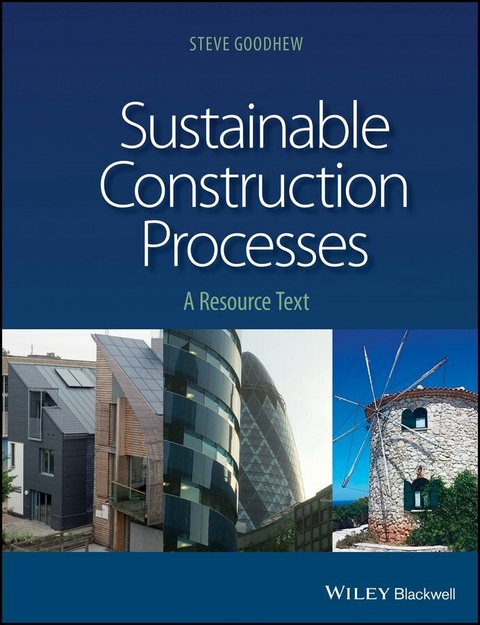
Sustainable Construction Processes (eBook)
352 Seiten
John Wiley & Sons (Verlag)
978-1-119-24794-4 (ISBN)
Offers an excellent text for those learning to construct, design and operate sustainable buildings.
Covers the drivers for sustainable construction, definitions, historical impacts, climate change and global, regional and individual responses.
enables the construction professional to achieve optimum solutions, both in design, process and the aftercare of buildings.
evaluates the effectiveness of different renewable technologies and provides guidance on the practicalities of their use.
Alerts the reader to future trends in this field.
Steve Goodhew is Professor of Environmental Building and Discipline Leader in the School of Architecture, Design and Environment at Plymouth University. He has been teaching and researching in the area of sustainable construction for over 20 years. His main focus has been the assessment and monitoring of existing buildings specialising in the in situ measurement of the thermal properties of building materials, particularly the use of thermal imaging.
Preface viii
About the author ix
Acknowledgments x
1 Introduction to sustainable construction 1
1.1 Why a book focused on sustainable construction? 1
1.2 Why construct sustainably? 2
1.3 How can we define sustainability? 2
1.4 The environmental importance of design, construction, and care of buildings 19
1.5 Where next? 19
References 19
2 Procurement and sustainability 22
2.1 Procurement and construction 22
2.2 Drivers for and concepts behind sustainable procurement 23
2.3 BREEAM 2011 and sustainable procurement 30
2.4 Organisational values, risk, and stakeholder goodwill 31
2.5 Contracts and sustainable construction 38
2.6 The RIBA plan of work 39
2.7 The sustainable procurement of materials and equipment 40
2.8 Summary 42
References 42
3 Energy, water, refurbishment, and sustainable building design 45
3.1 Design-related sustainability 45
3.2 Sustainable design 46
3.3 Energy and design: Building fabric 48
3.4 Energy and design: Renewable energy and sustainable technologies 78
3.5 Water 96
3.6 Design for sustainable refurbishment 102
3.7 Summary 105
References 106
4 Materials and sustainable building design 110
4.1 Materials and design 110
4.2 Responsible sourcing of materials 111
4.3 Life cycle assessment 112
4.4 Whole-life carbon (embodied energy and embodied carbon) 114
4.5 Materials and recycle/reuse 129
4.6 Sustainable construction materials 132
4.7 Summary/what next? 140
References 140
5 Construction-related sustainability 143
5.1 Sustainable construction 143
5.2 Site operations and organisation 145
5.3 Materials 167
5.4 Summary 183
References 183
6 Assessment and performance evaluation of buildings and construction processes 188
6.1 Building assessment 188
6.2 Introduction and rationale for the assessment of current and future building performance 188
6.3 Categories of sustainability and building assessment systems 189
6.4 Building- and project-specific tools 201
6.5 Post-occupancy assessments 216
6.6 Commissioning and technical assessment 223
6.7 Building simulation 238
6.8 Summary 244
References 244
7 Behaviour, sustainable construction, and the performance gap 249
7.1 People, sustainable construction, and buildings 249
7.2 The building performance gap 249
7.3 occupant behaviour: the performance gap 251
7.4 Modelling using occupant behaviour 257
7.5 Behaviour in the design process 257
7.6 Behaviour and sourcing materials 260
7.7 Sustainability and the business of construction 261
7.8 Commissioning 263
7.9 Facilities management 264
7.10 Summary 266
References 266
8 The practicalities of building with sustainable technologies 270
8.1 Building with sustainable technologies and innovations 270
8.2 General operational issues 275
8.3 Solar systems and technologies 278
8.4 Wind generation 287
8.5 Biomass 290
8.6 Ground/water/air source heat pumps 293
8.7 Micro CHP 298
8.8 Control systems and smart home energy management 299
8.9 Overheating and controlled ventilation systems 300
8.10 Rainwater and greywater collection systems 301
8.11 Summary 307
References 308
9 Future of sustainable construction 313
9.1 Future directions and policies 313
9.2 Future technologies 321
9.3 Future energy 324
9.4 Future materials 327
9.5 Future construction practices 329
9.6 Future norms and expectations 331
9.7 Chapter summary 332
References 333
Index 336
| Erscheint lt. Verlag | 13.4.2016 |
|---|---|
| Sprache | englisch |
| Themenwelt | Naturwissenschaften ► Biologie ► Ökologie / Naturschutz |
| Technik ► Architektur | |
| Technik ► Bauwesen | |
| Wirtschaft ► Volkswirtschaftslehre | |
| Schlagworte | Architecture • Architektur • Bauentwurf • Bauingenieur- u. Bauwesen • Baustoffe • Building Design • Civil Engineering & Construction • construction materials • Construction: Sustainability • Nachhaltiges Bauen |
| ISBN-10 | 1-119-24794-2 / 1119247942 |
| ISBN-13 | 978-1-119-24794-4 / 9781119247944 |
| Informationen gemäß Produktsicherheitsverordnung (GPSR) | |
| Haben Sie eine Frage zum Produkt? |
 PDF (Adobe DRM)
Kopierschutz: Adobe-DRM
Adobe-DRM ist ein Kopierschutz, der das eBook vor Mißbrauch schützen soll. Dabei wird das eBook bereits beim Download auf Ihre persönliche Adobe-ID autorisiert. Lesen können Sie das eBook dann nur auf den Geräten, welche ebenfalls auf Ihre Adobe-ID registriert sind.
Details zum Adobe-DRM
Dateiformat: PDF (Portable Document Format)
Mit einem festen Seitenlayout eignet sich die PDF besonders für Fachbücher mit Spalten, Tabellen und Abbildungen. Eine PDF kann auf fast allen Geräten angezeigt werden, ist aber für kleine Displays (Smartphone, eReader) nur eingeschränkt geeignet.
Systemvoraussetzungen:
PC/Mac: Mit einem PC oder Mac können Sie dieses eBook lesen. Sie benötigen eine
eReader: Dieses eBook kann mit (fast) allen eBook-Readern gelesen werden. Mit dem amazon-Kindle ist es aber nicht kompatibel.
Smartphone/Tablet: Egal ob Apple oder Android, dieses eBook können Sie lesen. Sie benötigen eine
Geräteliste und zusätzliche Hinweise
Buying eBooks from abroad
For tax law reasons we can sell eBooks just within Germany and Switzerland. Regrettably we cannot fulfill eBook-orders from other countries.
aus dem Bereich