


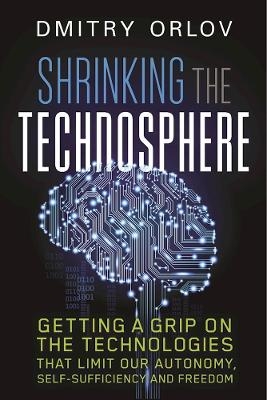
Shrinking the Technosphere
Getting a Grip on Technologies that Limit our Autonomy, Self-sufficiency and Freedom
Seiten
2016
New Society Publishers (Verlag)
978-0-86571-838-8 (ISBN)
New Society Publishers (Verlag)
978-0-86571-838-8 (ISBN)
- Titel ist leider vergriffen;
keine Neuauflage - Artikel merken
Making wise individual choices about technology use may just be the way it really saves us
Over the past two centuries we have witnessed a wholesale replacement of most of the previous methods of conducting both business and daily life with new, technologically advanced, more efficient methods. What exactly is progressive or efficient about this new arrangement is hardly ever examined in depth: if the new ways of doing things are so much better, then we must all be leading relaxed, stress-free, enjoyable lives with plenty of free time to devote to art and leisure activities. But a more careful look at these changes shows us that many of these advances are not weighing favourably in a harm/benefit comparison. The harm to the environment, society, and even to our own personalities, on an individual level, is plain to see, but is brushed off with hollow claims about efficiency and progress. Shrinking the Technosphere guides readers through the process of bringing technology down to a manageable number of carefully chosen, essential, well-understood and controllable elements. It is about regaining the freedom to use technology for our own benefit, and is critical reading for all who seek to get back to a point where technologies assist us rather than control us.
Dmitry Orlov was born in Leningrad, USSR, and emigrated to the United States in the mid-1970s. He holds degrees in Computer Engineering and Linguistics, and has worked in a variety of fields, including high-energy physics, Internet commerce, network security and advertising. He is the author of several previous books, including Reinventing Collapse and The Five Stages of Collapse.
Over the past two centuries we have witnessed a wholesale replacement of most of the previous methods of conducting both business and daily life with new, technologically advanced, more efficient methods. What exactly is progressive or efficient about this new arrangement is hardly ever examined in depth: if the new ways of doing things are so much better, then we must all be leading relaxed, stress-free, enjoyable lives with plenty of free time to devote to art and leisure activities. But a more careful look at these changes shows us that many of these advances are not weighing favourably in a harm/benefit comparison. The harm to the environment, society, and even to our own personalities, on an individual level, is plain to see, but is brushed off with hollow claims about efficiency and progress. Shrinking the Technosphere guides readers through the process of bringing technology down to a manageable number of carefully chosen, essential, well-understood and controllable elements. It is about regaining the freedom to use technology for our own benefit, and is critical reading for all who seek to get back to a point where technologies assist us rather than control us.
Dmitry Orlov was born in Leningrad, USSR, and emigrated to the United States in the mid-1970s. He holds degrees in Computer Engineering and Linguistics, and has worked in a variety of fields, including high-energy physics, Internet commerce, network security and advertising. He is the author of several previous books, including Reinventing Collapse and The Five Stages of Collapse.
Dmitry Orlov was born in Leningrad, USSR, into an academic family, and emigrated to the US in the mid-1970s. He holds degrees in Computer Engineering and Linguistics, and has worked in a variety of fields, including high-energy physics, Internet commerce, network security and advertising. He is the author of several previous books, including Reinventing Collapse and The Five Stages of Collapse.
Foreword
1 The Technosphere Defined
2 What is at Stake?
3 Approaches and Departures
4 Harm/Benefit Analysis
5 Naturelike Technologies
6 Social Machines
7 Political Technologies
8 Wresting Control
9 The Settled and the Nomadic
10 The Great Transition
| Erscheinungsdatum | 29.12.2016 |
|---|---|
| Verlagsort | Gabriola Island |
| Sprache | englisch |
| Maße | 152 x 229 mm |
| Gewicht | 426 g |
| Themenwelt | Naturwissenschaften |
| Sozialwissenschaften ► Soziologie | |
| Technik ► Umwelttechnik / Biotechnologie | |
| ISBN-10 | 0-86571-838-5 / 0865718385 |
| ISBN-13 | 978-0-86571-838-8 / 9780865718388 |
| Zustand | Neuware |
| Informationen gemäß Produktsicherheitsverordnung (GPSR) | |
| Haben Sie eine Frage zum Produkt? |
Mehr entdecken
aus dem Bereich

aus dem Bereich
Ein Grundproblem der Moderne | Die erste umfassende Studie zum …
Buch | Hardcover (2024)
Suhrkamp (Verlag)
CHF 44,75


