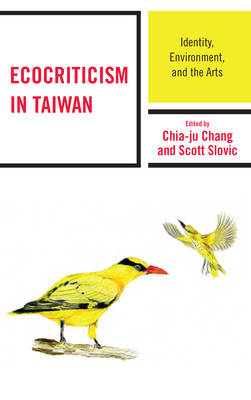
Ecocriticism in Taiwan
Lexington Books (Verlag)
978-1-4985-3827-5 (ISBN)
Taiwan's unique history, geographic location, geology, and subtropical climate generate locale-specific, vernacular thinking about island ecology and environmental history, as well as global environmental issues such as climate change, dioxin pollution, species extinction, energy decisions, pollution, and environmental injustice. In hindsight, Taiwan's industrial modernization no longer appears as a success narrative among Asia's “Four Little Dragons,” but as a cautionary tale revealing the brute force entrepreneurial exploitation of the land and the people. In this light, this volume can be seen as a critical response to Taiwan's postcolonial, capitalist-industrial modernity, as manifested in the scholars’ readings of Taiwan's "mountain and river," ocean, animal, and aboriginal (non)fictional narratives, environmental documentaries, and art installations.
This volume is endowed with a mixture of ecocosmopolitan and indigenous sensitivities. Though dominated by the Han Chinese ethnic group and its Confucian ideology, Taiwan is a place of complicated ethnic identities and affiliations. The succession of changing colonial and political regimes, made even more complex by the island’s sixteen aboriginal groups and several diasporic subcultures (South Asian immigrants, Western expatriates, and diverse immigrants from the Chinese mainland), has led to an ongoing quest for political and cultural identity. This complexity urges Taiwan-based ecoscholars to pay attention to the diasporic, comparative, and intercultural dimensions of local specificity, either based on their own diasporic experience or the cosmopolitan features of the Taiwanese texts they scrutinize. This cosmopolitan-vernacular dynamic is a key contribution Taiwan has to offer current ecocritical scholarship.
Chia-ju Chang is associate professor of Chinese at Brooklyn College, The City University of New York. Scott Slovic is professor of literature and environment and chair of the English Department at the University of Idaho.
Introduction - Chia-ju Chang and Scott Slovic
Section One: Island Identities, Eco-postcolonial Historiography, and Alter(native) Strategies
1.Going Back into a Future of Simplicity: Taiwan Aborigines’ Sustainable Utilization of Natural resources - Ming-tu Yang
2.(W)ri(gh)ting Climate Change in Neqou Soqluman’s Work - Hsinya Huang
3.Taiwanese Mountain and River Literature from a Postcolonial Perspective - Peter I-min Huang
4.Taiwan Is A Whale: The Emerging Oneness of Dark Blue and Human Identity in Chia-Hsiang Wang’s Historical Fiction - Shu-fen Tsai
5.Agrarian Origin Stories, National Imaginaries, and the Ironies of Modern Environmentalism: On Chi-Po Lin’s Beyond Beauty: Taiwan from Above - Hannes Bergthaller
Section Two: Slow Violence, Creative Activism, and Environmental Movements
6.Toxic Objects, Slow Violence, and the Ethics of Trans-Corporeality in Chi Wen-Chang’s The Poisoned Sky - Robin Chen-hsing Tsai
7.Imagining the Great Pacific Garbage Patch and Spectacles of Environmental Disaster: Envir
| Erscheinungsdatum | 25.06.2016 |
|---|---|
| Reihe/Serie | Ecocritical Theory and Practice |
| Co-Autor | Hannes Berthaller, Dean Anthony Brink, Kathryn Yalan Chang |
| Zusatzinfo | 10 b/w photos; |
| Sprache | englisch |
| Maße | 162 x 239 mm |
| Gewicht | 522 g |
| Themenwelt | Geisteswissenschaften ► Sprach- / Literaturwissenschaft ► Anglistik / Amerikanistik |
| Geisteswissenschaften ► Sprach- / Literaturwissenschaft ► Literaturwissenschaft | |
| Naturwissenschaften ► Biologie ► Ökologie / Naturschutz | |
| Technik ► Umwelttechnik / Biotechnologie | |
| ISBN-10 | 1-4985-3827-4 / 1498538274 |
| ISBN-13 | 978-1-4985-3827-5 / 9781498538275 |
| Zustand | Neuware |
| Informationen gemäß Produktsicherheitsverordnung (GPSR) | |
| Haben Sie eine Frage zum Produkt? |
aus dem Bereich