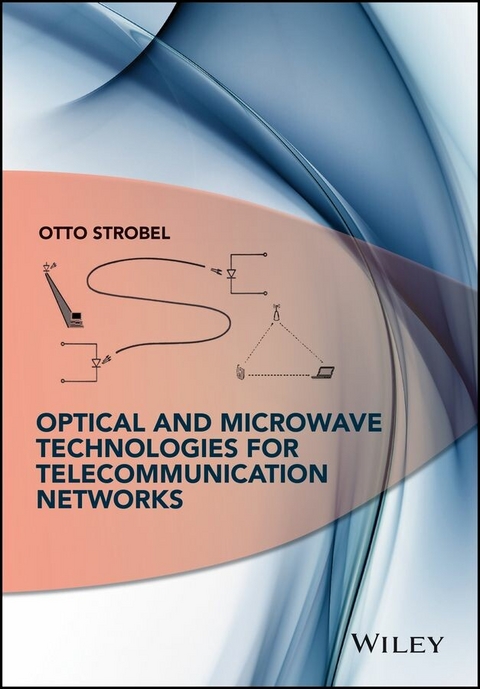
Optical and Microwave Technologies for Telecommunication Networks (eBook)
John Wiley & Sons (Verlag)
978-1-119-15459-4 (ISBN)
This is a self-contained book on the foundations and applications of optical and microwave technologies to telecommunication networks application, with an emphasis on access, local, road, cars, trains, vessels and airplanes, indoor and in-car data transmission as well as for long-distance fiber-systems and application in outer space and automation technology. The book provides a systematic discussion of physics/optics, electromagnetic wave theory, optical fibre technology, and the potential and limitations of optical and microwave transmission.
This is a self-contained book on the foundations and applications of optical and microwave technologies to telecommunication networks application, with an emphasis on access, local, road, cars, trains, vessels and airplanes, indoor and in-car data transmission as well as for long-distance fiber-systems and application in outer space and automation technology. The book provides a systematic discussion of physics/optics, electromagnetic wave theory, optical fibre technology, and the potential and limitations of optical and microwave transmission.
Otto Strobel, Esslingen University of Applied Sciences, Germany Otto Strobel has worked for many years in R&D and consultancy for companies including Daimler, Alcatel-Lucent (now Bell Labs Germany), HP (now Agilent), Siemens, and Diehl Aerospace. He currently teaches physics, optoelectronics, optical communication, optical buses in automotive applications and optical sensors at the Esslingen University of Applied Sciences.
Preface
After human beings solved their most elementary problems of nutrition and availability of warming and protective clothes, they felt the need to communicate between each other. Even then, this communication improved the results of their labor. People first started by talking to each other at distances our ears are able to understand acoustically. The next step was visible communication limited by the resolution and focusing abilities of our eyes. Smoke signals, for example, were used during the day and fire beacons at night. The oldest written proof of optical communication is presented in AESCHYLOS'S (Aισχυλoς) play Agamemnon, written in the 5th century BC [1.25]. The news of the fall of Troy in 1200 BC, after years of siege by the Greeks, was reported to Agamemnon's wife Clytemnestra by fires which were lit on hills all the way from Asia Minor to Argos in Greece.
The first development of a useful optical telegraph happened to be during the time of the French Revolution. CLAUDE CHAPPE, a former Abbé, invented the semaphore. On top of a building a moveable beam was arranged, which carried a moveable arm at both ends; 192 different positions could be realized. In 1880, Alexander Graham Bell invented the photophone. The idea was that a light beam was modulated by acoustic vibrations of a thin mirror. The demodulation of the optical signal could be realized, for example, by utilizing the photoelectric effect in selenium.
All free space transmissions depend on good weather and undisturbed atmosphere. Some methods work only during the daytime, some only at night. An exception is free space transmission in outer space because, outside of the Earth's atmosphere, typical problems like natural disturbances by fog, rain or snow or artificially caused impurities do not inherently exist. However, even on Earth, it was desirable that communication is independent of environmental conditions. Therefore, some form of guidance of the light beam in a protective environment was necessary. There were ideas of guiding the light within a tube, whose inner walls reflect the light.
The development of the laser by Theodor Maiman, at the beginning of the 1960s, provided a light source which yields an entirely different behavior compared to the sources we had before. A short time after this very important achievement, diode lasers for usage as optical transmitters were developed. Parallel to that accomplishment in the early 1970s, researchers and engineers accomplished the first optical glass fiber with sufficiently low attenuation to transmit electromagnetic waves in the near infrared region. The photodiode as detector already worked, and thus, systems could be developed using optoelectric (O/E) and electrooptic (E/O) components for transmitters and receivers, as well as a fiber in the center of the arrangement. In 1966, Charles K. Kao and G.A. Hockam of Standard Telecommunications Laboratories in Harlow, England, published a paper in which they proposed the guidance of light within dielectric glass fibers. The immediate problem was the optical attenuation in fibers. Whereas, on a clear day, atmospheric attenuation is about 1 dB/km, the best glass then available showed an attenuation of about 1000 dB/km. To illustrate this, the optical power is reduced to 1‰ after a path of only 30 m. Kao and Hockham's main thesis was that if the attenuation could be reduced to 20 dB/km at a convenient wavelength, then practical fiber-optic communication should be possible.
In 1970, Corning Glass Works, USA, achieved this goal. By further refinement of fiber production, the attenuation coefficient could be reduced to below 0.2 dB/km in 1982. Fibers of commercial mass production today show an attenuation of approximately 0.2 dB/km. The optical power in such a fiber still amounts to about 1% after traveling a distance of 100 km.
In the 1970s and 1980s, reliable semiconductor light sources and detectors were developed. First field trials of fiber-optic links were very successful during the 1980s.
People often discuss the quality of systems in simple terms, such as good or bad. From the physical point of view, nothing is good or bad; it is as it is – the only question is what you need it for. For example, are we discussing a high-speed long distance system in the order of one-tenth of Gbit up to 100 Gbit/s (or more) with nearly no cost restriction, or are we talking about application in cars with 150 Mbit/s and about 10 m link lengths at low cost demands? These are completely different worlds and thus, for each demand, we have to find the proper solution.
In the last five decades, landline network communication has mainly been considered for application in telecom areas. The most well-known use is for high-speed, middle and long distance systems, as well as MAN and LAN networking; any last-mile application, including in-house communication to a single user's desk, needs to be connected to the rest of the world. Most recently, mobile communication, in particular cell phones (more recently smart phones), tablets, tablet PCs, laptops, PCs, etc., have been developed to replace cable-based phone calls, emails and Internet communication.
For about 20 years, Fiber-to-the-home (FTTH) has become the phrase on everybody's lips – the efforts to also bring optical communication into a single-family house. This did not happen until now for reasons of economy. However, because of the soaring use of the Internet, higher data rate needs increasingly occur in single-family houses, too. In order to permit a corresponding quantum leap, it remains absolutely essential to reduce costs for the participants. The keyword is “opening up the last mile”. Latest developments can help to achieve this aim.
In the last ten years, communication in transportation systems has become more and more in demand – for communication within a vehicle, from one vehicle to another and to land-line networks too. Development started in high-end cars with application in the infotainment area and has already reached airplanes and ships where sensor-relevant needs were also addressed. These techniques began with low data rates. Car communication technologies for the coming decade will also include high bit-rate systems up to the level of Gbit/s. Moreover, a new industry-standard, named communication in automation engineering, has been developed. By applying this technology, new perspectives could be opened up for data linking between tooling machines and central control units.
The idea of this book is to address a broad scope of readers, in order to give them an introduction to optical and microwave communication systems. For this reason, we not only present articles on state-of-the-art methods but also promising techniques for the future are discussed as well. On the one hand, it is important that the key differences between optical and non-optical systems are appreciated, yet on the other hand, similarities can be also seen. Moreover, a combination of these different physical techniques might lead to excellent results, which cannot be reached using them separately. Taking all these optical and microwave techniques, as well as GPS, together with high-speed high-data processing devices and appropriate software, may mean that the old human dream of easy worldwide communication (involving nearly unlimited data consumption), be it listening, seeing or reading, could be realized in the not too distant future.
For readers not familiar with all these topics, there is coverage of many subjects of optical and microwave fundamentals. The book is intended to help undergraduate, graduate and PhD students with a basic knowledge of the subjects studying communication technologies. In addition, R&D engineers in companies should also find this book interesting and useful. This is true for novices as well as for experts checking certain facts or dealing with areas of expertise peripheral to their normal work.
I would like to express my appreciation to my former colleagues at Alcatel-Lucent Research Center (now Bell Labs Germany) for numerous helpful discussions. I also gratefully acknowledge my current colleagues at Esslingen University for much help, in particular Prof. Dr. Dr. h.c. R. Martin. Moreover, I have to mention my staff member Dipl.-Phys. H. Bletzer for active support in lab and manuscript preparation. For the latter, also many thanks to M.Sc. Marko Cehovski, who as my student also co-authored several publications – also Dipl.-Ing. Daniel Seibl, M.Sc. Jan Lubkoll, now with ASML Veldhoven/Niederlande. For this book, I was able to find a variety of R&D contributors from companies and universities all over the world: MSc. Werner Auer, FOP Faseroptische Produkte GmbH, Crailsheim, Germany (Chapter 4.1), Dr. Krzysztof Borzycki, National Institute of Telecommunications, Warsaw, Poland (Chapter 4.2 and 10.1), Dr. Ronald Freund, Dr. Markus Nölle, Fraunhofer Heinrich Hertz Institute, Berlin, Germany (Chapter 9.2), Dr. Ronald Freund, Dr. Nicolas Perlot, Fraunhofer Heinrich Hertz Institute, Berlin, Germany (Chapter 9.3), MSc. Marko Čehovski, Institut für Hochfrequenztechnik, Technische Universität Braunschweig, Germany (Chapter 9.5), Thorsten Ebach, eks Engel GmbH & Co. KG, Wenden, Germany (Chapter 9.6), Dr. Alicia López, Dr. M. Ángeles Losada, Dr. Javier Mateo, GTF,...
| Erscheint lt. Verlag | 28.3.2016 |
|---|---|
| Sprache | englisch |
| Themenwelt | Naturwissenschaften ► Physik / Astronomie ► Mechanik |
| Technik ► Elektrotechnik / Energietechnik | |
| Technik ► Nachrichtentechnik | |
| Schlagworte | Computer Science • Electrical & Electronics Engineering • Elektrotechnik u. Elektronik • Informatik • Microwave technology • Mikrowellen- u. Hochfrequenztechnik u. Theorie • Networking • Netzwerk • Netzwerke • Optical Communications • Optical networks • Optical Technology • Optische Nachrichtentechnik • Physics • radio over fibre (RoF) • Raumfahrttechnik • RF / Microwave Theory & Techniques • Telecommunications Networks |
| ISBN-10 | 1-119-15459-6 / 1119154596 |
| ISBN-13 | 978-1-119-15459-4 / 9781119154594 |
| Informationen gemäß Produktsicherheitsverordnung (GPSR) | |
| Haben Sie eine Frage zum Produkt? |
 EPUB (Adobe DRM)
Kopierschutz: Adobe-DRM
Adobe-DRM ist ein Kopierschutz, der das eBook vor Mißbrauch schützen soll. Dabei wird das eBook bereits beim Download auf Ihre persönliche Adobe-ID autorisiert. Lesen können Sie das eBook dann nur auf den Geräten, welche ebenfalls auf Ihre Adobe-ID registriert sind.
Details zum Adobe-DRM
Dateiformat: EPUB (Electronic Publication)
EPUB ist ein offener Standard für eBooks und eignet sich besonders zur Darstellung von Belletristik und Sachbüchern. Der Fließtext wird dynamisch an die Display- und Schriftgröße angepasst. Auch für mobile Lesegeräte ist EPUB daher gut geeignet.
Systemvoraussetzungen:
PC/Mac: Mit einem PC oder Mac können Sie dieses eBook lesen. Sie benötigen eine
eReader: Dieses eBook kann mit (fast) allen eBook-Readern gelesen werden. Mit dem amazon-Kindle ist es aber nicht kompatibel.
Smartphone/Tablet: Egal ob Apple oder Android, dieses eBook können Sie lesen. Sie benötigen eine
Geräteliste und zusätzliche Hinweise
Buying eBooks from abroad
For tax law reasons we can sell eBooks just within Germany and Switzerland. Regrettably we cannot fulfill eBook-orders from other countries.
aus dem Bereich