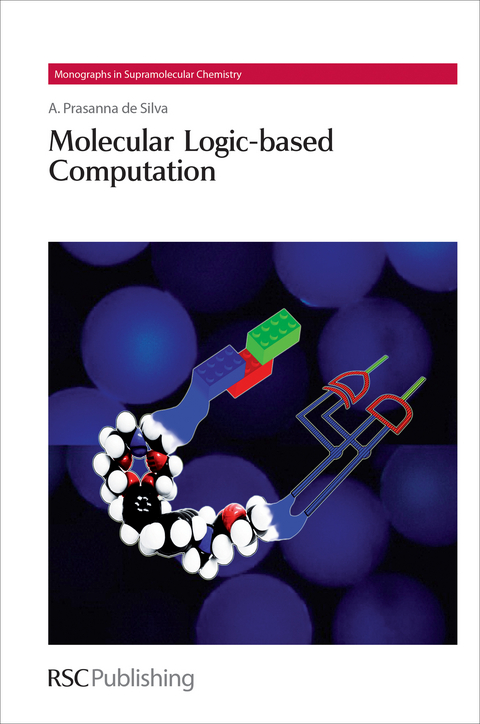
We all learn - in schools, factories, bars and streets. We gather, store, process and transmit information in society. Molecular systems involved in our senses and within our brains allow all this to happen and molecular systems allow living things of all kinds to handle information for the purpose of survival and growth. Nevertheless, the vital link between molecules and computation was not generally appreciated until a few decades ago. Semiconductor-based information technology had penetrated society at many levels and the interest in maintaining momentum of this revolution led to the consideration of molecules, among others, as possible information handlers. Such an overlap between the recent engineering-oriented revolution with the ancient biology-oriented success story is very interesting and George Boole's times in Ireland 150 years ago produced the logic ideas that provide the foundations of computation to this day. Molecular logic and computation is a field which is 17 years young, has had a healthy growth and is a story which deserves to be told. It is a growing branch of chemical science which highlights the connection between information technology (engineering and biological) and chemistry. The author and co-workers of this publication launched molecular logic as an experimental field by publishing the first research in the primary literature in 1993 and are uniquely placed to recount how the field has grown. There is no other book at present on molecular logic and computation and is more comprehensive than that found in any review available so far. It shows how designed molecules can play the role of information processors in a wide variety of situations, once we are educated by those information processors already available in the semiconductor electronics business and in the natural world. Following a short history of the field, is a set of primers on logic, computing and photochemical principles which are an essential basis in this field. The book covers all of the Boolean logic gates driven by a single input and all of those with double inputs and the wide range of designs which lie beneath these gates is a particular highlight. The easily-available diversity of chemical systems is another highlight, especially when it leads to reconfigurable logic gates. Further on in the book, molecular arithmetic and other more complex logic operations, including those with a memory and those which stray beyond binary are covered. Then follows molecular computing approaches which lie outside the Boolean blueprint, including quantum phenomena and finally, the book catalogues the useful real-life applications of molecular logic and computation which are already available. This book is an authoritative, state of the art, reference and a 'one-stop-shop' concerning the current state of the field for scientists, academics and postgraduate students.
A Prasanna de Silva is a Professor in the School of Chemistry and Chemical Engineering, Queen's University, Belfast, Northern Ireland.
A Little History; Chemistry and Computation; A Little Logic and Computation; A Little Photochemistry and Luminescence; Single Input-Single Output Systems; Subject Index
| Erscheint lt. Verlag | 13.1.2016 |
|---|---|
| Reihe/Serie | ISSN | Monographs in Supramolecular Chemistry |
| Verlagsort | Cambridge |
| Sprache | englisch |
| Themenwelt | Naturwissenschaften ► Chemie ► Organische Chemie |
| Naturwissenschaften ► Chemie ► Physikalische Chemie | |
| Naturwissenschaften ► Physik / Astronomie ► Astronomie / Astrophysik | |
| ISBN-13 | 9781782626237 / 9781782626237 |
| Informationen gemäß Produktsicherheitsverordnung (GPSR) | |
| Haben Sie eine Frage zum Produkt? |
 EPUB (Adobe DRM)
Kopierschutz: Adobe-DRM
Adobe-DRM ist ein Kopierschutz, der das eBook vor Mißbrauch schützen soll. Dabei wird das eBook bereits beim Download auf Ihre persönliche Adobe-ID autorisiert. Lesen können Sie das eBook dann nur auf den Geräten, welche ebenfalls auf Ihre Adobe-ID registriert sind.
Details zum Adobe-DRM
Dateiformat: EPUB (Electronic Publication)
EPUB ist ein offener Standard für eBooks und eignet sich besonders zur Darstellung von Belletristik und Sachbüchern. Der Fließtext wird dynamisch an die Display- und Schriftgröße angepasst. Auch für mobile Lesegeräte ist EPUB daher gut geeignet.
Systemvoraussetzungen:
PC/Mac: Mit einem PC oder Mac können Sie dieses eBook lesen. Sie benötigen eine
eReader: Dieses eBook kann mit (fast) allen eBook-Readern gelesen werden. Mit dem amazon-Kindle ist es aber nicht kompatibel.
Smartphone/Tablet: Egal ob Apple oder Android, dieses eBook können Sie lesen. Sie benötigen eine
Geräteliste und zusätzliche Hinweise
Buying eBooks from abroad
For tax law reasons we can sell eBooks just within Germany and Switzerland. Regrettably we cannot fulfill eBook-orders from other countries.
aus dem Bereich