


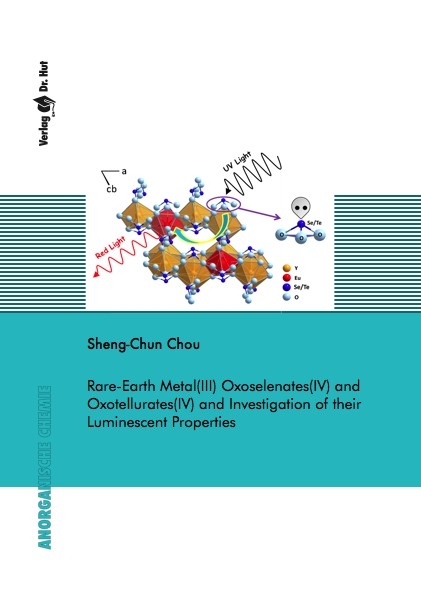
Rare-Earth Metal(III) Oxoselenates(IV) and Oxotellurates(IV) and Investigation of their Luminescent Properties
Seiten
2016
Dr. Hut (Verlag)
9783843925402 (ISBN)
Dr. Hut (Verlag)
9783843925402 (ISBN)
- Keine Verlagsinformationen verfügbar
- Artikel merken
The demand for energy efficient materials has become a major issue for saving this planet from global warming. The interest in new luminescent materials is constantly increasing, considering the rapid development of efficient energy delivering technologies (e.g. new LEDs, etc.).
Luminescent materials usually consist of an innocent (i.e. non-luminescent) host and a luminescence-active dopant. Very recently oxoselenates(IV) and oxotellurates(IV) of trivalent rare-earth metal cations have been extensively studied as host lattices for phosphors, which exhibit interesting luminescence properties when activated by trivalent lanthanoid cations (e.g. Eu(III), Tb(III)). Their crystal structures are dominated by tetrahedrally-shaped oxoselenate(IV) or oxotellurate(IV) anions with a stereochemically active lone pair residing at the Se(IV)/Te(IV) center. These lone pairs can provide a so-called “inorganic antenna effect”, and therefore the doped cations have not to be excited directly through the narrow f → f transition bands, but the excitation can first be absorbed in the region of the broad O–Se/O–Te charge transfer band (energy reservoir) and then transferred to the luminescent center. This can highly increase the efficiency of phosphors.
Therefore, the aim of this study had two tasks: finding the existent vacancies of known rare-earth metal(III) oxoselenate(IV) and oxotellurate(IV) phases (RE2Ch3O9 or their anionic derivatives) and chasing new related structures. Furthermore, the selected structures were doped with suitable trivalent lanthanoid cations (e.g. Eu(III) and Tb(III)) and spectroscopically investigated in order to find possible host lattices for the luminescent materials. One major point hereby is to find new efficient phosphor materials for different areas of applications (e.g. red or green phosphors used in phosphor converted blue LEDs), and the findings of this work will definitely be beneficial to energy-saving technologies with a better understanding of the relations between crystal structure and luminescence properties. To gain deep knowledge behind this, crystallographic data of non-doped compounds were investigated by X-ray powder diffraction (XRD), energy dispersive X-ray spectroscopy (EDX), infrared (IR) and Raman spectroscopy as well as single-crystal X-ray diffraction.
Luminescent materials usually consist of an innocent (i.e. non-luminescent) host and a luminescence-active dopant. Very recently oxoselenates(IV) and oxotellurates(IV) of trivalent rare-earth metal cations have been extensively studied as host lattices for phosphors, which exhibit interesting luminescence properties when activated by trivalent lanthanoid cations (e.g. Eu(III), Tb(III)). Their crystal structures are dominated by tetrahedrally-shaped oxoselenate(IV) or oxotellurate(IV) anions with a stereochemically active lone pair residing at the Se(IV)/Te(IV) center. These lone pairs can provide a so-called “inorganic antenna effect”, and therefore the doped cations have not to be excited directly through the narrow f → f transition bands, but the excitation can first be absorbed in the region of the broad O–Se/O–Te charge transfer band (energy reservoir) and then transferred to the luminescent center. This can highly increase the efficiency of phosphors.
Therefore, the aim of this study had two tasks: finding the existent vacancies of known rare-earth metal(III) oxoselenate(IV) and oxotellurate(IV) phases (RE2Ch3O9 or their anionic derivatives) and chasing new related structures. Furthermore, the selected structures were doped with suitable trivalent lanthanoid cations (e.g. Eu(III) and Tb(III)) and spectroscopically investigated in order to find possible host lattices for the luminescent materials. One major point hereby is to find new efficient phosphor materials for different areas of applications (e.g. red or green phosphors used in phosphor converted blue LEDs), and the findings of this work will definitely be beneficial to energy-saving technologies with a better understanding of the relations between crystal structure and luminescence properties. To gain deep knowledge behind this, crystallographic data of non-doped compounds were investigated by X-ray powder diffraction (XRD), energy dispersive X-ray spectroscopy (EDX), infrared (IR) and Raman spectroscopy as well as single-crystal X-ray diffraction.
| Erscheinungsdatum | 29.03.2016 |
|---|---|
| Reihe/Serie | Anorganische Chemie |
| Verlagsort | München |
| Sprache | englisch |
| Maße | 148 x 210 mm |
| Gewicht | 370 g |
| Einbandart | Paperback |
| Themenwelt | Naturwissenschaften ► Chemie ► Anorganische Chemie |
| Schlagworte | Luminescence • Oxotellurates(IV) • Rare-Earth Metal(III) Oxoselenates(IV) |
| ISBN-13 | 9783843925402 / 9783843925402 |
| Zustand | Neuware |
| Informationen gemäß Produktsicherheitsverordnung (GPSR) | |
| Haben Sie eine Frage zum Produkt? |
Mehr entdecken
aus dem Bereich
aus dem Bereich


