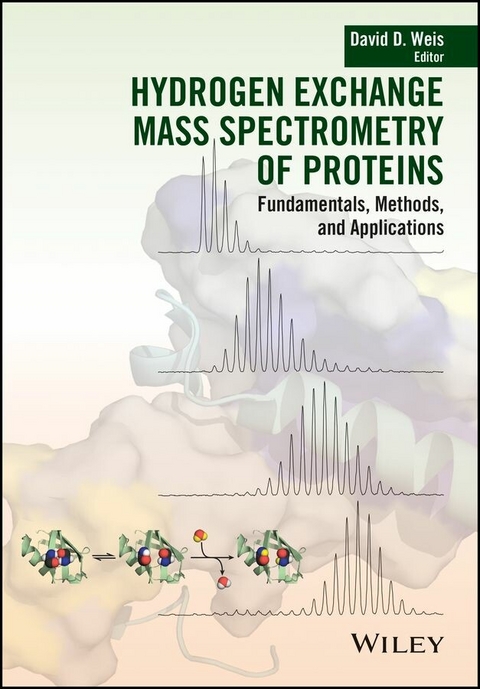
Hydrogen Exchange Mass Spectrometry of Proteins (eBook)
John Wiley & Sons (Verlag)
978-1-118-70373-1 (ISBN)

Hydrogen exchange mass spectrometry is widely recognized for its ability to probe the structure and dynamics of proteins. The application of this technique is becoming widespread due to its versatility for providing structural information about challenging biological macromolecules such as antibodies, flexible proteins and glycoproteins. Although the technique has been around for 25 years, this is the first definitive book devoted entirely to the topic.
Hydrogen Exchange Mass Spectrometry of Proteins: Fundamentals, Methods and Applications brings into one comprehensive volume the theory, instrumentation and applications of Hydrogen Exchange Mass Spectrometry (HX-MS) - a technique relevant to bioanalytical chemistry, protein science and pharmaceuticals. The book provides a solid foundation in the basics of the technique and data interpretation to inform readers of current research in the method, and provides illustrative examples of its use in bio- and pharmaceutical chemistry and biophysics
In-depth chapters on the fundamental theory of hydrogen exchange, and tutorial chapters on measurement and data analysis provide the essential background for those ready to adopt HX-MS. Expert users may advance their current understanding through chapters on methods including membrane protein analysis, alternative proteases, millisecond hydrogen exchange, top-down mass spectrometry, histidine exchange and method validation. All readers can explore the diversity of HX-MS applications in areas such as ligand binding, membrane proteins, drug discovery, therapeutic protein formulation, biocomparability, and intrinsically disordered proteins.
Professor David Weis is Assistant Professor of Chemistry at The University of Kansas. B.A., 1993, Earlham College; Ph.D., 1998, Indiana University, Bloomington; Research Assistant Professor, 2004-2006, University of New Mexico, Albuquerque. His areas of specialization is protein mass spectrometry, with research interests in bioanalytical and biophysical chemistry, protein conformation and dynamics, protein-protein and protein-nucleic acid interactions, transcription factors, mass spectrometry, H/D exchange, cross-linking, data analysis software.
Professor David Weis is Assistant Professor of Chemistry at The University of Kansas. B.A., 1993, Earlham College; Ph.D., 1998, Indiana University, Bloomington; Research Assistant Professor, 2004-2006, University of New Mexico, Albuquerque. His areas of specialization is protein mass spectrometry, with research interests in bioanalytical and biophysical chemistry, protein conformation and dynamics, protein-protein and protein-nucleic acid interactions, transcription factors, mass spectrometry, H/D exchange, cross-linking, data analysis software.
| Erscheint lt. Verlag | 12.1.2016 |
|---|---|
| Sprache | englisch |
| Themenwelt | Naturwissenschaften ► Chemie ► Analytische Chemie |
| Naturwissenschaften ► Chemie ► Anorganische Chemie | |
| Schlagworte | Biochemie • Biochemie u. Chemische Biologie • Biochemistry (Chemical Biology) • biocomparability • Biophysics • biotherapeutics • Biowissenschaften • Chemie • Chemistry • H/D exchange • hydrogen exchange • Life Sciences • Ligand binding • Massenspektrometrie • Mass Spectrometry • Protein dynamics • Proteine • Proteine u. Makromoleküle • Proteine u. Makromoleküle • Protein Folding • Proteins & Macromolecules • Protein Structure |
| ISBN-10 | 1-118-70373-1 / 1118703731 |
| ISBN-13 | 978-1-118-70373-1 / 9781118703731 |
| Informationen gemäß Produktsicherheitsverordnung (GPSR) | |
| Haben Sie eine Frage zum Produkt? |
 PDF (Adobe DRM)
Kopierschutz: Adobe-DRM
Adobe-DRM ist ein Kopierschutz, der das eBook vor Mißbrauch schützen soll. Dabei wird das eBook bereits beim Download auf Ihre persönliche Adobe-ID autorisiert. Lesen können Sie das eBook dann nur auf den Geräten, welche ebenfalls auf Ihre Adobe-ID registriert sind.
Details zum Adobe-DRM
Dateiformat: PDF (Portable Document Format)
Mit einem festen Seitenlayout eignet sich die PDF besonders für Fachbücher mit Spalten, Tabellen und Abbildungen. Eine PDF kann auf fast allen Geräten angezeigt werden, ist aber für kleine Displays (Smartphone, eReader) nur eingeschränkt geeignet.
Systemvoraussetzungen:
PC/Mac: Mit einem PC oder Mac können Sie dieses eBook lesen. Sie benötigen eine
eReader: Dieses eBook kann mit (fast) allen eBook-Readern gelesen werden. Mit dem amazon-Kindle ist es aber nicht kompatibel.
Smartphone/Tablet: Egal ob Apple oder Android, dieses eBook können Sie lesen. Sie benötigen eine
Geräteliste und zusätzliche Hinweise
Buying eBooks from abroad
For tax law reasons we can sell eBooks just within Germany and Switzerland. Regrettably we cannot fulfill eBook-orders from other countries.
aus dem Bereich